
In-Home Dog Training in Middletown, OH
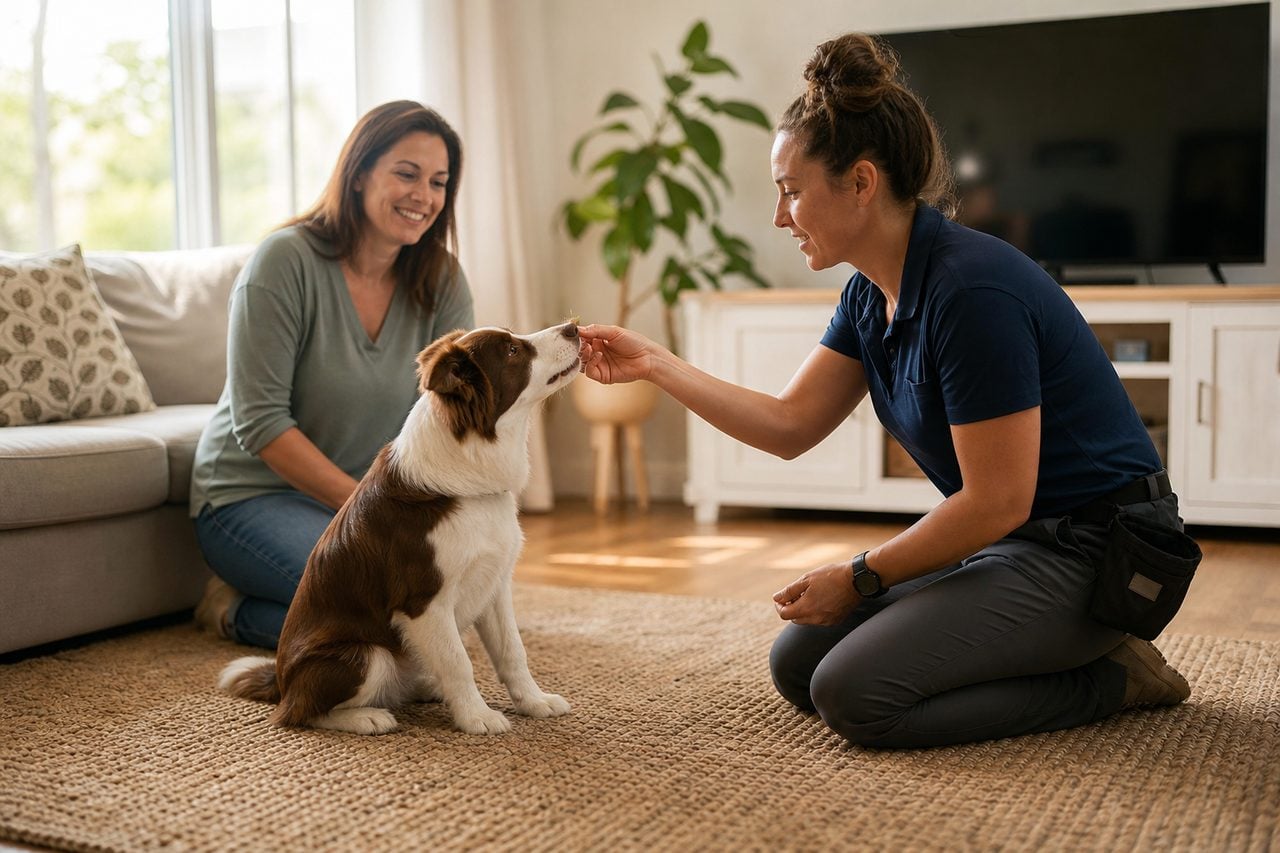
Middletown sits in a particular spot in southwest Ohio that shapes how local dog owners live with their dogs. Tucked into Butler County along the Great Miami River, the city runs north to south between Cincinnati (about 35 minutes south down I-75) and Dayton (roughly 25 minutes north). That means a lot of Middletown households are commuter households, with one or both adults driving the interstate every day and a dog left to figure out the quiet hours alone. It also means most people here have a yard, a driveway, a porch, and a neighborhood with sidewalks rather than a cramped apartment hallway. When you train a dog, where the dog actually lives matters more than almost anything else, and that is the entire premise behind in-home dog training.
In-home (or private in-home) training is exactly what it sounds like: a trainer comes to your house, works with you and your dog in the rooms, yard, and street where the real behavior happens, and builds a plan around your actual life rather than a generic curriculum. For a lot of Middletown families, especially those near the Highlands historic district, in the older neighborhoods around Smith Park, or out toward Monroe and Trenton, this format solves problems that a group class in a strip-mall storefront simply cannot reach. This guide walks through what in-home training is genuinely good for, how it tends to work in the Middletown area, what it costs, and how to tell whether it is the right fit for your dog.
What in-home training actually means
The phrase “in-home dog training” gets used loosely, so it helps to be precise. At its core, it means a trainer travels to your address and conducts the sessions in and around your home rather than at a facility. Beyond that single fact, the format varies a lot:
- Private in-home lessons are the most common version. The trainer comes to your house, usually for 60 to 90 minutes, coaches you through exercises with your dog, and leaves you with homework. You do the daily reps between visits. This is the model most people mean.
- In-home behavior consults are a single, longer first session (often two hours) focused on assessment and a written plan, sometimes followed by lessons or remote check-ins.
- Day training in the home is where the trainer works the dog directly while you are at work, then transfers the skills to you in shorter handoff sessions. Useful for busy Middletown commuters, but you still have to learn the cues eventually or the gains fade.
The common thread is context. Dogs are famously bad at generalizing. A dog that sits beautifully in a training center may completely ignore the same cue at the front door when the mail carrier arrives, because the dog learned “sit means sit in that building.” Training in the home closes that gap by teaching the behavior in the exact location and around the exact triggers where you need it.
What in-home training is genuinely good for
In-home training is not automatically better than a group class. It is better for specific problems. Here is where it tends to shine for Middletown dogs:
- House-specific behaviors. Door-dashing, counter-surfing, jumping on guests, barking at the front window, marking indoors, settling on a mat while you eat dinner. These are tied to your physical space. A trainer standing in your kitchen can fix a counter-surfing pattern in a way no off-site class can.
- Reactivity and fear. A dog that lunges at other dogs or people on walks, or panics at strangers, is often too over-threshold to learn anything inside a crowded class. Starting in the calm of the home and the quiet of your own street, then gradually adding the sidewalks near Sunset Park or the Highlands, lets the trainer control the intensity.
- Separation-related distress. With so many Middletown owners commuting to Cincinnati or Dayton, dogs left alone for long stretches are common. Separation work has to happen in the actual departure setup: your door, your keys, your routine.
- Puppies and the early window. A new puppy that is not fully vaccinated should not be on the floor of a shared facility yet. In-home lessons let socialization and foundation training start safely at eight or ten weeks instead of waiting.
- Multi-dog households and resource guarding. Tension between dogs over food, beds, or doorways plays out at home. That is where it has to be assessed and managed.
- Owners who want a tailored plan. Seniors, people with mobility limits, families with small kids, or anyone whose schedule does not fit a fixed weekly class time.
Where in-home training is NOT the best choice
A good trainer will tell you when you do not need them at your house, and an honest article should too. In-home is usually the wrong call when:
- Your main goal is socialization and neutrality around other dogs. A confident, friendly dog learning to be calm in a busy environment benefits enormously from a structured group class with other dogs present. You cannot replicate six other dogs in your living room.
- You want the lowest possible price. Group classes spread the trainer’s time across several owners, so they cost less per hour. In-home is one-on-one and includes travel time, so it carries a premium.
- The dog needs intensive, all-day reps fast. If you have a short window before a move, a baby, or a deadline and the behavior is severe, a board-and-train or day-training program may build the foundation faster than weekly home visits.
Many Middletown owners end up using a blend: in-home lessons to fix the house-specific and reactivity issues, then a group class once the dog is stable enough to handle a room full of distractions.
How an in-home program typically runs in the Middletown area
While every trainer structures things differently, a typical private in-home program around Middletown follows a recognizable arc:
1. The intake assessment. The first visit is usually the longest. The trainer wants to see the dog in its environment, watch the problem behaviors happen (or hear a detailed description), review feeding, exercise, and daily routine, and rule out anything that might need a vet. Expect a lot of questions about your goals. A trainer who shows up and immediately starts “fixing” without understanding your household is a red flag.
2. A written or verbal plan. You should leave the first session knowing what you are working on, why, and what to practice. The plan should be specific to your house and street, not a printed handout that could go to anyone.
3. Coaching sessions, spaced for practice. Lessons are usually weekly or every other week. The gap matters: the dog learns from your daily reps, not from the trainer’s visit. A trainer who books you for ten sessions back to back is selling visits, not results.
4. Generalizing to the real world. Once a behavior is solid indoors, the work moves to the driveway, then the sidewalk, then progressively busier spots. Middletown gives you a natural difficulty ladder: a quiet residential street, then a walk along the Great Miami River Trail, then the foot traffic and open green at Smith Park or Sunset Park on a weekend. Lebanon’s Armco Park or Springboro’s North Park work the same way for owners on the Warren County side.
5. Maintenance and fading the trainer out. The endpoint of good in-home training is that you no longer need the trainer. A reputable pro builds toward independence, not dependence.
What in-home training costs around Middletown
Southwest Ohio pricing is fairly consistent across the Cincinnati-Dayton corridor, and Middletown sits right in the middle of it. As a general guide for the local market:
- Private in-home sessions: roughly $100 to $175 per session, with single sessions at the higher end and multi-session packages bringing the per-visit cost down.
- In-home behavior consults (the longer first assessment): often priced as a standalone two-hour session at the upper part of that range, sometimes bundled into a package.
- Multi-session packages: most in-home trainers sell four-to-eight-session bundles, which usually work out cheaper per visit than booking one at a time.
A few things push the price up or down. Travel distance is a real factor: a trainer based in Middletown may charge a small surcharge to drive out to Trenton, Franklin, Springboro, or Lebanon, simply because windshield time is unpaid otherwise. Specialization matters too; trainers who handle serious aggression or fear cases, or who hold recognized certifications, command higher rates because the work carries more liability and skill. And session length varies: a 90-minute behavior session is naturally more than a 45-minute tune-up.
For comparison, group classes in the area typically run $150 to $300 for a multi-week course, and board-and-train programs range from about $1,500 to $6,000 depending on length and intensity. In-home lessons land in between on a per-hour basis but deliver one-to-one attention that a group cannot.
How to choose a reputable in-home trainer
Because the trainer is coming into your home and working with a family member who happens to have four legs, vetting matters. A few practical filters for the Middletown area:
- Ask how they handle mistakes. A trainer’s answer to “what do you do when the dog gets it wrong?” tells you almost everything about their methods. You want someone who can explain a clear, humane plan rather than vague talk about dominance.
- Ask for their assessment process. Good in-home trainers assess before they prescribe. Be wary of anyone who quotes a full program over the phone without seeing the dog.
- Match the specialty to your problem. Puppy foundations, basic manners, leash reactivity, and serious aggression are different skill sets. Confirm the trainer routinely handles your specific issue.
- Clarify what “the package” includes. Number of sessions, session length, between-session support (text, email, phone), and whether follow-ups cost extra. Get it in writing.
- Expect to be coached, not sidelined. The point of in-home training is that you become competent. If the plan is for the trainer to fix the dog while you watch, the behavior will rebound the moment they leave.
- Check that they teach generalization. A trainer who only ever works inside your living room is not preparing your dog for the river trail or a busy park.
The directory below lists trainers serving the Middletown and Butler-Warren area so you can compare formats, specialties, and availability directly.
Reviewed In-Home Dog Training Trainers in Middletown
These reviewed Middletown-area trainers from our directory handle in-home dog training. Each links to a full profile with specialties, verified credentials, reviews, and contact info:
- Dog Behavior Solutions — 5.0★ (2 reviews)
- Sit Means Sit Cincinnati — 4.8★ (156 reviews)
- Homeland K-9 Dog Training Academy — 4.7★ (34 reviews)
See all Middletown in-home dog training trainers →
Frequently Asked Questions
Is in-home dog training better than a group class?
Neither is universally better; they solve different problems. In-home training wins for house-specific issues (door-dashing, counter-surfing, barking at the window), reactivity and fear cases, separation distress, and young puppies who should not yet be on a shared facility floor. Group classes win for socialization and teaching a dog to stay calm around other dogs and people. Many Middletown owners use both: in-home first to stabilize the dog, then a class for real-world distraction work.
How much does in-home dog training cost in the Middletown area?
Private in-home sessions in southwest Ohio generally run about $100 to $175 per session, with package deals lowering the per-visit cost. Price is driven by the trainer’s specialization, session length, and travel distance, since a trainer may add a small surcharge to drive out to Trenton, Franklin, Springboro, or Lebanon. For context, local group classes run $150 to $300 per course and board-and-train programs run roughly $1,500 to $6,000.
How many in-home sessions will my dog need?
It depends entirely on the goal. Basic manners and puppy foundations might take four to six sessions spread over a couple of months, because the dog learns from your daily practice between visits, not from the visit itself. Reactivity, fear, and aggression cases take longer and are harder to predict. A reputable trainer will give you a realistic range after the first assessment rather than promising a fixed result in a fixed number of visits.
Can a trainer come to my house if my dog is aggressive or fearful?
Yes, and in-home is often the best starting point for these dogs precisely because the home is where they feel safest and where you can control the level of difficulty. A skilled trainer will start in the calm of your house, then gradually add your driveway, your street, and eventually busier spots like the Great Miami River Trail or a quiet corner of Smith Park. Make sure the trainer specifically lists aggression or fear work as a specialty, since it is a distinct skill set.
Do I need to be present and involved during in-home sessions?
For most in-home formats, absolutely. The trainer is coaching you as much as the dog, because you are the one who lives with the dog the other 167 hours of the week. Day-training is the partial exception (the trainer works the dog while you are at work), but even then you need handoff sessions to learn the cues, or the progress fades once the trainer stops coming. If a trainer expects you to sit out entirely, the results rarely last.
My puppy isn't fully vaccinated yet. Is in-home training safe?
This is one of the strongest arguments for starting in-home. The early socialization window is brief and important, but a young puppy that is not fully vaccinated should not be on the floor of a shared facility. In-home lessons let foundation training, handling, and controlled socialization begin safely at eight to ten weeks, in your own home, before the puppy is cleared for group environments.
Related: read our complete in-home dog training guide or the full Middletown dog training overview.
Ready to find the right in-home dog training pro in Middletown?