
In-Home Dog Training in Philadelphia, PA
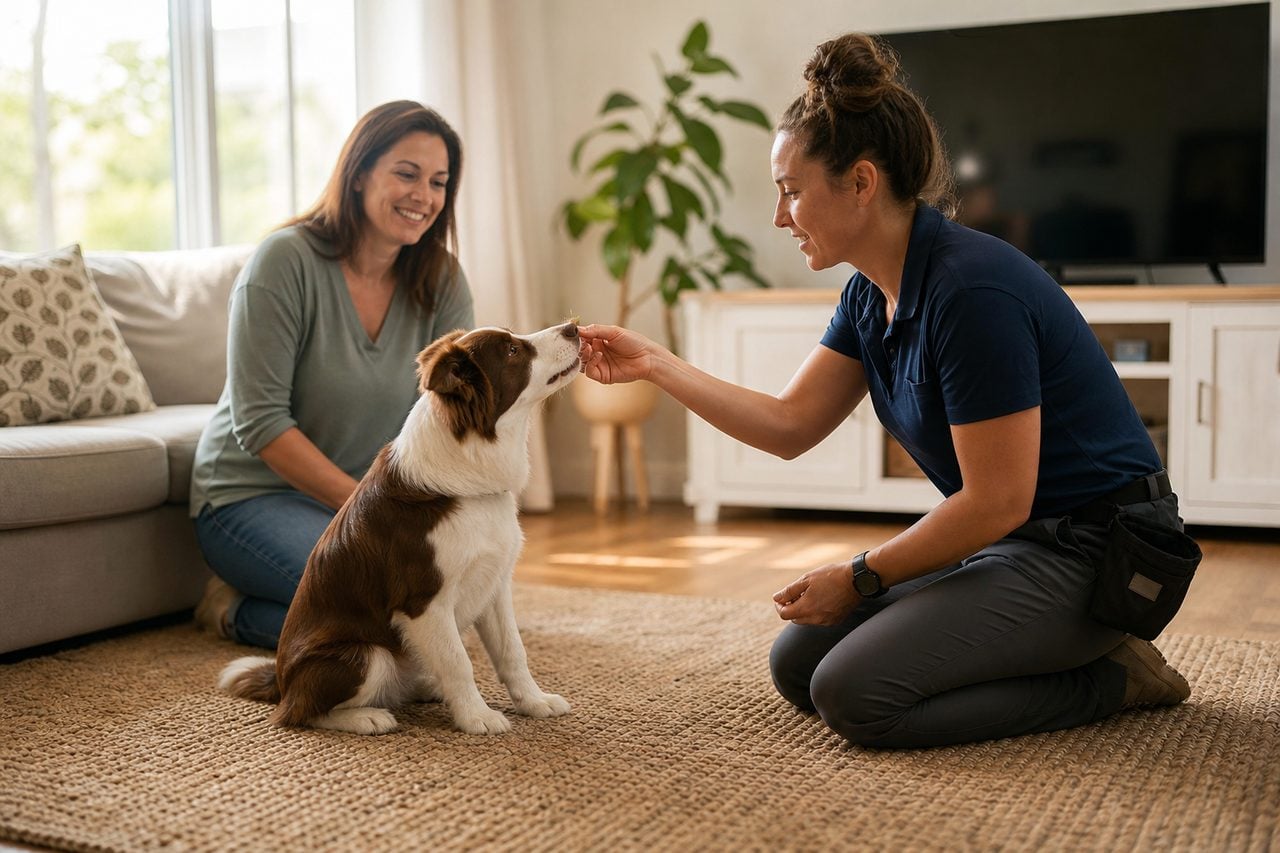
In-home dog training brings a professional trainer to where your dog actually lives and misbehaves — your Philadelphia rowhouse, your Center City condo, your Main Line property, or your collar-county home. Instead of working through cues in a sterile class environment and hoping the lessons transfer, in-home training tackles the real problems in the real context: the dog that bolts out the front door onto a busy Fishtown sidewalk, the one that loses its mind at the mail carrier coming up the stoop, or the one that cannot settle when guests arrive in a tight Northern Liberties living room.
This format has clear advantages for many households. It is convenient for owners with packed schedules and long commutes, it is ideal for dogs that are reactive or anxious in group settings, and it lets a trainer coach every member of the household so everyone handles the dog the same way. For Philadelphia specifically, the value is in addressing environment-specific challenges that a training facility simply cannot replicate — narrow streets, shared walls, SEPTA and street noise, stoops and front-door traffic, and the leash-walking realities of dense city blocks versus quieter suburban cul-de-sacs.
This guide walks through what in-home training involves, what problems it is best suited to, how it differs from group classes and board-and-train, and what to look for in a trainer across the city and the four collar counties — Montgomery, Bucks, Delaware, and Chester. It also touches on the practical realities of the format in Philadelphia, from the cold, snowy winters that make a trainer coming to you far more appealing than hauling your dog across town, to the wide gap between training in a Center City apartment and training on a larger property out toward Doylestown or West Chester. The goal is to help you decide whether bringing a trainer into your home is the right fit before you book anything, and to set sensible expectations about what the format can and cannot accomplish.
What In-Home Training Involves
In-home training is exactly what it sounds like: a qualified trainer comes to your residence and works with you and your dog in your everyday environment. A typical engagement begins with an assessment session where the trainer observes your dog in context, discusses your goals, and identifies the specific situations that trigger the problem behaviors. From there, the trainer builds a plan and coaches you through it across a series of sessions, usually with homework to practice between visits.
The defining feature is that you are being trained as much as your dog. Because the trainer is in your space, they can pinpoint the exact triggers — the spot by the front window where your dog barks at passersby, the doorway where guests get jumped on, the kitchen where counter-surfing happens — and show you how to manage each one. This is fundamentally different from board-and-train, where the dog is sent away; in-home training keeps the dog with the family and focuses on changing the daily patterns that created or maintained the behavior in the first place.
Common Problems In-Home Training Solves
In-home training is well suited to behaviors that are tied to the home environment and daily routine. Door-dashing and bolting — a serious safety issue on Philadelphia’s narrow, traffic-heavy streets — is a classic example, because it can only be worked on at the actual door the dog tries to escape from. Other frequent targets include jumping on guests, excessive barking at the window or at hallway sounds in an apartment building, leash pulling on neighborhood walks, counter-surfing, and general impulse control around the house.
It also shines for dogs that struggle in group settings. A dog that is reactive to other dogs, fearful of strangers, or simply too overstimulated to learn in a busy class often makes far better progress one-on-one at home, where the trainer can control the environment and keep the dog under threshold. Puppies benefit too: in-home sessions can address house training, crate training, nipping, and early socialization foundations in the exact setting where those habits form. The common thread is that the behavior is best addressed where it actually happens.
In-Home Versus Group Classes
Group classes and in-home training serve different needs, and neither is universally better. Group classes are excellent for socialization, for working around the controlled distraction of other dogs and people, and they tend to cost less per session. For a confident, social puppy or an adult dog that simply needs polish on basic cues, a good group class is often the right call — and many Philadelphia-area facilities run them.
In-home training wins when the problem is environment-specific, when the dog cannot cope in a group, or when the household needs hands-on coaching to get everyone consistent. A reactive dog that barks and lunges at every other dog will struggle to learn in a roomful of triggers, but can make real progress at home. The trade-off is cost and the loss of structured exposure to other dogs. Some owners combine both: in-home work to build foundations and reduce reactivity, then a class later for socialization once the dog can handle it. The right mix depends on your dog and your goals.
How Philadelphia’s Environment Shapes The Work
The city itself dictates much of what in-home training needs to cover. On dense rowhouse blocks, the front door opens almost directly onto the sidewalk, so door manners and a reliable stay are safety essentials, not luxuries. Leash skills matter enormously when you are navigating narrow streets, parked-car-lined blocks, and constant pedestrian and SEPTA-bus traffic — a dog that pulls or reacts is far harder to manage here than in a roomy suburban yard.
Apartment and condo dwellers in Center City and the River Wards face their own set: barking at hallway footsteps and elevator dings, settling calmly despite neighbors a few feet away, and managing a dog with no private yard. Suburban households in Montgomery, Bucks, Delaware, and Chester counties trade those for different challenges — larger properties, deer and wildlife along the Wissahickon or Pennypack edges, fenceless yards, and longer walks on quiet roads. A good in-home trainer tailors the plan to your exact setting rather than applying a one-size-fits-all curriculum.
Getting The Whole Household On The Same Page
One of the underrated strengths of in-home training is that it gets everyone who lives with the dog trained the same way. Dogs are quick to notice inconsistency — if one person allows the dog on the couch and another does not, or if the cue for “off” differs between family members, the dog learns that the rules are negotiable. Mixed signals slow progress more than almost anything else.
Because the trainer is in your home, they can coach partners, kids, and other household members directly, making sure the cues, the rewards, and the boundaries are uniform. This is especially valuable for behaviors like jumping on guests or begging at the table, where the behavior is reinforced — often accidentally — by whoever is present. Establishing shared house rules and a consistent routine is frequently the single biggest lever for lasting change, and it is something an in-home format is uniquely positioned to deliver because it works with the whole family, not just the dog.
What To Expect From A Typical Program
While every trainer structures things differently, in-home programs commonly run as a package of several sessions rather than a single visit, because behavior change takes repetition and follow-through. An initial assessment establishes the plan; subsequent sessions build skills, troubleshoot, and raise difficulty as the dog succeeds. Between visits, you practice short daily exercises — the homework is where most of the actual learning consolidates.
Expect the trainer to focus heavily on coaching you, since you are the one with the dog the other 167 hours of the week. Pricing in the Philadelphia market is typically quoted per session or as a multi-session package, and it varies by trainer experience and travel distance into the collar counties; ask for the structure up front so there are no surprises. A reputable trainer will set clear, realistic goals, explain their methods, and be candid about which problems respond quickly and which take sustained work. Steady, consistent practice between sessions is what turns a good plan into lasting results.
Choosing An In-Home Trainer In The Philadelphia Area
When evaluating an in-home trainer, look first at methods and transparency. Favor trainers who use reward-based, humane techniques and who can clearly explain how they will address your specific problem. Ask about their experience with your particular issue — reactivity, puppy foundations, door manners — and whether they work with your breed or temperament type. A trainer who insists on a thorough assessment before quoting a plan is showing good practice; one who promises a guaranteed overnight fix is a red flag.
Practical logistics matter too. Confirm the service area, since travel from Center City out to Doylestown, West Chester, or Quakertown affects scheduling and sometimes cost. Ask how many sessions are typical for your goals, what the homework looks like, and how they support you between visits. Because the trainer will be in your home and working with your family, comfort and clear communication are part of the fit. As always, verify credentials and references directly with the trainer rather than relying on any single listing, and choose someone whose approach you genuinely feel good about following through on.
Reviewed In-Home Dog Training Trainers in Philadelphia
These reviewed Philadelphia-area trainers from our directory handle in-home dog training. Each links to a full profile with specialties, certified credentials, reviews, and contact info:
- At Attention Dog Training — 5.0★ (469 reviews)
- Dog Gone Good Dog Training — 5.0★ (134 reviews)
- In Us They Trust, LLC — 5.0★ (126 reviews)
- Raise Your Right Paw Dog Training — 5.0★ (94 reviews)
- Dog Training Elite of Main Line — 5.0★ (79 reviews)
- Handful Of Leashes — 5.0★ (68 reviews)
- All Canines LLC — 5.0★ (48 reviews)
- Tri-Dog Solutions: Dog Training + Human Coaching — 5.0★ (40 reviews)
- REHAB Dog Training LLC — 5.0★ (36 reviews)
- Dentler’s Dog Training, LLC — 5.0★ (33 reviews)
See all Philadelphia in-home dog training trainers →
Frequently Asked Questions
What is the difference between in-home training and board-and-train?
In-home training keeps your dog with you and brings the trainer to your house to coach you and your dog in your real environment. Board-and-train sends the dog away to live with a trainer for a period. In-home training has the advantage of teaching behaviors in the exact context where problems occur and getting the whole household consistent, since you remain the primary handler throughout.
Is in-home training better than a group class?
Neither is universally better — they serve different needs. Group classes are great for socialization and working around controlled distractions, and usually cost less. In-home training is better for environment-specific problems like door-dashing, for dogs that cannot cope in a group such as reactive or fearful dogs, and for getting the whole family on the same page. Some owners use both.
What kinds of problems is in-home training best for?
It excels at behaviors tied to the home and daily routine: door-dashing and bolting, jumping on guests, barking at windows or hallway sounds, leash pulling on neighborhood walks, counter-surfing, and puppy foundations like house and crate training. It is also strong for reactive or anxious dogs that struggle to learn in a busy group setting.
How many sessions will my dog need?
Most in-home work is structured as a package of several sessions rather than a single visit, because lasting behavior change requires repetition and practice between visits. The exact number depends on your goals and your dog. A reputable trainer will give you a realistic estimate after an initial assessment and explain what the homework between sessions involves.
Do in-home trainers serve the suburbs and collar counties?
Many do, covering Montgomery, Bucks, Delaware, and Chester counties as well as the city, though travel distance to areas like Doylestown, West Chester, or Quakertown can affect scheduling and sometimes cost. Always confirm a trainer’s service area up front, since suburban properties bring different challenges — larger yards, wildlife, longer walks — than dense city blocks.
What should I look for when choosing an in-home trainer?
Prioritize reward-based, humane methods and clear communication. Ask about their experience with your specific problem and dog type, how many sessions they expect, and how they support you between visits. A trainer who assesses before quoting a plan is showing good practice, while anyone guaranteeing an overnight fix is a red flag. Verify credentials and references directly rather than relying on a single listing.
Related: read our complete in-home dog training guide or the full Philadelphia dog training overview.
Ready to find the right in-home dog training pro in Philadelphia?