
In-Home Dog Training in Port St. Lucie, FL
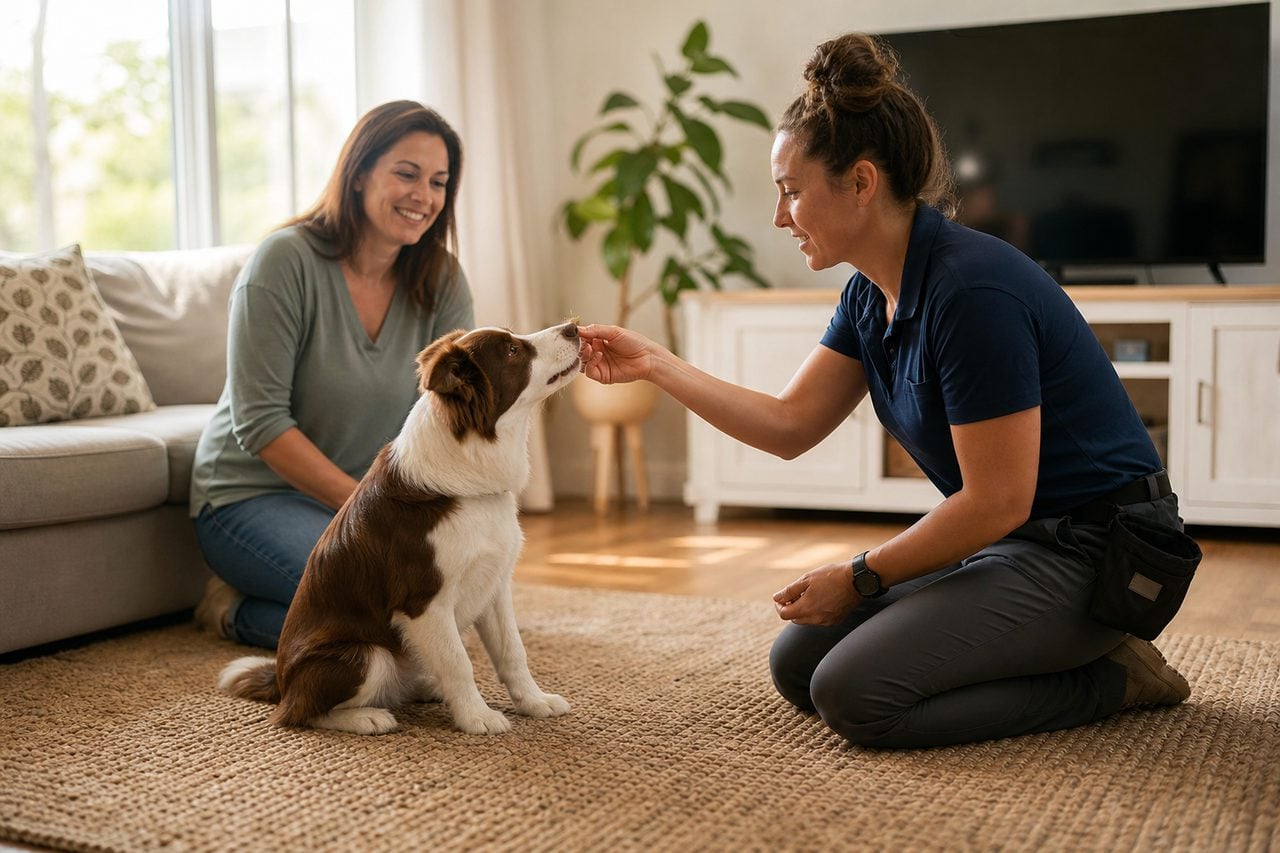
In-home dog training brings the trainer to your living room, your backyard and your own street in Port St. Lucie, which is exactly where most problems happen. Jumping on guests, pulling on the walk past the neighbor’s fence and chaos at the front door are easier to fix when the trainer can see them in person.
Private and in-home work leads the training market in this part of Florida, and many trainers travel across St. Lucie, Martin and Indian River counties, so a trainer based in Fort Pierce or Okeechobee may still come to you. Below is how in-home training works, who offers it locally, what a good first visit looks like, and how to get the most out of each session.
Why train at home
A training room is tidy and predictable. Your house is not, and that is the point. When a trainer works in your home, the lesson happens around your real doorbell, your real couch and the real squirrel in the yard, so there is less to translate afterward.
- The whole family can take part. Everyone who lives with the dog hears the same instructions and uses the same cues, which is often the biggest single fix.
- Problems show up on cue. Door manners, counter surfing, barking at the window and pulling on your usual route can be worked on where they occur.
- Less stress for some dogs. Puppies, nervous dogs and dogs that react to other dogs can learn without a busy room around them.
- Easier scheduling. No drive to a class, and some trainers offer weekend times or book around your calendar.
The trade-off is that your dog learns in a familiar place. A good in-home trainer plans for that by moving practice onto the sidewalk, into the neighborhood and eventually into busier places once the basics hold at home.
Who offers in-home training locally
Six trainers serving the Port St. Lucie area describe in-home training in their own services, and they cover a range of methods and specialties.
- A science-based tutor in Port St. Lucie. This trainer brings reward-based positive reinforcement to clients’ homes, teaching manners and working on behavior issues without pain. Weekend session times suit owners whose schedules do not fit classes, schedules and pricing options are flexible, and new and returning clients book through an online scheduler. One client wrote that the trainer explained everything clearly and made training fun and easy.
- An in-home specialist based in Fort Pierce. All of this trainer’s work happens at the client’s home across St. Lucie, Indian River and Martin counties, including Port St. Lucie. The focus is puppy development and obedience at every level, with a six-session weekly program for puppies from 8 weeks that introduces sit, down, stay, recall, leave it and loose-leash walking, plus customized obedience for older dogs. The owner started out running in-home training for an Orlando company, and free in-home evaluations are available by call or text.
- A veteran trainer serving three counties. Working across Palm Beach, Martin and St. Lucie counties by appointment, this trainer offers in-home private lessons and phone consults and says she has been training since 1989. She describes her methods as positively balanced, credits many techniques to her father, who opened a training school in 1962, and covers puppy training, obedience, behavior modification and tricks. She has noted only a handful of openings for new students and takes applications through a registration form.
- A trainer team with local coverage. Trainers for North St. Lucie and Indian River counties and for South St. Lucie and Martin counties offer private training in your own home, alongside public group classes and board-and-train. The team describes its approach as gentle and reward-based, balancing reward with gentle consequence, and offers in-home evaluations.
- A balanced facility in Fort Pierce. Many of its cases start with in-home sessions involving the whole family before moving on to group classes, and its packages come either in-home or at the facility. Spanish is spoken.
- An Okeechobee trainer. Home training is one of its formats, alongside private and group training and board-and-train, and every program begins with a free evaluation.
What a good first visit looks like
The first session sets the tone for everything after it, so it is worth knowing what to expect.
Questions before training. A careful trainer asks about your dog’s age, history, health, routine and the specific moments that go wrong. Have the family there, and think in advance about the two or three problems that bother you most.
Watching the dog in context. Expect the trainer to see the front door, the walk and whatever space causes trouble. This is where in-home work earns its keep, because the trainer can spot details, like where the leash hangs or which window the dog guards, that never come up in a classroom.
Early wins and a plan. Most trainers teach one or two skills in the first visit so you leave with something that works, then outline how the next sessions will build on it.
Clear homework. Ask what to practice, how often and for how long. In-home training only works if the family keeps practicing between visits.
Making in-home sessions count
- Keep sessions short and frequent at home. A few minutes of practice several times a day beats one long burst before the next visit.
- Agree on words and rules. If one person says down for get off the couch and another says off, the dog will be confused. Write the cues on the fridge.
- Manage between sessions. Baby gates, a leash indoors or a crate for quiet time stop the dog from rehearsing the problem while it is still learning.
- Take the training outside. Once skills hold in the kitchen, practice on your street and then in busier places. When your dog is ready, a fenced dog park such as Lyngate Park Dog Park in Port St. Lucie, which has separate areas for large, medium and small dogs, can be one stage in that process.
- Ask about next steps. Several local trainers can move you from in-home lessons into group classes or more advanced work when the time comes.
Questions to ask before you book
A short phone call will tell you a lot. These are the questions that separate one in-home trainer from another.
- Is my address inside your regular service area, and does travel affect the price?
- Which methods and tools do you use, and what happens when my dog gets it wrong?
- How many sessions do you usually recommend for a dog like mine?
- Who will come to my home, and what is their background?
- What support is available between visits and after the program ends?
- Do you offer a free evaluation or consultation first?
Honest trainers describe progress in ranges rather than promises. Results depend on the dog’s age, temperament and history, and on how consistently the household practices.
Reviewed In-Home Dog Training Trainers in Port St. Lucie
These reviewed Port St. Lucie-area trainers from our directory handle in-home dog training. Each links to a full profile with specialties, certified credentials, reviews, and contact info:
- Dog Training Elite Treasure Coast Facility — 5.0★ (76 reviews)
- Babette Haggerty – Dog Trainer — 4.9★ (85 reviews)
- KK’s Canine Training, LLC — 4.9★ (30 reviews)
- Outland K9 Dog Training — 4.9★ (12 reviews)
- Dog Science Training Services LLC
See all Port St. Lucie in-home dog training trainers →
Frequently Asked Questions
Do trainers come to homes outside Port St. Lucie city limits?
Many do. Local trainers serve areas such as St. Lucie, Martin and Indian River counties, and one veteran trainer also works in Palm Beach County. Ask whether your address is inside a trainer’s regular area before you book.
Is in-home training good for puppies?
It often is. A Fort Pierce in-home trainer runs a six-session weekly program for puppies from 8 weeks covering basic cues, recall, leave it and loose-leash walking, with guidance on socialization. Training at home lets you set up house rules and routines from the start.
Can I book in-home sessions on weekends?
Some trainers offer weekend times. A science-based in-home tutor in Port St. Lucie schedules weekend sessions for owners whose weekday schedules do not fit classes, and others book by appointment, so ask about availability when you call.
Is in-home training reward-based or balanced?
Both are available. One Port St. Lucie in-home tutor uses only reward-based positive reinforcement, while other local trainers describe themselves as balanced or positively balanced. Ask each trainer which tools they use and how they correct mistakes.
How do I know if in-home training is working?
Look for steady, practical changes, such as calmer greetings at the door or a looser leash on your usual walk. Keep notes between visits and share them with your trainer so the plan can be adjusted.
Related: read our complete in-home dog training guide or the full Port St. Lucie dog training overview.
Ready to find the right in-home dog training pro in Port St. Lucie?