
In-Home Dog Training in Pottsville, PA
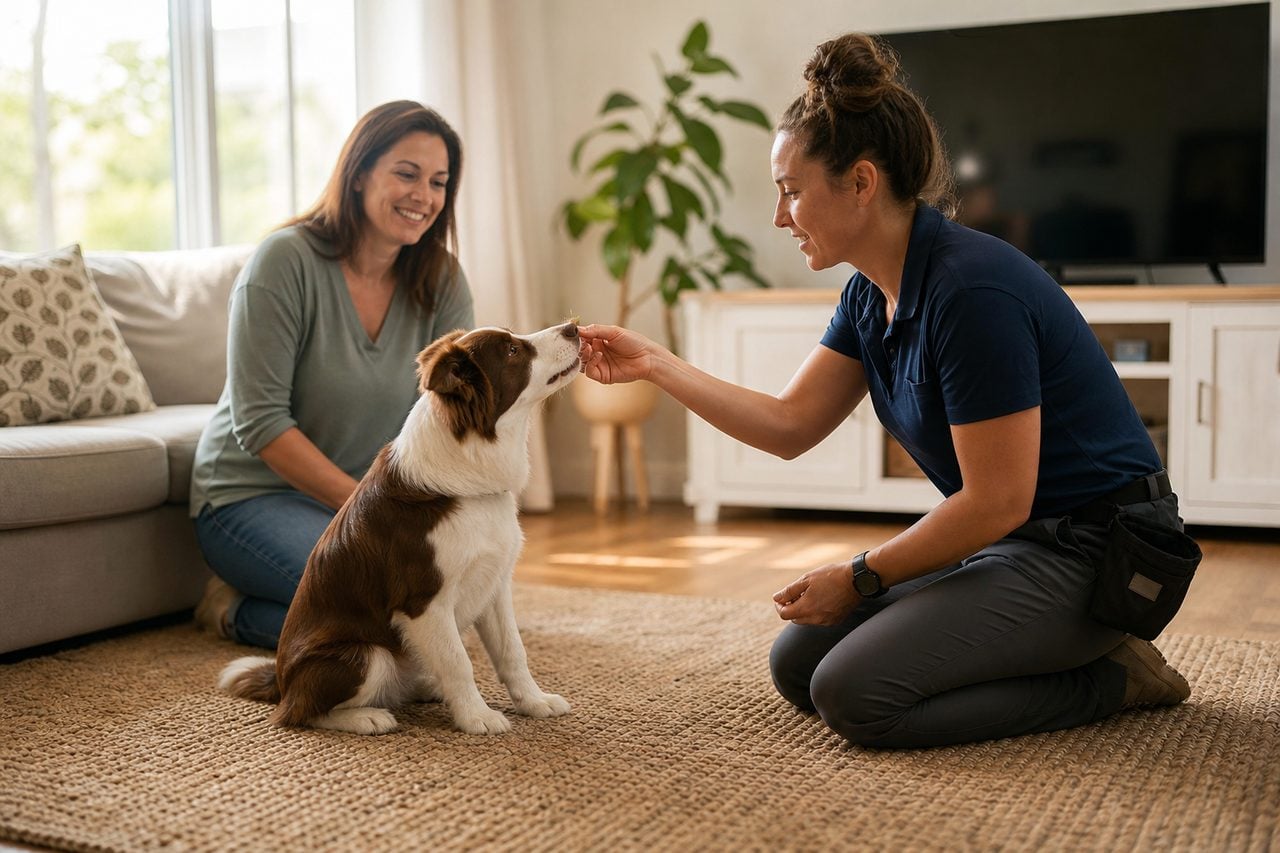
In-home dog training is exactly what it sounds like: a professional comes to your house and works with you and your dog in the environment where the behavior problems actually happen. For a lot of families around Pottsville and the wider Schuylkill County area, it turns out to be the most practical and effective option, and not just because it’s convenient. When your dog barks at the mail carrier, bolts out the front door, or won’t settle in the living room, those behaviors are tied to that specific place. Training in the exact spot where the problem lives has real advantages.
This guide covers why in-home training suits spread-out coal country, what a typical session looks like, what kinds of problems it handles well, and the practical realities of service radius and scheduling when trainers have to cover a lot of ground between boroughs.
Why In-Home Training Fits the Coal Region
Schuylkill County isn’t a compact city. It’s Pottsville plus a scattering of small boroughs, Schuylkill Haven, Saint Clair, Minersville, Frackville, Orwigsburg, Tamaqua, and dozens of rural townships spread across the ridges and valleys of the Coal Region. For a lot of dog owners, the nearest group-class facility is a real drive, and hauling a reactive or under-socialized dog into a strange building full of other dogs can be counterproductive before the lesson even starts.
In-home training flips that. The trainer comes to you, which erases the commute for you entirely and eliminates the stress of transporting a dog that doesn’t travel well. For an older owner, someone without reliable transportation, or a busy household juggling work and kids, having the lesson happen in the living room removes the single biggest barrier to actually following through with training.
There’s also a training benefit specific to a rural, spread-out area. Many local problem behaviors are territorial or environment-specific: barking at deer or wildlife along a wooded property line, reacting to the long gravel driveway, guarding the porch. Those are hard to reproduce and address in a classroom miles away. A trainer standing in your actual yard can work the real trigger in real time.
The home setting carries a subtler advantage too. Dogs don’t automatically apply what they learn in one place to every other place; a dog that behaves beautifully in a training center can be a different animal in its own living room, where all the familiar smells, routines, and habits are pulling it toward old patterns. By training in the environment where you actually need the behavior, in-home work skips much of that transfer problem. What the dog learns, it learns in the place it counts, which is one of the quietest but most practical reasons the format works so well for household manners.
What Happens in an In-Home Session
The first session usually starts with a conversation, not commands. A good trainer wants to understand your dog’s history, your daily routine, what’s working, what isn’t, and what you actually want to achieve. They’ll observe your dog behaving naturally in its own space, which often reveals the true root of a problem faster than any questionnaire. A dog that “ignores commands” might turn out to be anxious, overstimulated, or simply never taught the command clearly in the first place.
From there, sessions become hands-on and coaching-heavy. A defining feature of in-home training is that it trains the owner as much as the dog. The trainer demonstrates a technique, then hands it to you and corrects your timing, your body language, and your reward delivery on the spot. Because you’re the one who lives with the dog every day, building your skill is what makes the change permanent.
Sessions typically run about an hour and end with clear homework: specific exercises to practice before the next visit. The cadence is often weekly or every couple of weeks, giving you time to reinforce each skill before adding the next. Progress happens between sessions, in the daily reps you put in, more than during the lesson itself. Expect to be an active participant, not a spectator.
Good trainers also read the whole household during that first visit, not just the dog. They notice whether the dog gets fed from the table, whether the kids wind it up, whether the crate is used as punishment, whether everyone gives different commands for the same behavior. Those household patterns are often the real source of a problem, and fixing them frequently matters more than any single obedience drill. Don’t be surprised if some of the early advice is about changing what the people do, since that’s usually where the fastest wins hide.
Problems In-Home Training Handles Well
In-home training shines on behaviors that are anchored to the home environment. Door-dashing and bolting, jumping on guests, barking at people or vehicles passing the property, resource guarding around specific spots or objects, house-training struggles, and general household manners are all best addressed exactly where they occur. You can’t realistically practice a calm doorbell response in a training center; you can practice it at your actual front door.
It’s also excellent for foundational obedience and for puppy raising. New puppy owners get enormous value from a trainer setting up crate training, house-training routines, and early socialization plans tailored to their specific home layout and family. Getting the foundation right in the first few months prevents a long list of problems later.
Separation-related issues and general anxiety often benefit too, because the trainer can see the actual environment and daily patterns that feed the behavior. Watching how a dog acts when its people prepare to leave, or how the household inadvertently rewards clingy behavior, gives a trainer diagnostic information no description over the phone could match. That firsthand read of the real environment is one of in-home training’s biggest strengths.
That said, in-home isn’t the answer to everything. Some goals, like teaching a dog to be calm and focused specifically around other dogs, eventually need controlled exposure to other dogs, which a purely in-home program can’t provide alone. A good trainer will be honest about when to layer in other settings, such as gradual practice in a quiet public spot like a corner of Garfield Square once the foundation is solid. The point is to use in-home training for what it does best and to recognize when a goal calls for adding a controlled outing rather than pretending the living room can simulate every situation.
Understanding Service Radius and Travel
Here’s the practical catch of a spread-out county: the convenience of in-home training gets partly offset by trainer travel time. A trainer based near Pottsville might comfortably cover Schuylkill Haven, Saint Clair, Minersville, and Orwigsburg without much fuss, but a house call out to Pine Grove, Tamaqua, Shenandoah, or Mahanoy City means real windshield time each way. That reality shapes availability and, often, pricing.
Some trainers charge a flat rate within a core radius and add a travel fee beyond it. Others simply limit how far they’ll go, or offer fewer available time slots for distant clients because a far-out visit eats a bigger chunk of their day. None of this is unreasonable; it’s just the math of covering rural territory. Ask up front where the trainer’s service area ends and whether your address falls inside it.
If you’re on the edge of a trainer’s range, a few things can help. Ask whether they batch visits by area on certain days, which sometimes unlocks better scheduling. Ask whether an initial in-home assessment could be followed by some remote check-ins for maintenance. And clarify travel fees before booking so there are no surprises. Being flexible on day and time often matters more for a distant client than for one down the street.
It’s also worth thinking about session frequency in light of the drive. If a trainer has to travel a long way to reach you, you may get better value from slightly longer, less frequent sessions with substantial homework in between, rather than many short visits that spend as much time on the road as in your living room. A good trainer will help you structure the plan around the geography rather than fighting it, and that kind of practical flexibility is a sign you’re dealing with someone who works with rural clients regularly and understands the realities of covering a county like this one.
Getting the Most Value From Each Visit
Because in-home sessions are usually spaced out and each one costs money and travel, preparation pays off. Before the trainer arrives, write down the specific behaviors that concern you and any patterns you’ve noticed, such as when the barking spikes or what triggers the jumping. Concrete examples help the trainer diagnose faster than “he’s just bad on the leash.”
Have the whole household present when you can. Since in-home training is really owner coaching, everyone who interacts with the dog needs to learn the same techniques and cues. If one family member is out of the loop, they’ll unintentionally undo the work. Kids old enough to follow instructions should be part of it too, appropriately supervised, because dogs behave differently with different family members.
Then do the homework. The single biggest factor in results is what happens in the days between visits. Ten focused minutes a day beats an hour crammed in the night before the next session. Keep a simple log of what you practiced and how it went; it gives the trainer useful feedback and keeps you honest. Owners who treat the visits as the whole solution tend to be disappointed; owners who treat them as coaching that they carry out daily tend to get exactly what they hoped for.
Set the space up for success, too. Have treats, the right leash or harness, and a quiet room ready so the session isn’t eaten up by hunting for supplies or wrangling distractions. If your dog is easily overwhelmed, warn the trainer ahead of time so they can pace the introduction. And be candid about what hasn’t been working; a trainer can only fix problems they know about, and hiding the fact that nobody actually walks the dog, or that the kids feed it from the table, only slows down the very help you’re paying for. Honesty in that first conversation routinely saves a session or two down the line.
In-Home vs. Other Training Options
In-home isn’t automatically the best choice for every dog and goal; it’s the best choice for particular ones. Group classes have a genuine advantage that in-home can’t replicate: controlled proximity to other dogs and people, which is valuable for socialization and for building focus around distractions. For a friendly, stable dog that mainly needs polish and social exposure, a class can be a great, economical fit if you can get to one.
Board-and-train and boot-camp formats put the intensive work on the trainer for a compressed period, which suits owners who can’t commit to daily practice or who face serious behavior problems. The trade-off is that the dog learns in the trainer’s environment and the skills then have to transfer back to yours. In-home training front-loads that transfer by working in your home from day one, but it depends heavily on your consistent follow-through.
For many Pottsville-area families, the sweet spot is a blend: start with in-home sessions to fix the household-specific problems and build a foundation, then add controlled outings or an occasional group setting once the dog is ready for distraction work. Talk honestly with a trainer about your dog, your schedule, your location, and your goals, and let those factors, not just convenience, guide the format you choose.
What In-Home Training Costs and How to Judge Value
Private, one-on-one training costs more per session than a group class because you’re buying the trainer’s undivided attention, and in-home sits at the higher end of the private range because it adds travel. That extra cost isn’t padding; it reflects real time. A trainer who drives out to Pine Grove or Tamaqua spends a chunk of the day on the road that a facility-based trainer spends teaching, and pricing usually accounts for that, sometimes as a distance-based travel fee, sometimes as a limited service radius or fewer available slots for far-out clients.
The way to think about the price is value per result, not dollars per hour. In-home training’s whole advantage is relevance: the trainer works your actual triggers in your actual home and builds a plan around your specific dog and household. For behavior problems tied to your environment, that focus often solves things faster than a cheaper but generic option, which makes the higher per-session number a genuine bargain when it fixes the problem. It’s a poor value only when your dog would have done just as well in an inexpensive group class, so be honest about which situation you’re in.
Because so much of in-home training is coaching you rather than drilling the dog, the return on your spending hinges on your follow-through. The homework between visits is where the change actually consolidates, so money spent on excellent coaching is partly wasted if the daily practice never happens. Before booking, ask what’s included: how long each session runs, whether follow-up support between visits is part of the package, whether sessions can be bought as a discounted bundle, and exactly what travel will cost for your address. Nailing those details down up front is how you make sure that whatever you spend buys training that genuinely helps.
Reviewed In-Home Dog Training Trainers in Pottsville
These reviewed Pottsville-area trainers from our directory handle in-home dog training. Each links to a full profile with specialties, certified credentials, reviews, and contact info:
- Lead Your K9 — 4.7★ (33 reviews)
- Mountain Adventures K9 Academy — 4.6★ (22 reviews)
- Canine Learning Center
See all Pottsville in-home dog training trainers →
Frequently Asked Questions
How much of in-home training is teaching me versus teaching my dog?
A large part of it is teaching you. Because you live with your dog every day, your handling skills, timing, and consistency are what make training stick long after the trainer leaves. A good in-home session involves the trainer demonstrating a technique and then coaching you through it, correcting your body language and reward timing in real time. If you expect to sit back and watch the trainer fix your dog, in-home training may frustrate you; it works best when you’re an active participant.
Will a trainer travel out to my area in Schuylkill County?
Usually within a core radius, and possibly beyond it for a travel fee. A trainer based near Pottsville can typically cover nearby boroughs like Schuylkill Haven, Saint Clair, and Orwigsburg readily, while farther towns such as Tamaqua, Shenandoah, or Pine Grove may involve added travel charges or more limited scheduling. Always confirm the service area and any travel fees before booking. Being flexible on your appointment day and time helps, especially if you’re near the edge of a trainer’s range.
What behavior problems are best suited to in-home training?
Anything anchored to your home environment: door-dashing, jumping on guests, barking at people or cars passing the property, resource guarding, house-training issues, and general household manners. These are best fixed in the exact spot where they happen. In-home is also excellent for puppy raising and foundational obedience. It’s less ideal on its own for goals that require controlled exposure to other dogs, where a trainer may recommend layering in group or public-setting work once your dog’s foundation is solid.
How long is a typical in-home session and how often should they happen?
Most in-home sessions run about an hour. Frequency is commonly weekly or every couple of weeks, which gives you time to practice each new skill before the next one is added. The real progress happens in the days between visits, through the homework you do daily. A short, consistent practice habit of around ten focused minutes a day usually beats trying to cram everything in right before the next appointment.
Should the whole family be there for the sessions?
Yes, whenever possible. Since in-home training is largely about coaching the humans, everyone who interacts with the dog needs to learn the same cues and techniques, or they’ll unintentionally undo the progress. Children old enough to follow directions can and should be involved with appropriate supervision, because dogs often behave differently with different family members. Getting everyone on the same page about rules and commands is one of the biggest factors in whether the training lasts.
Is in-home training better than a group class?
Neither is universally better; they’re good at different things. In-home excels at household-specific problems and lets you skip transporting a stressed dog, which matters a lot in a spread-out area. Group classes offer something in-home can’t easily replicate: controlled proximity to other dogs and people for socialization and distraction training. For many families the ideal is a blend, starting with in-home work to build a foundation, then adding controlled outings or a class once the dog is ready. Match the format to your dog and goals.
Related: read our complete in-home dog training guide or the full Pottsville dog training overview.
Ready to find the right in-home dog training pro in Pottsville?