
In-Home Dog Training in South Bend, IN
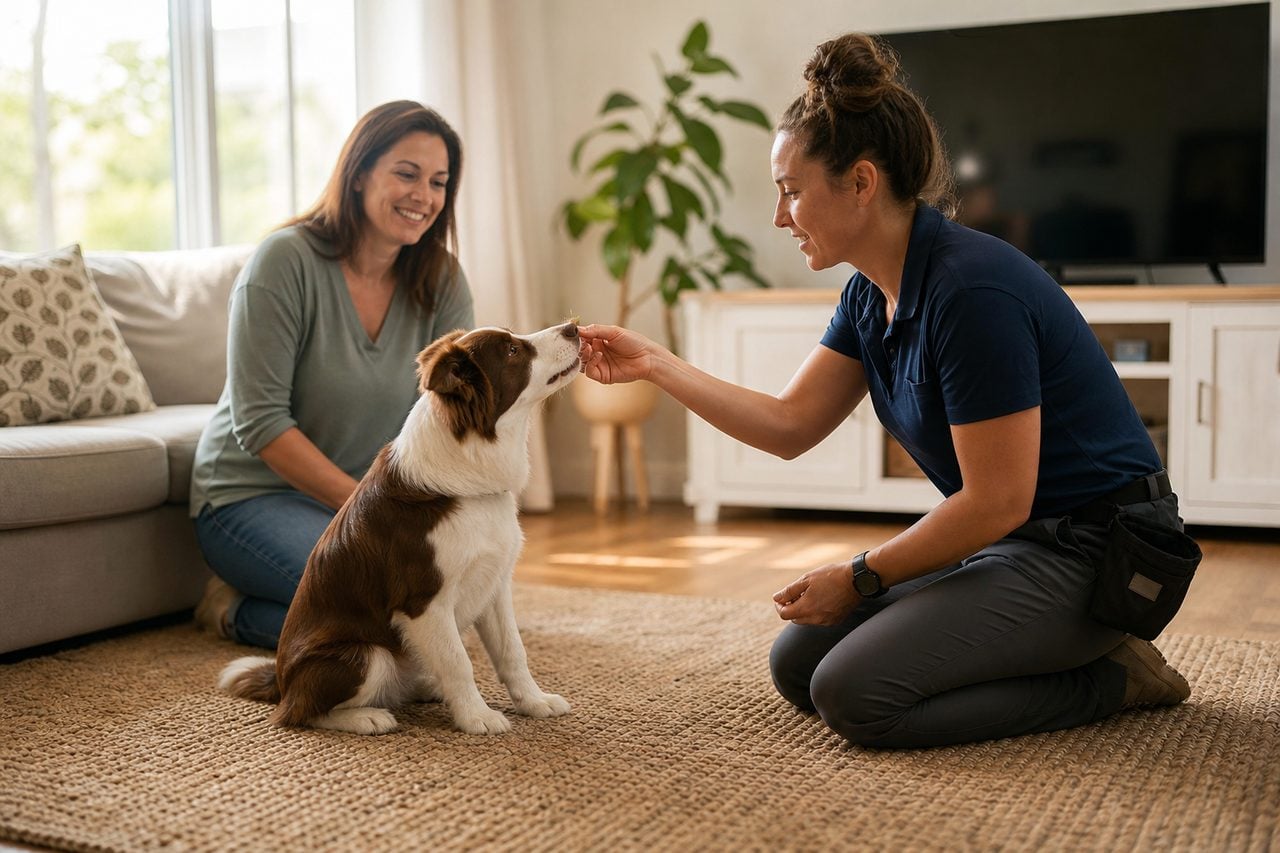
In-home dog training brings a professional trainer directly to your house or apartment somewhere across the South Bend and Elkhart area, so your dog learns in the exact place where the behavior actually happens. Instead of loading an anxious dog into the car and driving to an unfamiliar training center, you work through real problems at your own front door, in your own kitchen, and on your own street — the environments where jumping, barking, leash pulling, and counter surfing usually take root.
- Why Training in the Dog’s Own Environment Works
- What a Private In-Home Program Usually Covers
- In-Home Versus Group Classes and Board-and-Train
- How Michiana Trainers Cover the Region
- Choosing a Qualified In-Home Trainer
- Getting the Most Out of Your Sessions
- What to Expect at Your First In-Home Session
- Reviewed trainers
- FAQ
For families across St. Joseph County, from South Bend and Mishawaka to Granger, and out into Elkhart County toward Goshen, Bristol, and Middlebury, private in-home training has become a popular alternative to group classes. Many trainers serving the Michiana region travel a wide radius that reaches into Marshall County and the smaller towns of Plymouth, Bremen, and Lakeville, meeting owners wherever their dog lives.
This guide explains how in-home training works, who it suits best, what a typical program looks like, and how to choose a qualified private trainer in the South Bend region. The goal is to help you make an informed decision, not to sell one method over another.
Why Training in the Dog’s Own Environment Works
Dogs do not generalize the way people do. A dog that sits politely inside a quiet training facility may completely fall apart when a delivery truck rumbles down the street or when guests arrive at the door. That gap between the classroom and real life is exactly where in-home training earns its value. When the lesson happens in the same spot as the problem, the dog does not have to transfer a skill from one place to another — the skill is built where it will actually be used.
Consider the most common complaints in a typical Michiana household: a dog that bolts out the front door, one that barks at every person walking the East Bank Trail, or one that cannot settle when the family sits down for dinner. Each of these behaviors is tied to a specific location and a specific trigger. A trainer standing in your living room can watch the real sequence unfold, identify what sets it off, and coach you through a response in the moment instead of describing a hypothetical scenario.
There is also a comfort factor. Fearful, reactive, or under-socialized dogs often perform poorly in a crowded class because the environment itself is overwhelming. At home, the dog starts from a calm baseline, which means it can actually learn rather than simply cope. As skills solidify, a good trainer gradually adds difficulty — moving from the backyard to the driveway to a quiet neighborhood street — so the dog builds confidence in controlled steps.
Another underrated benefit is scheduling and stress reduction for the whole family. Loading a reactive or car-anxious dog into a vehicle and driving across town can leave both dog and owner frazzled before a lesson even begins, and it eats into the limited evenings and weekends that busy Michiana families have. When the trainer comes to you, that friction disappears — the dog is already relaxed, and the household is in its normal rhythm, which is precisely the state in which real learning happens.
Finally, in-home work naturally trains the humans. Because the whole household can take part, everyone learns to give the same cues the same way. Consistency among family members is one of the strongest predictors of lasting results, and it is far easier to achieve when the trainer is coaching the actual people who live with the dog every day. A trainer watching you handle the leash, deliver a reward, or respond to a jump can correct small timing errors on the spot — the kind of subtle feedback that a video or a handout simply cannot provide.
What a Private In-Home Program Usually Covers
In-home programs vary by trainer, but most are built around the specific goals you describe during an initial consultation. Rather than following a fixed group-class curriculum, the trainer tailors the plan to your dog, your home, and your priorities. That said, several themes come up again and again in the South Bend area.
Foundation manners. This includes reliable responses to cues like sit, down, stay, place, come when called, and polite leash walking. These form the backbone of a well-mannered dog and make almost every other problem easier to manage.
Household behavior. Jumping on visitors, counter surfing, door dashing, stealing laundry, and general over-arousal are classic in-home targets because they are so tied to the physical space. Working them in context tends to produce faster, cleaner results.
Puppy raising. Many families book in-home help for a new puppy to get housetraining, crate training, bite inhibition, and early socialization right from the start. Building good habits early is far easier than fixing entrenched ones later.
Behavior and emotional issues. Leash reactivity, barking, separation-related distress, resource guarding, and fear-based behavior often benefit from the calm, familiar setting of the dog’s own home. These cases usually require a longer commitment and a careful, gradual plan.
A typical structure might look like an initial assessment session followed by a package of several weekly visits, with homework between each one. The homework matters as much as the sessions — dogs learn through repetition, and the short daily practice you do between visits is where real progress accumulates.
In-Home Versus Group Classes and Board-and-Train
In-home training is one option among several, and the right choice depends on your dog, your schedule, and your goals. Understanding the trade-offs helps you spend your training budget wisely.
Group classes shine for one specific purpose: practicing skills around the controlled distraction of other dogs and people. For a stable, social dog that needs polish and proofing, a class can be excellent and is usually the most affordable route. The downside is that a class moves at the pace of the group, offers limited individual attention, and takes place away from the home environment where many problems live.
In-home private training offers the opposite profile: fully individualized attention, work in the real environment, and a schedule built around your family. It costs more per session than a group class because you are paying for the trainer’s travel and undivided time. It is the strongest fit for household-specific problems, reactive or fearful dogs, busy families, and owners who want coaching on their own handling.
Board-and-train programs send the dog to live with a trainer for a stretch of time. This can accelerate obedience, but it carries a well-known catch: the dog learns to respond to the trainer in the trainer’s environment, and skills must then be transferred back to you at home. Any board-and-train worth considering includes substantial owner handoff sessions. For many families, in-home training sidesteps this transfer problem entirely because the owner is involved from day one.
Some households combine approaches — for instance, private in-home sessions to resolve a reactivity problem, followed by a group class once the dog is ready to practice around other dogs. A good trainer will tell you honestly when another format would serve you better.
How Michiana Trainers Cover the Region
One practical advantage of in-home training in this part of Indiana is that many independent trainers cover a genuinely large service area. The South Bend metro sits right on the Michigan state line, and the surrounding communities are spread across several counties, so mobile trainers have adapted by traveling widely rather than expecting clients to come to them.
A typical service radius reaches across St. Joseph County — South Bend, Mishawaka, Granger, and the surrounding townships — and extends east into Elkhart County toward Elkhart itself, Goshen, Bristol, Middlebury, and Nappanee in the heart of Amish country. Many trainers also head south into Marshall County to serve Plymouth, Bremen, and Lakeville. Because the region blends dense city neighborhoods, suburban subdivisions, and rural acreage, experienced local trainers are comfortable adapting to very different home settings.
When you contact a trainer, ask directly whether your address falls within their standard service area and whether travel beyond a certain distance adds a fee. Some charge a flat rate within a core radius and a modest surcharge for the outer towns; others build travel into the package price. Clarifying this up front avoids surprises and helps you compare quotes fairly.
The area’s public spaces also become part of the training once your dog is ready to practice outside the home. Trainers often progress clients to lower-distraction outdoor settings and then to busier ones as skills firm up. Spots like Rum Village Nature Center, the East Bank Trail along the St. Joseph River, and Ox Bow County Park near Elkhart give handlers a range of real-world environments to proof behaviors, always in keeping with local ordinances across the South Bend area regarding leashes and cleanup.
Choosing a Qualified In-Home Trainer
Dog training is an unregulated field, which means anyone can call themselves a trainer regardless of experience. That makes your own due diligence essential. The good news is that a handful of straightforward questions will quickly separate thoughtful professionals from the rest.
Ask about methods. A qualified trainer should be able to explain their approach in plain language and tell you what happens when your dog gets something right and what happens when it gets something wrong. Look for trainers who prioritize reward-based, humane methods and who can clearly describe how they build behavior rather than simply suppress it.
Ask about education and credentials. Certifications from recognized independent bodies signal that a trainer has met a standard and commits to continuing education. Credentials are not a guarantee of skill, but combined with experience they are a meaningful data point. Ask how long they have worked with cases like yours.
Ask for a clear plan. A professional should give you a realistic assessment, define goals, and outline how progress will be measured. Be cautious of anyone who guarantees a specific outcome by a specific date — living creatures do not come with guarantees, and reputable trainers know it.
Consider these questions during your first call:
- What methods and tools do you use, and why?
- What is your experience with my dog’s specific issue?
- How many sessions do you expect this will take, and what does a package include?
- What is expected of me and my family between sessions?
- Can you provide references or reviews from clients in the area?
Trust your read of the trainer’s communication too. In-home training is a collaborative relationship, and you will be inviting this person into your home repeatedly. Clear explanations, patience with your questions, and obvious care for the dog matter as much as any certificate on the wall.
Getting the Most Out of Your Sessions
The families who see the best results from in-home training tend to share a few habits. None of them require special talent — just consistency and a willingness to follow through.
Practice in short, frequent bursts. Two or three five-minute sessions a day beat one long, tiring session. Dogs learn well in brief reps, and short practice fits neatly into the gaps of a busy day. Keep sessions upbeat and end while the dog is still succeeding.
Get everyone on the same page. If one person allows the dog on the couch and another does not, or if family members use different words for the same cue, the dog receives mixed signals and progress stalls. Agree on the rules and the vocabulary as a household, and ask the trainer to coach every regular handler.
Manage the environment between lessons. Prevention is part of training. If your dog counter surfs, keep counters clear while it learns; if it door dashes, use a gate or leash at the entryway during the training phase. Managing the setup stops the dog from rehearsing the unwanted behavior and speeds up learning.
Track progress honestly. Note what is improving and what is not, and share it with your trainer. Real behavior change is rarely a straight line — expect good days and setbacks. A trainer who sees your notes can adjust the plan intelligently.
Keep practicing after the program ends. The end of a package is not the end of training. Skills fade without maintenance, so fold cues into everyday life — ask for a sit before meals, a stay at the door, a settle during dinner. Woven into your routine, the training simply becomes how your dog lives.
What to Expect at Your First In-Home Session
Knowing how the first visit tends to unfold takes the guesswork out of booking and helps you prepare so the session is productive from the start.
Most in-home programs open with an assessment rather than a lesson. The trainer arrives, spends time observing your dog in its normal environment, and asks a thorough set of questions about the dog’s history, health, daily routine, diet, and the specific behaviors you want to change. Expect questions about when problems occur, what tends to trigger them, and how the household has responded so far. This intake is not idle chit-chat — the details shape the entire plan, and a trainer who skips it is guessing.
During the assessment, the trainer watches how your dog moves through its world: how it greets a stranger at the door, how it behaves when the doorbell rings, how it walks on leash down your own street, how it settles or fails to settle in the living room. Because these things happen in real context, the trainer gathers information that would be invisible in a training center. It is common for the exact problem behavior to appear naturally during the visit, giving the trainer a live example to work from.
From there, expect a candid conversation about realistic goals and a proposed plan — how many sessions, what the focus will be, and what the trainer expects you to practice between visits. A professional will describe the approach in plain language and welcome your questions. If your dog has a health component to its behavior, a good trainer may recommend a veterinary check before proceeding, since pain and medical issues can drive problems that no amount of training will fix.
To get the most from that first visit, prepare a little in advance. Have your dog’s favorite treats and toys on hand, keep the household calm, and write down the specific incidents that prompted you to call — the times, places, and what happened. Make sure the family members who interact with the dog most are present, since the trainer will want to coach the people, not just the dog. A clear, organized first session sets the tone for everything that follows and gives you the fastest possible start toward a better-behaved companion.
Reviewed In-Home Dog Training Trainers in South Bend
These reviewed South Bend-area trainers from our directory handle in-home dog training. Each links to a full profile with specialties, certified credentials, reviews, and contact info:
- Jamie’s Dog Training & Behavior Modification LLC — 5.0★ (37 reviews)
- Patty’s Pack — 5.0★ (10 reviews)
- THE ART OF PROFESSIONAL DOG TRAINING,LLC — 5.0★ (7 reviews)
- Dog Training Elite Michiana — 4.9★ (71 reviews)
- Top Hat & Tails Canine Training — 4.9★ (15 reviews)
See all South Bend in-home dog training trainers →
Frequently Asked Questions
How much does in-home dog training cost in the South Bend area?
Pricing varies widely by trainer, experience, and the type of problem being addressed, so the most reliable step is to request quotes from a few local trainers and compare what each package includes. In-home sessions generally cost more per visit than group classes because you are paying for individualized attention and the trainer’s travel across the Michiana region. Ask whether the quoted price covers travel to your town, how many sessions are included, and what support you receive between visits.
Is in-home training better than a group class?
Neither is universally better — they serve different purposes. In-home training excels for household-specific problems, reactive or fearful dogs, and busy families who want personalized coaching in their own environment. Group classes are excellent and usually more affordable for practicing skills around the controlled distraction of other dogs. Many owners use both, starting with private sessions and later joining a class once the dog is ready.
What kinds of problems can in-home training help with?
Common targets include jumping on guests, door dashing, counter surfing, leash pulling, poor recall, and general obedience. In-home work is also well suited to behavior and emotional issues such as leash reactivity, barking, separation-related distress, and fear-based behavior, because the calm familiarity of home helps the dog stay under threshold and actually learn. New-puppy help with housetraining, crate training, and socialization is another frequent request.
Do trainers travel to Elkhart, Goshen, and the smaller towns?
Many independent trainers serving South Bend cover a wide radius that reaches across St. Joseph and Elkhart counties — including Mishawaka, Granger, Elkhart, Goshen, Bristol, and Middlebury — and often extend south into Marshall County toward Plymouth, Bremen, and Lakeville. Always confirm your specific address is within a trainer’s standard service area and ask whether the outer towns carry a travel fee.
How many sessions will my dog need?
It depends entirely on the dog, the behavior, and how consistently the household practices between visits. Basic manners for a stable dog may come together in a handful of sessions, while behavior issues like reactivity or fear typically require a longer, gradual plan. A good trainer will give you a realistic estimate after an initial assessment and adjust as your dog progresses, rather than promising a fixed result by a fixed date.
Should the whole family take part in the training?
Yes. One of the biggest advantages of in-home training is that everyone who lives with the dog can learn to give the same cues the same way. Consistency across family members is one of the strongest predictors of lasting results, so a good trainer will coach every regular handler and help the household agree on shared rules and vocabulary for the dog.
Related: read our complete in-home dog training guide or the full South Bend dog training overview.
Ready to find the right in-home dog training pro in South Bend?