
In-Home Dog Training in Valparaiso, IN
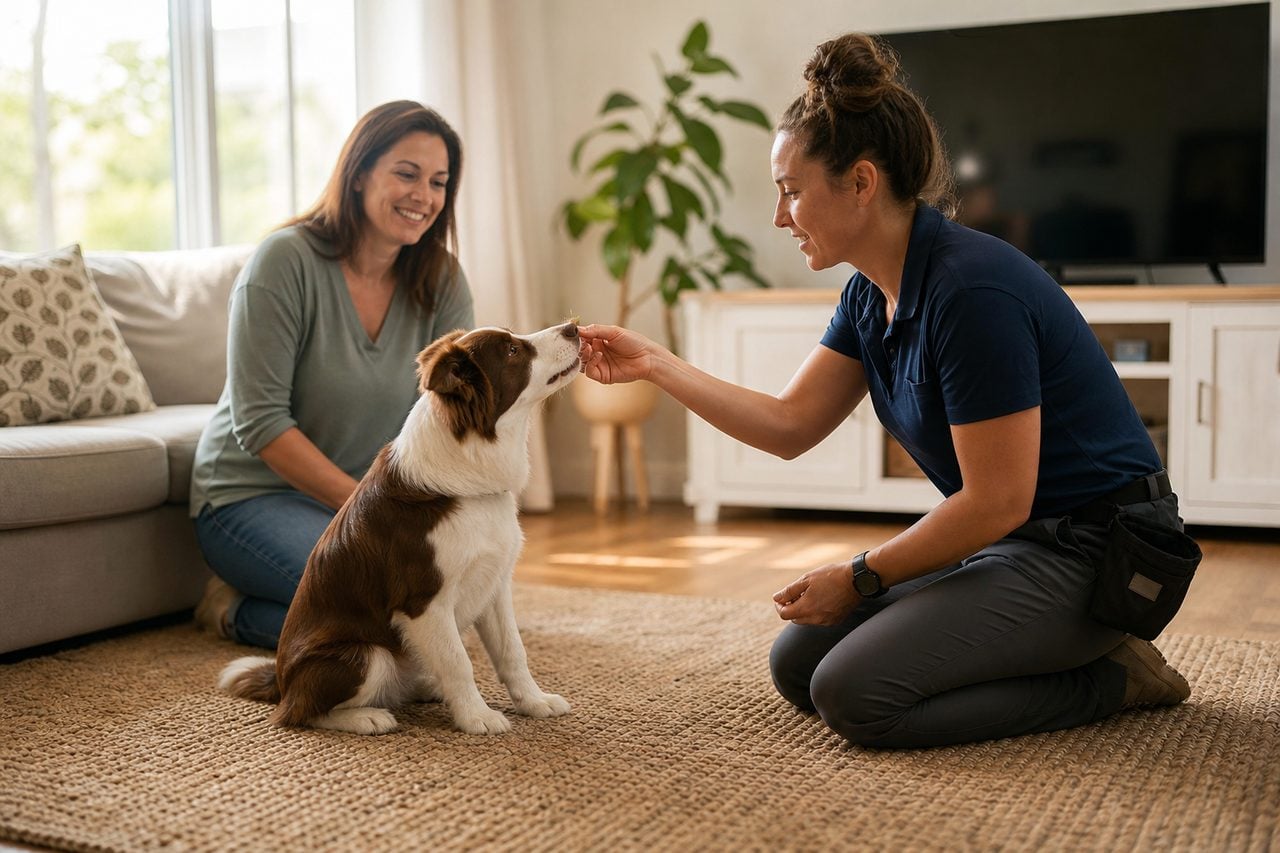
In-home dog training brings a professional trainer to the place where your dog actually lives, eats, sleeps, and misbehaves — your house and your neighborhood in Valparaiso and across Northwest Indiana. Instead of loading a nervous dog into the car and driving to an unfamiliar training center, the lesson happens on your own kitchen floor, at your own front door, and along the same Porter County sidewalks where the real problems tend to show up. For a lot of Region families, that difference is the whole reason the training finally sticks.
- What In-Home Dog Training Actually Means
- Why the Dog’s Own Environment Changes Everything
- Problems In-Home Training Solves Best
- How a Typical In-Home Program Is Structured
- Training Methods and What to Look For
- Coverage Across Porter, Lake, and LaPorte Counties
- Getting the Most Out of Your Investment
- Reviewed trainers
- FAQ
Private, one-on-one work is a natural fit for dogs who struggle in group classes, for busy households that cannot commit to a fixed weekly class schedule, and for behavior issues that are tied to a specific environment — the mail carrier at the porch, the resident cat, the fence line, the leash walk down the block. It is also a strong option for new puppies during their early socialization window and for newly adopted rescues still learning the rules of a strange home.
This guide explains how in-home training works around Valparaiso, what kinds of problems it solves best, how trainers here typically structure a program, and how to choose a qualified professional. Many area trainers travel a wide radius across Porter, Lake, and LaPorte counties, so households from Chesterton to Crown Point to LaPorte can usually find someone willing to come to them.
What In-Home Dog Training Actually Means
In-home dog training, sometimes called private or in-home board-and-train’s lighter cousin, is simply professional instruction delivered at your residence rather than at a facility. A trainer arrives at your Valparaiso-area home, observes your dog in its normal environment, and coaches both the dog and the humans through a customized plan. The sessions usually run somewhere between forty-five minutes and ninety minutes, and the number of visits depends entirely on the goals.
The format matters more than people expect. Dogs are highly context-dependent learners. A dog that sits politely in a quiet training hall may completely fall apart when a delivery truck rumbles down its own street, because the two situations feel like different worlds to the animal. Training in the real environment closes that gap. The dog learns the behavior in the exact location where you need it, which means far less of the frustrating “he does it in class but not at home” problem.
There is also a human side. In-home work is, in large part, coaching for the owner. A skilled trainer spends much of the visit teaching you the mechanics of timing, reinforcement, leash handling, and household management. You are the one who lives with the dog the other one hundred and sixty-seven hours of the week, so the real goal is to transfer the skills to you, not to have the trainer perform tricks and leave.
For many Region families, the practical appeal is just as important as the behavioral science. There is no drive across town with a car-anxious dog, no wrangling children and a leash into a class on a school night, and no waiting for a fixed session to come around on the calendar. The training comes to the doorstep and fits into the household’s real rhythm. That lower friction tends to translate into better follow-through, and follow-through is what ultimately decides whether training works. A program the family can realistically keep up with, in the setting where the behavior lives, beats a more polished-sounding option that never quite fits into a busy week.
Why the Dog’s Own Environment Changes Everything
The single biggest advantage of in-home training is context. Behavior problems almost never exist in a vacuum — they are attached to triggers, and most of those triggers live at your address. A dog that lunges at the window, guards the food bowl, bolts out the front door, or barks at every passerby is responding to specific cues in a specific place. You cannot fully rehearse the solution anywhere but there.
Consider a few common Region scenarios:
- Door-dashing. A dog that shoves past you when the doorbell rings needs practice at that exact door, with that exact bell, ideally with a helper playing the role of the visitor. A training center cannot replicate your entryway.
- Reactivity on the walk. If your dog erupts at other dogs on the Prairie Duneland Trail or along your subdivision streets, the productive rehearsal happens on those very routes, at a distance you can manage, building calm where the reaction actually occurs.
- Resource guarding and household tension. Multi-dog friction, couch and bed disputes, and food-bowl stiffness are all rooted in the home layout and daily routine. A trainer who sees your actual space can spot the environmental triggers you have stopped noticing.
- Separation-related distress. A dog that panics when left alone can only be assessed and desensitized in the home it is left alone in.
Because the learning happens in context, the results tend to generalize faster to daily life. There is no translation step where the dog has to figure out that the rules from the strange building also apply on the couch. The rules were taught on the couch.
Problems In-Home Training Solves Best
Private in-home programs are flexible enough to cover almost any goal, but some situations are an especially strong match:
- Puppy foundations and socialization. A young puppy in its early developmental window benefits from calm, controlled exposure and from learning house rules — potty training, crate comfort, name recognition, gentle handling, bite inhibition — right where those habits will live.
- Newly adopted rescues. A dog from a Region shelter or rescue is decompressing in a brand-new home. In-home work helps establish routine, build trust, and address the specific quirks a new dog reveals only once it settles in.
- Fearful, anxious, or reactive dogs. Dogs that shut down or overreact in busy group settings often make far better progress one-on-one, below threshold, in a familiar space.
- Everyday manners. Polite greetings instead of jumping, loose-leash walking, reliable recall, settling on a mat while the family eats, and calm behavior around guests are all easier to build at home first.
- Household-specific behavior issues. Counter-surfing, garbage raiding, excessive barking at the yard fence, and door manners are tied to your physical space and respond well to on-site coaching.
- Multi-dog households. When two or more dogs share a home, the dynamics between them are best assessed and managed in that home.
For a small number of severe cases — significant aggression with a bite history, or complex fear and anxiety — a trainer may recommend involving a veterinarian or a veterinary behaviorist alongside the training. A responsible in-home trainer will tell you when a case is beyond behavior coaching and needs a medical or specialist partner, rather than promising a quick fix.
How a Typical In-Home Program Is Structured
Programs vary by trainer, but most Northwest Indiana in-home services follow a recognizable arc.
The initial assessment
The first visit is usually an evaluation. The trainer watches your dog, asks detailed questions about routine, diet, exercise, medical history, and the specific behaviors that prompted the call, and often watches the problem happen in real time. From there they build a plan with realistic goals and a rough timeline.
The working sessions
Follow-up visits introduce and refine skills in a logical order — foundations first, then the harder real-world applications. A trainer might spend one session on calm greetings at the door and the next taking the work out to the sidewalk. You practice with the trainer watching, getting corrected on your timing and mechanics until the handling feels natural.
Homework between visits
The real training happens in the days between sessions. Expect short daily practice assignments — a few minutes several times a day beats one long weekly drill. Consistency from every member of the household is what converts a lesson into a lasting habit.
Management alongside training
Good trainers pair training with management: baby gates, crates, leashes, and routine changes that prevent the dog from rehearsing the unwanted behavior while the new one is still being built. Every time a dog gets to practice the old habit, it gets stronger, so controlling the environment is half the battle.
Some trainers offer packages of a set number of visits; others sell single sessions or ongoing support. Ask up front how many visits a goal like yours usually takes, and whether follow-up questions between visits are included.
Training Methods and What to Look For
The dog training industry is unlicensed and unregulated, in Indiana as everywhere else in the United States. Anyone can call themselves a dog trainer with no exam, no schooling, and no oversight. That makes it especially important to vet the person coming into your home.
Look for a trainer who leans on modern, reward-based methods grounded in how animals actually learn. Reinforcing the behavior you want — with food, praise, play, or access to something the dog values — builds reliable behavior without the fallout that harsh corrections can create, such as increased fear or defensive aggression. A quality trainer will explain clearly what they will do to your dog and why, and will never dodge the question.
Bear in mind that Indiana has no statewide leash law — leash and animal-control rules come from local ordinances across the Valparaiso area — so a well-trained recall and calm leash manners are not just nice-to-haves but genuinely useful for staying compliant on local streets, parks, and trails. A good trainer will factor your neighborhood’s realities into the plan rather than teaching in a vacuum.
Practical things to check:
- Credentials and continuing education. Independent certifications exist and signal that a trainer has passed a knowledge assessment and commits to ongoing learning, even though none are legally required. Ask what they hold and how they keep current.
- Clear methods. If a trainer cannot or will not describe their approach in plain language, keep looking.
- Realistic promises. Behavior change takes time. Be wary of guarantees of a fixed result by a fixed date — living animals do not come with warranties.
- References and reviews. Ask for references from clients with similar issues, and read reviews from other Region dog owners.
- Insurance. A professional coming into your home should carry liability insurance.
- Rapport. You will invite this person into your house repeatedly. They should be someone you and your dog are comfortable around.
Trust your read on the dog, too. If your dog seems more frightened after a session rather than more confident over time, that is a signal worth taking seriously.
Coverage Across Porter, Lake, and LaPorte Counties
One practical reality of the Region is that its towns are spread out. Valparaiso sits in the middle of Porter County, with Chesterton and Portage to the north near the Indiana Dunes, Lake County communities like Crown Point, Merrillville, Hammond, and Gary to the west, and LaPorte and Michigan City to the east in LaPorte County. Because in-home trainers come to you, geography is less of a barrier than it is for a fixed facility — but it is not free.
Many area trainers advertise a service radius that spans all three counties, and some will travel farther for the right case. When you call, confirm two things: that your address falls inside their normal service area, and whether there is a travel fee for the distance. A trainer based in Valparaiso may include Chesterton and Portage at no extra charge but add a surcharge for a drive out to Michigan City or the far side of Lake County.
The upside of that travel model is scheduling flexibility. Without the overhead of a training-hall calendar, in-home trainers can often work around a household’s real life — evenings after work, weekends, or whatever window fits. For families juggling jobs and kids, that convenience is frequently the deciding factor over a center-based class.
Keep in mind that once foundation skills are solid at home, most trainers will want to take the work into the wider world — a quiet corner of a local park, a low-traffic trail like the Prairie Duneland Trail or the paths at Deep River County Park, or a calm section of a store parking lot — to help the dog generalize its new manners. That real-world practice is a feature, not a detour, and worth planning for.
Getting the Most Out of Your Investment
In-home training is only as good as the follow-through, so a few habits dramatically improve the return.
- Get the whole household on board. Dogs cannot tell the difference between a rule that everyone enforces and a suggestion that one person makes. If one family member lets the dog jump up while another forbids it, the dog stays confused. Agree on the rules and enforce them consistently.
- Practice in short, frequent sessions. A few minutes a few times a day keeps the dog fresh and the skill sharp. Long, tedious drills sour a dog on training.
- Meet the dog’s baseline needs. A well-exercised, mentally stimulated dog learns better and misbehaves less. Sniffy walks, chew items, food puzzles, and play all take the edge off. A lot of “behavior problems” are really boredom and pent-up energy.
- Manage the environment. Use gates, crates, and leashes to prevent rehearsal of bad habits while the good ones are still forming.
- Be patient and track progress. Change is rarely linear. Note small wins week to week rather than expecting a straight line, and keep your trainer informed about what is and is not working between visits.
- Ask questions. If you do not understand why you are being asked to do something, ask. The point is to leave you capable of handling your dog on your own.
Done well, in-home training does more than fix a specific complaint. It gives you a working relationship with your dog built on clear communication, and a set of skills you can apply to whatever comes up next — a new couch, a new baby, a move to a new Region neighborhood, or a first visit to a busy local trail. That durability, more than any single fixed behavior, is what makes the private, on-site approach worth it for so many families across Porter, Lake, and LaPorte counties.
Reviewed In-Home Dog Training Trainers in Valparaiso
These reviewed Valparaiso-area trainers from our directory handle in-home dog training. Each links to a full profile with specialties, certified credentials, reviews, and contact info:
- Takacs In Home Dog Training — 5.0★ (165 reviews)
- Region K9 – Dog Training — 5.0★ (23 reviews)
- Crimson K9 Dog Training — 5.0★ (22 reviews)
- Dozer’s Pet Academy — 5.0★ (21 reviews)
- Life of Riley Dog Training — 5.0★ (15 reviews)
- dogs of the dunes — 4.8★ (41 reviews)
See all Valparaiso in-home dog training trainers →
Frequently Asked Questions
How many in-home sessions will my dog need?
It depends entirely on the goals, the dog, and the consistency of the household. Basic manners and puppy foundations may come together in a handful of visits, while deeper behavior issues like reactivity or anxiety can take longer and involve ongoing follow-up. A good trainer will give you a realistic estimate after the initial assessment rather than a one-size-fits-all number. Remember that the practice you do between visits is what actually drives the timeline — the sessions teach, but the daily repetition is what changes behavior.
Is in-home training better than a group class?
Neither is universally better — they solve different problems. In-home training excels for behavior issues tied to your specific environment, for fearful or reactive dogs that struggle in groups, and for households that need scheduling flexibility. Group classes shine for teaching a dog to focus around other dogs and people, which is valuable socialization. Many owners do both: private in-home work first to build foundations and address specific problems, then a group setting later to practice those skills around distractions.
Do trainers travel to my town in Northwest Indiana?
Many in-home trainers cover a wide radius across Porter, Lake, and LaPorte counties, reaching communities from Valparaiso and Chesterton to Crown Point, Portage, LaPorte, and Michigan City. Because they come to you, distance is less of a barrier than with a fixed facility. When you call, confirm that your address falls within their normal service area and ask whether a travel fee applies for longer drives, since a trainer based in one town may add a surcharge for the far corners of the Region.
Will the trainer fix my dog, or do I have to do the work?
You do the work — and that is by design. In-home training is largely about coaching the humans, because you are the one who lives with the dog every day. The trainer teaches you the mechanics of timing, reinforcement, and handling, then supervises while you practice. A trainer who only performs skills themselves and never transfers them to you is not setting you up for lasting success. The goal is to leave you able to manage your dog independently.
My dog is aggressive. Can in-home training help?
In-home work can help with many forms of reactivity and aggression, and being in the dog’s own environment often makes assessment easier. That said, serious aggression with a bite history is a specialized area. A responsible trainer will evaluate the case honestly, prioritize safety and management, and may recommend involving a veterinarian or veterinary behaviorist, since medical issues and anxiety can drive aggression. Be cautious of anyone who promises to eliminate aggression quickly or relies on heavy punishment, which can make defensive aggression worse.
What should I look for when choosing an in-home trainer?
Because dog training is unregulated in Indiana and nationwide, vetting matters. Look for a trainer who uses modern reward-based methods and can explain their approach in plain language, who holds independent certifications and pursues continuing education, who makes realistic rather than guaranteed promises, and who carries liability insurance. Ask for references from clients with similar issues and read reviews from other local owners. Finally, trust how your dog responds over time — growing confidence is a good sign; increasing fear is not.
Related: read our complete in-home dog training guide or the full Valparaiso dog training overview.
Ready to find the right in-home dog training pro in Valparaiso?