
Puppy Training in South Bend, IN
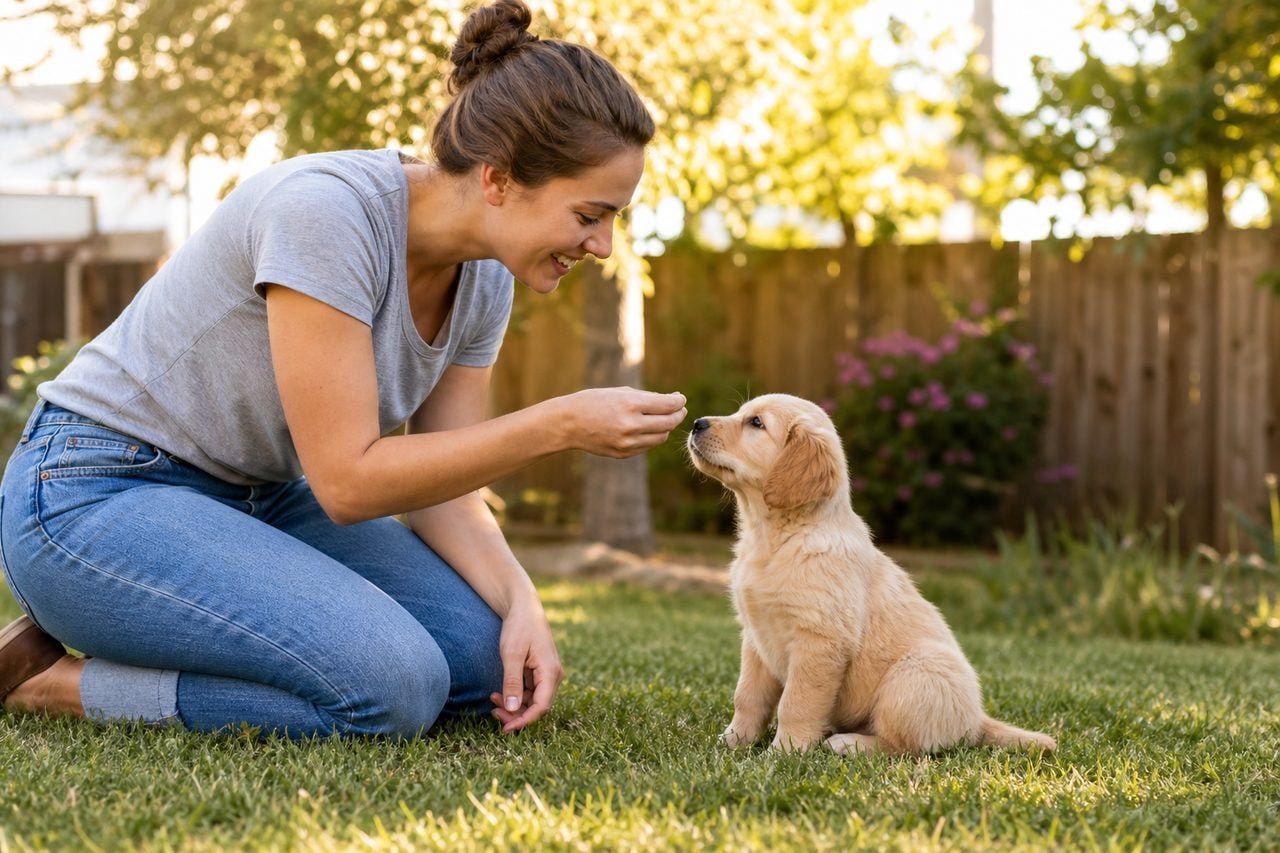
Bringing a puppy home in the South Bend and Elkhart area means starting a training journey that will shape the next decade or more of life with your dog. The Michiana region — St. Joseph and Elkhart counties, tucked right against the Michigan state line along the St. Joseph River — offers a distinctive setting for raising a young dog. Between the college rhythms of Notre Dame and Indiana University South Bend, the busy RV factories and Amish farmland around Elkhart and Goshen, and the long, snowy Michiana winters, local puppy owners face a mix of opportunities and challenges that a generic training guide simply cannot address.
- Why the First Sixteen Weeks Matter Most
- Building a House-Training Routine That Beats Michiana Winters
- First Skills: Name, Recall, and the Foundation Cues
- Bite Inhibition, Chewing, and the Sharp-Teeth Phase
- Local Spots to Practice as Your Puppy Grows
- The Student and Shift-Worker Reality: Fitting Training Into a Busy Life
- When to Bring in Professional Help
- Reviewed trainers
- FAQ
This guide walks through what effective puppy training looks like in the first year, how to build a routine that survives a Michiana winter, and how to make the most of the parks and trails that dot the region. The goal is not a perfectly obedient robot but a confident, well-adjusted companion who can handle a football Saturday crowd, a quiet Amish-country trail, and a snowy backyard with equal ease.
Whether you are a Notre Dame student adopting your first dog, a Granger family adding a puppy to the household, or an Elkhart RV worker fitting training around shift work, the fundamentals below apply. What changes is how you adapt them to your schedule, your space, and the seasons.
Why the First Sixteen Weeks Matter Most
The single most important window in a dog’s life closes earlier than most new owners expect. The primary socialization and learning period runs roughly from three weeks to sixteen weeks of age, and by the time many puppies come home — often around eight weeks — a large chunk of that window is already spent. What a puppy experiences, or fails to experience, during these weeks tends to set lifelong patterns for confidence, sociability, and resilience.
This does not mean training after sixteen weeks is pointless; dogs learn their entire lives. It means the early weeks carry disproportionate weight. A puppy who meets a wide variety of people, surfaces, sounds, and situations calmly during this window is far more likely to shrug off novelty as an adult. A puppy kept isolated during the same period may grow into a dog who finds the ordinary world frightening.
For South Bend owners, this creates a practical tension. Veterinarians rightly caution against exposing an under-vaccinated puppy to high-traffic dog areas before the vaccine series is complete. The resolution is not to lock the puppy away but to socialize thoughtfully: carry the puppy through a hardware store, sit on a bench near the East Bank Trail and let the puppy watch joggers and cyclists from a safe distance, invite vaccinated adult dogs from trusted households over for supervised play. Controlled exposure beats both isolation and reckless free-for-alls.
Keep a simple checklist and aim to introduce a handful of new, positive experiences every day. Novel footing — grass, gravel, metal grates, the smooth concrete of a parking garage, the wooden planks of a trail bridge — matters as much as meeting new people. Every calm, rewarded encounter is an investment that pays off for years.
Building a House-Training Routine That Beats Michiana Winters
House-training runs on two things: supervision and predictability. A young puppy has limited bladder control, and the general rule of thumb is that a puppy can hold it for roughly one hour per month of age, plus or minus. An eight-week-old will need to go out very frequently; a four-month-old can wait longer but still needs a steady schedule.
Set fixed potty trips: first thing in the morning, after every meal, after every nap, after play sessions, and last thing before bed. Take the puppy to the same spot each time, wait quietly, and reward calmly the moment the puppy finishes. Praise delivered outside, at the right moment, teaches far more than any scolding delivered after the fact indoors.
Michiana winters complicate this. Lake-effect snow off Lake Michigan can bury a South Bend or Elkhart backyard, and bitter wind chills make a small puppy reluctant to squat in the open. Plan for it. Shovel and, where appropriate, use pet-safe ice melt to clear a small designated potty patch so your puppy is not wading through belly-deep snow. A short trip to a cleared, familiar spot succeeds far more often than a hopeful wander across a frozen yard.
Crate training pairs naturally with house-training. A properly sized crate — big enough to stand, turn, and lie down, but not so large the puppy can soil one end and sleep in the other — leverages a dog’s instinct to keep the sleeping area clean. Introduce the crate as a good place with treats and meals, never as punishment. For apartment dwellers near campus, the crate also becomes the puppy’s safe den during class hours, though no puppy should be crated for stretches longer than it can physically hold its bladder.
Accidents will happen. Clean them thoroughly with an enzymatic cleaner so no scent lingers to mark the spot as a repeat target, and quietly tighten your supervision. Progress is rarely linear, but a consistent routine gets most puppies reliable within a few months.
First Skills: Name, Recall, and the Foundation Cues
Before any fancy tricks, a puppy needs a handful of foundation behaviors that make daily life safe and pleasant. Start with the name game: say the puppy’s name once in a bright tone, and the instant those ears swivel or eyes turn toward you, mark it and reward. A dog who reliably orients to its name has the beginning of attention, and attention underpins everything else.
Recall — coming when called — is the skill most worth its weight in gold, and it is the one owners most often accidentally poison. Never call your puppy to you for something unpleasant, and never repeat the cue over and over while the puppy ignores it. Begin indoors with zero distractions, make coming to you a party every single time, and only gradually add distance and distractions. The fenced areas and quieter corners of local parks are useful for graduating a long-line recall once the basics are solid, but keep a young puppy on a long line rather than trusting an unproven recall off leash.
Layer in sit, down, and a hand target (touching the puppy’s nose to your open palm) using lures and rewards. Keep sessions short — two to five minutes, several times a day, beats one long grind. Puppies have brief attention spans and tire mentally fast; ending on a success keeps them eager for the next round.
Teach a settle or place cue early, too. A puppy who can relax on a mat while the household bustles is a puppy who will handle a busy Elkhart household, a game-day gathering, or a coffee-shop patio without unraveling. Reward calm behavior liberally; too many owners only pay attention to the puppy when it is being wild, accidentally teaching that chaos earns attention.
Bite Inhibition, Chewing, and the Sharp-Teeth Phase
Every new puppy owner is startled by how much a small dog wants to bite. Needle-sharp teeth on hands, ankles, and furniture are normal, not a sign of aggression. This mouthing phase is how puppies explore the world and how they learn to control the force of their jaws — a lesson called bite inhibition that is critically important for a safe adult dog.
The approach is to redirect, not punish. When those teeth land on skin, calmly redirect to an appropriate chew toy. If the biting escalates during play, a brief pause — standing up, ending the game for a few seconds — teaches the puppy that hard teeth make the fun stop. Consistency across everyone in the household matters; if one person roughhouses and encourages mouthing, the puppy cannot learn a clear rule.
Teething, which peaks somewhere around four to six months as adult teeth come in, drives a surge of chewing. Provide a rotating variety of appropriate chews and puppy-safe toys, and puppy-proof aggressively: charging cables, shoes, and the corners of furniture are all fair game to a teething mouth. Frozen chews can soothe sore gums. Managing the environment so the puppy simply cannot practice destructive chewing is far more effective than trying to correct it after the fact.
Mental stimulation cuts chewing dramatically. A bored puppy chews; a puppy who has worked for meals out of a food puzzle, practiced a few cues, and had a good sniff walk is a tired, content puppy. During long Michiana cold snaps when outdoor time is limited, indoor enrichment becomes essential to burn off the energy that would otherwise be aimed at your couch.
Local Spots to Practice as Your Puppy Grows
Once your veterinarian confirms the vaccine series is far enough along, the South Bend and Elkhart area offers plenty of low-key places to practice skills in gradually more challenging environments. The key is to match the difficulty to your puppy’s current level: start where it is quiet and build up.
The East Bank Trail and Riverside Trail along the St. Joseph River give you long, flat stretches to practice loose-leash walking with a manageable trickle of joggers and cyclists to work around. Rum Village Nature Center on the southwest side offers wooded paths and natural footing that build a puppy’s confidence on varied terrain. Potawatomi Park provides open space near the river, while Ferrettie/Baugo Creek County Park and, over in Elkhart County, Ox Bow County Park and Bonneyville Mill County Park near Bristol give you room to work a long-line recall away from crowds.
For something scenic and quiet, the Pumpkinvine Nature Trail running from Goshen toward Shipshewana passes through Amish country and offers calm, flat miles — just be ready for the occasional horse and buggy, which is excellent (and very local) exposure for a young dog. Wellfield Botanic Gardens in Elkhart is another pleasant setting when dogs are permitted; always confirm current rules before you go.
A word on leashes and rules: Indiana has no statewide leash or park law, so requirements vary by local ordinances across the South Bend area and by individual park. Check the posted signage and the managing city or county park rules for each location, keep your puppy leashed unless an area is clearly designated otherwise, and always clean up. A puppy who learns good trail manners early becomes a dog you can take anywhere.
The Student and Shift-Worker Reality: Fitting Training Into a Busy Life
South Bend and Elkhart households do not run on a nine-to-five suburban schedule. Notre Dame and IU South Bend students juggle class blocks, exams, and long breaks. RV-industry workers in Elkhart and Goshen often run shift schedules that shift again seasonally with the recreational-vehicle market. Amish-country small businesses keep their own rhythms. Good puppy raising has to fit real lives, not the other way around.
The most important principle is consistency of rules, even when the schedule is irregular. A puppy does not need training at the exact same clock time every day, but it does need the same rules from everyone, every time. If jumping on people is never allowed, it must be never — not tolerated when you are tired and corrected when you are not. Mixed messages slow learning more than an odd schedule does.
For students especially, the honest question to ask before getting a puppy is who covers the gaps. A puppy cannot be crated through back-to-back classes and a shift at work. Plan for midday help — a roommate, a trusted neighbor, a professional walker or a daytime care option — before the puppy arrives, not after the first accident. Long university breaks can be a gift for house-training and socialization, but the transition back to a full class schedule needs a plan so the puppy is not suddenly alone far longer than it can handle.
Short, frequent training folds neatly into a busy day. A two-minute sit-and-settle session while coffee brews, a bit of recall practice in the yard between tasks, a food puzzle instead of a bowl at dinner — these micro-sessions add up and require no dedicated hour. The owners who succeed are rarely the ones with the most free time; they are the ones who weave training into the time they already have.
When to Bring in Professional Help
Plenty of puppy raising can be done at home with good information and steady effort, but professional guidance accelerates progress and heads off problems before they set. A structured puppy class does double duty: it teaches you mechanics and gives your puppy carefully managed socialization with other dogs and people during that critical early window. Many local trainers offer puppy-specific classes designed for under-vaccinated or newly-vaccinated dogs.
Look for trainers who use reward-based, force-free methods grounded in modern behavior science. Ask how they handle mistakes, what happens if a puppy is overwhelmed, and whether they can adapt to a puppy who is shy or, alternatively, over-the-top. A good class is small enough for individual attention and calm enough that no puppy is bullied or frightened. Credentials and continuing education are worth asking about, but temperament and clear communication matter just as much.
Certain signs warrant reaching out sooner rather than later: a puppy who freezes, cowers, or panics around normal sights and sounds; guarding of food or objects with stiffness or growling that escalates; or handling sensitivity that makes basic grooming and vet care a battle. These patterns are far easier to reshape in a young puppy than in an adult dog, so early intervention is genuinely worth it.
As you evaluate options across South Bend, Mishawaka, Granger, Elkhart, and Goshen, think about fit: group classes for socialization and skills, private sessions for specific problems or awkward schedules, and board-and-train only from providers whose methods you have vetted closely. Whatever route you choose, the best professional is one who teaches you to keep training long after the sessions end — because the puppy goes home with you, and you are the one raising the dog.
One last practical point on choosing help locally: ask a prospective trainer how they adapt to Michiana conditions. A trainer who runs indoor classes through the winter, who understands the socialization value of the area’s trails and towns, and who can advise on the specific challenges of raising a puppy in an apartment near campus versus a house in Granger or on an Elkhart-county acreage is one who will give you advice that actually fits your life. Generic training transplanted from a very different climate and lifestyle rarely holds up, so a professional grounded in the realities of the region is worth seeking out.
Reviewed Puppy Training Trainers in South Bend
These reviewed South Bend-area trainers from our directory handle puppy training. Each links to a full profile with specialties, certified credentials, reviews, and contact info:
- Jamie’s Dog Training & Behavior Modification LLC — 5.0★ (37 reviews)
- Trustee Training Services — 5.0★ (26 reviews)
- Canine Body and Mind — 5.0★ (19 reviews)
- THE ART OF PROFESSIONAL DOG TRAINING,LLC — 5.0★ (7 reviews)
- All About Dogs Training & Pet Sitting — 5.0★ (1 review)
- Dog Training Elite Michiana — 4.9★ (71 reviews)
- Top Notch Dog Training LLC — 4.9★ (49 reviews)
- Top Hat & Tails Canine Training — 4.9★ (15 reviews)
- Kasten’s Dog Training Inc — 4.8★ (127 reviews)
- Windsong Kennel LLC — 4.8★ (11 reviews)
See all South Bend puppy training trainers →
Frequently Asked Questions
At what age should I start training my puppy in South Bend?
Training starts the day your puppy comes home, typically around eight weeks. Puppies are learning constantly whether or not you are deliberately teaching, so the sooner you establish clear rules and reward good choices, the better. The critical socialization window closes around sixteen weeks, which makes early, thoughtful exposure and gentle skill-building especially valuable. You do not need to wait for a formal class to begin the basics at home.
How do I socialize a puppy before its vaccinations are complete?
Socialize carefully rather than not at all. Avoid high-traffic dog areas and standing water until your veterinarian clears your puppy, but do arrange controlled experiences: carry the puppy through stores, let it watch activity from a bench near a trail, expose it to varied surfaces and sounds at home, and invite known, vaccinated adult dogs over for supervised play. Confirm the specifics with your vet, since the right balance depends on your puppy’s vaccine schedule and local risk.
How long does house-training take, and how do winters affect it?
Most puppies become reliably house-trained over a few months with consistent supervision and a fixed potty schedule, though full reliability can take longer for some dogs. Michiana winters add friction: lake-effect snow and cold make puppies reluctant to go outside. Clearing a small, familiar potty area and keeping trips short and rewarding keeps progress steady through the cold months. Enzymatic cleaner for any indoor accidents prevents repeat marking.
Where can I take my puppy to practice around South Bend and Elkhart?
Once your vet approves, the East Bank and Riverside Trails along the St. Joseph River, Rum Village Nature Center, Potawatomi Park, Ferrettie/Baugo Creek County Park, and Elkhart County spots like Ox Bow and Bonneyville Mill parks all offer good practice environments. The Pumpkinvine Nature Trail near Goshen is quiet and scenic. Start somewhere calm and build up to busier settings, and always check each park’s posted rules first.
Do I need a leash at South Bend parks and trails?
Indiana has no statewide leash law, so requirements come from local ordinances across the South Bend area and from individual park rules rather than a single state statute. In practice, most trails and parks expect dogs to be leashed unless an area is specifically designated otherwise. Always check posted signage and the managing city or county park regulations before your visit, and keep your puppy leashed by default for safety.
Is puppy biting normal, or a sign of aggression?
Mouthing and nipping are completely normal for puppies and are not aggression. It is how they explore and how they learn to control their jaw pressure, a lesson called bite inhibition. Redirect the teeth to appropriate chew toys, pause play briefly when biting gets too hard so the puppy learns that rough teeth end the fun, and make sure everyone in the household follows the same rule. Plenty of chew options and mental stimulation reduce it significantly.
Related: read our complete puppy training guide or the full South Bend dog training overview.
Ready to find the right puppy training pro in South Bend?