
In-Home Dog Training in Canton, OH
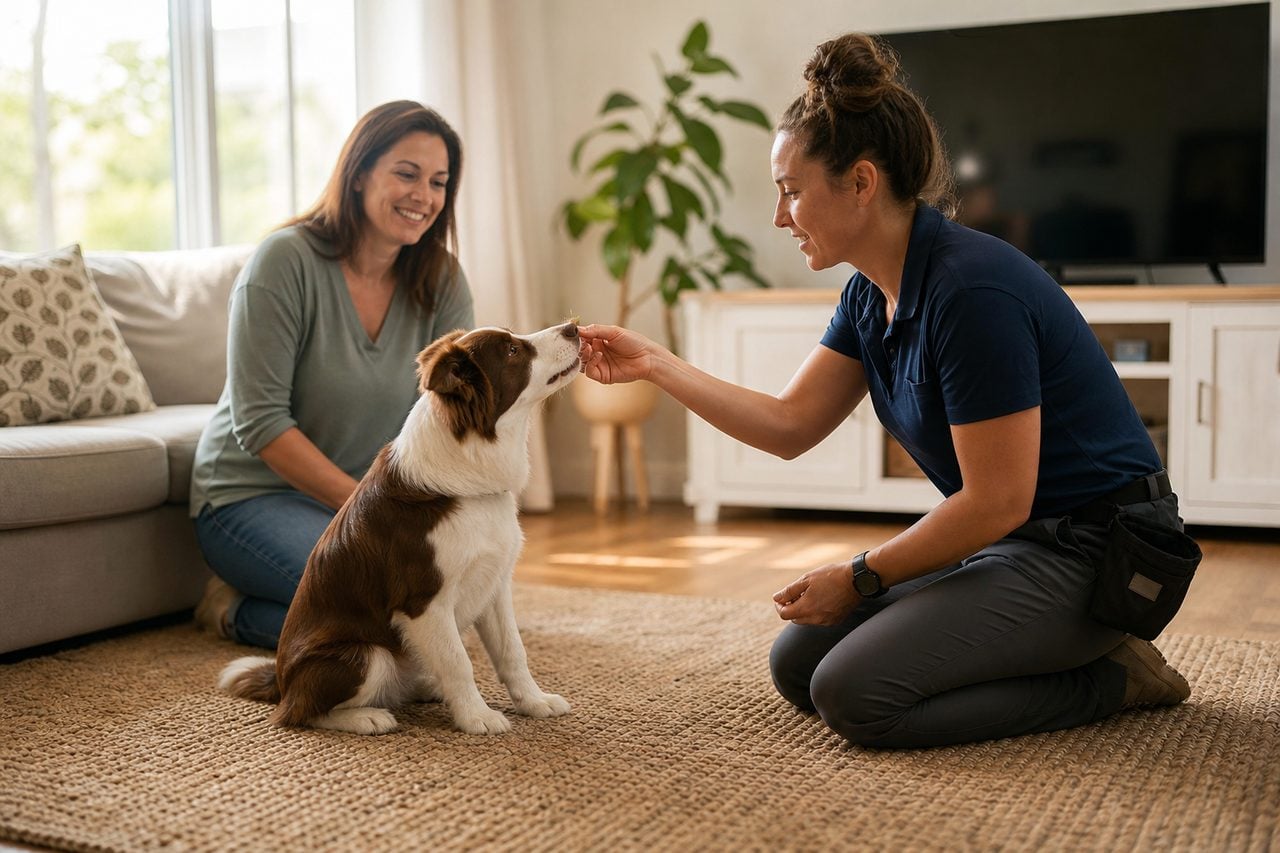
For a lot of Canton families, the obstacle to training a dog is not motivation, it is logistics. Between work shifts at the area’s employers, kids’ schedules, and a calendar that fills up fast, loading the dog into the car and driving across town to a class on a fixed weeknight is the kind of plan that quietly never happens. That is the gap in-home dog training is built to close. Instead of you going to the training, the training comes to your living room, your kitchen, your backyard, and your actual front door, on a schedule that bends around your life rather than the other way around.
In-home training means private lessons delivered by a local trainer in the owner’s own home, typically on a service-area model that covers Canton and the surrounding Stark County communities. It is the format of choice for busy and working households precisely because it removes the two biggest barriers, travel and rigid scheduling, while also fixing a quieter problem: dogs behave differently at home than they do in a strange training facility. This guide explains how in-home training works, who it is right for, what gets covered, how the Stark County service-area model functions, what it costs, and how to choose the right trainer to walk through your door.
What In-Home Dog Training Actually Is
In-home dog training is exactly what it sounds like: a professional trainer comes to your house and runs private, one-on-one lessons with you and your dog in the environment where you both actually live. There is no group class, no shared room full of other dogs, and no commute. The trainer works around your kitchen island, on your stairs, at the spot by the front door where your dog loses its mind when the bell rings, and in the yard where recall keeps failing. The lessons are tailored to your specific dog and your specific household rather than a generic curriculum.
This is fundamentally different from board-and-train, where the dog leaves home to live with a trainer, and from group obedience classes at a facility. The defining feature of in-home work is that the owner is hands-on in every session. A good in-home trainer is as much a coach for you as a trainer for the dog, because the person who lives with the dog the other 167 hours of the week is the one who has to maintain the behavior. You learn the timing, the cues, and the handling in the exact context where you will use them.
That context is the whole point. Many dogs that behave perfectly in a sterile training room fall apart at home, where the smells, the routines, the family members, and the trigger spots are all different and emotionally loaded. Training in the real environment means the skills are learned where they need to work, with no fragile “transfer” step from a facility back to daily life. For problems that are deeply tied to the home, doorbell chaos, counter surfing, jumping on guests, resource guarding a specific couch, leash reactivity that starts the moment you step off your own porch, this on-location approach is hard to beat.
Why In-Home Training Fits Busy Canton Families
The service-area model is what makes in-home training so practical across Stark County. Rather than expecting clients to come to a single location, the trainer drives a radius that typically spans Canton proper, Jackson Township, North Canton, Massillon, Louisville, Hartville, Canal Fulton, and often out toward Alliance. You book a time that works for your week, the trainer arrives, and the lesson happens in your home. For a household where both adults work, or where a single parent is managing kids and a dog at once, that convenience is frequently the difference between training that gets done and training that gets perpetually postponed.
The time savings are real and add up. A group class across town can cost you the class hour plus a half-hour of driving each way and the effort of wrangling a dog into the car. In-home sessions eliminate the travel entirely and can often be slotted into a lunch break, an early evening, or a weekend morning. There is also no exposure to a roomful of unfamiliar dogs, which matters a great deal if your dog is reactive, anxious, under-vaccinated as a young puppy, or recovering from an illness or injury and not ready for a crowded environment.
Just as importantly, in-home training tends to bring the whole family onto the same page. When the trainer is in your kitchen, your partner, your kids, and anyone else who lives with the dog can take part and learn the same cues and rules. Consistency across handlers is one of the biggest predictors of whether training sticks, and it is far easier to achieve when everyone is coached together in their own home than when one person attends a class and tries to relay the lessons secondhand. For Canton families specifically, that shared, in-context coaching is often what finally makes a behavior plan hold together day to day.
What Gets Covered in In-Home Sessions
In-home training spans a wide range, from puppy foundations to serious behavior modification, and the agenda is set by your household’s actual needs rather than a fixed syllabus. On the foundational end, trainers commonly cover puppy basics like house-training and crate-training, bite inhibition for needle-toothed pups, early socialization guidance, and the building blocks of obedience: name response, sit, down, stay, place, loose-leash walking, and a reliable recall. Doing this work at home means the puppy learns these skills in the very environment where the rules apply.
The format is especially strong for the everyday problems that are anchored to the house and yard. Jumping on guests, barking and lunging at the doorbell or the window, counter surfing, stealing food, bolting out the front door, pulling on leash the second you leave the driveway, and general manners around the family are all easiest to fix where they actually happen. A trainer can stage the exact scenario, a knock at your real door, a walk down your real street, and coach you through it in the moment, which is far more effective than rehearsing an artificial version in a classroom and hoping it carries over.
On the more advanced end, many in-home trainers handle behavior modification for issues like leash reactivity, fear and anxiety, and certain forms of resource guarding, working at the dog’s pace in a familiar setting that keeps stress lower. It is worth noting that two specialties usually run on their own dedicated tracks: true separation anxiety is most often handled through remote, camera-based desensitization, and protection or working-dog training is a separate discipline entirely. A reputable in-home generalist will tell you honestly when your situation calls for that kind of specialist rather than stretching beyond their lane.
The Stark County Service-Area Model and How Scheduling Works
Because in-home trainers travel to clients, they operate on a defined service area, and understanding how that works helps set expectations on availability and cost. Most trainers serving Canton define a core radius around the city and Jackson Township and then extend outward to North Canton, Massillon, Louisville, Hartville, Canal Fulton, and Alliance, sometimes with a small travel surcharge for the farther edges of that zone. When you reach out, it is worth confirming up front that your address falls inside the service area and asking whether any travel fee applies, so there are no surprises.
Scheduling is generally more flexible than a fixed-night group class, but it is also constrained by how many homes a trainer can physically reach in a day. Because each session includes drive time, in-home trainers tend to book by appointment in blocks and may have limited slots during peak evening and weekend hours. The practical takeaway is to book ahead, especially for prime times, and to be a little flexible if you want a popular window. Many trainers will batch nearby clients on the same day to manage their routes, which can occasionally work in your favor for scheduling.
Programs are usually structured as packages of several sessions rather than endless open-ended visits, with practice homework between appointments. A typical arc might be an initial assessment session where the trainer evaluates the dog and your goals in your home, followed by a series of training sessions spaced out to give you time to practice, and tapering as the behaviors solidify. The spacing is deliberate, the real learning happens in the days between visits when you and your family rehearse, and the trainer’s job in each session is to teach the next step and troubleshoot what came up since last time.
Making the Most of Canton's Climate and Spaces
One advantage of the in-home model in Stark County is that it adapts naturally to the local climate, which can be a real obstacle for facility-based training. Canton winters are cold, gray, and long, and the flat terrain means snow and ice can sit on roads and sidewalks for stretches. When the weather makes a drive across town to a class miserable or unsafe, an in-home trainer simply works inside your house, running indoor obedience, manners, and impulse-control games that do not require going anywhere. Training continues year-round instead of stalling out every January.
When the weather cooperates, the trainer can build outdoor skills using your own yard and neighborhood, and then point you toward Canton’s parks for real-world practice between sessions. Once your dog has solid foundations, proofing those skills in gradually more distracting environments is the key to reliability, and Stark County has good options. A quieter weekday visit to Sippo Lake Park, a stretch of the Ohio & Erie Canal Towpath Trail, the trails at Quail Hollow State Park near Hartville, or a loop at Petros Lake all make excellent venues for practicing loose-leash walking, recall, and settling around distractions, with the trainer’s coaching fresh in your mind.
The home environment also lets the trainer tailor advice to your exact living situation, which a generic class cannot do. A trainer standing in your space can spot the specific layout issues feeding a problem, the sightline to the window that fuels barking, the open floor plan that makes the dog hard to manage during dinner, the back-door routine that has accidentally taught the dog to bolt, and give you fixes built around your actual home. That personalized, on-site problem solving is one of the strongest reasons Canton families choose the in-home format over a one-size-fits-all class.
Costs and Choosing the Right In-Home Trainer
In-home training is private and includes the trainer’s travel, so per-session it generally costs more than a group class, but many owners find the convenience and customization well worth it. Stark County pricing tends to sit at or just below the national average, with the north side around Jackson Township and North Canton typically running a bit higher than the east side and the rural-south communities. As realistic ranges, individual in-home sessions commonly fall somewhere around 75 to 150 dollars each, while multi-session packages, which bundle an assessment and several lessons, often land roughly in the few-hundred to low-four-figure range depending on the number of sessions and the complexity of the goals. Always ask exactly how many sessions a package includes, how long each runs, and whether any travel surcharge applies to your part of the county.
When choosing a trainer, look for someone who relies on modern, reward-based methods and who can clearly explain their approach in plain language. Ask what their typical package looks like, how they handle the specific issues you are dealing with, and how much of the session is coaching you versus working the dog directly, since you want to come away able to maintain the behavior yourself. Reputable trainers are transparent about their methods and happy to describe their process before you book. Be cautious of anyone promising guaranteed results on a fixed timeline or leaning heavily on harsh, punishment-based tools as a first resort.
Fit matters as much as credentials, because this person is coming into your home and working closely with your family. Confirm that your address is within their Stark County service area, that their available times realistically match your schedule, and that their communication style works for you, you will be taking direction from them in your own living room, so rapport counts. Most local in-home trainers serving Canton, Massillon, North Canton, and the wider area will do a brief intro call or assessment where you can get a feel for all of this. That first conversation is the best moment to confirm the trainer is the right match before committing to a package.
Reviewed In-Home Dog Training Trainers in Canton
These reviewed Canton-area trainers from our directory handle in-home dog training. Each links to a full profile with specialties, verified credentials, reviews, and contact info:
- Milligan Valley K9 Academy — 5.0★ (100 reviews)
- Hopebridge Farm & RTA — 5.0★ (41 reviews)
- Raising Pawtential — 5.0★ (26 reviews)
- Cathy’s K9 Kids Dog Training, LLC — 5.0★ (14 reviews)
- dog gone worth it — 5.0★ (1 reviews)
- K9 Manners Matter, LLC — 4.9★ (7 reviews)
- Lucky Dog Training LLC — 4.8★ (52 reviews)
- WAGS & Wiggles Dog Training — 4.8★ (27 reviews)
- Lucky Dog K9 Academy — 4.4★ (14 reviews)
See all Canton in-home dog training trainers →
Frequently Asked Questions
What areas around Canton do in-home trainers cover?
Most in-home trainers serving Canton operate on a service-area model with a core radius around the city and Jackson Township, extending out to North Canton, Massillon, Louisville, Hartville, Canal Fulton, and often Alliance. Some apply a small travel surcharge for the farther edges of that zone. When you first reach out, confirm that your address falls inside the trainer’s service area and ask whether any travel fee applies, so there are no surprises on pricing.
Is in-home training better than a group class?
It depends on your goals, but in-home training has clear advantages for busy households and home-specific problems. It eliminates travel, bends around your schedule, lets the whole family learn the same cues together, and trains skills in the exact environment where you need them. It also avoids exposing reactive, anxious, or under-vaccinated dogs to a roomful of strangers. Group classes can be great for general socialization and are usually cheaper per session, so the right choice comes down to your dog and your priorities.
What kinds of problems can in-home training fix?
A wide range, from puppy foundations like house-training, crate-training, and basic obedience, to the everyday home problems such as jumping on guests, doorbell barking, counter surfing, door bolting, and leash pulling. Many trainers also handle behavior modification for leash reactivity, fear, and certain forms of resource guarding. Two areas usually run on dedicated tracks: true separation anxiety is typically handled through remote desensitization, and protection or working-dog training is a separate specialty.
How much does in-home dog training cost in Canton?
Because it is private and includes travel, it generally costs more per session than a group class. Stark County pricing tends to sit at or just below the national average, with the north side typically a bit higher than the east and rural-south. As realistic ranges, individual sessions often run roughly 75 to 150 dollars, and multi-session packages commonly land in the few-hundred to low-four-figure range depending on session count and complexity. Always confirm how many sessions are included and whether a travel surcharge applies.
How many sessions will my dog need?
It varies with your goals and your dog. Basic manners and puppy foundations may take only a handful of sessions, while behavior modification for issues like reactivity or fear can take longer. Programs are usually sold as packages with practice homework between appointments, and the real learning happens in the days between visits when you rehearse. A trainer will give you a realistic estimate after an initial assessment of your dog and your household goals.
Does the whole family need to be involved?
Ideally, yes. Consistency across everyone who lives with the dog is one of the biggest predictors of whether training sticks. One of the strengths of the in-home format is that your partner, kids, and anyone else in the household can take part in the session and learn the same cues and rules together. Even when not everyone can attend every visit, getting the household aligned on the plan makes a real difference in how quickly and reliably the behaviors hold.
Related: read our complete in-home dog training guide or the full Canton dog training overview.
Ready to find the right in-home dog training pro in Canton?