
Board & Train in Newark, OH
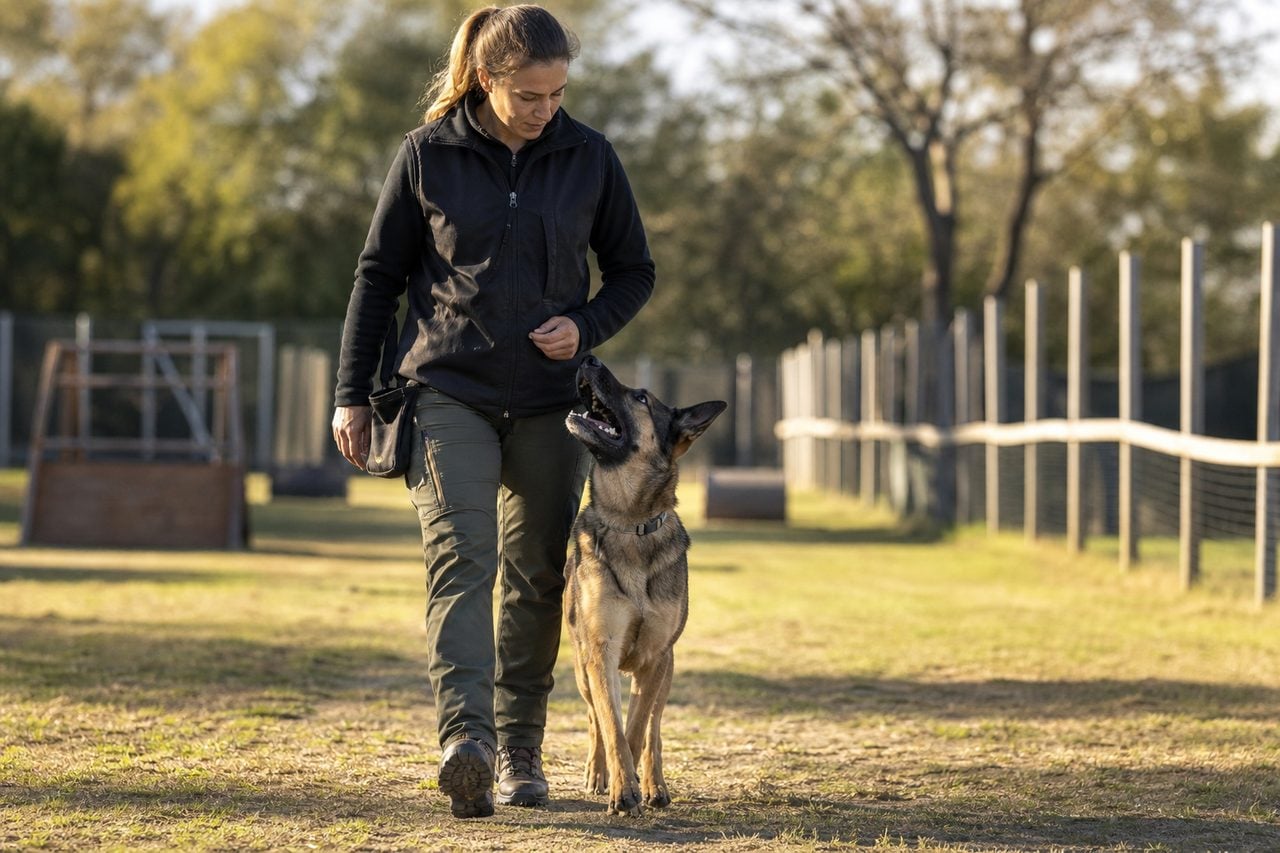
If you live in Newark and you’ve reached the point where day-to-day life with your dog feels like a constant negotiation — pulling on every walk down the T.J. Evans Trail, ignoring recalls at Infirmary Mound Park, or losing his mind every time the doorbell rings — you’ve probably started looking at board-and-train programs. The promise is appealing: hand the dog off for a couple of weeks, let a professional live with him around the clock, and get back a calmer, more responsive animal. For the right dog and the right owner, that’s exactly what happens. But board-and-train is also the most expensive and most misunderstood option in dog training, and central Ohio has a wide spread of programs ranging from genuinely excellent to overpriced and opaque.
This guide walks through what board-and-train actually is, how the process works week by week, what it costs in the Newark and greater Licking County area, and — most importantly — how to tell a program worth your money from one that isn’t. We’ll keep it specific to what local owners actually deal with: dogs that need to behave at Buckeye Lake on a busy summer weekend, on leash through downtown Newark around the courthouse square, and at home when the grandkids visit. By the end you should be able to walk into a consultation and ask the questions that separate a real trainer from a slick sales pitch.
What board-and-train actually means
Board-and-train (sometimes shortened to “B&T”) is an immersive program where your dog lives at the trainer’s facility or in the trainer’s home for a set period — usually two to four weeks — while receiving daily, structured training. Instead of you attending a weekly group class and doing the homework yourself, the professional does the heavy lifting of teaching new behaviors during the most intensive learning phase.
The core appeal is consistency. Dogs learn fastest when the rules never bend. In a normal household, even motivated owners are inconsistent: one person lets the dog on the couch, another doesn’t; recall gets practiced on good days and skipped on busy ones. A board-and-train environment removes that noise. Every repetition, every meal, every door threshold becomes a training opportunity handled the same way every single time. For a dog that’s been getting mixed signals for months or years, that clarity alone can produce dramatic change.
It’s important to understand what board-and-train is not. It is not a magic reset button, and it is not boarding with a little obedience sprinkled on top. A real program is a full-time behavior-modification process. The trainer is building a foundation — reliable obedience, impulse control, and often addressing specific problem behaviors — that you then have to maintain. The single biggest predictor of long-term success isn’t the two weeks the dog spends away; it’s what happens in the months after he comes home. We’ll come back to that, because it’s where most programs quietly fail their clients.
How the process works, week by week
While every trainer runs things differently, a well-structured Newark-area board-and-train tends to follow a recognizable arc.
Before drop-off: A good program starts with a consultation, not a payment link. The trainer should evaluate your dog — ideally in person — ask detailed questions about the behaviors you want changed, and set honest expectations. Be wary of anyone who guarantees specific results sight-unseen. Aggression and severe anxiety cases in particular need a real assessment before anyone quotes you a timeline.
Week one — decompression and foundation: The first few days are often quieter than owners expect. A responsible trainer lets the dog settle, learns his temperament, and starts building rapport before drilling obedience. Pushing a stressed dog too hard on day one backfires. By the end of week one you’d typically see the early shape of the core obedience — marker training, place command, the beginnings of loose-leash walking, and impulse-control work like waiting at thresholds.
Week two and beyond — proofing and real-world application: This is where the value lives. Teaching a “sit” in a quiet room is easy; getting a reliable response near the geese at Buckeye Lake or with distractions on a Granville sidewalk is the hard part, and it’s what you’re paying for. A strong program deliberately proofs behaviors against distraction, duration, and distance. Many local trainers take dogs on field trips — hardware stores, parks, downtown — specifically to generalize the training to the messy real world.
Go-home transfer: The most critical and most skipped phase. The dog’s new skills mean nothing if you can’t operate them. A quality program includes one or more in-person handoff sessions where the trainer coaches you, plus follow-up support. If a facility’s plan is “we’ll text you a video and you’ll be fine,” that’s a red flag.
What it costs around Newark and Licking County
Board-and-train is priced as a package, not per session, and the range is wide. In central Ohio, expect roughly $1,500 to $6,000 depending on length, the trainer’s experience, and the complexity of the behaviors. A two-week obedience-focused program for a basically sound dog sits toward the lower end. A three- to four-week program addressing reactivity, resource guarding, or serious leash aggression sits at the top.
For comparison, the other formats in the Newark market run very differently. Group obedience courses typically run $150 to $300 for a multi-week course, and private in-home or facility sessions run $100 to $175 per session. That makes board-and-train the premium option by a wide margin — which is exactly why you want to understand what you’re buying.
What should the price include? At minimum: room and board, daily training, all the proofing and field-trip work, and — this is the line item people forget to ask about — the go-home transfer sessions and a period of follow-up support. If a quote looks suspiciously cheap, find out what’s missing. Sometimes the low number is just boarding plus a short daily session, with the real training (and real cost) hidden in “add-ons.”
One more cost-context note for local owners: factor in the indirect costs of not training. A dog that can’t be safely walked or left with the grandkids costs you in stress, vet bills from incidents, and sometimes in damaged relationships with neighbors. That doesn’t justify overpaying, but it does reframe a one-time $2,000 program against years of management.
Is board-and-train right for your dog?
Board-and-train is a fit for specific situations, and a poor fit for others. It tends to make sense when:
- You’re short on time or consistency. Busy professionals, families with young kids, and owners who travel often struggle to deliver the daily reps that other formats require. Outsourcing the intensive phase solves a real bottleneck.
- The problem is well past basic obedience. Strong reactivity, leash aggression, or deeply ingrained habits often need full-time intervention that a weekly class can’t match.
- You’ve tried group classes and stalled. If you’ve done a course at a local facility and the gains evaporated at home, immersion plus a proper transfer can break the cycle.
It’s a weaker choice when:
- The dog is young and the issues are minor. A friendly puppy that just needs socialization and manners is often better served — and far more cheaply served — by a group puppy class and consistent home practice.
- You won’t do the maintenance. This is the hard truth. If you’re hoping to pay for a permanent fix that requires nothing from you afterward, you’ll be disappointed regardless of how good the trainer is.
- The dog has severe separation anxiety. Removing a dog with intense attachment issues from its home and people can sometimes worsen the underlying anxiety. These cases need careful, often home-based protocols — discuss this honestly with any trainer before booking.
How to choose a program (and spot the red flags)
This is the section worth slowing down on, because the Newark and Columbus-area market includes both excellent trainers and operations that count on owners not knowing what to ask.
Ask to see the facility. Where will your dog sleep? How much human interaction does he get versus crate time? A reputable trainer welcomes the question. If you can’t tour the space or the answer is evasive, walk away.
Ask exactly what methods they use. Get specifics, not slogans. Whether a trainer leans more reward-based or uses tools like prong collars or e-collars, what matters is that they can explain their approach clearly, describe how they introduce any tool humanely, and adjust to your dog. “Trust me” is not an answer.
Demand a clear go-home and follow-up plan. As covered above, the transfer is everything. Ask how many handoff sessions are included, whether they offer refreshers, and what happens if a behavior regresses. The best programs treat the day your dog comes home as the start of the relationship, not the end.
Be skeptical of guarantees. No honest trainer can guarantee a living animal will behave perfectly forever, because behavior depends partly on you. Be wary of “100% guaranteed” marketing.
Verify credentials and references. Ask about experience with your specific issue, look for professional certifications, and ask to speak with past clients who had similar dogs. A trainer proud of their results will connect you happily.
Check insurance and contracts. Your dog is living in someone else’s care. There should be a written agreement covering health protocols, vaccination requirements, emergency vet procedures, and liability. Read it.
Setting your dog (and yourself) up for success after pickup
Let’s say you’ve chosen well and pickup day arrives. Here’s how to protect your investment.
Treat the first weeks home as a continuation, not a graduation. Your dog learned new behaviors in a controlled environment with an expert handler. Coming home reintroduces every old trigger — the same furniture, the same routines, the same family members who used to let things slide. Hold the line. The behaviors are fresh and can erode quickly if old habits creep back.
Practice in the places that matter to you. Don’t just rehearse in the living room. Take the new skills to the T.J. Evans Trail, to a leashed walk through Dawes Arboretum, to the area around Infirmary Mound Park where there are real distractions. Generalizing to your actual life is the point.
Get the whole household on the same page. The fastest way to undo a board-and-train is to have one family member quietly reverting to old rules. Everyone who interacts with the dog should know the commands and the boundaries.
Use your follow-up sessions. If the program includes refreshers or check-ins, schedule them — don’t wait until things slide. A 30-minute tune-up at week three or four catches small regressions before they become big ones.
Done right, board-and-train gives a Newark dog owner something genuinely valuable: a dog that can actually enjoy the life you wanted to share with him — calm at home, manageable in town, and welcome at the parks and trails that make Licking County a good place to own a dog. The two weeks away are the spark. What you do with them afterward is the fire.
Reviewed Board & Train Trainers in Newark
These reviewed Newark-area trainers from our directory handle board & train. Each links to a full profile with specialties, verified credentials, reviews, and contact info:
- Sit Means Sit Dog Training Licking Valley — 5.0★ (62 reviews)
- Ohio K9 Ranch — 5.0★ (18 reviews)
- Central Ohio K9 — 5.0★ (5 reviews)
- Paradigm K9 LLC — 4.9★ (37 reviews)
- All Tails R Waggin’ — 4.7★ (783 reviews)
See all Newark board & train trainers →
Frequently Asked Questions
How long does a typical board-and-train program last?
Most programs run two to four weeks. Two weeks is common for foundational obedience and manners in a basically sound dog, while three to four weeks is more typical when addressing serious issues like reactivity, leash aggression, or resource guarding. The right length depends on your dog and your goals, which a trainer should assess before quoting you.
How much does board-and-train cost in the Newark area?
Expect roughly $1,500 to $6,000 in central Ohio, depending on program length, the trainer’s experience, and how complex your dog’s issues are. By comparison, group obedience courses run about $150 to $300 and private sessions about $100 to $175. Always confirm what the package includes, especially the go-home transfer sessions and follow-up support.
Will my dog forget me or feel abandoned during board-and-train?
No. Dogs are adaptable and form strong bonds quickly, and they readily reconnect with their families at pickup. That said, a dog with severe separation anxiety can sometimes struggle when removed from home, so discuss that specific issue honestly with any trainer before booking, since a home-based approach may be safer in those cases.
What happens if the training doesn't stick after my dog comes home?
This is the most common failure point, and it usually comes down to inconsistent maintenance at home rather than the training itself. Choose a program with included go-home transfer sessions and follow-up support, hold the new rules consistently across the whole household, and use any refresher sessions early if you notice regression rather than waiting for the behavior to fully unravel.
Is board-and-train better than group classes or private lessons?
It’s not universally better, just different. Board-and-train excels when you’re short on time, when issues are past basic obedience, or when group classes have stalled. For young dogs with minor needs, a group class plus consistent home practice is often more effective and far cheaper. The best format depends on your dog, your schedule, and your willingness to do the follow-through.
How do I know if a board-and-train trainer is reputable?
Ask to tour the facility and see where your dog will stay, get specific answers about their training methods rather than slogans, and confirm there’s a clear go-home and follow-up plan. Be skeptical of guaranteed-results marketing, ask for references from clients with similar dogs, and make sure there’s a written contract covering vaccinations, emergency vet care, and liability.
Related: read our complete board & train guide or the full Newark dog training overview.
Ready to find the right board & train pro in Newark?