
Dog Training Prices in Newark, OH
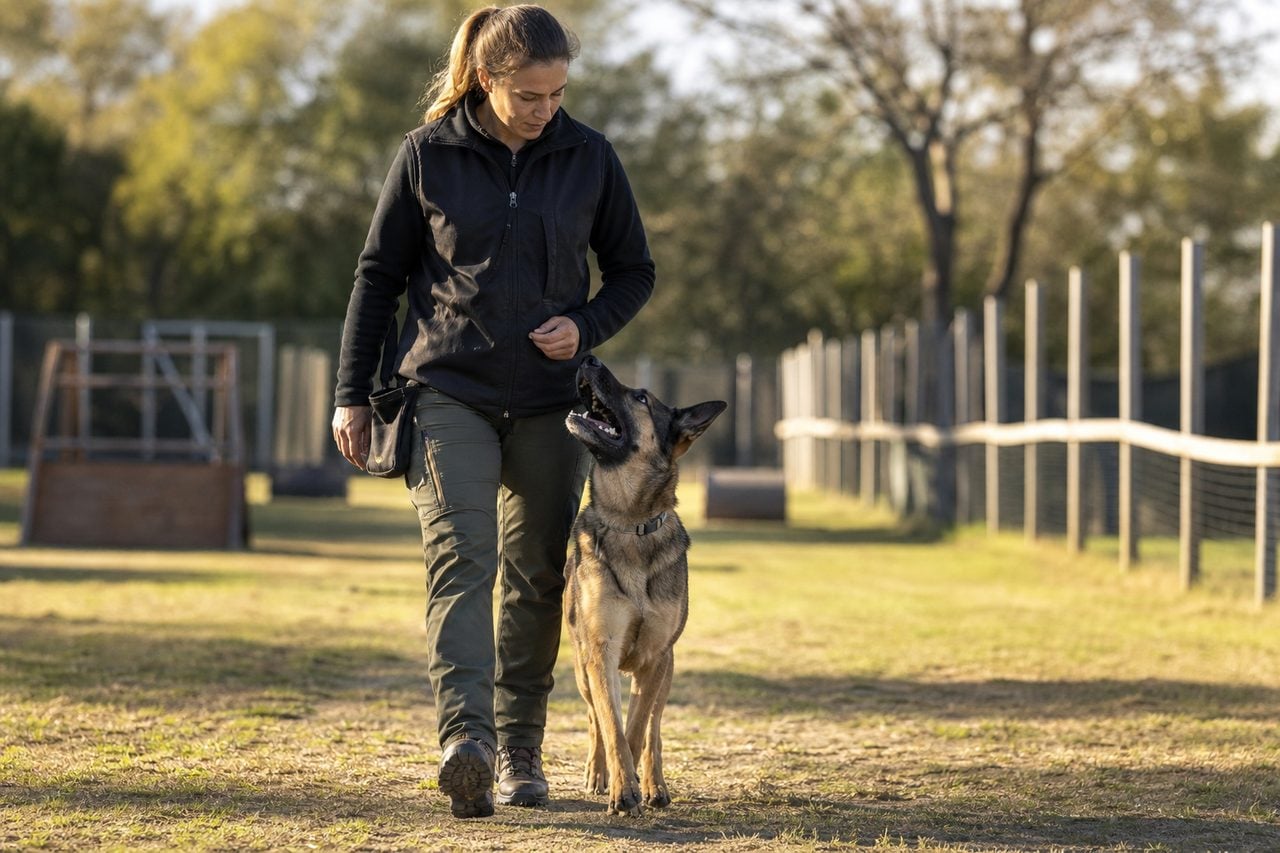
If you live in Newark, Ohio, and you’ve started shopping around for dog training, you’ve probably already noticed the same thing most Licking County dog owners do: the prices are all over the map, and few trainers explain why. That gap is exactly what this guide is built to close.
- Group Classes: The Best Value for Most Newark Dogs
- Private Lessons and In-Home Training: Paying for Focus
- Day Training and Board-and-Train: When You're Paying Someone to Do the Work
- Behavior Consultations: The Specialty Tier
- What Actually Drives the Price Up or Down
- Train in Newark or Drive to Columbus? Running the Real Math
- Reviewed trainers
- FAQ
Newark sits about 40 minutes east of Columbus along State Route 16, and that geography matters more than you’d think when it comes to what you pay. The town is close enough to the Columbus metro that big-city pricing pulls local rates upward, but far enough out that you’re not actually in that market unless you’re willing to make the drive. Whether you’re in downtown Newark near the Licking County Courthouse, out toward Granville and Denison, in Heath near the Newark Earthworks, or further out in Hebron, Buckeye Lake, Utica, Johnstown, or Pataskala, the math of “train here vs. drive to Columbus” comes up constantly.
This guide walks through the five main formats you’ll find in Licking County (group classes, private and in-home lessons, day training, board-and-train, and behavior consultations), explains what drives the price of each up or down, and helps you decide whether your money is better spent locally or on I-70 heading west. Every trainer prices differently based on their experience, methods, and what they include, so use this as a way to recognize a fair deal and ask sharper questions, not as a price tag you can hold anyone to.
Group Classes: The Best Value for Most Newark Dogs
For a healthy puppy or a dog that just needs the basics (sit, down, stay, loose-leash walking, recall, and some manners around distractions), group classes are almost always the best-value choice in the Newark area. You and your dog learn alongside several other owner-dog teams, usually in a weekly series. Puppy kindergarten and basic obedience sit at the lower end of the cost scale; more specialized group work, such as canine good citizen prep or reactive-dog classes, costs more.
What you’re really buying in a group class isn’t just instruction; it’s controlled distraction. A dog that sits perfectly in your quiet living room off Mount Vernon Road falls apart the first time another dog walks past. Group settings build that real-world reliability in a way one-on-one sessions in your home simply can’t replicate. For a young dog, the socialization exposure alone is worth the price.
The trade-off is pace and personalization. In a class of six to eight teams, the instructor can’t spend twenty uninterrupted minutes on your dog’s specific issue. If your dog is reactive, fearful, or aggressive toward other dogs, a standard group class is the wrong tool: you’ll spend the whole hour managing a meltdown instead of learning. For those dogs, look for specialized small-group reactive classes (which cost more) or start private.
Newark-specific tip: because class options here are thinner than Columbus’s, popular beginner and puppy courses fill up. If you’ve just brought home a puppy, get on a waitlist early rather than assuming you can start whenever you’re ready. The socialization window closes fast, and waiting two months for an opening can cost you behaviorally even if it saves you nothing on price.
Private Lessons and In-Home Training: Paying for Focus
Private lessons are one-on-one sessions, either at a facility or in your home, and they cost more per hour than a class because the trainer’s time is yours alone. This is also where Newark’s geography starts showing up in the price. A trainer based near downtown Newark has a quick hop to Heath or Granville, but a session out at Buckeye Lake, Hebron, or Utica means real travel time, and that often pushes the rate up or adds a travel fee.
The case for private and in-home training is strong when:
- Your dog’s problem only happens at home: door-dashing, jumping on guests, leash chaos on your specific street, or backyard fence-line barking.
- You have a packed schedule and can’t commit to a fixed weekly class time.
- Your dog is too reactive or anxious to function in a group yet.
- You want to fix something fast and are willing to pay for an accelerated, customized plan.
In-home training has a genuine advantage that justifies its premium: dogs learn contextually. A dog trained to settle on its mat in your actual living room, or to greet guests politely at your actual front door, generalizes that behavior more easily than one trained in a neutral facility. You’re not just buying convenience; you’re buying training that’s already happening in the environment where the problem lives.
The honest downside is cost per outcome. Paying one-on-one rates to teach a basic sit and down is an expensive way to get what a group class does well, so save private sessions for problems that are genuinely specific to you, your home, or a dog that can’t yet handle a group.
Day Training and Board-and-Train: When You're Paying Someone to Do the Work
These two formats share a core idea: instead of you being trained to train your dog, a professional puts in the reps directly. That’s why they cost more: you’re buying labor and skill, not just guidance.
Day training is the gentler-on-the-wallet version. Your dog stays in your home and life, but the trainer does focused sessions during the day, either at a facility you drop off at or at your place, then meets with you on transfer days to hand the skills back to you. It’s usually sold as a package, and the price depends on the duration and how many coaching sessions are baked in. It’s a strong middle option for busy Newark professionals who commute toward Columbus and can’t run a structured home-training program after a long day, but who don’t want to send the dog away entirely.
Board-and-train is the most expensive format. Your dog lives with the trainer for one to several weeks, getting multiple training sessions a day plus room, board, and round-the-clock management. The wide price spread comes down to length (one week vs. three or four), what’s covered (basic obedience vs. serious behavior modification), and the facility’s overhead and reputation. In a market like Newark, where there’s no glut of board-and-train facilities, you may find yourself choosing between a handful of local kennels or driving toward Columbus for more options.
Two cautions specific to choosing board-and-train around here. First, the format is only as good as the transfer: a dog can be flawless at the trainer’s facility and revert at home if you aren’t taught to maintain the behavior. Always ask how many owner-coaching sessions are included after the dog comes home; that’s where the real value lives. Second, vetting matters more here, not less, because the dog is living unsupervised (by you) in someone else’s care for weeks. Ask exactly what methods they use before you book.
Behavior Consultations: The Specialty Tier
There’s a real difference between obedience training and behavior work, and the price separation reflects it. Teaching a dog to sit is training. Resolving genuine aggression, separation anxiety that destroys the house, severe fear, or resource guarding is behavior modification: a different skill set, often requiring more credentialed professionals, and priced accordingly.
A behavior consultation is a focused session, or short series, built around one specific problem. Serious cases are almost never solved in one visit; they’re sold as a package or an ongoing engagement, so expect the total to be well above the cost of a single consultation. If a trainer offers a free phone screening or evaluation first, use it to describe the problem honestly and ask whether it’s within their experience.
This is the one tier where the Newark-vs-Columbus question gets sharpest. The most specialized behavior professionals, certified behavior consultants and especially veterinary behaviorists who can combine training with medication when needed, cluster in larger metros. Licking County has capable trainers, but for a complex or potentially dangerous case (a dog that has bitten, for example), the right call may genuinely be the drive to Columbus to access deeper specialization. Paying more for the correct level of expertise is far cheaper than paying twice because the first person was out of their depth.
If you’re dealing with anything involving real aggression or a bite history, prioritize the credential and the method over the convenience and the price. This is the category where a bargain can backfire badly.
What Actually Drives the Price Up or Down
Once you understand the formats, the price variation within each one comes down to a handful of factors. Knowing them lets you read a quote intelligently instead of just reacting to the number.
- Trainer experience and credentials. A newer trainer and a certified professional with years of behavior cases will quote very different rates for the “same” private session, and they’re not selling the same thing. Credentials matter most for behavior work, least for puppy basics.
- Group vs. individual. The single biggest lever. Splitting a trainer’s hour across six teams is why group classes are cheap and private sessions aren’t.
- Location and travel. In a spread-out county like Licking, in-home training to outlying areas (Utica, Buckeye Lake, Hebron, the rural stretches) carries more drive time, and that shows up in the price or as a travel fee. Facility-based training avoids this.
- What’s included. A board-and-train that includes four follow-up coaching sessions, a written plan, and email support is worth more than a cheaper one that hands your dog back at the door. Compare what’s bundled, not just headline price.
- Package vs. single session. A multi-session package is often priced below the same sessions bought one at a time, and it usually comes with a clearer plan from start to finish.
- The problem’s difficulty. Basic manners are commoditized and relatively cheap. Aggression, anxiety, and complex behavior cases command premiums because they take more skill, time, and risk.
- Facility overhead. A trainer renting a dedicated indoor space has costs a home-based or mobile trainer doesn’t. That’s neither good nor bad, but it explains price gaps.
The most useful question you can ask any trainer isn’t “how much?” but “what’s included, and what happens if it doesn’t work?” That single question separates professionals who stand behind their outcomes from those selling a number.
Train in Newark or Drive to Columbus? Running the Real Math
This is the calculation almost every Licking County dog owner ends up making, so let’s do it honestly. Columbus, 40 minutes west via SR-16, offers more trainers, more specialization, and more options at every price point. But “more options” isn’t automatically “better choice.”
The hidden cost of the drive. A 40-minute trip each way is roughly 80 minutes of round-trip time plus fuel, per visit. For a one-time behavior consult, that’s trivial. For a six-week group class that meets weekly, you’re committing to twelve trips and roughly sixteen hours in the car over the course. For day training with frequent drop-offs, the math gets worse fast. Local training that’s “slightly more” per session can easily come out ahead once you price your own time and the mileage.
When staying local clearly wins: basic obedience, puppy classes, manners, loose-leash work, and most group training. There’s no quality reason to drive to Columbus for sit-stay-recall, and the convenience keeps you consistent, and consistency, not the trainer’s zip code, is what actually trains a dog. In-home training is also a local-wins category by definition; you want someone who can reach your house without a surcharge-justifying drive.
When the Columbus drive can be worth it: serious behavior cases needing a certified behavior consultant or veterinary behaviorist, specialized sport or working-dog training, or board-and-train when local options don’t fit your dog or your standards. For these, the expertise gap can justify the miles: you’re driving for a capability that genuinely isn’t available next door, not just for a slightly cheaper number.
The bottom line for Newark owners: default to local for everything routine, and reserve the Columbus drive for the specialized cases where the extra expertise actually changes the outcome. Paying a bit more locally to avoid sixteen hours in the car, and to keep your dog on a consistent schedule, is usually the smarter spend. Compare local quotes like for like, then weigh them against what the drive really costs you in time, fuel, and consistency.
Reviewed Dog Training Prices Trainers in Newark
These reviewed Newark-area trainers from our directory handle dog training prices. Each links to a full profile with specialties, verified credentials, reviews, and contact info:
- WMK9-Well Mannered K9 LLC — 5.0★ (99 reviews)
- Northeast Ohio Dog Training — 5.0★ (67 reviews)
- Sit Means Sit Dog Training Licking Valley — 5.0★ (62 reviews)
- Rowan’s Dog Training — 5.0★ (56 reviews)
- Athens Canine — 5.0★ (39 reviews)
- Ohio K9 Ranch — 5.0★ (18 reviews)
- Bomber K9 LLC — 5.0★ (9 reviews)
- Central Ohio K9 — 5.0★ (5 reviews)
- Brewer K-9 Academy — 5.0★ (4 reviews)
- Sigman K9 Services LLC — 5.0★ (1 reviews)
See all Newark dog training prices trainers →
Frequently Asked Questions
What's the most affordable way to get basic dog training in Newark, Ohio?
For most healthy dogs that just need the basics, a group class is the best value. Puppy kindergarten and basic obedience classes sit at the lower end of the cost scale, while specialized group work like reactive-dog classes costs more. Popular local courses fill up, so join a waitlist early if you have a new puppy.
Why is board-and-train so much more expensive than other formats?
You’re paying for the trainer to do the actual work rather than coaching you to do it, plus room, board, and round-the-clock management. The price varies with program length, whether it’s basic obedience or serious behavior modification, and how many owner-coaching sessions are included after your dog comes home. Those follow-up transfer sessions are where much of the real value lives, so always ask what’s included.
Is it cheaper to drive to Columbus for dog training?
Sometimes the per-session price is lower in Columbus because there are more trainers competing, but you have to factor in the drive. Columbus is about 40 minutes from Newark via SR-16, so a weekly group class becomes roughly sixteen hours of round-trip driving over a six-week course, plus fuel. For routine training like obedience and puppy classes, staying local in Licking County is almost always the smarter spend once you price your own time. The Columbus drive tends to pay off only for specialized behavior cases or services that genuinely aren’t available locally.
What's the difference between a behavior consultation and regular training?
Regular training teaches skills like sit, stay, and loose-leash walking. A behavior consultation addresses problems like aggression, severe anxiety, fear, or resource guarding, which require a different and often more credentialed skill set. For anything involving a bite history or real aggression, prioritize the trainer’s credentials and methods over price, and consider whether a Columbus specialist or veterinary behaviorist is the right call.
Does in-home training cost more than facility training in the Newark area?
Usually, yes, because you’re paying for one-on-one time plus the trainer’s travel, and outlying areas like Buckeye Lake, Hebron, or Utica may carry a travel fee. The trade-off is that in-home training happens in the exact environment where your dog’s problems occur, so behaviors like polite greetings at your front door or calm settling in your living room generalize more easily. It’s worth the premium for home-specific problems, less so for basics you could learn in a group class.
What should I ask a trainer before paying, beyond the price?
The most useful question isn’t ‘how much’ but ‘what’s included, and what happens if it doesn’t work?’ Ask what training methods they use, how many sessions or follow-ups are part of the package, and whether there’s any support after the program ends. For board-and-train specifically, ask how many owner-coaching sessions happen after your dog comes home, since a dog can perform perfectly at a facility and revert without proper transfer. Clear answers to these questions separate professionals who stand behind their outcomes from those just selling a number.
Related: read our complete dog training prices guide or the full Newark dog training overview.
Ready to find the right dog training prices pro in Newark?