
In-Home Dog Training in Indianapolis, IN
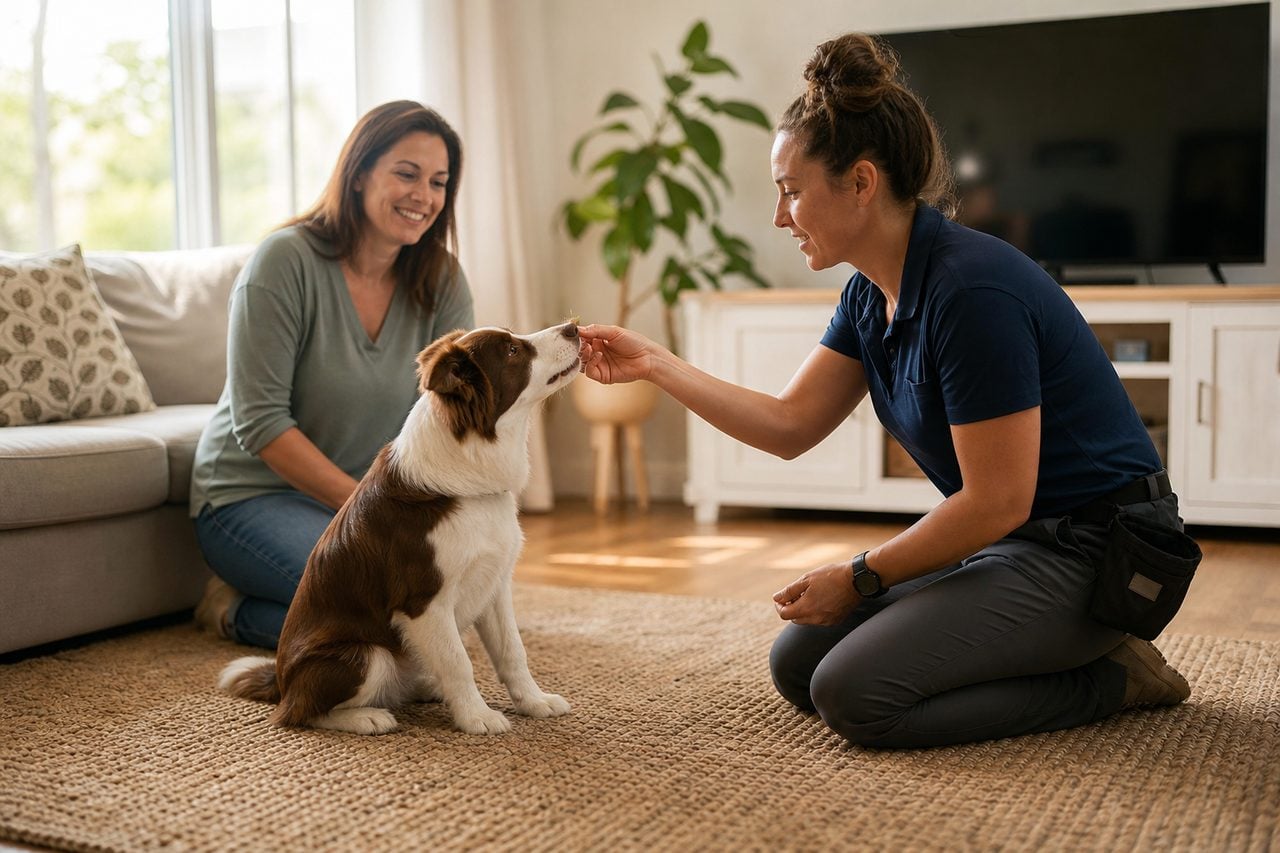
In-home dog training flips the usual model: instead of sending your dog away or hauling it to a class across town, the trainer comes to you. Sessions happen in your actual living room, backyard, and on your real neighborhood walk — which means the training targets the exact situations where your dog struggles, in the exact place those problems happen. For a huge number of Indianapolis households, that real-environment advantage is the whole reason this format works when others haven’t.
It’s the natural fit for three kinds of owners in particular: busy people who can’t add another commute to a packed week, dogs with context-specific problems that only show up at home, and reactive or anxious dogs that fall apart in a group-class setting and never get a chance to learn. Rather than teaching skills in a sterile training room and hoping they transfer, in-home training builds them where they actually need to hold.
This page covers how in-home sessions work, the kinds of problems they solve best, why real-environment training matters so much, and how the model fits life across the Indy metro — from city neighborhoods to spread-out suburbs.
How in-home training works
A private trainer comes to your home, usually for a series of one-on-one sessions spaced out over several weeks. The first visit is typically an assessment: the trainer watches how your dog behaves in its own space, asks about your routine and goals, and identifies what’s actually driving the behavior — which is often invisible until someone sees the home setup in person.
From there, sessions are highly customized. The trainer coaches you as much as the dog, because in this model you’re the one doing the daily work between visits. You’ll learn the timing, the cues, the leash handling, and how to set up your home environment so good behavior becomes the easy default. Each visit builds on homework from the last.
This is the most owner-involved format of all the training options. That’s a feature, not a drawback — because you’re trained alongside your dog, the skills are already living in your home and your hands by the time the program ends.
The real-environment advantage
Dogs are famously bad at generalizing. A dog that nails ‘stay’ in a quiet training facility will frequently ignore the same cue at home when the doorbell rings, the kids are loud, or a squirrel crosses the yard. The reason is simple: behavior is tied to context, and the home context is where most real problems live.
In-home training removes the transfer problem entirely. The doorbell that triggers the barking is your doorbell. The counter that gets surfed is your counter. The leash reactivity happens on your street, walking past your neighbors’ fences. By training in the precise environment where the behavior occurs — with the real triggers present — the skills are built to work exactly where you need them, with nothing lost in translation.
For Indianapolis owners, this also means training adapts to your real life: a fenced suburban yard in Noblesville, an apartment near downtown with shared hallways, or a busy Broad Ripple sidewalk all present different challenges, and in-home training meets each one on its own terms.
Best for context-specific problems
Some behaviors are almost impossible to address anywhere but home, because that’s the only place they appear:
- Doorbell and visitor chaos — barking, jumping, and door-dashing when guests arrive.
- Household manners — counter-surfing, getting on furniture, stealing items, begging at the table.
- Territorial barking at the window, the yard fence, or passersby.
- Separation-related issues that only happen in your home when you leave.
- House-training and crate problems tied to your specific layout and routine.
- Multi-dog household dynamics — squabbles and resource tension between dogs that share your space.
You can’t easily recreate any of these in a group class. In-home training tackles them at the source, which is why it’s often the most efficient path for these particular problems.
Ideal for reactive and anxious dogs
For dogs that struggle in group settings, in-home training can be the difference between progress and a wasted enrollment. A leash-reactive or fearful dog dropped into a room full of other dogs is frequently over threshold — too stressed to learn anything — from the moment it walks in. The very environment meant to help becomes the obstacle.
Working one-on-one in a familiar, low-stress space lets a reactive or anxious dog stay calm enough to actually take in the training. A skilled trainer can then introduce triggers gradually and on the dog’s terms — starting in the safe home base and building outward to the front yard, the sidewalk, and eventually busier settings as the dog gains confidence. That controlled, incremental exposure is hard to engineer in a group class.
If a previous group-class attempt left you feeling like your dog ‘failed’ or ‘isn’t trainable,’ an in-home approach is often the reset that finally works — not because the dog changed, but because the environment finally suited how it learns.
Built for busy owners
The Indianapolis metro runs on long commutes and packed schedules, and in-home training is built for exactly that reality. There’s no driving across the city to a 7 p.m. class after fighting traffic on I-465, no rearranging the whole evening around a fixed group time. The trainer comes to you, sessions are scheduled around your life, and the rest of the work folds into your normal daily routine — the walk you were taking anyway, the dinner prep where the counter-surfing happens.
That convenience makes consistency realistic, and consistency is what actually produces trained dogs. For households in spread-out suburbs — Carmel, Fishers, Noblesville, and Westfield to the north, Greenwood and Franklin to the south, Avon, Plainfield, Brownsburg, and Speedway to the west, and Zionsville to the northwest — eliminating the round-trip is a genuine deciding factor.
Indiana’s weather quietly reinforces the point: when it’s a brutal humid July afternoon or an icy February night, you’re far more likely to keep up training that happens at home than to load the dog up for a drive across town.
What a typical in-home program covers
While every plan is tailored, most in-home programs across the Indianapolis area follow a recognizable arc. The first session is diagnostic: the trainer observes your dog in its normal environment, watches the problem behaviors play out where they actually happen, and asks detailed questions about your daily routine, feeding, exercise, and household rules. That on-site read is something no class or facility can replicate.
Early sessions usually establish foundations — clear communication, basic cues, structure around doorways and feeding, and the management changes that stop a problem from being rehearsed. From there, the work moves toward your specific goals: calming the doorbell routine, ending the counter-surfing, fixing the leash pulling on your own street, or rebuilding a reactive dog’s confidence step by step.
Between visits, you’ll have homework — short, realistic daily practice folded into your normal routine. Because the trainer is coaching you to run the program day to day, your consistency between sessions is the biggest lever on how fast you progress. By the time the series wraps, the skills already live in your hands and your home, which is the entire advantage of the format.
In-home vs. board-and-train and boot camps
It helps to see where in-home sits among the other formats Indianapolis owners weigh. Board-and-train and boot camps send your dog away to a facility where a professional does the heavy daily repetition for you — ideal when your schedule can’t deliver consistency or you want a fast, hands-off foundation. The trade-offs are cost, time apart, and a handoff step where the skills have to transfer from the trainer’s environment to yours.
In-home training inverts that. Nothing transfers because nothing leaves home in the first place — the skills are built in the exact place they need to work, and you’re trained alongside your dog from day one. The trade-off is that you do the daily work between visits, so it rewards owners who have at least some time and willingness to practice, even if they don’t have time for a commute to class.
The choice often comes down to the problem. Home-context issues, reactivity, and busy-but-engaged owners point toward in-home; a need for intensive immersion or a fully hands-off foundation points toward residential programs. Plenty of Indy dogs use both at different stages — an intensive to install obedience, then in-home work to solve the household-specific behaviors that only surface at home.
Finding an in-home trainer near you
Because the trainer travels to you, service area is the first thing to confirm. Many Indianapolis private trainers cover specific zones of the metro, so check that yours reaches your neighborhood — whether you’re downtown or on the near-north side, in Broad Ripple and the mid-north neighborhoods, on the east side or in Irvington, or out in any of the north, south, west, or northwest suburbs.
When you reach out, describe the specific problem and where it happens — the more concrete you are, the better a trainer can tell you whether in-home is the right fit. Ask how many sessions a typical program runs, what the homework expectation is between visits, and how they handle your particular issue. Good private trainers will be candid about whether your goal is better served by in-home work, a class, or an intensive program.
Browse the in-home trainers listed below for your area of the metro, and reach out to a couple to compare approaches and availability before booking.
Reviewed In-Home Dog Training Trainers in Indianapolis
These reviewed Indianapolis-area trainers from our directory handle in-home dog training. Each links to a full profile with specialties, certified credentials, reviews, and contact info:
- Nate Schoemer Dog Training — 5.0★ (188 reviews)
- Good Bones K9 Training — 5.0★ (31 reviews)
- Paw Partner Dog Training & Grooming — 5.0★ (18 reviews)
- Steven’s Bootcamp Dog Training Indianapolis — 5.0★ (9 reviews)
- Brooks Canine Training Services — 5.0★ (1 reviews)
- Indy K-9 — 4.9★ (123 reviews)
- Big N’ Small Paws 317 — 4.9★ (97 reviews)
- Indiana Canine Assistant Network — 4.9★ (68 reviews)
- Von Dietrich German Shepherds — 4.9★ (37 reviews)
- Purpose Driven K9 Dog Training — 4.8★ (106 reviews)
See all Indianapolis in-home dog training trainers →
Frequently Asked Questions
What is in-home dog training?
It’s private, one-on-one training where the trainer comes to your house and works with you and your dog in your real living environment — your living room, yard, and neighborhood walk. Because the training happens where the problems actually occur, the skills are built to hold in exactly the situations you care about, with no transfer problem from a separate facility.
Is in-home training better than group classes?
It depends on your goal. In-home is the strongest choice for context-specific home problems (doorbell barking, counter-surfing, territorial behavior), for reactive or anxious dogs that can’t focus in a group, and for busy owners who can’t add a commute. Group classes are great for socialization and motivated owners with time. Many dogs benefit from in-home work first, then a class once they’re ready.
Why is in-home training good for reactive dogs?
A reactive or anxious dog is often too stressed to learn in a room full of other dogs — it’s over threshold the moment it walks in. Working one-on-one in a familiar, low-stress space keeps the dog calm enough to actually take in training. A skilled trainer can then introduce triggers gradually, from the safe home base outward, which is hard to do in a group setting.
How many in-home sessions will I need?
It varies with the problem and how consistently you do the between-session homework. Many programs run as a series of visits over several weeks, with the trainer adjusting the pace to your progress. Because you’re coached to do the daily work, your follow-through between visits has a big effect on how quickly you reach your goals.
Does the trainer come to my specific neighborhood?
Most Indianapolis private trainers cover defined service areas across the metro — from downtown and the near-north side to Broad Ripple, Irvington, and the north, south, west, and northwest suburbs. Service area is the first thing to confirm when you reach out, since the whole model depends on the trainer traveling to your home.
What problems does in-home training handle best?
Anything tied to your specific environment: doorbell and visitor chaos, counter-surfing and household manners, territorial window or fence barking, house-training and crate issues, multi-dog household tension, and separation-related behaviors. It’s also excellent for reactive and anxious dogs and for owners whose schedules make a commute to class impractical.
Related: read our complete in-home dog training guide or the full Indianapolis dog training overview.
Ready to find the right in-home dog training pro in Indianapolis?