
In-Home Dog Training in Evansville, IN
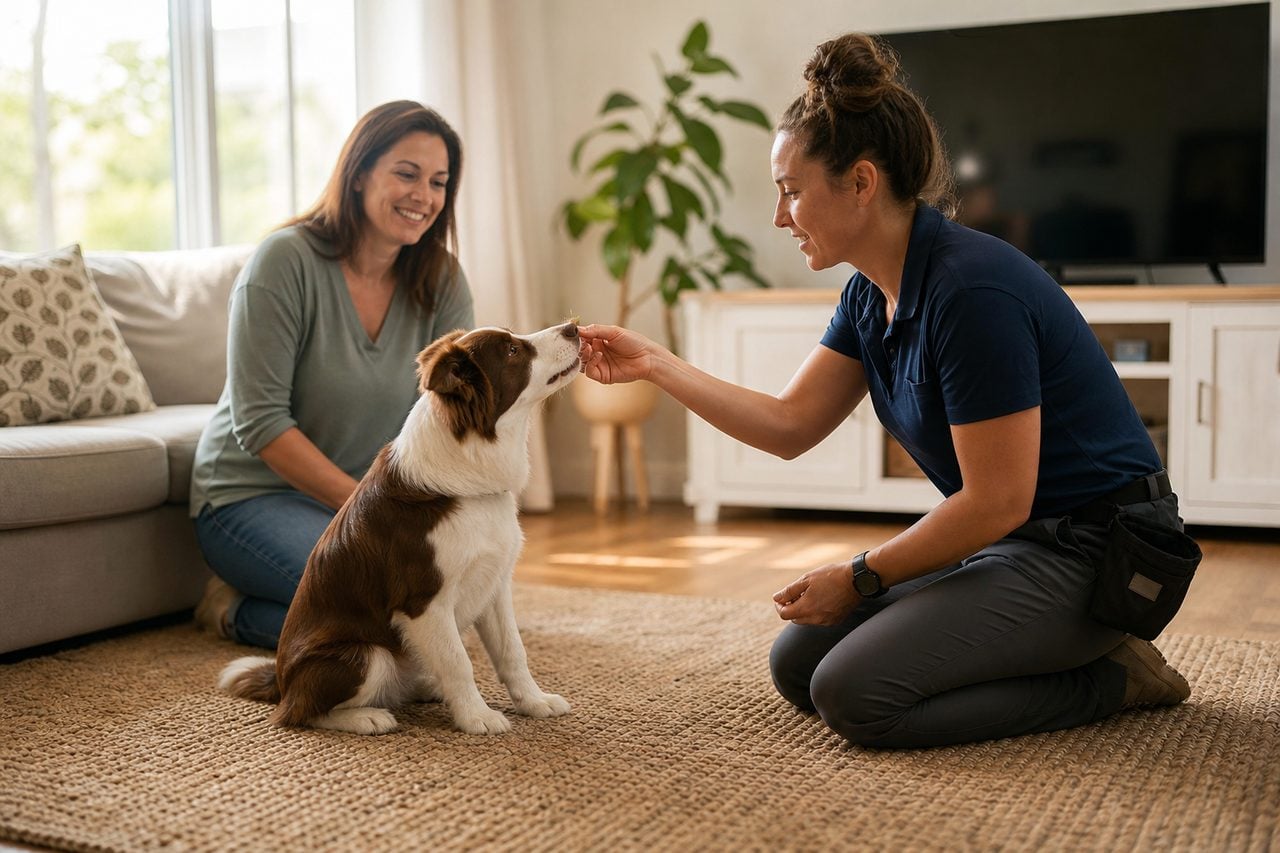
In-home dog training brings a professional trainer directly to your house or apartment somewhere across the Evansville area, so the lessons happen in the exact place where your dog actually lives, eats, sleeps, and misbehaves. Instead of loading the dog into the car and driving to a strange facility across town, the training meets your dog where the real problems occur — the front door that sets off a barking fit, the kitchen where counters get raided, the backyard fence line that triggers a meltdown every time the neighbor’s dog walks by. For families in Vanderburgh County and the surrounding Tri-State, that convenience often makes the difference between training that gets done and training that keeps getting postponed.
- What In-Home Dog Training Actually Is
- Why the Dog's Own Environment Changes the Results
- Common Goals Evansville Families Bring to In-Home Training
- What a Typical In-Home Program Looks Like
- The Service Area: How Far Local Trainers Travel
- How to Choose the Right In-Home Trainer
- Setting Your Dog Up for Success Between Sessions
- Reviewed trainers
- FAQ
The Evansville region is a natural fit for the private, come-to-you model. It is a spread-out place — the city core sits on the Ohio River, but households ripple outward into Newburgh, Boonville, Chandler, Princeton, Fort Branch, and Mount Vernon, with plenty of rural properties in between. Many area trainers build their business around covering that ground, traveling a wide radius across Vanderburgh, Warrick, Gibson, and Posey counties rather than expecting every client to come to a single storefront. That travel-based approach is one of the defining features of in-home training here.
This guide explains how in-home training works, why the home environment produces such durable results, what a realistic program looks like, and how to choose a trainer who fits your household. The goal is to help you make an informed decision, not to sell any particular method or provider.
What In-Home Dog Training Actually Is
In-home dog training — also called private, one-on-one, or in-home private training — is a format in which a trainer works individually with you and your dog on your own property. There is no group class, no other dogs competing for attention, and no unfamiliar building to acclimate to. The entire session is built around your dog, your household, and the specific behaviors you want to change.
It helps to understand how this differs from the other common training formats you will find around Evansville:
- Group classes gather several dogs and handlers in one location to learn foundational obedience together. They are affordable and add controlled socialization, but the pace is set by the group, not by your dog, and the skills are learned in a setting very different from home.
- Board-and-train sends the dog to live with a trainer for a set period. The dog comes back with skills, but those skills were built in the trainer’s environment and with the trainer as the handler — which means a careful transfer back to you is essential.
- In-home private training keeps the dog at home the entire time and, crucially, trains you as much as the dog. You are in the room for every repetition, learning the timing, the cues, and the handling that make the results stick.
That last point is the heart of it. A well-run in-home program is really a coaching relationship. The trainer diagnoses what is happening, demonstrates the technique, then hands the leash back to you and coaches your mechanics until you can do it without them. When the trainer eventually leaves, the skill leaves with you — not with them.
Why the Dog's Own Environment Changes the Results
Dogs are famously poor at generalizing. A dog that sits perfectly in a quiet training hall may act like it has never heard the word in its own living room with the TV on, the kids home from school, and a delivery truck idling outside. This is not stubbornness — it is how canine learning works. Behaviors are tightly linked to the context in which they were taught. Train in the real context, and you skip the frustrating step of trying to transfer skills from an artificial setting back into daily life.
The home environment matters for a second reason: most of the behaviors people want to fix are environmental. They are reactions to specific triggers that only exist at home. Consider how many of the most common complaints are location-locked:
- Barking and lunging at the front door or front window when someone approaches
- Jumping on guests the moment they walk in
- Counter-surfing, trash-raiding, or stealing food off the table
- Separation-related distress that only appears when the family leaves the house
- Fence-line reactivity toward neighbors, mail carriers, or other dogs
- Housetraining accidents in particular rooms
- Resource guarding around a specific bed, crate, or feeding spot
You simply cannot rehearse the front-door meltdown at a training center — there is no front door. An in-home trainer can stage that exact scenario, watch your dog’s real reaction, and build a plan around the true trigger. They also see the full picture: the layout of your rooms, where the dog sleeps, how the household moves through the day, whether the crate is in a high-traffic hallway, and dozens of small management details that a facility-based trainer never gets to observe. Those details are frequently where the real solution lives.
Finally, working at home is lower-stress for anxious, reactive, or under-socialized dogs. A fearful dog learns very little while it is overwhelmed by a novel place full of strange dogs and people. Starting on home turf, where the dog already feels safe, lets learning begin immediately — and later sessions can deliberately expand outward into the yard, the driveway, the neighborhood, and eventually public spaces once the foundation is solid.
Common Goals Evansville Families Bring to In-Home Training
In-home training is flexible enough to cover nearly any goal, from a brand-new puppy to a senior dog with an entrenched habit. Around the Tri-State, the requests tend to cluster into a few categories.
Puppy foundations
New puppy owners often want to start right, before problems set in. In-home puppy work usually covers housetraining on a realistic schedule, crate training, gentle handling for future vet and grooming visits, bite-inhibition for needle-sharp puppy teeth, and the first building blocks of name recognition, sit, and coming when called. Getting these fundamentals right in the first few months prevents most of the issues that show up later.
Everyday manners for adolescent and adult dogs
The most common in-home request is simply a dog that is easier to live with: no jumping on visitors, no bolting out the door, polite walking without dragging you down the Pigeon Creek Greenway, a reliable recall in the backyard, calm settling when guests arrive, and an off switch in the evening. These are quality-of-life skills, and they respond very well to home-based coaching because they are practiced in exactly the moments they are needed.
Behavior and reactivity challenges
Harder cases — leash reactivity, fear, separation-related distress, resource guarding, or aggression — are often where in-home training shines, because the trainer can observe the actual triggers and design a gradual, structured plan. Serious behavior cases sometimes warrant a veterinary check first, since pain and medical issues can drive behavior change; a good trainer will say so rather than promising a quick fix.
Household integration
Bringing home a second dog, integrating a dog with a new baby or cat, or helping a rescue decompress into a new home are all situations that play out entirely within the household — making them ideal for the in-home format.
What a Typical In-Home Program Looks Like
While every trainer runs their business differently, most in-home programs across the Evansville area follow a recognizable arc. Knowing the shape of it helps you set expectations and ask better questions.
The initial consultation and assessment
The first visit is usually longer than the rest. The trainer gathers history — the dog’s background, health, diet, daily routine, and what has been tried already — then observes the dog in its environment. Expect a conversation about your specific goals and an honest read on what is realistic and how long it may take. By the end, you should have a working plan and a clear sense of the road ahead.
Ongoing sessions
Most programs run as a series of sessions spaced a week or two apart, often bundled into a package rather than sold one at a time. That spacing is deliberate: the real learning happens in the days between visits, when you practice what was introduced. A common rhythm is to introduce a skill, coach your handling of it, assign homework, then review and build on it at the next visit.
Your homework between visits
This is where in-home training succeeds or fails. Short, consistent daily practice — often just five to fifteen minutes, a few times a day, woven into normal routines like mealtimes and walks — produces far better results than one long weekly cram session. Trainers who provide written notes, checklists, or short videos make it much easier to stay on track.
Involving the whole household
Dogs need consistency across everyone they live with. If one person allows jumping and another does not, the dog stays confused and progress stalls. The best outcomes happen when every family member — including older kids — learns the same cues and rules. In-home training makes this easy because everyone is already home.
Generalizing beyond the house
As skills solidify, good programs deliberately push them into harder settings: the yard, the front step, the sidewalk, a quiet corner of a park. This is the step that turns a dog that behaves at home into a dog that behaves everywhere, and it is far easier when the home foundation is already rock-solid.
The Service Area: How Far Local Trainers Travel
One practical reality of in-home training in this region is travel. Because the trainer comes to you, service-area boundaries matter, and they vary from provider to provider. Many Evansville-area trainers deliberately cover a broad footprint, serving clients across Vanderburgh, Warrick, Gibson, and Posey counties and treating the wider Tri-State as their market rather than the city alone.
In practice, that means a single trainer may work with a household in central Evansville in the morning, drive out to Newburgh or Boonville in Warrick County that afternoon, and take a Gibson County appointment in Princeton or Fort Branch later in the week, with Mount Vernon and the rest of Posey County also within reach. Chandler and the smaller communities along the river corridor typically fall inside these routes as well.
A few things are worth clarifying up front when you contact any in-home trainer:
- Is your address inside their standard service area? If you are on the far edge of a county or across a state line into Kentucky or Illinois, confirm before booking.
- Do they charge a travel fee for longer drives? Some build a radius into their pricing; others add a fee beyond a certain distance. Ask so there are no surprises.
- How does travel affect scheduling? A trainer covering a wide area may batch appointments by region on certain days, which can shape when they are available near you.
None of this is a drawback — it is simply the logistics of a come-to-you service in a spread-out region. Being clear about your location from the first phone call helps you find a trainer whose routes and radius line up with where you live.
How to Choose the Right In-Home Trainer
Dog training is an unregulated field. There is no license required to call oneself a dog trainer, which means quality varies widely and the burden is on you to vet carefully. A few questions and observations reliably separate strong professionals from the rest.
Ask about methods and philosophy
Ask a trainer directly how they teach new behaviors and how they handle unwanted ones. You want clear, specific answers, not vague reassurances. Reward-based, positive-reinforcement approaches are the mainstream standard in modern training and are backed by the major professional bodies. Be cautious of anyone who leans heavily on fear, intimidation, or pain, or who guarantees to fix a serious behavior problem — especially aggression — on a fixed timeline. Behavior is not that predictable, and guarantees are a red flag.
Look into credentials and continuing education
Because the field is unregulated, voluntary certifications and professional memberships signal that a trainer has invested in their education and holds themselves to a standard. Independent certifications and membership in recognized professional training associations are reasonable things to ask about. So is how they keep their skills current — this field evolves, and good trainers keep learning.
Check references and reviews
Ask for references from past clients with similar issues, and read reviews with an eye for people describing problems like yours. A trainer who has helped several families with, say, leash reactivity or separation distress is a better bet for that specific issue than a generalist who has not.
Watch how they interact with your dog
During the first visit, notice whether the dog seems comfortable, whether the trainer reads the dog’s body language well, and whether they explain what they are doing and why. You should feel like a partner in the process, not a bystander. If something feels off, trust that instinct.
Get the practical details in writing
Before committing, confirm pricing structure, what a package includes, session length and frequency, the cancellation policy, and what kind of follow-up support you get after the program ends. Clarity here prevents friction later.
Setting Your Dog Up for Success Between Sessions
Even the best trainer only spends a handful of hours in your home. The other twenty-three-plus hours of every day are yours, and that is where lasting change is actually built. A few principles help you get the most out of any in-home program.
Practice in short, frequent bursts. Dogs learn better from many brief sessions than from occasional long ones. Fold training into things you already do — ask for a sit before meals, a wait at the door before a walk, a hand target during a commercial break.
Keep the whole household consistent. Agree on the cues and the rules, and make sure everyone uses them the same way. Mixed messages are the single most common reason progress stalls.
Manage the environment while you train. Management and training work together. If your dog raids the counter, keep it clear while you build the skill. If it bolts out the front door, use a leash or a gate as a safety net. Preventing rehearsal of the bad habit speeds up the good one.
Meet your dog’s underlying needs. Many behavior problems are really unmet-need problems. A dog that gets enough physical exercise, mental enrichment, and appropriate rest simply has fewer surplus behaviors to redirect. The Tri-State offers plenty of outlets — leashed walks along the Pigeon Creek Greenway, the wooded trails around Wesselman Woods Nature Preserve, and the open space at Burdette Park all give dogs constructive ways to burn energy, always in line with local ordinances across the Evansville area and any posted park rules.
Be patient and celebrate small wins. Behavior change is rarely linear. There will be good days and setbacks. Tracking progress over weeks rather than days keeps you motivated and gives your trainer useful feedback to adjust the plan. Consistency, not intensity, is what carries an in-home program across the finish line.
Reviewed In-Home Dog Training Trainers in Evansville
These reviewed Evansville-area trainers from our directory handle in-home dog training. Each links to a full profile with specialties, certified credentials, reviews, and contact info:
- Midwest Canine Training Academy — 5.0★ (3 reviews)
- Training With Grace — 5.0★ (2 reviews)
- The Training Retreat by Barks and Recreation — 4.8★ (30 reviews)
See all Evansville in-home dog training trainers →
Frequently Asked Questions
How much does in-home dog training cost in the Evansville area?
Pricing varies by trainer, by the format they offer, and by the complexity of your goals. Private in-home sessions are typically sold either individually or in multi-session packages, and packages usually offer better value per session. Because in-home training is a come-to-you service across a wide region, some trainers also add a travel fee for longer drives into Warrick, Gibson, or Posey counties. Rather than relying on any published figure, ask each trainer directly for their current rates, what a package includes, and whether travel affects the price so you can compare on equal terms.
Is in-home training better than group classes or board-and-train?
Not universally better — better for certain goals. In-home training is ideal for problems that occur in the home environment, for dogs that are anxious or reactive in new settings, and for owners who want to be coached directly. Group classes add affordable, controlled socialization and are great for basic obedience foundations. Board-and-train can suit owners short on time, though skills learned in the trainer’s home must be carefully transferred back to you. Many families combine formats. The right choice depends on your dog, your goals, and how much hands-on involvement you want.
How long does it take to see results?
It depends heavily on the behavior, the dog’s history, and how consistently you practice between sessions. Simple manners like polite greetings or a reliable sit can improve within a few weeks of steady work. Deeply rooted issues such as reactivity, fear, or separation-related distress are gradual projects that can take months of structured effort. Be skeptical of anyone promising a fast, guaranteed fix for a serious behavior problem — behavior change is a process, and the daily practice you do between visits matters as much as the sessions themselves.
Do in-home trainers travel outside the city of Evansville?
Many do. A large share of Evansville-area in-home trainers deliberately cover a wide radius across the Tri-State, serving Vanderburgh, Warrick, Gibson, and Posey counties — including communities such as Newburgh, Boonville, Chandler, Princeton, Fort Branch, and Mount Vernon. Service-area boundaries and travel fees differ from trainer to trainer, so confirm that your address is within their range and ask whether distance affects pricing or scheduling when you first make contact.
What should I do to prepare for the first session?
Have a clear list of the behaviors you want to address and any history that might be relevant — the dog’s background, health, diet, daily routine, and what you have already tried. Try to have all household members present for at least the first visit, since consistency across everyone is central to success. Keep the environment normal rather than staged; the trainer needs to see the dog’s real behavior. Have treats, a leash, and any relevant gear on hand, and be ready to take notes so you can practice accurately afterward.
Can in-home training help with serious problems like aggression?
It can be an appropriate setting for serious behavior work, because the trainer can observe the real triggers and build a gradual, structured plan on the dog’s home turf. That said, aggression and severe anxiety are complex and sometimes have a medical component, so a veterinary check is often a sensible first step to rule out pain or illness. Look for a trainer experienced with the specific issue, ask about their approach, and be wary of anyone who guarantees to eliminate aggression on a fixed timeline. Realistic goals for these cases usually center on management and meaningful improvement rather than a guaranteed cure.
Related: read our complete in-home dog training guide or the full Evansville dog training overview.
Ready to find the right in-home dog training pro in Evansville?