
In-Home Dog Training in Terre Haute, IN
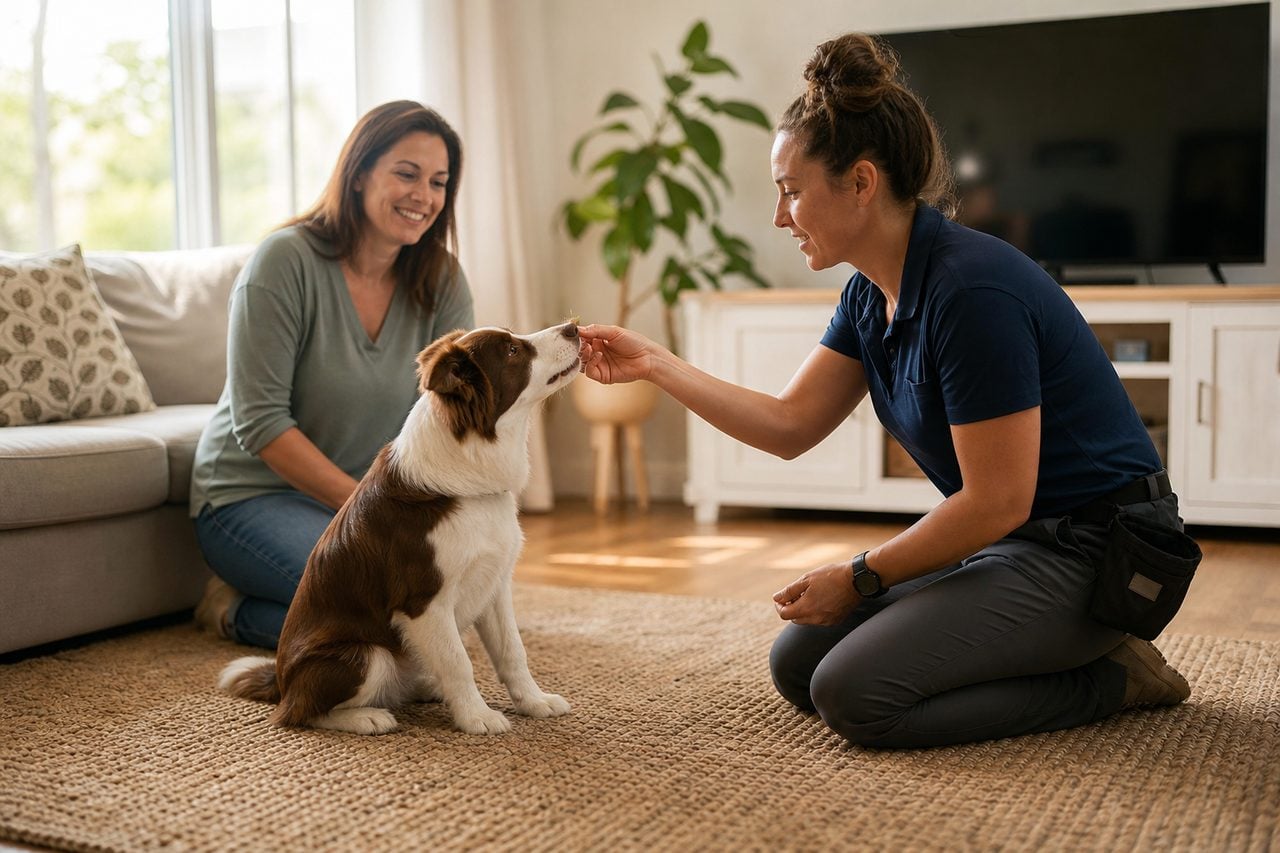
In-home dog training means the trainer comes to you — your living room, your kitchen, your driveway, the stretch of county road where your dog loses his mind at the neighbor’s tractor. For a lot of Terre Haute households that is not a luxury version of dog training. It is the only version that touches the problem where the problem actually lives. The Wabash Valley is a spread-out place: Vigo County seat on the east bank of the Wabash River at the Illinois line, a compact downtown around Indiana State University, student rentals and apartment stairwells within walking distance of campus, the Rose-Hulman side of town to the north, and then farm country in every direction — West Terre Haute across the river, Brazil out toward Clay County, Rockville and the Parke County covered bridges to the north, Clinton and Sullivan strung along US-41. Dogs in this metro live very different lives depending on which of those addresses they wake up at.
- Why in-home training suits the Wabash Valley in particular
- What actually happens in an in-home session
- Who offers in-home training around Terre Haute
- In-home vs. board-and-train vs. group class
- The local conditions a visiting trainer will notice
- What in-home training is not the right tool for
- How to vet an in-home trainer before you book
- Reviewed trainers
- FAQ
A group obedience class is genuinely useful, but a class is a controlled room, and most of the behavior people want fixed does not happen in a controlled room. It happens at the front door, on the stairs, at the fence line, at the mailbox, at 6am when the dog hears gravel crunch in the drive. In-home training puts a professional inside that footage instead of asking you to describe it from memory. This page covers what a session looks like, which Terre Haute trainers currently offer it, how it compares to board-and-train and facility classes, and how to vet a trainer before you let them into your house.
Why in-home training suits the Wabash Valley in particular
Geography does a lot of work in this metro. Terre Haute proper is a mid-sized city with dense student housing near ISU, older neighborhoods with alleys and chain-link, and a downtown grid built around US-40, the old National Road. Ten minutes in most directions and you are somewhere completely different: unfenced acreage, gravel drives, open ditches, farm equipment, loose barn cats, and livestock on the other side of a wire fence. The behavior consequences of those two environments have almost nothing in common.
Consider what a reactive dog is actually reacting to. In an apartment stairwell near campus, it is a stranger appearing four feet away with no warning, at the exact height of the dog’s face, on a hard surface that amplifies everything. There is no distance to work with, no way to arc around, and the trigger arrives in under a second. Out on a county road it is the opposite problem: enormous distances, long approach times, a dog that has twelve seconds to build arousal while a UPS truck comes down a straight half-mile of gravel. Those two dogs may both be labelled “leash reactive,” but the training plan — threshold distance, timing of the marker, what you do with your feet — is not the same plan.
A trainer who only ever sees your dog inside a training building is working from your account of these environments. That is not a knock on their skill; it is an information problem. In-home training removes it. The trainer sees the actual sight lines, the actual doorway, the actual fence gap, the actual place the dog stages before it bolts. They see that your “yard” is three acres with no boundary, or that your recall is failing because there is a deer trail thirty yards past the tree line, or that the dog is body-blocking the kitchen entry because the food bowl lives in a corridor with no exit.
There is a second, blunter reason in-home works here: drive time. If you live in Sullivan or Rockville, a weekly evening group class in Terre Haute is a real commitment — and dog training is a habit, not an event. Programs die on logistics far more often than they die on technique. A trainer coming to you, or a hybrid of in-person plus virtual check-ins, survives a busy month in a way a Tuesday-night drive across two counties often does not.
What actually happens in an in-home session
The first appointment is usually more interview and observation than drilling. A good in-home trainer spends real time on history: where the dog came from, what the medical picture looks like, what the daily routine is, who in the household enforces what, what has already been tried, and what specifically happened during the worst incident. That last question matters. “He’s aggressive” is a label. “He was on the couch, my son leaned over him to grab the remote, and he air-snapped and then went stiff” is data you can build a plan from.
Then they watch. Not a performance — the ordinary stuff. How the dog greets them at the door. Whether he settles or paces. What happens when you stand up. Whether he checks in with you or orbits the room ignoring everyone. Whether the sit you think he knows survives a doorbell. Experienced trainers read a household fast, and a lot of what they notice is environmental rather than canine: a crate stuffed in a loud hallway, a leash hanging where the dog can see it and pre-load, free-feeding that has removed food as a currency, three people using three different words for the same behavior.
After that, the session usually splits into two halves: management and training. Management changes are the unglamorous ones that buy you relief immediately — move the crate, add a baby gate, change where the dog is when guests arrive, stop letting him rehearse the fence-running for two weeks. Training is the actual skill building, and the honest truth is that most of it is coaching you. The trainer demonstrates, then hands the leash back and fixes your mechanics: your marker timing is late, your reward is coming from the wrong hand, you are repeating the cue four times, you are luring when you should have faded the lure a week ago.
You should leave the session with a written or recorded plan, a short list of things to practice in specific contexts, and criteria for when to raise difficulty. Sessions after that tend to move outward: from the living room to the doorway, to the driveway, to the sidewalk, to the trail. Deming Park, Fowler Park, Hawthorn Park, Dobbs Park and the National Road Heritage Trail all get used as graduated real-world proofing environments once the dog can hold the behavior at home — that progression, home first and public later, is the whole logic.
Who offers in-home training around Terre Haute
The clearest in-home option in the metro is Unlimited Pawsibilities at 1209 N Fruitridge Ave in Terre Haute. They offer private and in-home training alongside a broad menu: group obedience, a puppy program, the AKC ladder (Canine Good Citizen, Community Canine, AKC Urban CGC, Trick Dog and Rally), behavior modification for aggression, reactivity, anxiety and fear, K-9 nose work, and canine agility and fitness. The trainer goes by Mariah — a certified trainer and AKC Evaluator with ten years as a veterinary assistant and more than nine years training. The veterinary background is worth noting for anyone whose problem might have a medical layer underneath it, which is more common than owners expect with sudden-onset reactivity, house-training regression or touch sensitivity.
They also offer a virtual home-manners evaluation, which is a genuinely practical entry point for the outlying parts of the metro. A video call from your own kitchen still shows a trainer the room, the traffic pattern, the crate placement and the dog’s actual behavior in context — and it costs you no drive time from Sullivan or Rockville.
Top Dog Training LLC, run by Nicole Thraen, runs the inverse model: an in-home board-and-train where dogs live in the trainer’s home on an eight-acre property rather than in a kennel facility. That is still “in a home,” but it is the trainer’s home, not yours, and the two models solve different problems. One important caveat: their website is no longer live and intake has been paused in the past, so treat availability as something to confirm directly rather than assume.
Other trainers operate in the area — VonBernd K9 Training Center at 11750 S US Hwy 41, K9.5 Training Academy (facility-based obedience and board-and-train), Cultivate K9 Training, CABP Canine Training Academy, K9 812 Terre Haute and M&B Dog Training. Several of these publish little or nothing about whether they travel to clients, so the only honest advice is to ask rather than to assume. And it is worth being straight about the depth of the bench: a metro this size supports a handful of generalists, not a dozen dedicated in-home specialists. Indianapolis, roughly an hour and fifteen minutes east on I-70, has a substantially deeper pool if your case is unusual or you want several specialists to choose between.
In-home vs. board-and-train vs. group class
These three formats are not ranked. They solve different problems, and the wrong pick is the most common reason people feel like training “didn’t work.” Group class is unbeatable for one thing: controlled exposure to other dogs and people at manageable distance, with a professional watching. If your dog is fundamentally sound and you want obedience, socialization and structure, a class is efficient and usually the cheapest per hour. It is a poor fit if your dog cannot function in the room — a dog over threshold in a class is not learning obedience, he is rehearsing panic while you apologise to strangers.
Board-and-train puts the dog in the professional’s hands full-time for a set period. The advantage is density and consistency: a skilled trainer gets many short reps a day with perfect mechanics, which can move a stuck case faster than a once-weekly hour. The limitation is transfer. The dog learns to perform for that person, in that environment, and the handoff back to you is the entire ballgame. Ask any board-and-train provider a direct question: how many transfer sessions with the owner are included, and what happens if the behavior falls apart at home in week three? A program with a serious answer is worth a great deal more than one that hands you a trained dog and a wave.
In-home optimises for transfer and context, and trades away density. You get fewer professional reps, and you are responsible for the practice between visits. That makes it excellent for household management problems, door and guest behavior, resource guarding in the actual rooms it happens in, separation issues, house-training, puppy foundations, and reactivity where the specific triggers are on your street. It is a weaker fit when the owner genuinely cannot put in the reps, or when the dog needs sustained daily work that a working household cannot supply.
Plenty of real cases end up blended: a board-and-train or intensive private block to break the pattern, then in-home follow-ups to install it in your house, then a group class or a public-access outing for proofing. Nobody should be selling you a format on ideology. The question is always which one addresses your dog’s actual failure point.
The local conditions a visiting trainer will notice
Some of the most useful output from an in-home session has nothing to do with obedience commands. It is a trainer walking your property and telling you what is going to bite you later. Unfenced acreage is the first of these. A great deal of housing around Vigo, Clay, Parke and Sullivan counties has land but no boundary. Owners often assume that space equals exercise and safety. It does not — it equals opportunity to self-reward at distance. A dog that gets to chase deer, chase a truck, or go visit the neighbor’s cattle is being paid handsomely by the environment every single time, and no recall you build in a living room survives that. A visiting trainer will tell you to put a long line on the dog for a while, and will show you where your actual containment line is.
Livestock next door. This is a safety issue before it is a training issue. Indiana farm neighbors take stock harassment seriously and so should you. A dog with any interest in hooved animals needs management first, then structured desensitisation at a distance where he can still hear you, and never off-lead access to a fence line he finds interesting.
Apartments and stairwells near campus. The student-housing belt around ISU produces a very particular set of cases: barking at hallway traffic, elevator and stairwell surprises, no yard for potty routines, noise complaints, and dogs left alone during long class blocks. Solutions here are heavily environmental — where the crate sits, what the dog can see from the window, sound masking, potty schedules built around a class timetable — and a trainer standing in the unit will spot them in five minutes.
County roads and gravel drives. Long sight lines mean long arousal build-ups, and drivers on rural roads are not slow. Leash work here is genuinely different from sidewalk leash work. Similarly, driveway greetings — where visitors arrive by vehicle rather than on foot — are their own training scenario, and one you cannot rehearse in a training hall.
What in-home training is not the right tool for
An honest directory should tell you where the format fails. In-home training is not magic, and a few situations call for something else first or instead. Start with the biggest one: anything with a plausible medical component goes to a veterinarian first. Sudden behavior change in an adult dog, house-training regression, new touch sensitivity, snapping when handled in one specific spot, escalating anxiety, or a dog that seems to “forget” known skills — these deserve a physical exam before a training plan. Pain changes behavior, and training a painful dog through the pain is both cruel and ineffective. Any competent trainer will refer rather than override this.
Serious bite history may need a veterinary behaviorist. There is a difference between a trainer who works behavior cases and a board-certified veterinary behaviorist, who is a veterinarian with specialist training and the ability to prescribe. For dogs with significant aggression, severe separation distress, or anxiety that does not respond to good behavior work, medication combined with a behavior plan is often what actually moves the needle. Terre Haute does not have a deep specialist bench for this; Indianapolis and the Purdue veterinary hospital region are the realistic referral direction.
Dog-dog socialisation needs other dogs. You cannot build a dog’s comfort around unfamiliar dogs in an empty living room. In-home work builds the handler skills and the foundation; at some point the case has to move to a controlled setting with helper dogs, which usually means a facility, a class, or arranged sessions.
Owners who genuinely cannot practice. If the household is in a stretch where nobody has fifteen minutes a day — a new baby, a brutal work rotation, a family illness — in-home coaching is going to underdeliver, because the model depends on you doing the reps. In that window, a board-and-train or a heavy management plan is a more honest recommendation than a weekly visit you will not act on.
How to vet an in-home trainer before you book
You are letting someone into your home to work with an animal you love, in a field with no licensing requirement. Vetting matters. Ask these things directly, and treat evasiveness as an answer. What is your methodology, in plain language, and what happens when my dog gets it wrong? That second half is the real question. Every trainer will say they use positive reinforcement. The differences show up in the consequence side: what tools they use, whether they use aversives, under what conditions, and how they decide. You do not have to prefer one philosophy, but you should get a clear, unembarrassed answer rather than a deflection, and you should never feel pressured into a tool you do not understand.
What are your credentials, and who issued them? Dog training is unregulated in Indiana as everywhere else in the US, so “certified” means nothing until you know certified by whom. Legitimate independent credentials exist and are worth asking about. So is genuine experience — and so is being an AKC Evaluator, which is a specific role rather than a vague claim. And ask: have you worked cases like mine, and what happened? Ask for the failures too — a trainer who has never had a case go sideways is either new or not telling you the truth.
What is included, and what does follow-up cost? Get the package structure in writing: number of sessions, session length, travel radius and whether there is a mileage charge for Sullivan, Clinton, Rockville or Brazil addresses, what between-session support looks like, and the refund or reschedule policy. Prices in this metro are not published consistently, so ask for current rates directly rather than trusting any figure you find quoted online, including on this site. And ask whether they carry insurance — professional liability is standard for anyone working in clients’ homes, it is a fair question, and the answer should be immediate.
Finally, trust the consultation itself. A trainer who listens more than they lecture, who asks about your goals rather than assuming them, who is willing to say “that’s a vet question,” and who leaves you with something you can do tomorrow morning — that is what competence looks like in someone’s living room.
In-Home Dog Training in Terre Haute: Local Options & Nearest Specialists
Local Terre Haute-area options for in-home dog training:
- Unlimited Pawsibilities — 4.8★ (79 reviews)
Nearest in-home dog training specialists — Indianapolis
For complex cases, some families travel to the larger pool of specialists in the Indianapolis area for an assessment or a board-and-train stay. Top-reviewed options:
- Nate Schoemer Dog Training — 5.0★ (188 reviews)
- Good Bones K9 Training — 5.0★ (31 reviews)
- Steven’s Bootcamp Dog Training Indianapolis — 5.0★ (9 reviews)
- Brooks Canine Training Services — 5.0★ (1 review)
- Indy K-9 — 4.9★ (123 reviews)
- Big N’ Small Paws 317 — 4.9★ (97 reviews)
- Indiana Canine Assistant Network — 4.9★ (68 reviews)
- First Friend K-9 Training — 4.6★ (409 reviews)
See all Indianapolis in-home dog training trainers →
Frequently Asked Questions
How much does in-home dog training cost in Terre Haute?
Local trainers here do not publish rates consistently, and pricing varies with session length, package size, travel distance and case complexity — a puppy manners visit and a multi-session aggression protocol are not the same product. Rather than trusting any figure quoted secondhand, ask each trainer directly for their current rates, whether travel to your address adds a fee, what is included between sessions, and how packages are structured. Get it in writing before you book.
Does anyone in Terre Haute actually come to my house?
Yes. Unlimited Pawsibilities on N Fruitridge Ave offers private and in-home training, plus a virtual home-manners evaluation that works well if you are out toward Sullivan, Clinton, Rockville or Brazil. Top Dog Training LLC runs the reverse arrangement — your dog stays in the trainer’s home on an eight-acre property — though their website is no longer live and intake has been paused before, so confirm availability directly. Several other area trainers do not publish whether they travel, so ask.
Is in-home training better than a group class?
Neither is better; they answer different questions. In-home wins on context and transfer — door behavior, guests, resource guarding, house-training, separation issues, and triggers specific to your street or property. Group class wins on controlled exposure to other dogs and people, and is usually the cheapest per hour. A dog that cannot function in a class room is not learning there. Many real cases use both: build at home, then proof in a class or in public.
Can in-home training fix aggression or reactivity?
It can be a strong part of the plan, especially when the triggers live at your address. Unlimited Pawsibilities lists behavior modification for aggression, reactivity, anxiety and fear, and VonBernd K9 Training Center works behavior and aggression cases as well. Two cautions: rule out pain or illness with a veterinarian first, because medical issues masquerade as behavior problems constantly; and for serious bite history or severe anxiety, a board-certified veterinary behaviorist — realistically an Indianapolis-area referral — may need to be part of the team.
How many sessions will my dog need?
It depends far more on the problem and on your practice than on the dog’s breed or age. Basic manners and puppy foundations often move quickly across a handful of visits, because the skills are simple and the reps are easy to fit into a day. Fear, reactivity and guarding cases work on a longer timeline — weeks to months — because you are changing an emotional response, not teaching a trick. Be skeptical of anyone who promises a fixed number for a behavior case before meeting the dog.
Should I drive to Indianapolis instead?
For most everyday cases, no — Terre Haute has capable trainers and the drive undermines the consistency that makes training work. It is worth considering when your case is unusual, when you want to compare several specialists, when you need a board-certified veterinary behaviorist, or when local intake is closed. Indianapolis is roughly an hour and fifteen minutes east on I-70, which is manageable for an assessment or an occasional intensive, but hard to sustain weekly.
Related: read our complete in-home dog training guide or the full Terre Haute dog training overview.
Ready to find the right in-home dog training pro in Terre Haute?