
In-Home Dog Training in Reading, PA
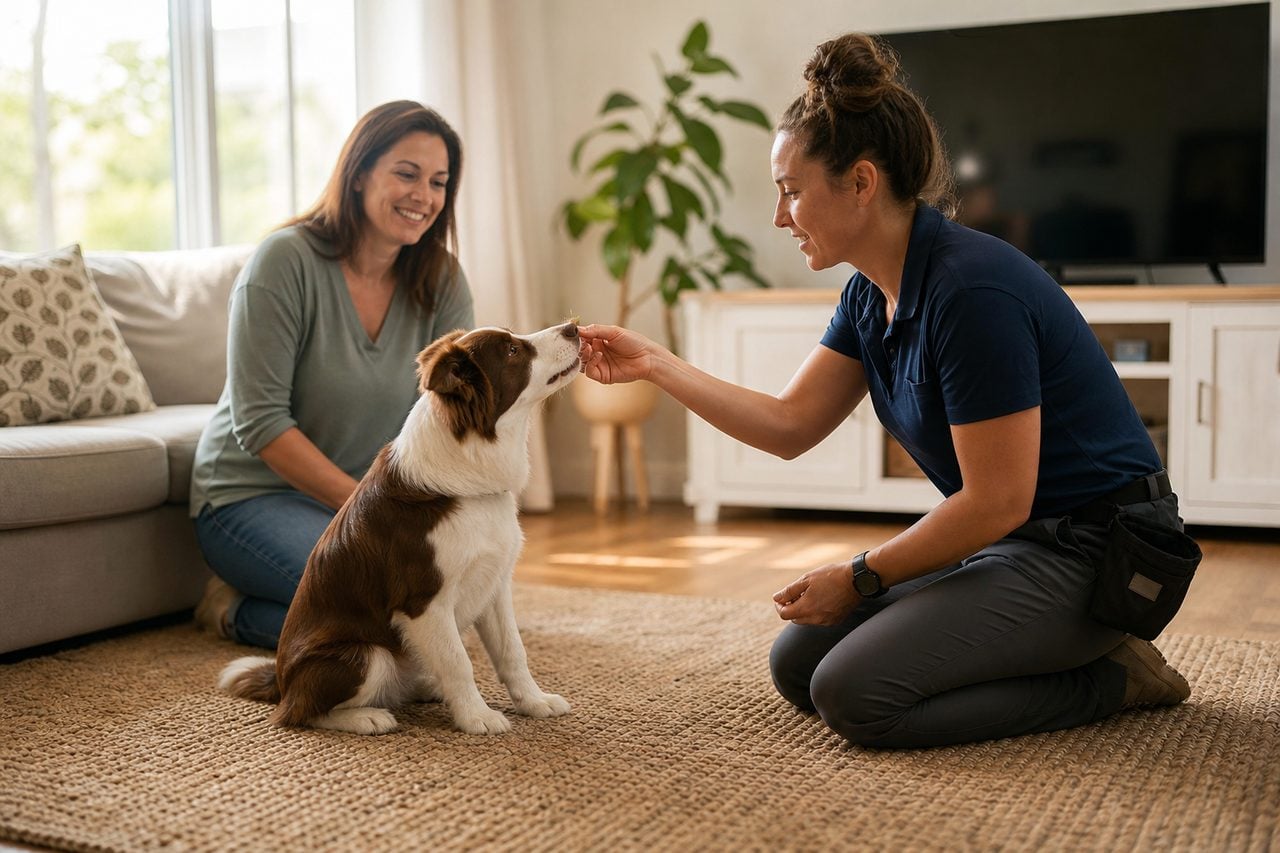
In-home dog training brings the lesson to where your dog actually lives, and for many Berks County families that is exactly what makes it work. A dog behaves very differently in a quiet training studio than it does in your own kitchen at dinnertime, at the front door when the mail carrier comes, or on the sidewalk of your Mount Penn block when a neighbor’s dog appears. When the training happens in the real environment — the same rooms, the same doorways, the same triggers — the skills tend to stick because there is no gap between where the dog learns and where the dog needs to perform.
- What In-Home Training Is Best For
- Where In-Home Training Has Limits
- What a Typical In-Home Session Looks Like
- How Programs Are Typically Structured
- Preparing Your Home and Family for Training
- Choosing a Qualified In-Home Trainer in the Reading Area
- Getting the Most Out of In-Home Training
- Reviewed trainers
- FAQ
For Reading-area households, in-home training also solves practical problems. If you have a reactive dog that is hard to load into the car, a new puppy you would rather not expose to other dogs yet, a senior dog with mobility limits, or a packed schedule across Wyomissing, Sinking Spring, or the farm country out toward Bernville, having a trainer come to you removes a real barrier. It is private, focused entirely on your dog, and built around the specific layout and routines of your home rather than a generic curriculum.
This guide walks through what in-home training is good for and where it has limits, how a typical session and program run, what the trainer will assess about your space, and how to choose a qualified professional in the Reading area. It also covers how to prepare your household so the visits land well and how to keep the skills holding up once the trainer is no longer coming by. From Reading city and Mount Penn out to Kutztown, Birdsboro, Boyertown, and the Pottstown edge, in-home work meets your dog on its own turf — which is both its greatest strength and the thing that defines its limits. The goal is to help you decide whether bringing training into your home is the right fit for your dog — and how to get the most out of it if it is.
What In-Home Training Is Best For
In-home training shines for problems that are tied to your specific environment. Housetraining, door-dashing, jumping on guests, counter-surfing, leash manners that fall apart on your own street, crate training, and settling calmly while the family eats are all behaviors that live in the home — so teaching them there is the most direct route. The dog learns the rule in the exact spot where the rule applies, which removes the frustrating “but he does it perfectly in class” problem many owners report.
It is also a strong fit for particular dogs and households. Puppies who are not yet fully vaccinated can begin learning safely at home without exposure to unknown dogs. Fearful or reactive dogs that find a group class overwhelming can make progress in the low-distraction comfort of their own space before tackling busier environments. Senior or recovering dogs with limited mobility avoid the stress of travel. And busy Reading families who simply cannot commit to a fixed weekly class time across the county get flexibility that group programs cannot match.
In-home work is equally valuable for coaching the humans. Because the trainer sees your actual routines — how the family comes and goes, where the dog sleeps, how mealtimes run — the advice is tailored rather than generic. Much of in-home training is really about teaching the household consistent handling, since the dog spends almost all its time with you, not the trainer. That hands-on, family-wide coaching is hard to replicate in a one-size-fits-all class.
Where In-Home Training Has Limits
For all its strengths, in-home training is not the right tool for every goal, and an honest trainer will say so. The biggest limitation is distraction and socialization. A dog can master a perfect “stay” in the calm of its own living room and still fall apart at the Reading farmers market or on a busy stretch of the Schuylkill River Trail. Skills learned in a quiet home do not automatically generalize to chaotic public settings — that requires deliberate practice in progressively harder environments, which a home cannot fully provide.
Socialization is the other gap. Puppies and under-socialized dogs need controlled, positive exposure to other dogs and people, and a living room cannot supply that. For dog-dog social skills in particular, a well-run group class or structured outings offer something in-home work simply cannot. Many trainers address this by blending approaches — starting in-home to build foundations, then moving to public locations or recommending a group class once the dog is ready.
There are practical limits too. In-home sessions are typically pricier per hour than group classes because you are paying for one-on-one time and the trainer’s travel across Berks County. Some serious cases — significant aggression, complex behavior disorders — may need a board-and-train arrangement or a veterinary behaviorist rather than periodic home visits. In-home training is a powerful starting point and an excellent fit for environment-specific issues, but the smartest programs treat it as one stage in a plan, not the whole plan.
What a Typical In-Home Session Looks Like
Most in-home programs open with an assessment visit. The trainer talks through your goals, watches how the dog behaves in its normal environment, and observes the household dynamics — who feeds the dog, where it sleeps, what triggers the problem behaviors, and how the family currently responds. This first session is as much about gathering information as teaching, and it is where the customized plan takes shape. A good trainer spends real time listening before prescribing anything.
Subsequent sessions usually run around an hour and are highly hands-on. The trainer demonstrates a technique, then coaches you and your family members to do it correctly, because the household is who carries the training forward between visits. You might work on door manners at your actual front door, practice loose-leash walking on your own street, or rehearse a calm settle on the mat where the dog usually pesters guests. The trainer adjusts in real time to your dog and your space.
Homework is central to the model. Because the trainer is only present a few hours a week at most, the real learning happens in the practice you do daily between sessions. Expect to receive specific assignments — short, repeatable exercises woven into normal routines — and to report back on what worked and what did not. Owners who treat the homework as the main event, with the trainer as coach rather than miracle worker, get dramatically better results than those who expect the visits alone to fix things.
How Programs Are Typically Structured
In-home training is usually sold in packages rather than single visits, because behavior change takes repetition over time. A common structure is a multi-session package — often spanning several weeks — that starts with foundations and builds toward your specific goals. Spacing sessions a week or so apart gives the household time to practice each skill before adding the next, which is far more effective than cramming everything into back-to-back visits.
Prices vary by trainer, package length, and how far across Berks County the trainer has to travel, so expect in-home work to cost more per session than a group class — you are paying for individualized attention and drive time. Rather than quoting figures, it is worth asking each trainer exactly what a package includes: number and length of sessions, between-session support by phone or text, written plans, and whether follow-up visits are available if a new issue arises. Clear scope prevents surprises.
Many Reading-area trainers offer hybrid models that play to in-home strengths while covering its gaps. A program might begin with several home sessions to establish foundations, then graduate to practicing in public spots — a quiet park, a pet-friendly store, a trailhead — to build the real-world reliability a living room cannot. Some pair in-home work with an eventual group class for socialization. When evaluating options, look for a trainer who is honest about when to move beyond the home rather than one who sells home visits as the answer to everything.
Preparing Your Home and Family for Training
A little preparation makes in-home sessions far more productive. Before the trainer arrives, think through your top priorities so the first visit is focused — whether that is housetraining, jumping, leash pulling, or settling during meals. Have the dog’s gear handy (a flat collar or harness, a regular leash, high-value treats your dog loves), and clear a workable space. Decide whether the dog should be calm and crated when the trainer first knocks or free to greet, and ask the trainer ahead of time which they prefer.
Getting the whole household on board is one of the biggest predictors of success. Because the dog lives with the family, everyone who interacts with it needs to apply the same rules and cues the same way — mixed messages from different family members are a leading cause of slow progress. Aim to have the people who handle the dog regularly present for at least the key sessions so they learn the techniques directly rather than secondhand. Consistency across the household is what turns a trained behavior into a permanent habit.
Managing the environment during training also helps. If counter-surfing is the issue, keep counters clear so the dog is not rehearsing the bad habit between sessions; if door-dashing is the problem, use a baby gate or leash to prevent practice runs while the new skill is still forming. Removing easy opportunities to repeat the unwanted behavior means the dog spends its time practicing the right thing instead. Small management tweaks like these, combined with daily homework, let the in-home program work as designed.
Choosing a Qualified In-Home Trainer in the Reading Area
Because dog training is an unregulated field — anyone can call themselves a trainer — vetting matters, especially when you are inviting someone into your home. Start by looking for recognized professional credentials and continuing education, and ask what methods the trainer uses. Reward-based, positive-reinforcement approaches are the current standard of care and are appropriate for the vast majority of pet-dog issues. Be cautious of anyone who leans on fear, intimidation, or harsh corrective tools, particularly for fearful or reactive dogs where such methods can backfire badly.
Ask practical, specific questions before booking. How does the trainer handle a problem like yours? What does a package include and cost? Do they carry liability insurance? Will they coach the whole family? Can they explain what happens if the dog does not respond to the plan? A confident, qualified professional welcomes these questions and answers them clearly. Vague guarantees of a “fully trained dog in X days” are a red flag — reputable trainers talk in terms of process and your participation, not magic timelines.
Finally, factor in your Berks County geography and the trainer’s honesty about scope. Confirm the trainer actually services your area — from Reading city out to Kutztown, Birdsboro, Boyertown, or the Pottstown edge — since travel range varies. And give weight to a trainer who tells you when in-home work alone is not enough and recommends a group class or public practice for socialization and real-world reliability. That kind of candor signals someone focused on your dog’s actual outcome rather than just selling more home visits.
Getting the Most Out of In-Home Training
The owners who get the best results from in-home training treat themselves as the dog’s primary teacher, with the trainer as a skilled coach. Since the professional is in your home only a few hours across the whole program, the daily five-to-ten-minute practice sessions you run yourself are where the behavior actually changes. Keeping those sessions short, upbeat, and frequent — woven into normal moments like before a meal or before a walk — outperforms occasional long drills that leave both you and the dog frustrated.
Build practice into Reading life rather than treating it as a separate chore. Reinforce loose-leash walking on the way to the Schuylkill River Trail, practice a calm settle while the family watches TV, rehearse polite door greetings when a neighbor stops by, and reward check-ins on quiet strolls around Mount Penn. The more the trained behaviors show up in ordinary daily situations, the more reliable they become — the dog learns that the rules apply everywhere, not just during a formal session.
Plan for the generalization step that home training alone cannot finish. Once your dog is solid at home, deliberately practice the same skills in gradually busier settings — a quiet corner of a park, a pet-friendly store, a less-trafficked trailhead — so the behaviors hold up around real distractions. Keep a light log of wins and sticking points to share with your trainer, and do not hesitate to book a follow-up if a new issue surfaces. In-home training gives you the foundation; consistent daily practice and a thoughtful move toward real-world distractions are what make it last.
Reviewed In-Home Dog Training Trainers in Reading
These reviewed Reading-area trainers from our directory handle in-home dog training. Each links to a full profile with specialties, certified credentials, reviews, and contact info:
- Cappuccino Dog Training Inc. — 5.0★ (109 reviews)
- Dentler’s Dog Training, LLC — 5.0★ (33 reviews)
- For Them Dog Training — 5.0★ (30 reviews)
- Alpha U dog training — 5.0★ (23 reviews)
- Happy Wags Dog Training LLC — 5.0★ (20 reviews)
- The Clever Hound LLC — 5.0★ (11 reviews)
- The Virtuous Dog — 5.0★ (10 reviews)
- The Art of Dog Training — 5.0★ (10 reviews)
- Get Connected Canine Coaching — 5.0★ (1 reviews)
- Neverland K-9 Institute — 4.9★ (16 reviews)
See all Reading in-home dog training trainers →
Frequently Asked Questions
What is in-home dog training best for?
It is best for problems tied to your specific environment — housetraining, door-dashing, jumping on guests, counter-surfing, crate training, and settling calmly at home — because the dog learns the rule exactly where it applies. It also suits puppies not yet fully vaccinated, fearful or reactive dogs that find group classes overwhelming, senior dogs with mobility limits, and busy Berks County families who need flexibility. A major benefit is coaching the whole household in consistent handling.
What can't in-home training handle on its own?
Its biggest limits are distraction-proofing and socialization. A dog can be perfect in a quiet living room and fall apart on a busy trail or at a crowded market, because skills do not automatically generalize to chaotic settings. Puppies and under-socialized dogs also need controlled exposure to other dogs that a home cannot provide. The best programs blend in-home foundations with later public practice or a group class to fill these gaps.
How much does in-home training cost in the Reading area?
Expect in-home work to cost more per session than a group class, since you are paying for one-on-one attention plus the trainer’s travel across Berks County. Programs are usually sold as multi-session packages rather than single visits. Rather than focusing on a single figure, ask each trainer what a package includes — number and length of sessions, between-session support, written plans, and follow-up availability — so you can compare value fairly.
What happens during a typical in-home session?
The first visit is usually an assessment: the trainer discusses goals, watches your dog in its normal environment, and observes household routines before building a customized plan. Later sessions run about an hour and are hands-on — the trainer demonstrates a technique, then coaches you and your family to do it at your actual front door, on your street, or wherever the issue occurs. You then practice assigned homework daily between visits, which is where most of the learning happens.
Will in-home training socialize my puppy?
Only partly. In-home training lets an under-vaccinated puppy start learning safely without exposure to unknown dogs, which is valuable early on. But true socialization — controlled, positive exposure to other dogs and people — needs more than a living room can offer. A common approach is to build foundations at home, then move to a well-run group class or structured outings for the dog-dog social skills that in-home work cannot fully provide.
How do I choose a qualified in-home trainer near Reading?
Dog training is unregulated, so vet carefully before inviting someone into your home. Look for recognized credentials, continuing education, and reward-based methods, which are the standard of care for pet dogs. Ask how they would handle your specific problem, what packages include and cost, whether they carry insurance, and whether they coach the whole family. Confirm they service your part of Berks County, and value a trainer honest enough to recommend a group class when in-home work alone is not enough.
Related: read our complete in-home dog training guide or the full Reading dog training overview.
Ready to find the right in-home dog training pro in Reading?