
Board & Train in Altoona, PA
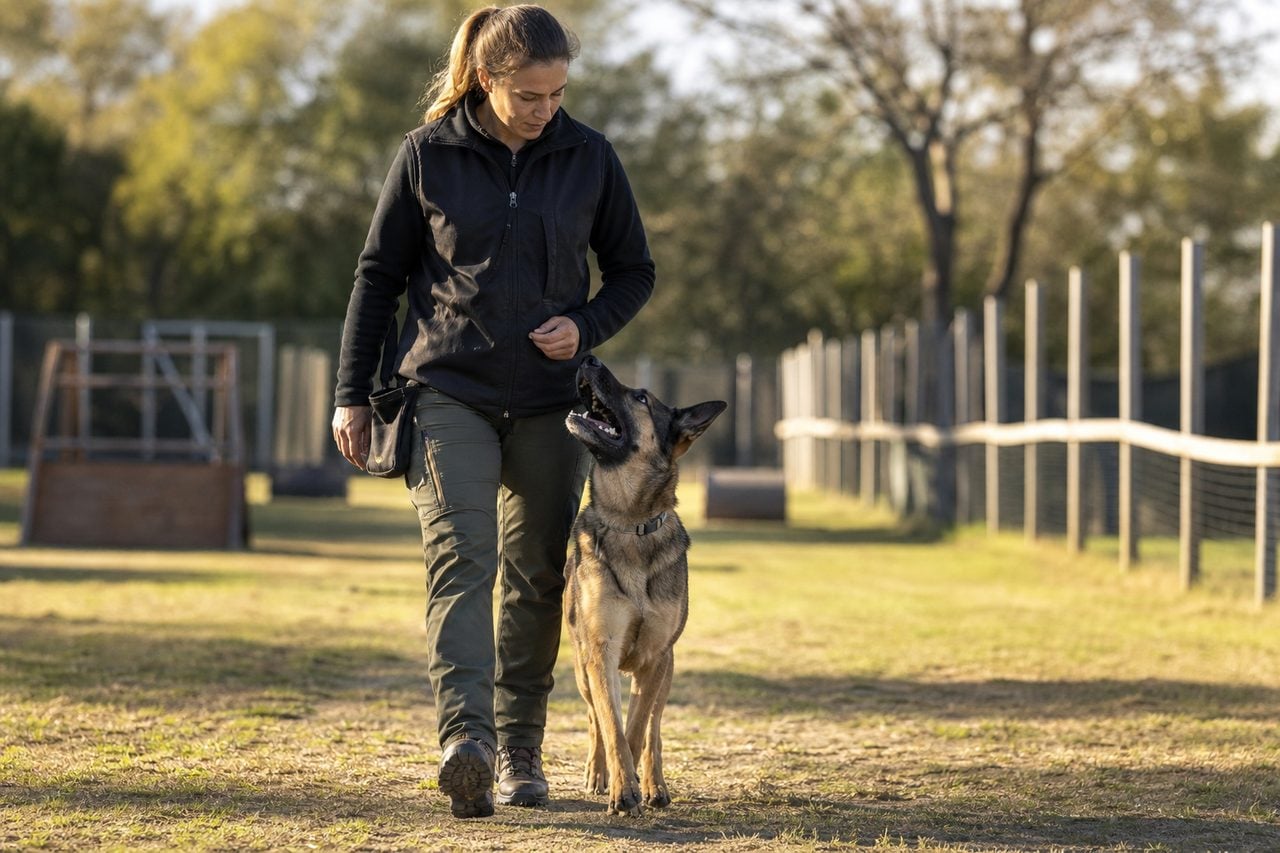
Board-and-train programs send your dog to live with a professional trainer for a stretch of days or weeks, so that structured instruction happens away from the daily chaos of home. For families across Altoona and Logan Township — and out through Hollidaysburg, Duncansville, Tyrone, and the Morrisons Cove towns of Roaring Spring, Martinsburg, and Claysburg — the appeal is obvious. A busy work schedule, a rambunctious adolescent dog, and not nearly enough hours in the week to run consistent training sessions add up to a stubborn problem. A residential program promises to compress weeks of daily reps into one focused block, all while the dog stays with someone who does this for a living.
- How Board-And-Train Actually Works
- Board-And-Train Versus Day Boot Camp
- What A Program Near Altoona Can Realistically Deliver
- Questions To Ask Before You Enroll
- Preparing Your Dog And Your Home
- Cost, Distance, And The Harrisburg Or Pittsburgh Question
- Deciding Whether Board-And-Train Is Right For You
- Reviewed trainers
- FAQ
It is worth being honest about what the Altoona market actually looks like before you start calling around. This is a railroad city of roughly 43,000 people, tucked into the Logan Valley beneath the Allegheny Front, and it is a considerably smaller market than Harrisburg or Pittsburgh. Some local trainers here do offer residential or send-away options, and a few are genuinely good at them. But the deepest selection of dedicated board-and-train facilities — purpose-built kennels, multiple program tiers, and staff carrying formal behavior credentials — tends to concentrate in those larger metros about an hour and a half away in either direction. Locally you may find one or two solid options rather than a dozen, and that is simply the reality of a valley town, not a knock on the trainers who work here.
This guide explains how board-and-train actually works, how it differs from a day-based boot camp, what to ask before you hand over your dog, how to prepare your household, what it tends to cost, and how to judge whether a program near Altoona fits your particular dog — or whether a drive toward Harrisburg or Pittsburgh is the smarter call for a harder case. The GetDogSchool Editorial Team writes these guides to help you make an informed decision, not to steer you toward any single trainer or push you out of town for problems that can be handled right here in Blair County.
How Board-And-Train Actually Works
In a board-and-train, your dog lives at a trainer’s facility or private home for a defined period, most commonly two to four weeks, though some programs run shorter and others considerably longer. During that stay the trainer works the dog through a curriculum — typically foundation obedience, leash manners, impulse control, and whatever specific issues you flagged at intake. The core idea is repetition and consistency: a professional running multiple short sessions a day, every single day, without the interruptions and mixed signals of a working household where three different people give three different commands.
The critical, often-overlooked half of the program is the handoff. A dog trained by someone else does not automatically obey you the moment it comes home. Good programs build in transfer sessions where you learn the exact cues, the timing, and the handling the trainer used, so the behavior carries back to your home in Altoona or Bellwood rather than staying locked with the trainer. When you compare programs, weigh the go-home instruction as heavily as the boarding weeks themselves. Ask how many owner sessions are included, whether follow-up visits are part of the quoted price, and what happens if the dog backslides once it is back in its old Logan Valley routines. A residential program with no structured handoff is only half a program, no matter how polished the dog looks on pickup day.
Board-And-Train Versus Day Boot Camp
People use these two terms loosely and interchangeably, so it helps to separate them clearly before you shop. Board-and-train is residential by definition: the dog sleeps at the facility for the full duration of the program. A day boot camp, sometimes called a day-training program, is a different arrangement — the dog is dropped off in the morning, works through intensive sessions during the day, and comes home again each night. Both formats compress training into a concentrated block, but the living arrangement changes what kind of dog and owner each one suits.
Residential board-and-train makes the most sense when the home environment itself is part of the problem, when travel or work makes daily drop-offs impractical, or when a dog genuinely needs a full reset away from deeply established habits. A day boot camp keeps the dog in its own home each evening, which many owners prefer for anxious dogs, and which lets you reinforce that day’s progress every night. For an Altoona family weighing a Hollidaysburg day program against a residential stay somewhere farther out, the deciding factors are usually your dog’s temperament, how far you can realistically drive twice a day, and whether nights at home help or hinder the specific behavior you are trying to change. Neither format is universally better than the other; they simply solve slightly different problems for slightly different dogs.
What A Program Near Altoona Can Realistically Deliver
Set your expectations honestly before you enroll and pay. A well-run residential program can build a strong, reliable foundation: a dependable sit, down, place, and recall, loose-leash walking, and noticeably calmer responses to everyday triggers. What it cannot do is guarantee a finished dog that never needs maintenance again. Behavior is an ongoing practice, not a one-time software install, and the dog’s environment back home — the kids, the doorbell, the delivery trucks, the squirrels along the Lower Trail — keeps shaping it long after the program ends and the trainer waves goodbye.
In a smaller market like Blair County, the range of specialization on offer is naturally narrower than in a big metro. A local trainer may be genuinely excellent at everyday obedience and household manners while not offering a dedicated track for, say, severe separation distress or complex aggression. That is entirely normal for a valley town and nothing to be surprised by. The honest framing is that Altoona-area programs are often a strong, convenient fit for the common cases — the unruly adolescent, the relentless puller, the jumper, the dog that treats recall as a suggestion — and that genuinely specialized or difficult cases may be better served by a program in Harrisburg or Pittsburgh. Match the difficulty of your case to the depth of the program, and do not assume the nearest option is automatically right, nor that you must drive an hour for a routine problem you could solve locally.
Questions To Ask Before You Enroll
Before committing your dog to weeks away from home, treat the intake conversation like a serious interview, because it is one. Ask what methods the trainer uses and press them to explain those methods in plain language — you want a clear, reward-based, humane approach that you actually understand, not vague reassurances or industry jargon. Ask directly about their experience with dogs like yours, how the daily sessions are structured, and how much of each day the dog spends actively working versus resting quietly in a kennel run.
Get specifics on the living conditions your dog will experience. Where does the dog sleep? How often is it exercised and let out? Does it mix with other dogs, and how do they handle a dog that gets sick or injured on their watch? Ask for references from past clients and, ideally, to tour the facility in person before you book anything. Clarify the money side too — the total cost, exactly what the follow-up support includes, and any refund or reassessment policy if the program plainly is not working. A trustworthy trainer near Altoona will answer all of this openly and invite you to come see the place. Evasiveness, high-pressure sales tactics, or bold promises of guaranteed results are all good reasons to slow down and keep looking, whether the program sits in Duncansville or an hour away in a larger city.
Preparing Your Dog And Your Home
A little preparation makes the whole transition smoother for everyone involved, dog and human alike. Before the stay begins, make sure your dog’s vaccinations are fully current — most reputable facilities require proof, and it protects both your dog and the others sharing space in the program. Pack the food your dog already eats to avoid the stomach upset that so often follows an abrupt diet switch, and send along a familiar item or two if the trainer permits it. Share an honest, complete history: bite incidents, specific fears, medical conditions, and what has and has not worked in past training attempts. Withholding information helps no one and can put both the dog and the handlers at real risk.
Prepare your home for the return, too, because that is where the investment either holds or evaporates. The entire point of the program is that the trained behavior comes back with the dog, and that only happens if you keep the structure going. Decide as a household, in advance, on consistent cues and consistent rules, so the dog is not getting one message in the kitchen and the opposite one in the backyard. Block out real time in the first weeks home to practice what the trainer taught you during the handoff. A dog returning to a Logan Township house that quietly reverts to all its old habits will lose ground within days; a household that holds the routine steady will watch the investment actually pay off and last.
Cost, Distance, And The Harrisburg Or Pittsburgh Question
Residential training is one of the more expensive services in the dog world, and for an understandable reason: you are paying for weeks of daily professional time plus room and board on top of it. Prices vary widely with program length, facility quality, and the trainer’s credentials and reputation, so gather several quotes rather than anchoring on the very first number you hear. Cheaper is not automatically worse, and pricey is not automatically better — look hard at what the fee actually buys, and pay particular attention to how much follow-up support is bundled in versus billed separately later.
Distance is the other big variable that Altoona families end up weighing. Harrisburg and Pittsburgh each sit roughly an hour and a half away, and each holds more residential facilities and more specialized programs than the Logan Valley can. For a routine obedience reset, that drive is usually unnecessary — a solid local or regional program handles the common cases perfectly well, and staying close makes the go-home sessions far easier to actually attend. For a difficult or unusual case where local depth genuinely runs thin, the larger markets may offer a better-matched program, and the extra travel can be worth every mile. Decide based on your dog’s actual needs and how involved you want to stay during the boarding weeks, not on distance alone or on the assumption that farther and pricier must mean better.
Deciding Whether Board-And-Train Is Right For You
Board-and-train is a tool, not a cure-all, and it fits some situations far better than others. It tends to pay off handsomely when you have a healthy dog with trainable habits, a genuine time crunch that blocks consistent daily practice at home, and a real willingness to do the go-home work that makes the results stick. It is a poor fit if you are quietly hoping to outsource the relationship entirely, because the dog still comes home to you, your handling, and your household, and it will read all three within an afternoon of being back.
If your dog’s issue is rooted in fear, anxiety, or aggression rather than plain obedience, a straight obedience board-and-train may not address the underlying emotion at all — those cases often need an assessment-first, behavior-focused approach, and possibly a veterinary check to rule out pain or illness, before any intensive program even begins. In the Altoona area, start by talking with local trainers about whether your case fits what they honestly offer, and stay open to a Harrisburg or Pittsburgh referral if it does not. The GetDogSchool Editorial Team’s aim is a realistic match between your dog, your budget, and the program — whether that program sits right here in the Logan Valley or an hour and a half down the road toward a bigger city.
Board & Train in Altoona: Local Options & Nearest Specialists
A few Altoona-area trainers can help with milder board & train needs:
- Triple Tree Kennels — 5.0★ (1 reviews)
- Altoona Area Kennel Association — 1.0★ (1 reviews)
Nearest board & train specialists — Harrisburg
For complex cases, the closest metro with dedicated board & train trainers is Harrisburg (an easy drive for an assessment or a board-and-train stay). Top-reviewed options:
- Carolyn Hart Dog Training — 5.0★ (63 reviews)
- Cold Creek Dog Training- Hummelstown – Harrisburg — 5.0★ (34 reviews)
- Arcona Prep — 5.0★ (32 reviews)
- Bark Boot Camp — 5.0★ (22 reviews)
- Hard Nose K9 Services LLC — 5.0★ (20 reviews)
- Anchors Dog Training Academy — 5.0★ (11 reviews)
- Magnus K9 — 5.0★ (11 reviews)
- Cold Creek Dog Training- Carlisle, PA — 5.0★ (7 reviews)
See all Harrisburg board & train trainers →
Frequently Asked Questions
How long does a typical board-and-train program last?
Most residential programs run two to four weeks, though some are shorter and others longer depending on the goals and the individual dog. Longer is not automatically better — what matters far more is the quality of the daily work and the go-home instruction that transfers the behavior back to you. Ask any Altoona-area trainer to explain why they recommend a particular length for your specific dog, rather than accepting a one-size-fits-all package at face value.
Will my dog listen to me after training with someone else?
Only if the program includes a proper handoff. A dog trained by a professional does not automatically obey a new handler, so the transfer sessions where you learn the cues, timing, and handling are absolutely essential. When comparing programs near Altoona or Hollidaysburg, weigh the owner-instruction and follow-up support as heavily as the boarding weeks themselves. A residential stay with no structured go-home component is only half a program, however good the dog looks at pickup.
What is the difference between board-and-train and a day boot camp?
Board-and-train is residential — your dog lives at the facility for the program’s full duration. A day boot camp is drop-off in the morning and back home each night. Residential suits cases where a full reset away from home helps, or where daily drop-offs are impractical; day programs let anxious dogs sleep at home and let you reinforce progress nightly. Neither is universally better; they fit different dogs, temperaments, and schedules.
Are there board-and-train options right in Altoona?
Some local trainers in the Altoona and Blair County area do offer residential or send-away options, but this is a smaller market than Harrisburg or Pittsburgh, so the selection is naturally narrower. You may find one or two solid options rather than many. For routine obedience that is usually plenty; for specialized or difficult cases, the larger markets about ninety minutes away hold more dedicated facilities and credentialed staff worth the drive.
Can board-and-train fix aggression or severe anxiety?
A standard obedience board-and-train is not designed to resolve aggression or deep anxiety, which are emotional problems rather than simple obedience gaps. Those cases call for an assessment-first, behavior-focused approach and often a veterinary check to rule out pain or a medical cause. Be cautious of any program guaranteeing a cure. For serious behavior cases, ask about a referral toward veterinary behavior resources in Harrisburg or Pittsburgh, where the deepest expertise sits.
How much should I expect to pay?
Residential training is among the pricier dog services because you are paying for weeks of daily professional time plus room and board, so costs vary widely with program length, facility, and credentials. Gather several quotes and compare what each fee actually includes — especially the follow-up support — rather than anchoring on the lowest or highest number. Cheaper is not automatically worse, and expensive is not automatically better; the details of the program matter most.
Related: read our complete board & train guide or the full Altoona dog training overview.
Ready to find the right board & train pro in Altoona?