
In-Home Dog Training in Grand Rapids, MI
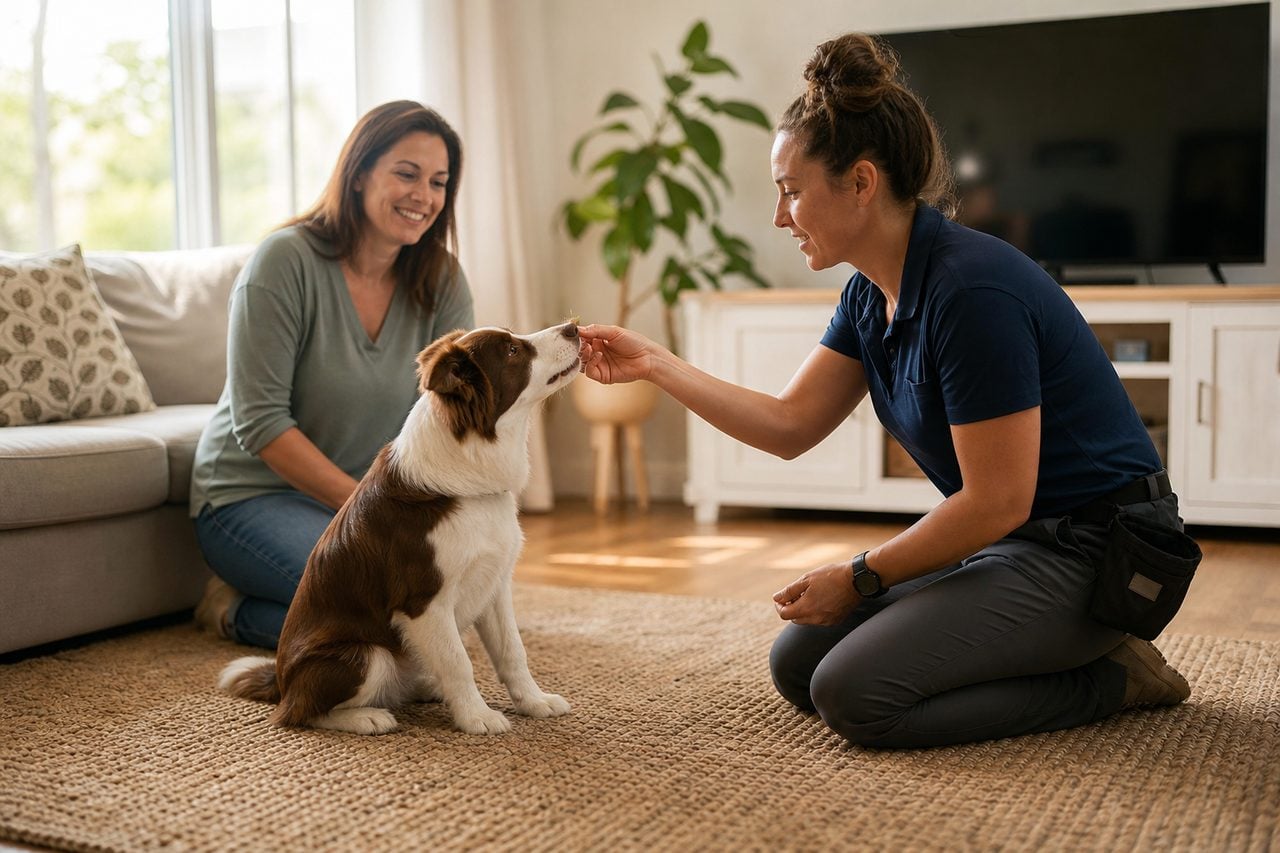
In-home dog training flips the usual model: instead of loading your dog into the car and driving to a class, the trainer comes to you. For a lot of Grand Rapids households that turns out to be exactly what the situation calls for, because most behavior problems don’t happen in a training center — they happen at your front door when guests arrive, on your street when a neighbor’s dog walks by, or in your kitchen when the counter is loaded with food. Training where the problem lives means you fix the real thing rather than a rehearsal of it.
This guide covers what in-home training is, the situations where it beats other formats, how a typical program is structured, and how to get the most out of a trainer working in your own space. Whether you’re in a downtown apartment, a house in Wyoming or Kentwood, or out toward Lowell or Rockford with more land, understanding the format helps you decide if it’s the right investment.
What In-Home Dog Training Involves
In-home dog training means a professional trainer comes to your house to work with you and your dog in the environment where you both actually live. Sessions usually run about an hour and are spaced out over several weeks, with homework in between so the training compounds. The trainer coaches you as much as the dog — the goal is to build your handling skills so the behaviors continue long after the program ends.
Because it happens in your real environment, the training addresses your specific triggers and layout. If your dog loses its mind when the doorbell rings, you practice at your actual door. If it bolts out of the gate, you work on your actual gate. This context is the whole advantage: dogs are famously bad at generalizing, so a behavior learned in a neutral training room often doesn’t transfer home, while a behavior trained at home is already where you need it.
In-home programs typically cover the same fundamentals as any good training — recall, leash manners, sit, down, stay, place, polite greetings, and impulse control — plus household-specific issues like door-dashing, jumping on guests, counter-surfing, resource guarding around furniture, and crate or potty problems. The plan is customized to your goals rather than following a fixed class curriculum, which is one reason it works well for problems that don’t fit neatly into a group syllabus.
When In-Home Training Is the Right Choice
In-home training is the strongest option when the problem is tied to your specific environment. Door manners, guest greetings, guarding a particular spot on the couch, backyard boundary issues, and reactivity that fires on your own street are all things that are far easier to fix on location than to simulate elsewhere. If your frustration is mostly about what happens inside your four walls, this format targets it directly.
It’s also ideal for dogs that struggle in busy group settings. A fearful, easily overwhelmed, or reactive dog may be unable to learn anything in a room full of other dogs — the stress simply crowds out the learning. Starting one-on-one at home, where the dog feels safe, often lets it make progress that a group class never could, and you can add controlled distractions gradually on your own terms.
Convenience is a legitimate reason too. Families with young kids, people with mobility limitations, owners with packed schedules, and anyone without an easy way to transport a large or anxious dog all benefit from the trainer coming to them. And puppies that aren’t fully vaccinated yet can start learning good habits at home safely before they’re cleared for public spaces. The main trade-off is that a pure in-home program offers less exposure to novel environments and other dogs, so if broad socialization is a top goal you may want to layer in outings to public spots around town as the dog progresses.
How a Typical In-Home Program Runs
A good in-home program starts with an assessment session. The trainer observes your dog in its home environment, asks detailed questions about the history and the specific problems, watches the behaviors happen naturally, and builds a customized plan. This first visit is also where a skilled trainer often spots contributing factors the owner has stopped noticing — a routine, a layout issue, or a well-meaning habit that’s quietly reinforcing the problem.
From there, sessions build progressively. Early visits establish foundational communication and the core behaviors; later visits layer in difficulty and tackle the specific issues on your list. Crucially, the trainer coaches you through the handling in real time, corrects your timing and mechanics, and leaves you with clear homework for the days between sessions. That between-session practice is where most of the actual learning happens — the weekly visit is really a checkpoint and course-correction, not the whole of the training.
As your dog gets reliable at home, a thoughtful trainer starts generalizing the skills to more challenging settings. That might mean practicing on your street, then a quiet neighborhood park, then somewhere busier. West Michigan gives you a natural progression to work with — a calm stretch at a neighborhood park, then somewhere with more foot traffic like Riverside Park, then the genuine bustle of Millennium Park on a weekend — so your dog learns the same skills hold up everywhere, not just in the living room.
In-Home Versus Group Classes and Board-and-Train
Each format has a niche, and understanding the trade-offs helps you spend wisely. Group classes are typically the most affordable and offer something in-home can’t easily replicate: practice around other dogs and people in a controlled setting, which is valuable for socialization and for proofing behaviors against distraction. The downside is a fixed curriculum that may not target your specific issue, and an environment that overwhelms some dogs.
Board-and-train, or boot camp, hands the daily work to a professional who trains your dog full-time for weeks. It suits owners who can’t commit to daily practice or who are stuck on an entrenched problem, but it’s the most expensive option and it does the initial work away from your home, so there’s always a transfer step to bring the results back into your environment.
In-home training sits in a useful middle ground: more personalized than a group class, less expensive than board-and-train, and uniquely good at fixing environment-specific problems because it happens in that exact environment. Its weakness is limited exposure to novelty and other dogs. Plenty of Grand Rapids owners get the best of both worlds by starting in-home to build a foundation and fix household issues, then adding group sessions or public outings once the dog is ready for more distraction. There’s no single right answer — match the format to the actual problem you’re solving.
Getting the Most From Your Sessions
The owners who get the best results treat in-home training as a partnership rather than a drop-off service. Before the first session, write down the specific behaviors you want to change and any patterns you’ve noticed — when the problem happens, how often, and what usually triggers it. This gives the trainer a head start and helps you both measure progress honestly over the weeks.
During sessions, get everyone in the household involved when possible. Dogs quickly learn to obey the person who enforces the rules and ignore the one who doesn’t, so if one family member is doing all the training and another is undoing it, progress stalls. Even kids can learn to give cues consistently with a little coaching, and a united household is one of the biggest predictors of success.
Between sessions, do the homework — genuinely, in short bursts, most days. Ten focused minutes daily beats one long session a week by a wide margin. Practice the skills in the actual situations where you need them, not just in a quiet moment when it’s convenient. And keep notes on what’s working and where you’re stuck so you can use each session efficiently. Finally, be patient and consistent: real behavior change is a gradual process, and the plateaus are normal. Trust the plan, keep the standards up, and lean on your trainer when you hit a wall.
Choosing an In-Home Trainer You Can Trust
Because an in-home trainer works closely with you and your dog in your personal space, fit and trust matter a great deal. Start by asking how they train and how they handle unwanted behavior. You want clear, humane, specific answers grounded in rewarding good choices and setting the dog up to succeed, not vague talk or heavy reliance on intimidation. A trainer who can explain their reasoning in plain language usually knows what they’re doing.
Ask about their experience with your particular issue. A trainer who’s great with basic puppy manners may not be the right person for serious reactivity or resource guarding, and a good professional will tell you honestly where their strengths lie and refer out when a case is beyond their scope — especially with aggression or significant anxiety. That honesty is a green flag, not a weakness.
Clarify the practical details up front: how many sessions a program includes, roughly how far apart they’re spaced, what happens if you need extra support, and what’s expected of you between visits. Ask whether they serve your area — trainers in the region cover the city and suburbs from Grandville and Wyoming out to Rockford, Ada, and Lowell, but travel range varies. West Michigan has a deep and experienced training community, so you can afford to talk with more than one and choose the person who communicates clearly, sets realistic expectations, and genuinely connects with your dog.
In-Home Dog Training in Grand Rapids: Local Options & Nearest Specialists
Right now there are no listed Grand Rapids trainers focused specifically on in-home dog training. Many general Grand Rapids dog trainers handle milder cases, and for anything serious the nearest specialists are below.
Nearest in-home dog training specialists — Detroit
For complex cases, some families travel to the larger pool of specialists in the Detroit area for an assessment or a board-and-train stay. Top-reviewed options:
- Paws Around Motown — 5.0★ (78 reviews)
- K9 AdvantEDGE Dog Training — 5.0★ (40 reviews)
- Iron Clad K9 Training — 5.0★ (13 reviews)
- New Tricks: Puppy and Dog Training LLC — 5.0★ (12 reviews)
- Tip Top K9 Sterling Heights Dog Training — 5.0★ (7 reviews)
- Paws N Play — 4.9★ (70 reviews)
- Four Legged Rascals — 4.9★ (16 reviews)
- Animal Behavior Consultants of Michigan — 4.7★ (29 reviews)
See all Detroit in-home dog training trainers →
Frequently Asked Questions
How many in-home sessions will my dog need?
It depends on the goals and the dog, but many programs run somewhere in the range of a handful to a dozen sessions spaced over several weeks. Basic manners and a specific issue or two resolve faster; multiple entrenched problems or serious behavior work take longer. What matters more than the exact number is consistency between visits — the homework you do on your own days is where most of the learning actually happens, so steady daily practice can shorten the overall timeline.
Is in-home training more expensive than group classes?
Generally yes — in-home training costs more per session than a group class because you’re getting one-on-one, customized attention and the trainer’s travel time. It’s usually less expensive than board-and-train, though, which includes weeks of full-time care. Think of it in terms of value for your specific problem: if your issues are environment-specific or your dog can’t cope in a group, the personalized in-home approach often solves things faster and more directly, which can make it the more economical choice overall.
Can in-home training fix reactivity or aggression?
In-home training is often a good starting point for reactivity because you can begin in a low-stress environment and add controlled distractions gradually. Many reactivity cases improve substantially this way. Aggression is more serious and needs an in-person evaluation first; some cases are well-suited to in-home work while others require a longer, carefully managed plan and possibly input from a veterinary behavior professional. A responsible trainer will assess honestly and tell you if the case is beyond an in-home program’s scope.
Will my dog listen to me or only to the trainer?
A good in-home trainer coaches you, not just your dog — the entire point is to build your handling skills so the behaviors continue after the program ends. You’ll be doing the training under guidance and practicing on your own between sessions, so the dog learns to respond to you. This is actually an advantage of the in-home format over drop-off models: because you’re involved throughout and working in your own home, the results transfer directly to daily life with you.
Does my dog still need socialization if we train at home?
Often yes. In-home training is excellent for household behavior and building a foundation, but by design it offers less exposure to other dogs and novel environments. If broad socialization is one of your goals, plan to layer in controlled outings as your dog progresses — practicing learned skills at increasingly busy public spots around town helps the behaviors generalize and gives your dog healthy exposure. Many owners start in-home and add group sessions or public practice once the dog is ready.
What should I do to prepare for the first session?
Write down the specific behaviors you want to change and any patterns you’ve noticed — when problems happen, how often, and what triggers them. Have your dog’s usual food and any high-value treats on hand, since food is a common training reward. Make sure the humans who live with the dog can be present or at least aligned on the plan, and be ready to be an active participant rather than an observer. The more context and involvement you bring, the more the trainer can accomplish.
Do trainers travel to the Grand Rapids suburbs?
Many do, though the exact service area varies by trainer. Professionals in the region commonly cover the city plus surrounding communities like Wyoming, Kentwood, Grandville, Rockford, Ada, and Lowell, and some travel farther out toward the lakeshore. Because travel time is part of what you’re paying for, it’s worth confirming coverage and any distance considerations when you first reach out. West Michigan’s training community is deep enough that you should be able to find an experienced in-home trainer who serves your specific area.
Related: read our complete in-home dog training guide or the full Grand Rapids dog training overview.
Ready to find the right in-home dog training pro in Grand Rapids?