
In-Home Dog Training in Flint, MI
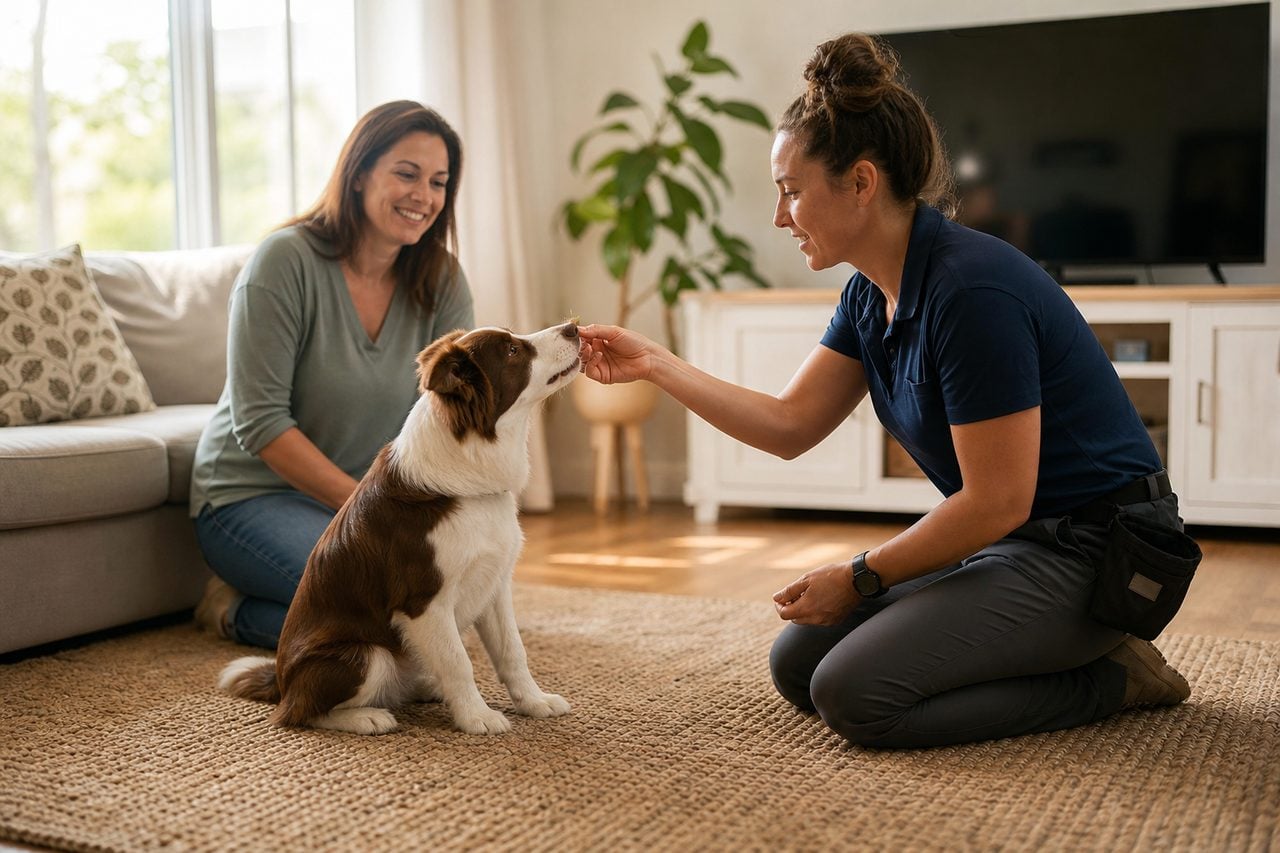
In-home dog training brings a professional trainer directly to your house, working with your dog in the exact environment where most of its behavior actually happens. For a lot of Flint-area families, that convenience and relevance is a perfect fit: the trainer sees the real doorway your dog bolts through, the real couch it will not stay off, and the real backyard where recall falls apart. It removes the drive to a facility, works around a busy schedule, and tackles problems in the context where they occur rather than in an artificial training room.
Dedicated in-home and private trainers are somewhat thinner on the ground in the immediate Flint metro than group-class facilities, and some Genesee County families end up looking toward the wider Detroit region to find a private trainer whose availability and specialty match their needs. Even so, there are real options locally, and understanding how in-home training works, what it is best suited for, and how to prepare will help you get strong value whether your trainer comes from down the road in Burton or a bit farther out.
This guide is vendor-neutral and meant to help you decide whether in-home training fits your situation and how to choose well. The directory listings below show the trainers serving the Flint area, including who offers in-home visits.
How In-Home Training Works
In-home dog training is a private, one-on-one service delivered at your residence. Instead of you loading the dog into the car and driving to a class, the trainer arrives at your Flint-area home, observes your dog in its normal setting, and works through a customized plan with you and your family. Sessions typically run around an hour, and most programs are structured as a package of several visits spread over a few weeks, with homework between each one, rather than a single visit.
The defining feature is that the training targets your real life. If your dog jumps on guests, the trainer can stage a realistic arrival at your actual front door. If it ignores recall in the yard, you practice in that exact yard with its specific distractions. Because the trainer is coaching you as much as the dog, a big part of each session is teaching your household consistent handling, so that everyone gives the same cues the same way once the trainer leaves. Consistency across family members is often the missing ingredient that in-home training is uniquely positioned to fix.
It is worth distinguishing in-home training from board-and-train, where the dog goes to stay with a trainer for a period. In-home keeps the dog with you the whole time and puts the human family at the center of the process, which is why the behaviors tend to stick: the people who live with the dog have practiced them in the place they will be used.
What In-Home Training Is Best For
In-home training shines for certain situations. It is excellent for house manners and daily-life issues: jumping on people, counter-surfing, door-dashing, demand barking, settling on a mat, and general politeness, because all of these are context-specific and best trained where they happen. It is also strong for puppy raising, where a trainer can help you set up the home for success from day one, covering crate training, house-training routines, chewing management, and early foundation behaviors in the environment the puppy is learning to live in.
It is a good fit for households that struggle with a fixed weekly schedule, families with young children who make getting to a class difficult, and owners of dogs that are too stressed, reactive, or unvaccinated to do well in a group setting yet. A dog that would melt down in a room full of other dogs can often learn calmly and productively at home, and skills built there can later transfer to more public settings. For multi-dog homes, in-home training lets the trainer see the actual dynamic between your dogs rather than guessing at it.
In-home training is less necessary when your main goal is simple obedience for a confident, social dog and you want the cost efficiency and built-in distractions of a group class. Many families do both: an in-home start to sort out house manners and build a foundation, then a group class to proof skills around other dogs. Knowing what each format does best lets you spend your training budget where it counts.
Finding an In-Home Trainer in Genesee County
Because private in-home trainers are more limited locally than group facilities, it pays to widen your search and plan around service areas. Many trainers cover a defined radius and charge for travel beyond it, so when you inquire, confirm that your specific town, whether that is Davison, Fenton, Linden, Mt Morris, Clio, or one of the rural northern townships, falls within their normal service area or ask what the travel arrangement is. A trainer based toward the Detroit region may still serve the southern edge of Genesee County, particularly around Fenton and Grand Blanc, but the drive can affect scheduling and cost.
Screen for the same things you would in any quality program. Ask what methods the trainer uses; reward-based, humane training is the modern standard, and you want someone who leads with teaching the dog what to do rather than punishing what it does. Ask about their experience with your specific issue, how many sessions a typical program includes, and what the package covers. A good in-home trainer will usually start with an assessment visit to see your dog and household before committing to a plan, and will be candid about what is realistic.
Practical logistics matter more with in-home work than with classes. Confirm the session length, how many people from the household should be present (usually as many as possible, so everyone learns the same handling), and what the trainer needs from your space. Ask how they handle follow-up between visits, whether by phone, email, or video, because the homework you do between sessions is where most of the progress is made. Use the directory below to identify which local trainers offer in-home visits and where their service areas reach.
Preparing Your Home for a Session
A little preparation makes each in-home session far more productive. Before the trainer arrives, think through and jot down the specific behaviors you want to address, ideally with concrete examples: not just “he’s bad on walks” but “he pulls hard the moment we leave the driveway and lunges at the neighbor’s dog.” Specifics let the trainer diagnose accurately and design targeted exercises rather than spending the visit gathering basic information.
Have your dog’s essentials ready: a good supply of small, high-value treats, your regular leash and harness or collar, the crate or bed if crate and settle work is on the agenda, and any tools or toys your dog particularly likes. Manage your dog’s energy sensibly before the session; a dog that has had a normal amount of exercise and is a little hungry (not just fed a huge meal) will be more focused and food-motivated. If your dog is nervous with new people, ask the trainer in advance how they would like to handle the introduction so the first few minutes go smoothly.
Gather the household. One of the biggest advantages of in-home training is that everyone who lives with the dog can learn to handle it the same way, so try to have all the regular adults, and age-appropriate kids, present and engaged. Reduce distractions during the working part of the session by silencing phones and, if possible, arranging for very young children or other pets to be occupied elsewhere until the trainer wants them involved. The more focused the environment, the more your dog and your family will absorb.
Making the Training Stick
The trainer’s visit is only the beginning; what happens in the days between sessions is what turns a good visit into lasting change. Every reputable in-home program sends you off with homework, and doing it is non-negotiable. Plan on short, frequent practice woven into normal routines: ask for the new behavior before meals, at the door, during commercial breaks, on the way to the yard. Two or three brief sessions a day, plus reinforcing the behavior whenever it naturally comes up, will move you forward far faster than a single long weekend push.
Consistency across the household is the piece families most often drop. If one person enforces “off” on the couch and another lets the dog up, the dog learns that the rule is negotiable and the behavior stalls. Agree as a family on the cues, the rules, and the rewards, and keep them the same for everyone. Post a short cheat sheet on the fridge if that helps. This shared consistency is exactly what in-home training is designed to build, and it is where the format’s real power lives.
Finally, take your progress out into the world. Once a behavior is solid at home, practice it in gradually more distracting places: the driveway, a quiet walk around your Genesee County block, then a calmer park or an open stretch near the Flint River Trail. Home is the ideal place to build a skill, but generalizing it to new environments is what makes it reliable everywhere. When you are ready, browse the directory below to compare trainers serving the Flint area, note who offers in-home visits and how far they travel, and reach out to a couple to find the right fit for your dog and your household.
In-Home vs. Other Training Formats
It helps to see in-home training alongside its alternatives so you can pick the right tool. Group classes are the most economical way to teach basic obedience to a confident, social dog and add the benefit of practicing around real canine distractions, but they happen on a fixed schedule at a facility and give you less individual attention. In-home private training costs more per session but delivers a fully customized plan in your real environment, on your schedule, with the whole family involved, which is why it excels at house-manners issues and works well for dogs not suited to a group room.
Board-and-train, where the dog stays with a trainer, can jump-start certain behaviors but places the learning outside your home and still requires you to maintain the results afterward, so the transfer back to daily life takes deliberate effort. Virtual or remote coaching, increasingly common, can be a cost-effective way to get expert eyes on your handling for follow-ups and for owners in the outlying townships who face a long drive, though it obviously lacks hands-on help.
For many Flint-area families the strongest strategy is a blend: begin with in-home sessions to establish house manners and a solid foundation where the problems actually occur, then move into a group class to proof those skills around other dogs, using virtual check-ins to fine-tune along the way. There is no single best format, only the format that best fits your dog, your goals, your schedule, and your budget. The directory below will help you find the trainers who offer each option across Genesee County.
What to Expect From the First Visit
Most in-home programs open with an assessment or first working visit, and knowing how it typically unfolds helps you get more out of it. The trainer usually begins by talking with you, gathering your dog’s history, your household routine, and the specific behaviors that prompted the call. This conversation is not filler; the details of when, where, and how a problem shows up often point straight to its cause. Be candid, including about things that feel embarrassing, such as inconsistent rules among family members or a management shortcut that has been making a problem worse. The trainer has seen it all and needs the real picture to build an accurate plan.
From there the trainer will typically want to observe your dog in action, sometimes deliberately setting up a low-key version of the problem, like having someone approach the front door if your dog jumps on guests, so they can watch the actual behavior rather than rely on your description. They may also do some initial hands-on work with your dog to gauge how it responds to reward-based techniques and to demonstrate the approach to you. Expect to be handed a few small exercises to begin practicing right away; the between-visit homework usually starts after this very first session.
By the end of the visit, a good trainer will lay out a realistic plan: what you will work on, in what order, roughly how many sessions it is likely to take, and what your daily practice should look like in the meantime. This is the moment to ask questions freely. How will we handle it if my dog has an off day? What do I do if the behavior happens between our sessions? How do you prefer I reach you for a quick question? Clear answers here set the tone for a productive working relationship and tell you whether this is a trainer you want to keep working with.
It is also perfectly reasonable to expect honesty about scope. A skilled in-home trainer will tell you if your goal is a straightforward few-session job or a longer behavior project, and will flag anything that might warrant looping in your veterinarian, such as a sudden behavior change that could have a medical component. Walking away from the first visit with a clear plan, realistic expectations, and a good rapport is exactly what you are paying for, and it is the foundation everything else builds on.
In-Home Dog Training in Flint: Local Options & Nearest Specialists
Right now there are no listed Flint trainers focused specifically on in-home dog training. Many general Flint dog trainers handle milder cases, and for anything serious the nearest specialists are below.
Nearest in-home dog training specialists — Detroit
For complex cases, some families travel to the larger pool of specialists in the Detroit area for an assessment or a board-and-train stay. Top-reviewed options:
- Paws Around Motown — 5.0★ (78 reviews)
- K9 AdvantEDGE Dog Training — 5.0★ (40 reviews)
- Iron Clad K9 Training — 5.0★ (13 reviews)
- New Tricks: Puppy and Dog Training LLC — 5.0★ (12 reviews)
- Tip Top K9 Sterling Heights Dog Training — 5.0★ (7 reviews)
- Paws N Play — 4.9★ (70 reviews)
- Four Legged Rascals — 4.9★ (16 reviews)
- Animal Behavior Consultants of Michigan — 4.7★ (29 reviews)
See all Detroit in-home dog training trainers →
Frequently Asked Questions
What is the difference between in-home training and board-and-train?
In-home training keeps your dog with you the whole time; the trainer comes to your house, works with your dog in its normal environment, and coaches your family on consistent handling. Board-and-train sends your dog to stay with a trainer for a period, so the dog learns away from home and you take over maintaining the behaviors afterward. In-home training puts the human household at the center of the process, which is why the results tend to transfer well to daily life.
Is in-home training available throughout Genesee County?
Availability is more limited than group classes, and each trainer typically serves a defined radius. Towns like Grand Blanc, Burton, Davison, Flushing, and Swartz Creek are usually well within reach, while the outlying northern and rural townships may involve a travel arrangement. Some trainers based toward the wider Detroit region serve the southern edge of the county. Always confirm your specific town falls within a trainer’s service area when you inquire, and ask how travel is handled.
What problems is in-home training best for?
It is especially strong for house-manners and daily-life issues that are tied to your specific environment, such as jumping on guests, counter-surfing, door-dashing, demand barking, and settling calmly. It is also excellent for puppy raising, crate and house-training, multi-dog household dynamics, and dogs that are too stressed or reactive to do well in a group class yet. For basic obedience with a confident, social dog, a group class is often more cost-effective.
How should I prepare for an in-home training session?
Write down the specific behaviors you want to address with concrete examples, have plenty of small high-value treats and your dog’s usual gear ready, and make sure your dog has had normal exercise and is not stuffed full from a huge meal. Gather all the household members who regularly handle the dog so everyone learns the same approach, and minimize distractions during the working part of the session. If your dog is wary of strangers, ask the trainer how they would like to be introduced.
How many in-home sessions will my dog need?
It depends on the goals and the dog, but most in-home programs are structured as a package of several visits over a few weeks rather than a one-time appointment, with homework between each. Simple manners issues may resolve in a handful of sessions, while more involved behavior work takes longer. A good trainer usually starts with an assessment, then gives you an honest estimate of what your specific situation will require.
Can in-home training help with a fearful or reactive dog?
Yes, and for some dogs it is the better starting point, because learning in the calm, familiar setting of home avoids the overwhelm of a group class full of other dogs. A trainer can build foundation skills and confidence at home first, then help you gradually transfer them to more challenging environments. For dogs that react strongly to other dogs specifically, also see our leash-reactive dog training guide for the Flint area.
Related: read our complete in-home dog training guide or the full Flint dog training overview.
Ready to find the right in-home dog training pro in Flint?