
Board & Train in Chambersburg, PA
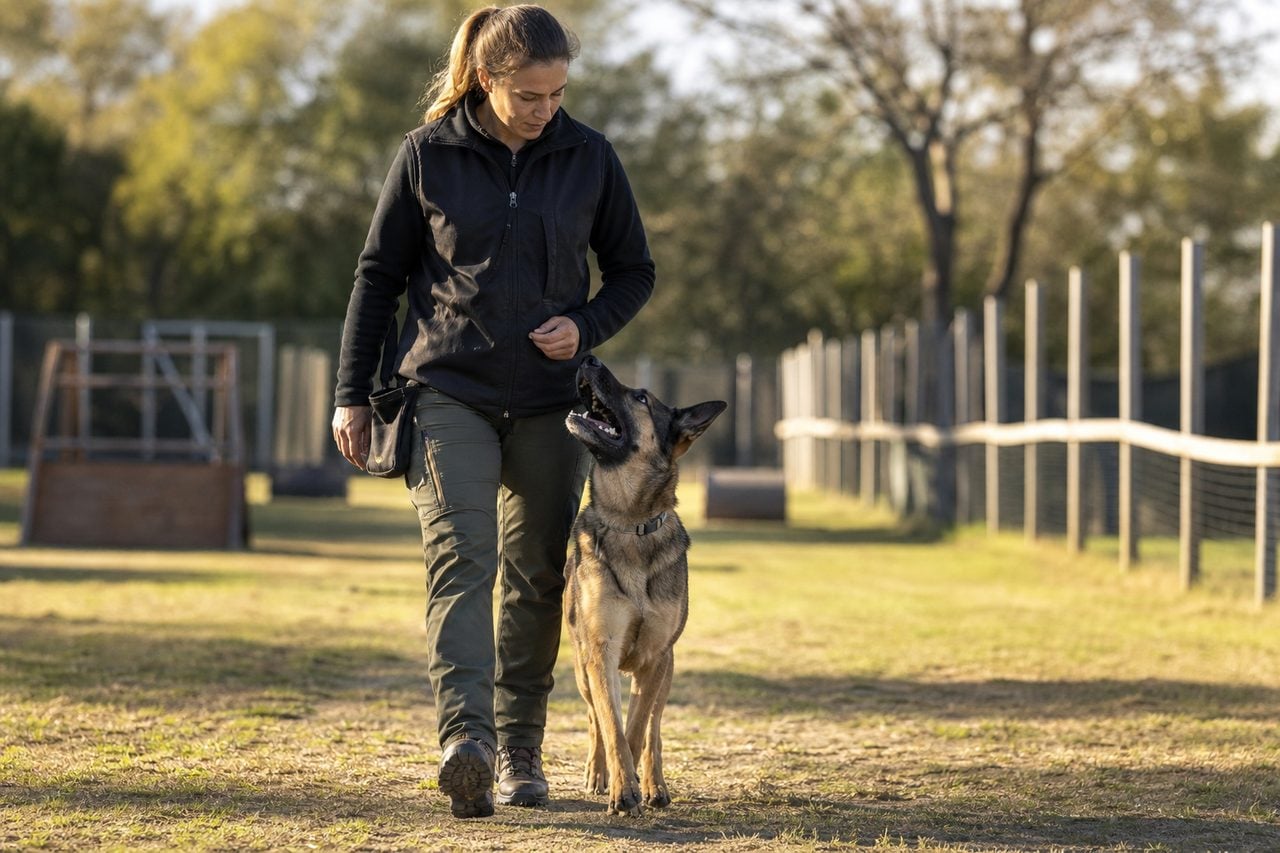
Board-and-train programs ask you to hand your dog over for a stretch of days or weeks so a trainer can live and work with the animal around the clock. For families in Chambersburg and across Franklin County, that residential model can look like an appealing shortcut — especially when a busy schedule in the Cumberland Valley leaves little time for the daily repetition that dog training really demands. This guide explains honestly what board-and-train is, what it is not, and how a household in the Chambersburg area can decide whether it fits.
- What Board-And-Train Actually Means
- Board-And-Train Versus Boot Camp
- When A Residential Program Makes Sense
- Choosing A Trainer In A Small Market
- The Handoff: Why The Transfer Home Decides Everything
- Costs, Timelines, And Setting Fair Expectations
- Preparing Your Household For A Send-Away Stay
- Reviewed trainers
- FAQ
It helps to be clear about the local reality first. Chambersburg is the Franklin County seat, a working I-81 town closer to the Maryland line than to any large metro. Some trainers in the borough and the surrounding townships — Guilford, Antrim, Montgomery — do offer residential or send-away options, but the selection here is genuinely small. If your dog needs a program with deep specialization, a large kennel roster, or several residential slots to choose from, the nearest markets with more depth are Harrisburg, roughly fifty minutes northeast on I-81, or York, about an hour east. We will not invent a directory of local residential programs that does not exist; instead we help you ask the right questions of whoever you contact.
Throughout, remember that residential training is a tool, not a transformation. A skilled trainer can install reliable behaviors and habits in a controlled setting, but the results only hold if the handoff back to your household in the Cumberland Valley is done carefully. The transfer of skills to you is the part that decides whether the investment was worth it, and it is the part cheap programs most often shortchange. We will look at the format itself, how it differs from a day-based boot camp, when it genuinely earns its cost, how to vet a trainer in a thin local market, and how to prepare your Franklin County home so the results survive the drive back. The aim is to help you spend confidently — or to recognize when a different approach, or a program an hour up I-81 in Harrisburg or over in York, would serve your dog better.
What Board-And-Train Actually Means
Board-and-train is a residential arrangement: your dog stays at a trainer’s facility or home, sleeps there, and works through structured sessions every day for the length of the program. The distinguishing feature is time and control. A trainer sees your dog across many hours, in many moods, and can shape behavior consistently without the interruptions of ordinary family life. That density of practice is the real product you are paying for.
Programs vary widely in length. A short obedience tune-up might run one to two weeks; a program addressing deeper habits can stretch to three, four, or more. Longer is not automatically better — what matters is the match between the goal and the time allotted. Ask any Chambersburg-area provider to describe a typical day: how many training sessions, how much rest, how much socialization, and how your dog spends the hours between drills.
Be wary of vague promises. A trustworthy residential trainer talks in terms of specific behaviors and measurable criteria, not sweeping guarantees of a "fixed" dog. Residential work builds a foundation; it does not overwrite temperament or erase the need for ongoing practice once your dog comes home to Guilford Township or wherever you live in Franklin County. Judge a program by how precisely it defines that foundation and how clearly it explains the practice you will need to keep up afterward.
Board-And-Train Versus Boot Camp
These two terms are often used loosely, and the overlap causes confusion for Chambersburg owners comparing options. The cleanest distinction is residency. Board-and-train is residential — the dog stays overnight for the duration. A dog boot camp is more often a day program — an intensive daytime schedule where the dog comes home each evening. Both are immersive; only one involves your dog sleeping away from home.
The difference matters for practical reasons. Residential board-and-train removes household variables entirely for a period, which can help with dogs whose problem behaviors are reinforced by the home environment. A day-based boot camp keeps the dog in your routine each night, which some owners prefer for anxious dogs or for maintaining the bond during training. Neither is superior in the abstract; the right choice depends on your dog and your goals.
When you call around Franklin County, ask directly: is this residential or day-based, and where does my dog sleep? Some providers blur the labels in marketing. Getting a plain answer up front prevents a mismatch of expectations, and it lets you compare apples to apples if you also look at listings in Harrisburg or York for a wider set of residential choices. In a small market like Chambersburg, that clarity is worth insisting on, because you may be weighing only a handful of local options against programs an hour or so up the valley.
When A Residential Program Makes Sense
Residential training is not the default answer for every dog, and a good trainer will tell you so. It tends to earn its cost in specific situations: an owner whose schedule genuinely cannot support consistent daily practice, a dog whose habits are strongly reinforced by the current home setting, or a jump-start need where several weeks of dense, professional repetition would take months of scattered home sessions to match.
It can also suit a household preparing for a change — a move, a new baby, a new dog joining a Chambersburg home — where getting reliable baseline behaviors in place ahead of time reduces stress for everyone. For working families along the I-81 corridor who commute toward Harrisburg or spend long days away, the round-the-clock structure can fill a gap that evening classes cannot.
What residential training is not is a rescue for a fundamentally mismatched situation. If the real issue is an under-exercised high-drive dog in too small a space, or a household that will not maintain the routines afterward, no amount of send-away time solves it. Be honest with yourself about whether you will keep up the work when your dog returns home to the Cumberland Valley. A frank conversation with a trainer about your real routine — your commute, your household, your available time — will tell you more about fit than any brochure, and a good one will say so if a residential program is not the right call for your situation.
Choosing A Trainer In A Small Market
Because dedicated residential programs are thin on the ground in Franklin County, the quality of the individual trainer matters even more than usual. Start by asking about methods in plain language. A reputable trainer can explain their approach without jargon, describes how they handle mistakes and setbacks, and does not lean on fear, intimidation, or one-size-fits-all tools. If someone dodges questions about method, that is a signal to keep looking.
Ask what happens in the facility when no one is running a session. Where do dogs stay, how are they housed, how often are they let out, and can you tour the space? A trainer confident in their setup will welcome a visit before you commit your dog to a multi-week stay away from home. Cleanliness, safety, and honest answers about supervision tell you a great deal.
Finally, weigh the trade-off of staying local versus traveling. A Chambersburg-area program spares you a long drive and keeps your dog close. But if the local options do not fit your dog’s needs, an hour to York or under an hour to Harrisburg opens a meaningfully larger pool of residential specialists. There is no shame in traveling for the right match — the outcome outlasts the commute, and a residential dog spends its days at the facility regardless, so the drive is a handful of trips rather than a daily haul.
The Handoff: Why The Transfer Home Decides Everything
The most overlooked part of any residential program is what happens after your dog comes home to Franklin County. Dogs are highly context-dependent learners. A behavior that is rock-solid at the trainer’s facility can wobble the moment your dog returns to the familiar smells, spaces, and habits of your Chambersburg household. Without a deliberate transfer, weeks of expensive work can fade in days.
That is why the go-home sessions are not an afterthought — they are the point. A quality program includes structured time teaching you the exact cues, timing, and reinforcement the trainer used, plus a written plan and ideally follow-up check-ins. Ask before you enroll how the handoff is handled: how many owner sessions are included, whether follow-ups cost extra, and what support exists if a behavior slips a month later.
Treat yourself as the real student. The trainer trains the dog; you have to maintain it. Budget time in the first weeks home to run through the behaviors daily, in the rooms and yards and Cumberland Valley walking routes where you actually live. A program that skimps on this stage is selling you a result that will not last, no matter how impressive the dog looks on go-home day. When you compare Chambersburg-area options, treat the quality of the handoff as a deciding factor, not a bonus — it is the difference between a lasting change and an expensive demonstration.
Costs, Timelines, And Setting Fair Expectations
Residential training is among the most expensive services in the dog-training world, and for understandable reasons: you are paying for boarding, daily professional labor, and facility overhead across weeks. Prices in a small market like Chambersburg can differ sharply from those in Harrisburg or York, and packages are structured differently from one provider to the next, so compare what is actually included rather than the headline number alone.
When you compare quotes, look past the total to the specifics. How many training sessions per day? Is boarding included or billed separately? Are go-home owner sessions part of the price or an add-on? Is there any follow-up support? A cheaper program with no transfer support can cost more in the long run if the results do not stick once your dog is back in Franklin County.
Set expectations honestly about timelines too. Reliable obedience and manners are achievable in a well-run residential stint. Deep behavioral change — particularly around fear or aggression — is slower, riskier, and should never be sold with a guarantee. If a program promises a permanent cure in a fixed number of days, be skeptical. Lasting change is a partnership that continues long after your dog comes home, and the honest providers in and around Franklin County will describe it that way rather than as a one-time purchase.
Preparing Your Household For A Send-Away Stay
A little preparation makes a residential program go more smoothly for everyone, including your dog. Before drop-off, get vaccinations and a vet check current — most reputable facilities require proof, and it is simply good sense before your dog lives alongside other animals. Bring familiar items if the trainer allows them, and be candid on the intake form about your dog’s quirks, triggers, and medical needs. Withholding information helps no one.
Prepare the humans as well. Talk with everyone in the household about the plan so that when your dog returns to your Chambersburg home, the whole family enforces the same cues the same way. Inconsistency among family members is one of the fastest ways to undo residential work. Agree in advance on house rules — furniture, doorways, greetings — before the dog comes back.
Finally, plan the return. Block out time in the first week home to run the behaviors daily and to reintroduce your dog gradually to normal life — the yard, the neighborhood, the Cumberland Valley trails you frequent. A calm, structured homecoming lets the training settle in. Treat go-home day as the start of the next phase, not the finish line, and the investment you made will hold up over the seasons ahead, from summer walks along the creek to quiet winter routines indoors.
Board & Train in Chambersburg: Local Options & Nearest Specialists
Right now there are no listed Chambersburg trainers focused specifically on board & train. Many general Chambersburg dog trainers handle milder cases, and for anything serious the nearest specialists are below.
Nearest board & train specialists — Harrisburg
For complex cases, the closest metro with dedicated board & train trainers is Harrisburg (an easy drive for an assessment or a board-and-train stay). Top-reviewed options:
- Carolyn Hart Dog Training — 5.0★ (63 reviews)
- Cold Creek Dog Training- Hummelstown – Harrisburg — 5.0★ (34 reviews)
- Arcona Prep — 5.0★ (32 reviews)
- Bark Boot Camp — 5.0★ (22 reviews)
- Hard Nose K9 Services LLC — 5.0★ (20 reviews)
- Anchors Dog Training Academy — 5.0★ (11 reviews)
- Magnus K9 — 5.0★ (11 reviews)
- Cold Creek Dog Training- Carlisle, PA — 5.0★ (7 reviews)
See all Harrisburg board & train trainers →
Frequently Asked Questions
Are there board-and-train programs in Chambersburg?
Some trainers in Chambersburg and the surrounding Franklin County townships do offer residential or send-away training, but the selection is small in this market. If your dog needs a program with more specialization or several residential slots to choose from, the nearest larger markets are Harrisburg, about fifty minutes northeast on I-81, and York, roughly an hour east. It is worth calling local providers first and then widening your search if the fit is not there.
What is the difference between board-and-train and a dog boot camp?
The cleanest distinction is where your dog sleeps. Board-and-train is residential — your dog stays overnight at the facility for the length of the program. A dog boot camp is usually a day program, an intensive daytime schedule after which the dog comes home each evening. Both are immersive, but only board-and-train removes the home environment entirely for a period. Always ask a provider directly which model they run.
How long does a board-and-train program usually last?
It varies with the goal. A short obedience tune-up might run one to two weeks, while deeper habit work can stretch to three, four, or more weeks. Longer is not automatically better — what matters is the match between the objective and the time allotted. Ask any Chambersburg-area trainer to describe a typical day and to define the specific behaviors your dog will work on so you can judge whether the timeline is realistic.
Will the training last once my dog comes home?
Only if the handoff is done well. Dogs are context-dependent learners, so a behavior that is solid at the facility can wobble when your dog returns to your familiar Chambersburg household. The go-home owner sessions, a written plan, and follow-up support are what make the results stick. Before enrolling, ask how many owner sessions are included and what support exists if a behavior slips weeks later. You are the one who maintains it.
How much does residential dog training cost?
Residential training is among the most expensive dog-training services because you are paying for boarding, daily professional labor, and facility overhead across weeks. Prices in a small market like Chambersburg can differ from those in Harrisburg or York, and packages are structured differently from one provider to the next. Compare what is actually included — sessions per day, boarding, go-home sessions, and follow-up — rather than just the headline price.
Is board-and-train the right choice for my dog?
It depends on your situation. Residential training tends to earn its cost when an owner genuinely cannot support consistent daily practice, when home habits strongly reinforce the problem, or when you need a jump-start ahead of a life change. It is not a fix for a mismatched setup or a household that will not maintain the routines afterward. A good trainer will tell you honestly whether it fits, and may suggest a day program or private lessons instead.
Related: read our complete board & train guide or the full Chambersburg dog training overview.
Ready to find the right board & train pro in Chambersburg?