
Dog Boot Camp in Newark, OH
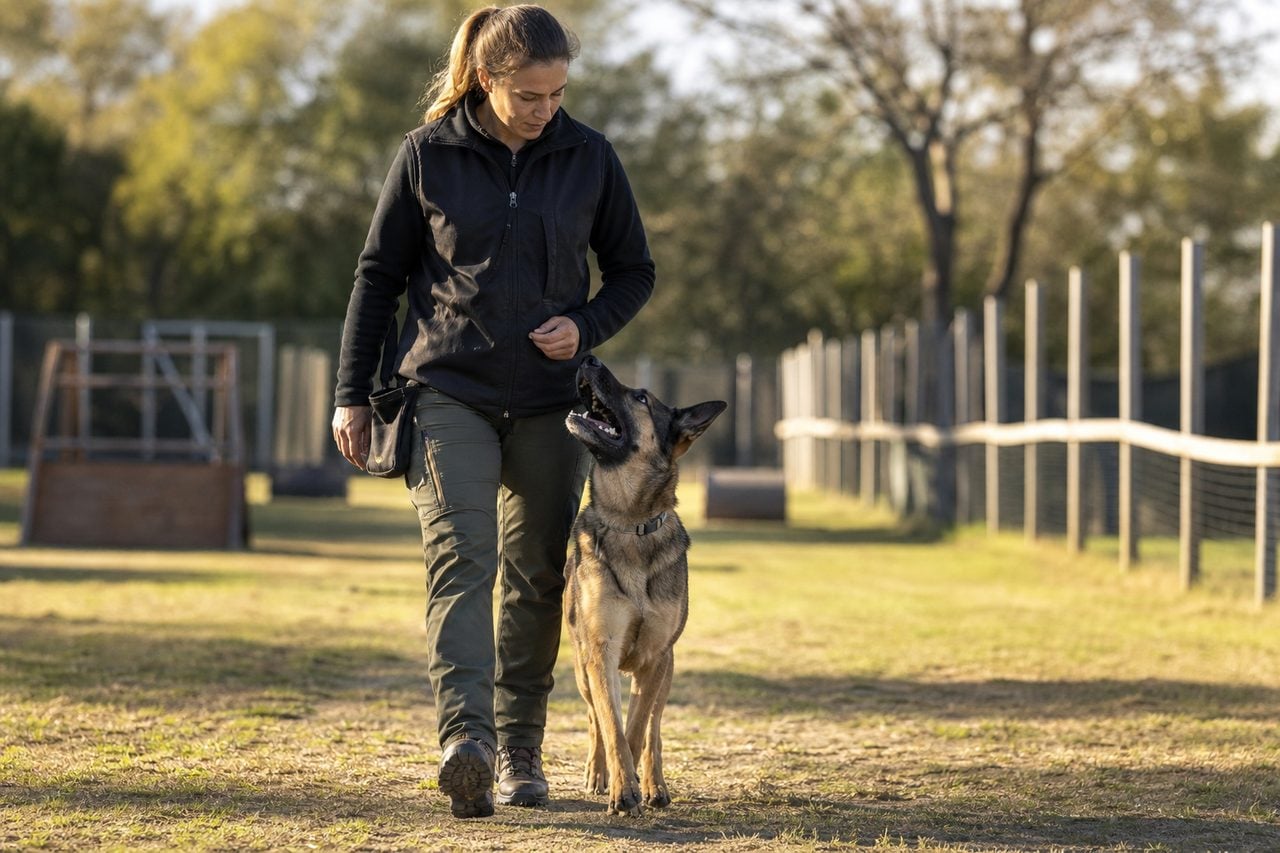
“Dog boot camp” is a phrase that gets thrown around a lot in the Newark and central Ohio training scene, and it conjures a clear image: an intensive, results-driven program that takes a difficult dog and turns him around fast. If you’ve been searching for one, you’ve probably also seen the term “board-and-train” used almost interchangeably — and that’s where a lot of confusion starts. They overlap, but they’re not the same thing, and understanding the difference will save you money and disappointment.
- Boot camp vs. board-and-train: the real distinction
- What 'intensive' should actually look like
- The realistic timeline: what changes fast, what doesn't
- What drives fast results (and what sabotages them)
- Choosing an intensive program in the Newark area
- After boot camp: locking in the transformation
- Reviewed trainers
- FAQ
This guide is specifically about the boot-camp angle: the intensive-results promise, the realistic timeline for change, and what actually drives fast transformation in a dog’s behavior. We’ll look at what “intensive” should mean, how quickly you can realistically expect results, which problems respond fast and which don’t, and how to read past the marketing. Whether your goal is a dog that walks calmly on the T.J. Evans Trail, settles at a Buckeye Lake cookout, or stops treating downtown Newark walks like a sled-pull, the question underneath it all is the same: how fast is fast, and what makes it last?
Boot camp vs. board-and-train: the real distinction
Let’s clear this up first, because the terms are marketed loosely. Board-and-train describes the logistics: your dog lives at the trainer’s facility while being trained. Boot camp describes the intensity and intent: a concentrated, high-rep program designed to produce noticeable results in a compressed window.
In practice, most “dog boot camps” are a form of board-and-train — the dog stays on-site so the trainer can deliver many sessions per day. But not all of them are. Some Newark-area trainers run a “day boot camp” or “day-train” model: you drop the dog off in the morning, the trainer drills intensively all day, and the dog comes home each night. That hybrid keeps the dog in your home environment (good for separation-sensitive dogs and for owners who want to stay closely involved) while still delivering high training volume.
The other distinction is emphasis. A classic board-and-train often aims for a well-rounded foundation. A boot camp, true to the name, tends to be more outcome-focused and front-loads the hardest work — it’s built around the question “what does this dog need to stop or start doing, and how fast can we get there?” If your motivation is specifically speed and a defined problem to crack, the boot-camp framing fits. If you want a comprehensive education with a gentler ramp, a standard program may suit better. Either way, ask the trainer to describe their daily schedule — that tells you far more than the label on the website does.
What 'intensive' should actually look like
Intensity isn’t about being harsh — it’s about volume, frequency, and structure. A genuine boot camp packs many short, focused training reps into each day, with deliberate rest in between, because dogs learn in bursts and consolidate during downtime. Endless drilling with no breaks doesn’t create a faster dog; it creates a stressed, shut-down one.
Here’s what a well-run intensive day tends to include:
- Multiple short sessions, not one marathon. Several 10–20 minute blocks across the day beat a single exhausting hour. This is the single biggest reason on-site programs accelerate learning — the trainer can hit that frequency in a way a working owner simply can’t.
- Deliberate distraction layering. Skills get tested against progressively harder environments — quiet room, then yard, then a real-world outing. A program that only ever works in a sterile room isn’t proofing for your actual life.
- Structured rest and decompression. Crate downtime, sniff walks, and recovery are part of the protocol, not gaps in it.
- Daily documentation. Good intensive programs track progress and often share video so you can see the change, not just hear about it.
If a trainer describes a boot camp as the dog being “worked all day,” push for specifics. The number, length, and content of daily sessions — and how rest is built in — is what separates a real intensive program from boarding dressed up with marketing language.
The realistic timeline: what changes fast, what doesn't
This is the heart of the boot-camp question, so let’s be honest about it. Some things genuinely move fast. Others don’t, and any program that promises they will is overselling.
Changes quickly (days to two weeks): Basic obedience and impulse control respond fast in an immersive setting. Loose-leash walking, reliable sit/down/place, waiting at thresholds, settling on a mat, and basic recall in low-distraction settings can show dramatic improvement inside a two-week intensive. Owners are often genuinely surprised at the difference at pickup.
Changes more slowly (weeks to months, with maintenance): Emotional and instinct-driven behaviors take longer because you’re changing how the dog feels, not just what he does. Leash reactivity, fear-based behaviors, resource guarding, and deeply rehearsed habits can begin shifting in a boot camp, but they require ongoing work after the dog comes home. A two-week program might establish the foundation and management plan; the consolidation happens over the following weeks and months as you maintain it.
The honest reframe: A boot camp doesn’t compress the dog’s entire learning journey into two weeks — it compresses the teaching phase. The trainer can teach a new behavior fast. Making that behavior bombproof across every context in your life, and keeping it there, is a longer process that you participate in. The fastest-looking results come from realistic goals plus disciplined follow-through, not from the program alone.
What drives fast results (and what sabotages them)
If two dogs enter similar programs and one transforms while the other barely budges, the difference usually comes down to a handful of factors — most of which you can influence.
Drives fast results:
- Clear, specific goals. “I want him to stop lunging at dogs on walks” gives a trainer something to attack. “I want him to be good” does not.
- The right dog for the format. Food-motivated, recovery-resilient dogs tend to progress quickly. Very fearful or shut-down dogs may need a slower, gentler ramp before speed is even possible.
- High-quality, high-frequency reps. This is the trainer’s job, and it’s why intensity works — but only when the reps are well-timed and the dog isn’t over-faced.
- A real transfer to the owner. The single biggest accelerator of lasting results is the handoff. A dog returned to an owner who knows how to maintain the work keeps improving; one returned to an owner who doesn’t regresses.
Sabotages results:
- Inconsistency at home. The fastest way to erase two weeks of gains is a household where the rules wobble.
- Unrealistic expectations. Expecting a perfect, off-leash, distraction-proof dog after one two-week intensive sets everyone up to feel like it “didn’t work” when in fact it worked exactly as far as a foundation can.
- Skipping the proofing. A dog that’s only ever practiced in a quiet room will fall apart at Buckeye Lake on a holiday weekend. Results that aren’t proofed against real distraction aren’t really results.
Choosing an intensive program in the Newark area
Because “boot camp” is a marketing term as much as a method, evaluate the substance behind it. Here’s what to probe in a consultation:
Ask for the daily schedule. As covered, the structure of the day — number and length of sessions, rest, real-world outings — reveals whether “intensive” is real or just a word on the homepage.
Ask what they expect to achieve in the timeframe. A trustworthy trainer will tell you honestly what’s realistic in two weeks versus what will need home follow-up. Anyone promising a complete personality overhaul on a tight timeline is selling, not training.
Ask how they handle your specific problem. Generic obedience and reactivity rehab are different jobs. Make sure the trainer has direct experience with the behavior you’re trying to fix.
Ask about the go-home process. Since lasting results hinge on transfer, confirm you’ll get hands-on coaching and follow-up. The intensive part is for the dog; the education part is for you.
Decide between residential and day-boot-camp. If your dog is separation-sensitive, or you want to stay closely involved and reinforce nightly, a day-train model may beat a full residential stay. If you need the dog fully out of the home environment to break entrenched patterns, residential makes more sense. Local trainers often offer both — ask.
Match cost to format. Intensive residential programs sit in the same premium bracket as board-and-train (roughly $1,500–$6,000 in central Ohio). Day-boot-camp models are often priced between that and standard private lessons. As always, confirm exactly what’s included so you’re comparing like with like.
After boot camp: locking in the transformation
The most common boot-camp regret isn’t “it didn’t work” — it’s “it worked, and then I let it slip.” Here’s how to hold the line once your dog is home.
Run a maintenance routine, not a one-time event. Short, daily practice — even five or ten minutes — keeps fresh behaviors sharp. Fold it into things you already do: a quick place-command before meals, a structured walk instead of a chaotic one.
Recreate the distraction ladder yourself. Start practicing where it’s easy, then gradually take the work into harder settings: your yard, a quiet stretch of the T.J. Evans Trail, then busier spots like the area around Buckeye Lake or a leashed walk through Dawes Arboretum. You’re doing the same proofing the trainer did, just continuing it.
Protect the new normal from the old triggers. Your home is full of the cues that produced the original behavior. For the first few weeks especially, manage the environment so your dog can’t rehearse old habits — every repetition of the bad behavior makes it stronger again.
Get everyone consistent. If one family member reverts to old patterns, the dog learns the rules are negotiable. Make sure everyone knows the commands and uses them the same way.
Tune up early. If your program offers refresher sessions, book one before you think you need it. A short check-in a few weeks out catches drift while it’s still easy to correct.
A boot camp can deliver a genuinely fast, visible turnaround — that’s the whole appeal, and for the right dog and goal, it’s real. Just go in understanding what “fast” honestly covers: the trainer can teach quickly; you make it permanent. Get that division of labor right, and your Newark dog can go from a daily struggle to an easy companion in a remarkably short time.
Reviewed Dog Boot Camp Trainers in Newark
These reviewed Newark-area trainers from our directory handle dog boot camp. Each links to a full profile with specialties, verified credentials, reviews, and contact info:
- Sit Means Sit Dog Training Licking Valley — 5.0★ (62 reviews)
- Ohio K9 Ranch — 5.0★ (18 reviews)
- Central Ohio K9 — 5.0★ (5 reviews)
- Paradigm K9 LLC — 4.9★ (37 reviews)
- All Tails R Waggin’ — 4.7★ (783 reviews)
See all Newark dog boot camp trainers →
Frequently Asked Questions
What's the difference between dog boot camp and board-and-train?
Board-and-train describes the logistics: your dog lives at the trainer’s facility during training. Boot camp describes the intensity and intent: a concentrated, results-focused program meant to produce fast change. Most boot camps are a form of board-and-train, but some run as day-boot-camp models where the dog trains intensively by day and goes home each night. Ask for the daily schedule rather than relying on the label.
How fast can I expect results from a dog boot camp?
Basic obedience and impulse control — loose-leash walking, sit/down/place, settling, and recall in low-distraction settings — can improve dramatically within a one-to-two-week intensive. Emotional and instinct-driven issues like leash reactivity, fear, and resource guarding begin shifting in that window but need ongoing work over weeks to months. A boot camp compresses the teaching phase; you complete the consolidation at home.
Does 'intensive' mean my dog will be worked all day without rest?
No, and you should be cautious of any program that describes it that way. Dogs learn best in multiple short, focused sessions with deliberate rest in between, which is exactly why on-site programs accelerate learning. A well-run intensive day includes several short training blocks, distraction layering, and structured downtime, not nonstop drilling.
Is a boot camp worth it if I have a separation-sensitive dog?
A full residential stay can be stressful for separation-sensitive dogs and sometimes worsens the underlying anxiety. A day-boot-camp model, where the dog trains intensively during the day and comes home at night, is often a better fit because it keeps the dog in its home environment while still delivering high training volume. Discuss this specific concern with any trainer before booking.
Why do some dogs transform in a boot camp while others barely change?
The biggest factors are clear and specific goals, whether the dog is well-suited to the format, the quality and frequency of training reps, and the transfer to the owner afterward. Results get sabotaged most often by inconsistency at home, unrealistic expectations, and skipping the real-world proofing that makes behaviors hold up outside a quiet room.
How much does an intensive program cost around Newark?
Residential intensive programs sit in the same premium bracket as board-and-train, roughly $1,500 to $6,000 in central Ohio depending on length and complexity. Day-boot-camp models often fall between that and standard private lessons, which run about $100 to $175 per session. Always confirm exactly what the package includes, especially the go-home coaching and follow-up.
Related: read our complete dog boot camp guide or the full Newark dog training overview.
Ready to find the right dog boot camp pro in Newark?