Dog Trainers in Northern Kentucky, KY
Covington is the largest city in Northern Kentucky and the seat of Kenton County, sitting on the south bank of the Ohio River directly opposite downtown Cincinnati and wedged between the Ohio and Licking rivers. It anchors a three-county urban area — Kenton, Boone and Campbell — that reads as one continuous suburb from the river south to the I-275 loop and then thins quickly into farmland along the I-71/75 corridor toward Grant County. That geography shapes dog ownership here more than anything else. North of the interstate loop you have dense pre-war neighborhoods with narrow lots, on-street parking and constant foot traffic, where leash manners and reactivity to passing people and dogs are the everyday problem. South and west of it — Union, Burlington, Walton, Verona, Dry Ridge — you have subdivisions on half-acre lots and then genuine acreage, where the complaints are recall, fence-running, livestock and wildlife. Training supply is unusual for a metro this size, and the reason is the river: a great many of the trainers who serve Northern Kentucky households are Cincinnati businesses that cross the bridges, and a great many of the Kentucky-side listings that look like trainers turn out to be boarding kennels, daycares, groomers, pet sitters or hidden-fence dealers. The businesses that genuinely deliver training on this side of the river are a small, identifiable group, and they cluster along the Dixie Highway corridor through Erlanger and Fort Mitchell, out the US-42 corridor to Florence and Union, and in a handful of one-owner operations further south.
- Top-Rated Dog Trainers in Northern Kentucky
- What Kind of Training Does Your Dog Need?
- Training Formats and Typical US Dog-Training Prices
- Dog Training Schools & Classes in Northern Kentucky
- How to Pick the Right Trainer
- Dog Training by Northern Kentucky Neighborhood
- Northern Kentucky Dog Training Resources
- Common Questions About Dog Training in Northern Kentucky
- Start Here
This page is your starting point. Whether you need puppy socialization, basic obedience, off-leash training, or help with a serious behavior problem, we’ll help you understand your options, what to expect, and how to connect with the right professional in Northern Kentucky.
Top-Rated Dog Trainers in Northern Kentucky
Compare Northern Kentucky’s top-rated dog trainers below — each listing shows real Google reviews and, where we’ve checked them, certified credentials, so you can reach out with confidence.

What Kind of Training Does Your Dog Need?
Before you start comparing trainers, figure out which category your dog falls into. This determines the type of training, the format, and the realistic timeline.
Puppy (8 weeks to 5 months)
Priority: socialization and foundation habits. This is the most time-sensitive stage — the critical socialization window closes around 16 weeks, and what your puppy is exposed to during this period shapes their temperament permanently. Group puppy classes are ideal. Read our full guide: Puppy Training in Northern Kentucky.
Adolescent dog (5 to 18 months)
Priority: obedience and impulse control. This is the stage where most owners hit the wall — the cute puppy has turned into a teenager who jumps on guests, pulls on the leash, and has developed selective hearing. Group obedience classes or private lessons work well here. Consistency is everything.
Adult dog — new to training
Priority: basic obedience and household manners. It’s never too late. Adult dogs are often faster learners than puppies because they have longer attention spans.
Adult dog — specific behavior issue
Priority: targeted behavior modification. Reactivity, aggression, separation anxiety, resource guarding, excessive barking. These issues need a qualified trainer or behaviorist — not a group class. Start with a behavior consultation.
Any dog — intensive training needed fast
Priority: results on a compressed timeline. Board-and-train programs offer intensive daily training over 2 to 6 weeks — the fastest path to results when done right.
Training Formats and Typical US Dog-Training Prices
The formats below are the same everywhere; the figures are national ranges, not Northern Kentucky rates. Prices vary by city and by trainer — confirm directly with the trainer before you book.
Group classes
Best for socialization and foundation obedience. Meet once a week for 5 to 6 weeks with other dogs. Most affordable option. Typical US range: $150 to $300 for a full course.
Private lessons
One-on-one with a trainer at their facility or your home. Best for specific goals, reactive dogs, or customized plans. Typical US range: $100 to $175 per session (facility) or $125 to $200 (in-home).
Day training
Your dog goes to the trainer during the day and comes home at night. Great for working professionals. Typical US range: $75 to $125 per day.
Board and train
Your dog stays with the trainer for 2 to 6 weeks. Most intensive option. Typical US range: $1,500 to $6,000+ depending on length and complexity.
Behavior consultation
A diagnostic assessment for serious behavioral issues — a professional evaluation that produces a treatment plan. Typical US range: $200 to $400 for the initial assessment.
Dog Training Schools & Classes in Northern Kentucky
Looking for a dog training school or group obedience classes in Northern Kentucky? Plenty of local trainers and facilities run weekly group classes — a structured, affordable way to cover socialization and basic obedience alongside other dogs. Browse dog obedience classes in Northern Kentucky, or use the trainer directory above to compare every dog school and trainer in the Northern Kentucky area by specialty, reviews and price.
How to Pick the Right Trainer
Choosing a dog trainer is a lot like choosing a doctor — credentials matter, but so does communication style, philosophy, and whether you trust them with someone you care about.
Training methodology
This is the most important factor and the one most people skip. Dog training ranges from purely positive reinforcement (rewards only) to balanced training (rewards plus corrections). There is no single “right” approach — but there IS a right approach for your dog. A fearful rescue needs a different approach than a confident, drive-y working breed. Ask every trainer what tools and methods they use, and don’t commit until you understand and agree with their philosophy.
Credentials
Look for recognized certifications — CPDT-KA (Certified Professional Dog Trainer), KPA-CTP (Karen Pryor Academy), IACP, AKC CGC Evaluator, or for complex behavior, a CAAB or veterinary behaviorist. Credentials aren’t everything — some of the best trainers built their skills through decades of hands-on experience — but a trainer with no credentials AND no verifiable track record is a risk.
Transparency — red flags and green flags
Red flags: won’t let you observe a class or tour the facility, gets defensive about methodology, guarantees specific results, pressures you to sign up immediately, or trash-talks every other trainer. Green flags: welcomes questions, offers to let you observe a class first, gives references, is honest about what training can and cannot achieve, and tells you upfront if your dog’s issue is outside their expertise.
Dog Training by Northern Kentucky Neighborhood
The Northern Kentucky metro is large, and driving 45 minutes for a weekly class isn’t sustainable for most people. Here’s a quick overview of training availability by area:
Mainstrasse Village & Licking Riverside
Covington’s restored historic core — the Mainstrasse district west of the Licking and the riverfront streets east of it, with 19th-century townhouses, brick sidewalks and small or no yards. Dogs here live an entirely leash-based life: sidewalk walks past patios, bar crowds and other dogs at close quarters. It is the part of Northern Kentucky where leash pulling, barrier frustration and door-greeting problems surface first, and where a fenced back yard is rarely part of the solution.
Latonia & South Covington
The larger residential half of the city south of the 12th Street corridor, running out toward Latonia and the Decoursey Pike valley. Older single-family housing on modest lots with detached garages and alleys, a mix of long-time residents and newer families. Yards exist but are small and often shared-fence, which makes fence-line reactivity between neighboring dogs a recurring complaint.
The Dixie Highway corridor — Fort Mitchell, Fort Wright, Erlanger, Elsmere
US-25 runs south from Covington through the older Kenton County suburbs and out past the airport interchange. This is where most of Northern Kentucky’s actual training capacity sits: the corridor’s commercial strips have the light-industrial and retail space a training facility needs, which is why the metro’s facility-based programs are concentrated here rather than in Covington proper. For owners it means the drive to a class is usually ten to twenty minutes from anywhere in Kenton County.
Florence & the US-42 corridor
Boone County’s commercial center and the busiest retail ground in Northern Kentucky, spreading west along US-42 and Mall Road. Newer subdivisions, a lot of apartment and townhouse stock, and a steady inflow of households moving in from elsewhere — which in practice means a lot of adolescent dogs meeting a lot of unfamiliar dogs in shared green space.
Union, Burlington & western Boone County
The fastest-growing part of the metro: large-lot subdivisions and new construction stretching west from Union and Burlington toward the river bends at Petersburg and Rabbit Hash. Big yards, invisible fencing, and a lot of dogs that have never had to hold a recall against deer, farm noise or open water. The training questions out here are almost entirely about off-leash reliability and boundary behavior rather than about crowds.
Campbell County river towns — Bellevue, Fort Thomas, Wilder, Cold Spring
The eastern side of the metro, from the tight riverfront grids of Bellevue up the hill to Fort Thomas and then south along US-27 through Wilder and Cold Spring. Fort Thomas in particular is a walking town with steep streets and a large park, so its dogs get more structured exercise than most — and its owners tend to arrive at training with distance-management and greeting problems rather than basic manners.
The southern corridor — Walton, Verona, Crittenden, Dry Ridge, Williamstown
Where the metro thins out along I-71/75 into Grant County farmland. Acreage, working dogs, hunting dogs and long drives. Owners here will happily travel thirty or forty minutes north for a class, which is why several of the region’s board-and-train programs sit down this way rather than in the urban core — the space is available and the clients are used to the distance.
Northern Kentucky Dog Training Resources
Beyond professional training, Northern Kentucky has some excellent resources for dog owners.
Parks and off-leash areas
- Devou Park, Covington — Roughly 700 acres on the hills above Covington, given to the city in 1910 and still the largest park in Northern Kentucky. It holds the Behringer-Crawford Museum, a golf course, an amphitheatre and a network of wooded hiking and mountain-bike trails, plus the overlook with the well-known view across the river to downtown Cincinnati. The trail system is the most useful training ground in the metro for anything involving distance work: long, quiet, wooded paths with intermittent joggers and cyclists, which is exactly the graduated distraction a recall needs.
- England-Idlewild Park, Burlington — Boone County’s main park on Idlewild Road, with ball fields, trails and a fenced off-leash dog area. For most of western Boone County this is the default off-leash outlet, and it is the honest test of whether a dog’s recall holds when other dogs are loose — a very different problem from recall in an empty field, and the one most owners underestimate.
- Boone County Arboretum at Central Park, Union — About 120 acres on Camp Ernst Road, notable for being built inside a working county park rather than as a separate botanical garden. Paved loop trails wind through several thousand labelled trees and shrubs alongside ball fields and playgrounds. The paving and the constant low-level activity make it a good place to practice loose-leash walking with predictable, repeatable distractions.
- Tower Park, Fort Thomas — The former Fort Thomas military reservation, now a large city park with stone buildings, an amphitheatre, ball fields and wooded trails running down the hillside toward the river. Steep, varied ground and heavy local foot traffic make it the eastern metro’s equivalent of Devou for structured walks.
- Middleton-Mills Park, Crescent Springs — A Kenton County park off Buttermilk Pike with trails, ball fields and open ground, sitting close to the Dixie Highway suburbs. Convenient enough to be a routine mid-week walk rather than a weekend outing, which is what makes it useful for practice — repetition beats novelty when you are proofing manners.
- Lincoln Ridge Park, Independence — A Kenton County park on the southern edge of the built-up area, with sports fields and walking paths and noticeably less crowding than the riverfront parks. A reasonable middle-distance option for owners in Independence, Taylor Mill and Erlanger who want space without driving to Boone County.
- A.J. Jolly Park, Campbell County — A large county park south of Alexandria built around A.J. Jolly Lake, with a marina, campground, golf course and trails. It is the closest thing eastern Campbell County has to open country inside the park system, and the water and wildlife make it a genuinely difficult recall environment — useful, but not where you start.
- Big Bone Lick State Historic Site, Union — A state site in southwestern Boone County known for its Pleistocene fossil beds and its small resident bison herd, with several miles of trail through open and wooded ground. Leashed only, and the bison enclosure means livestock exposure is unavoidable — which for a dog that has never seen large animals is precisely the point.
These parks are great for socialization practice AFTER your dog has a foundation of training. Taking an untrained dog to an off-leash park is asking for trouble.
Veterinary behaviorists
For complex behavior cases that may require medication alongside training, ask your primary vet for a referral to a veterinary behaviorist serving the Northern Kentucky area.
Dog Trainers by Community in the Northern Kentucky Area
Looking for a trainer in a specific Northern Kentucky-area community? Here are the local options town by town.
Dog Trainers in Erlanger, KY
- For Paws K9 Training — 5.0★ (51)
- Allie’s Walkabout — 4.7★ (344)
- PetSuites Erlanger — 4.6★ (704)
- Northern Kentucky K9, LLC
Dog Trainers in Fort Mitchell, KY
- MLK9 Kentucky — 5.0★ (1)
- Dog-Abilities Dog Training — 4.8★ (6)
Dog Trainers in Walton, KY
- Mossy Creek Retrievers — 5.0★ (3)
- KC4K9 Dog Training
Dog Trainers in Florence, KY
- Doggie Paddles LLC — 4.8★ (1325)
Dog Trainers in Ludlow, KY
- Atlas Canine College — 5.0★ (4)
Dog Trainers in Wilder, KY
- Tri-State Canine Obedience — 5.0★ (20)
Dog Trainers in California, KY
- Pawlished Dog Training, LLC. — 5.0★ (108)
Dog Trainers in Union, KY
- H3K9 — 5.0★ (13)
Dog Trainers in Burlington, KY
- Cincy In Home Dog Training — 5.0★ (5)
Dog Trainers in Dry Ridge, KY
- Kentucky Canine Coach LLC — 5.0★ (29)
Dog Trainers in Williamstown, KY
- WMK9-Well Mannered K9 LLC — 5.0★ (99)
Also in Northern Kentucky: Dog, Come
More trainers near Northern Kentucky
These trainers are just outside the Northern Kentucky communities listed above.
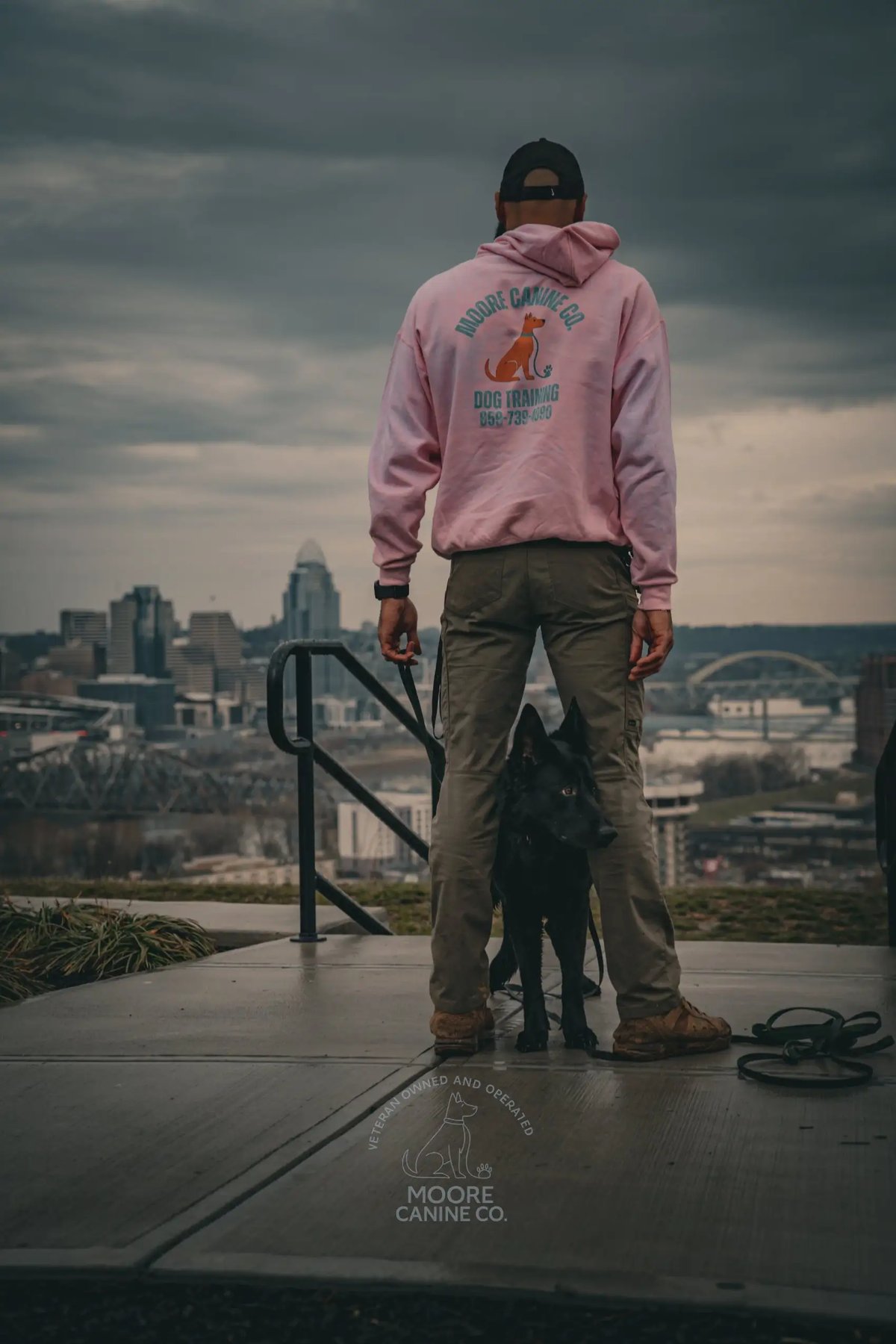
- Moore Canine Co., LLC — Newark, KY · 16.6 mi
- Eagle Valley Kennels- Boarding & Training — Sanders, KY · 33.1 mi
- Glorified Canine Training — Carrollton, KY · 37.0 mi
Common Questions About Dog Training in Northern Kentucky
How many dog trainers are there in Covington and Northern Kentucky?
Fewer than the listings suggest. A full sweep of Kenton, Boone and Campbell counties plus the Grant County edge turns up around ten businesses on the Kentucky side that genuinely publish and deliver dog training. Most of the rest — and there are many — are boarding kennels, doggy daycares, grooming salons, pet sitters, dog walkers, veterinary practices or hidden-fence dealers. Several of them use words like ‘K9’ or ‘training’ in their names or list training as a service while sending the actual work to a partner business. It is worth reading what a business publishes about its own programs before you book.
Are there any trainers actually inside Covington itself?
Not at present, and this surprises people. Covington has plenty of dog businesses — a pet boutique, grooming, boarding, day camp, the county animal shelter — but the metro’s training capacity sits a few miles south along the Dixie Highway corridor in Erlanger and Fort Mitchell, and west along US-42 toward Florence and Union. For a Covington household that is a ten-to-twenty-minute drive rather than a walk, and several of the region’s trainers work in-home, which removes the drive entirely.
Should I look at Cincinnati trainers instead?
Many Northern Kentucky owners do, and for some problems it makes sense — the Ohio side of the river has considerably more training businesses, including specialisms that simply are not offered on the Kentucky side. The trade-off is the bridges. A weekly class in Cincinnati means crossing the river at a fixed time twice a night, and the I-71/75 and I-471 river crossings are the metro’s worst congestion. For weekly group classes most people find the Kentucky-side options easier to sustain; for a one-off behavior consult or a specialism nobody here offers, crossing is worth it.
What does dog training cost in Northern Kentucky?
Published local pricing spans a wide range because the products are genuinely different. Group classes run in multi-week blocks and are the cheapest way in. Private and in-home lessons are priced per session or in small packages. Board-and-train is the expensive end by a wide margin — it is residential care plus daily training, and local programs publish both per-day and per-program pricing, so compare on total program cost and on how many training sessions a day are actually included rather than on the headline number. Always ask what happens after the program ends: the follow-up sessions that transfer the behavior to you are what determine whether it holds.
Is board-and-train the right choice?
It is the most available format in Northern Kentucky — roughly half the region’s trainers run one — but availability is not the same as suitability. Residential programs work well for building obedience and off-leash reliability on a dog that is fundamentally sound. They are a poor tool for separation anxiety, for handler-specific reactivity, and for most household-management problems, because the behavior has to be relearned with you in your own house anyway. If a trainer recommends board-and-train for separation anxiety without first assessing the dog, get a second opinion.
My dog is reactive on the leash. Who handles that here?
Leash reactivity is the single most common problem reported in the older riverfront neighborhoods, and a small number of Northern Kentucky trainers publish specific behavior-modification programs for it. Supply is genuinely thin, so expect a waiting list, and expect an assessment before anyone quotes you a program. Be wary of anyone who quotes a fixed number of sessions before meeting the dog — reactivity work is paced by the dog, not by a package.
Is there anywhere to work a dog off-leash legally?
The fenced dog area at England-Idlewild Park in Burlington is the main public off-leash option in Boone County. Everywhere else — Devou, Tower Park, the arboretum, Big Bone Lick, the county parks — is leashed. That is worth knowing before you buy an off-leash program: the dog will spend most of its life on a leash regardless, so the value of off-leash training here is reliability at distance on a long line, not a license to drop the lead in a public park.
Do Northern Kentucky trainers do protection or personal-protection work?
Not as a bookable service, as far as any local business publishes. Several Kentucky-side businesses carry ‘K9’ in their names, but a name is not a service, and the region’s trainers publish obedience, puppy, behavior and board-and-train programs rather than protection work. If you are looking for genuine protection or bite-sport training you will need to look outside Northern Kentucky.
Start Here
The best time to start training is today. Whether your puppy needs socialization, your adolescent dog needs impulse control, or your adult dog has a behavior issue that’s been building for years — the sooner you start, the faster things improve.
Browse dog trainers in Northern Kentucky on GetDogSchool.com. Compare programs, read reviews, and connect with professionals who fit your dog’s needs and your budget.
Find Dog Trainers in Northern Kentucky →
Ready to find the right trainer for your dog in Northern Kentucky?
Get matched with a trainer in Northern Kentucky →