
In-Home Dog Training in Ann Arbor, MI
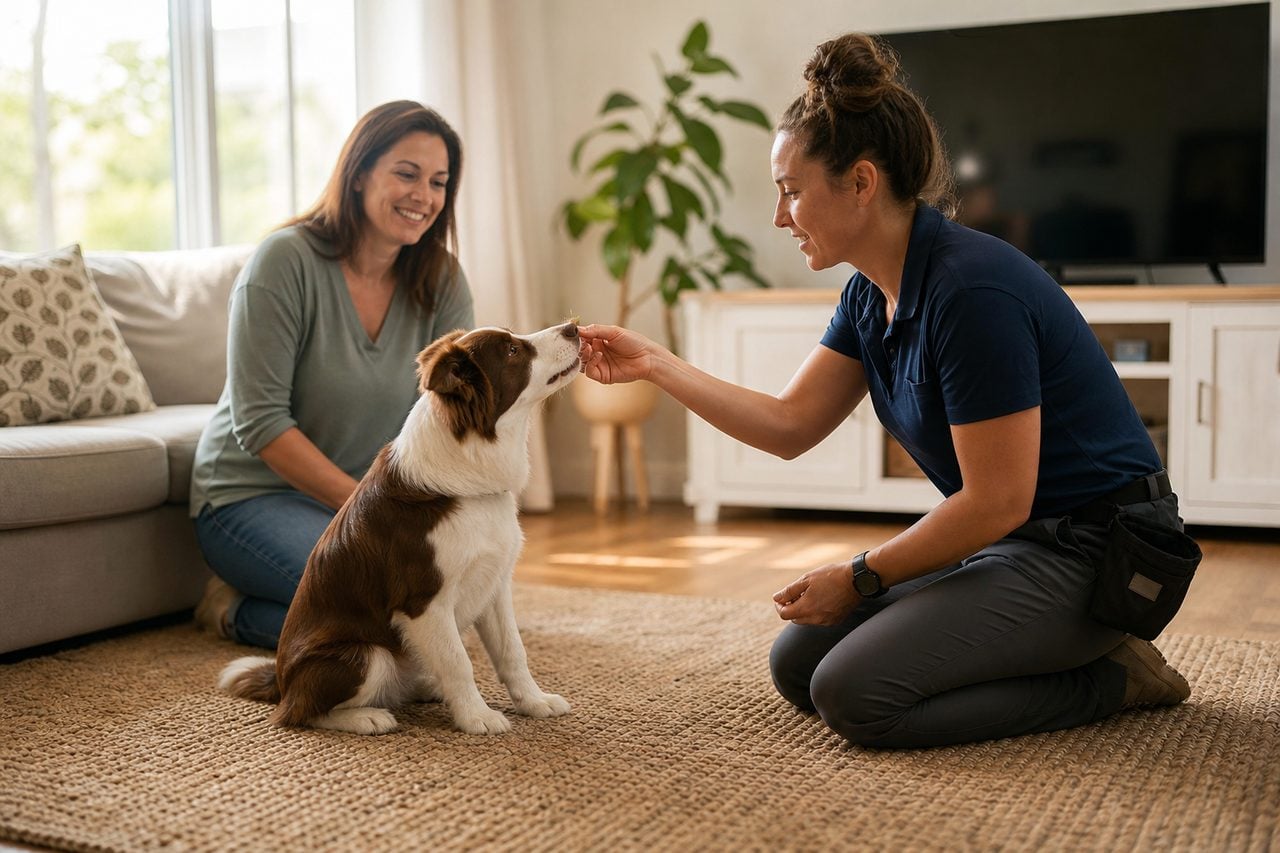
In-home dog training brings a professional trainer to your door instead of asking you to bring your dog to a class or facility. For a lot of Ann Arbor dog owners, that difference is the whole point. Many behavior problems — bolting out the front door, barking at delivery drivers, guarding the couch, ignoring you in the backyard — only happen at home, in the exact context where they were learned. A trainer who works with your dog in your own living room, hallway, and yard can see and fix those problems where they actually occur, which a class in a neutral room simply cannot do.
In-home training also fits the reality of a busy Washtenaw County life. If you are commuting toward Detroit, teaching or studying at the University of Michigan, or managing kids and a dog at once, having the trainer come to you removes a major logistical hurdle. This guide covers how in-home training works, which dogs and problems it suits best, how to prepare, and how to tell a strong in-home program from a weak one.
What In-Home Training Involves
In-home training is a private, one-on-one service delivered at your residence. A trainer comes to your Ann Arbor home, observes your dog in its normal environment, and works directly with both dog and owner to address specific goals. Sessions typically run under an hour and are spaced out over several weeks, with homework assigned between visits so you keep the momentum going.
The format is inherently personalized. Rather than following a fixed group curriculum, the trainer builds a plan around your dog’s temperament, your household’s routines, and the exact behaviors you want to change. If your dog loses its mind when the doorbell rings, you can rehearse doorbell scenarios at your actual door. If the problem is pulling on walks, you head out onto your real street and practice where it counts.
Crucially, in-home training coaches you as much as the dog. Because the trainer is standing in your kitchen watching how you handle feeding, greetings, and corrections, they can catch the small habits that reinforce bad behavior and adjust them on the spot. You come away not just with a better-behaved dog but with a clearer understanding of how to keep it that way.
Problems In-Home Training Solves Best
Certain issues are almost tailor-made for the in-home format because they are tied to a specific place. Front-door chaos — jumping, bolting, frantic barking when someone arrives — is far easier to fix at your real door than in an abstract exercise. Resource guarding around a particular couch, bed, or food bowl needs to be worked in the actual spot the dog defends. House-training setbacks, crate anxiety, and destructive behavior when left alone all show up at home and are best addressed there.
In-home work also suits dogs that struggle in busy or novel environments. A fearful or easily overwhelmed dog may shut down in a group class full of strange dogs and people, learning little. In the calm of its own home, that same dog can focus, build confidence, and actually absorb training before gradually being exposed to more stimulation on its own terms.
Multi-dog households benefit too. When two or three dogs feed off each other’s excitement or squabble over space, a trainer needs to see the whole dynamic in the environment where it plays out. And for owners with mobility limitations, small children, or packed schedules, in-home training may simply be the only realistic way to get consistent professional help.
The main trade-off is socialization and distraction. A dog whose primary need is exposure to other dogs and busy settings may get more from a group class or from sessions that move out to parks. Many trainers blend the two — starting at home, then progressing to spots like Gallup Park or the Nichols Arboretum trails as the dog is ready.
What A Typical Program Looks Like
Most in-home programs begin with an initial assessment. The trainer spends time observing your dog, asking detailed questions about its history and your goals, and watching how your household operates day to day. From that they build a customized plan and usually a package of sessions rather than a single visit, because behavior change takes repetition over time.
Early sessions tend to establish foundations: clear communication between you and your dog, basic obedience cues, and structure around daily routines like feeding and greetings. As the foundation solidifies, the work shifts toward your priority problems and toward proofing skills against real distractions. A trainer might start recall practice in your quiet living room, move it to the backyard, then out to the sidewalk, and eventually to a park where squirrels and other dogs raise the difficulty.
Between visits you get homework — short, specific exercises to run daily. This is where progress is actually made. The trainer’s visit sets the direction and corrects your technique, but the dozens of small reps you do between sessions are what cement the behavior. Owners who do the homework see steady results; owners who wait for the trainer to fix everything in the room usually stall.
How To Prepare For Your First Session
A little preparation makes the first visit far more productive. Before the trainer arrives, write down the specific behaviors you want to change and note when and where they happen. Vague goals like better behaved are hard to work with; concrete ones like stops dragging me on the leash toward the Huron River trail or quiets down when the mail arrives give the trainer something to build a plan around.
Have your dog’s basics on hand: its regular food, some high-value treats it loves, its usual leash and collar or harness, and any tools you currently use. Feed a bit lighter than normal before the session if food will be used as a reward, so your dog is motivated to work. Make sure the family members who interact with the dog most are present, since consistency across everyone in the household is a huge factor in success.
Think honestly about your routines, too. Be ready to describe how the dog is fed, walked, exercised, and left alone, and what rules currently exist. Trainers often find that the fastest wins come from small changes to daily structure rather than formal obedience drills. The more openly you share how life actually runs, the better the plan you will get.
Choosing A Good In-Home Trainer
Since this person will be working in your home and shaping how you interact with your dog, vet them carefully. Ask about methods first. You want a trainer who leads with reward-based, low-stress techniques and can clearly explain how they teach a behavior and what they do when a dog makes a mistake. Be cautious of anyone promising instant fixes or relying heavily on fear and force — those approaches can suppress symptoms while making underlying anxiety worse.
Ask how they structure programs. Do they start with an assessment? Do they offer packages that allow for repetition over time, or just one-off visits? Do they assign homework and check your progress? A trainer who coaches you and builds your skills is worth more than one who only handles the dog while you watch, because you are the one living with the dog after they leave.
Ask about experience with your specific issue. A trainer strong in puppy manners may not be the right fit for serious reactivity or separation anxiety, and vice versa. It is fair to ask how many cases like yours they have handled and how they typically approach them. Finally, trust the interaction: a good trainer reads your dog calmly, explains things in plain language, and makes you feel more capable rather than more dependent.
Making Results Stick After The Trainer Leaves
The goal of in-home training is not to make you dependent on the trainer — it is to leave you able to maintain and build on the results yourself. That starts with consistency across your whole household. If one person enforces the no-jumping rule and another lets the dog jump up for attention, the dog learns that the rule is negotiable and it erodes. Everyone who interacts with the dog needs to use the same cues and hold the same lines.
Build short practice into daily life rather than treating training as a separate chore. A few minutes of recall in the yard, a place command while you make dinner, calm leash manners on your normal walk — folding reps into routines you already have makes maintenance nearly effortless. Dogs thrive on this kind of steady, low-key structure.
Expect some testing. When the intensive phase ends, many dogs probe boundaries to see if the rules still hold. Hold them calmly and consistently and the testing passes quickly. If a problem resurfaces or a new one appears, a single tune-up session is usually enough to get back on track. Ann Arbor’s training community is deep enough that ongoing support — refreshers, group classes for added socialization, or occasional private check-ins — is easy to find whenever you need it.
In-Home Dog Training in Ann Arbor: Local Options & Nearest Specialists
A few Ann Arbor-area trainers can help with milder in-home dog training needs:
- Attaboy Dog Training — 4.8★ (62 reviews)
- Longsnouts [Dog Training] — 3.4★ (14 reviews)
Nearest in-home dog training specialists — Detroit
For complex cases, the closest metro with dedicated in-home dog training trainers is Detroit (an easy drive for an assessment or a board-and-train stay). Top-reviewed options:
- Paws Around Motown — 5.0★ (78 reviews)
- K9 AdvantEDGE Dog Training — 5.0★ (40 reviews)
- Iron Clad K9 Training — 5.0★ (13 reviews)
- New Tricks: Puppy and Dog Training LLC — 5.0★ (12 reviews)
- Tip Top K9 Sterling Heights Dog Training — 5.0★ (7 reviews)
- Paws N Play — 4.9★ (70 reviews)
- Four Legged Rascals — 4.9★ (16 reviews)
- Animal Behavior Consultants of Michigan — 4.7★ (29 reviews)
See all Detroit in-home dog training trainers →
Frequently Asked Questions
Is in-home training better than group classes?
Neither is universally better — they solve different problems. In-home training excels at issues tied to your specific environment, like door-bolting, resource guarding, or house-training, and it suits fearful dogs that get overwhelmed in busy settings. Group classes are stronger for socialization and for proofing behavior against real-world distraction. Many Ann Arbor owners combine them: start in-home to build a foundation and fix location-specific problems, then add a group class or park sessions for socialization and distraction work.
How many in-home sessions will my dog need?
It depends on your dog, your goals, and how consistently you practice between visits. Simple manners work may take only a handful of sessions, while entrenched behavior problems or fear-based issues can require an extended program. Most trainers start with an assessment and then recommend a package rather than a single visit, because lasting behavior change comes from repetition over weeks. The homework you do between sessions matters as much as the sessions themselves.
Does my whole family need to be involved?
Ideally yes. Dogs learn from everyone they live with, so if the rules and cues differ from person to person, the dog gets confused and progress stalls. Having the main handlers present during sessions lets the trainer coach everyone to use the same commands, timing, and structure. Consistency across the household is one of the biggest factors separating dogs that hold onto their training from dogs that slide back within weeks.
Can in-home training help with an aggressive or reactive dog?
It often can, and the home setting can be a real advantage because a reactive dog can start learning in a calm, familiar space before being gradually exposed to triggers. That said, aggression and reactivity are serious and benefit from a trainer experienced specifically with those issues, using reward-based, low-stress methods. Ask directly about a trainer’s background with cases like yours, and be wary of anyone promising a quick fix through force, which can make anxiety-driven aggression worse.
What should I have ready before the trainer arrives?
Write down the specific behaviors you want to change and note when and where they happen. Have your dog’s regular food, high-value treats, and its usual leash and collar or harness on hand, and feed a little lighter beforehand if treats will be used so your dog is motivated. Make sure the family members who handle the dog most are present. Being ready to honestly describe your daily routines helps too, since small changes to structure often produce the fastest wins.
Will the training transfer to walks and parks, or just work at home?
A good in-home program deliberately builds toward generalization. Skills start in the quiet of your home, then move to the yard, the sidewalk, and eventually busier settings like Gallup Park or the Nichols Arboretum trails as your dog is ready. Dogs are contextual learners, so a behavior practiced only in the living room will not automatically hold at a distraction-filled park. Ask your trainer how they proof skills against real-world distraction so the results follow you outside.
Related: read our complete in-home dog training guide or the full Ann Arbor dog training overview.
Ready to find the right in-home dog training pro in Ann Arbor?