
In-Home Dog Training in Bloomington, IN
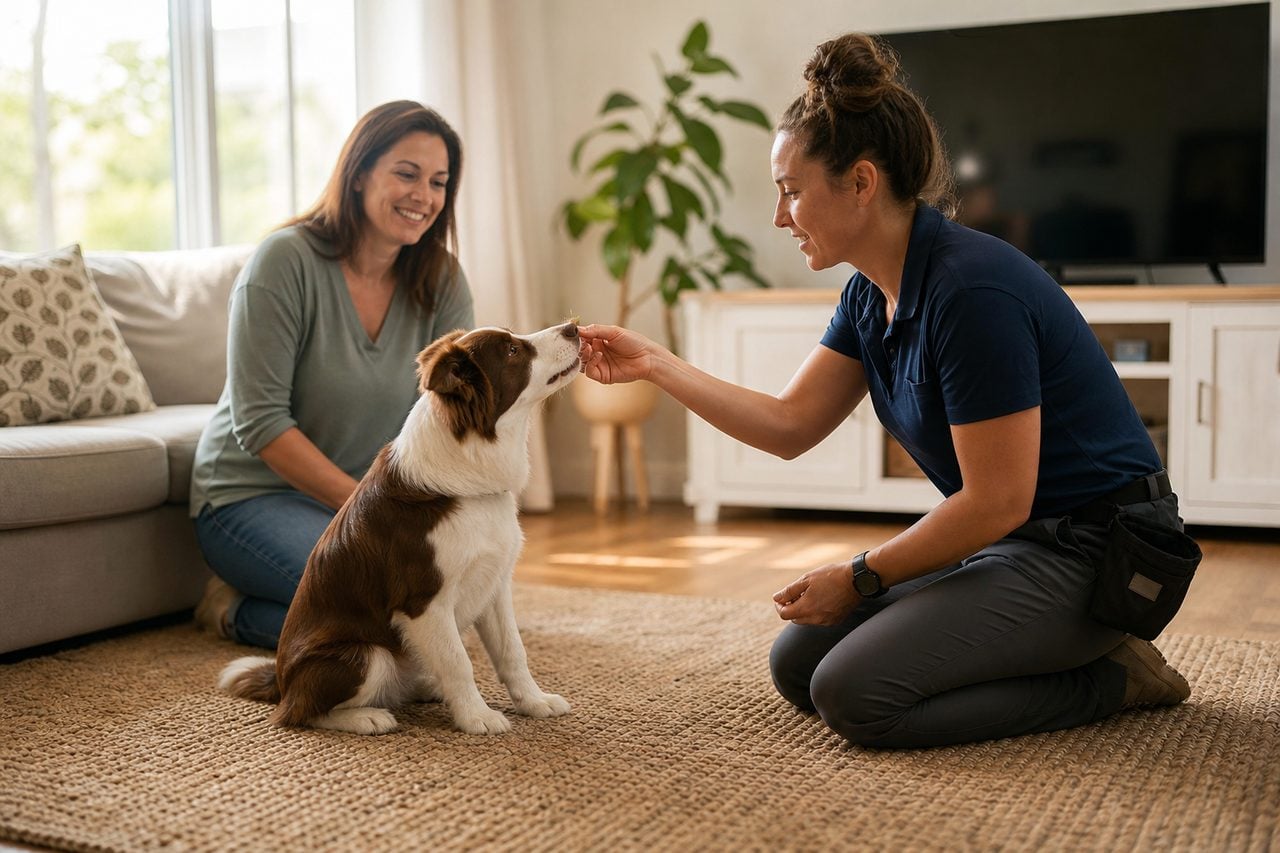
In-home dog training brings a professional trainer directly to your house or apartment somewhere in the Bloomington area, so lessons happen in the exact environment where your dog actually lives, sleeps, barks at the mail carrier, and jumps on guests. Instead of loading a nervous or reactive dog into the car and driving to an unfamiliar facility, the training meets the dog where the real behavior occurs. For many Monroe County families — from the near-campus neighborhoods around Indiana University to the quieter streets of Ellettsville and the rural parcels toward Spencer and Bedford — this convenience is the difference between training that gets done and training that keeps getting postponed.
- Why Training in the Dog's Own Environment Works
- What In-Home Training Is Best For
- How the Bloomington-Area Service Radius Works
- Choosing a Qualified Private Trainer
- What a Typical In-Home Program Looks Like
- Local Practice Spots and Ordinances to Know
- Setting Realistic Expectations and Making It Last
- Reviewed trainers
- FAQ
Private, one-on-one instruction also means the entire session is built around your dog and your goals. There is no splitting a trainer’s attention across six other dogs, no waiting your turn, and no pace set by the group. A puppy that needs house-training and crate work gets a completely different plan than an adolescent shepherd mix that pulls on the B-Line Trail or a rescue that panics during thunderstorms rolling in off Lake Monroe.
This guide explains how in-home training works in the Bloomington region, what it is best suited for, how to choose a qualified private trainer, and how to make the most of every visit so the results stick long after the trainer drives back down SR-37.
Why Training in the Dog's Own Environment Works
Dogs are contextual learners. A behavior practiced in a bright, neutral training room does not automatically transfer to the living room where the dog has rehearsed jumping on visitors hundreds of times. In-home training closes that gap by working on the real problem in the real place, with the real triggers present. The doorbell, the kitchen counter, the specific window the dog guards, the hallway where leash tension starts — these are the settings where change actually needs to happen.
Training on home turf carries other advantages that group classes cannot match:
- Reduced stress for reactive or fearful dogs. A dog that shuts down or over-arouses in a crowded facility can think and learn calmly in familiar surroundings, which speeds progress rather than masking it.
- The whole household participates. Everyone who interacts with the dog — partners, kids, roommates near campus — can be coached to use the same cues and rules, which is the single biggest predictor of lasting results.
- Real-world problem solving. The trainer can see your actual crate placement, feeding setup, gate positions, and yard layout, then tailor management to your space instead of offering generic advice.
- Immediate generalization. Skills learned at home are already anchored to the environment where you need them, so there is less of the frustrating gap where a dog is perfect in class and ignores you the moment you get home.
For behaviors rooted in a specific location — house-soiling, door-dashing, resource guarding of a particular spot, separation-related distress — there is simply no substitute for working where the behavior lives.
There is also a comfort dividend that is easy to overlook. Owners tend to be more relaxed in their own homes, and dogs read their people closely. A handler who is at ease learns better, practices more naturally, and communicates more clearly than one who is self-conscious in a room full of strangers. Kids can stay involved without the logistics of a car trip, older or mobility-limited owners avoid a stressful outing, and the household routine keeps running around the lesson rather than being upended by it. Over a full program, that lowered friction usually translates into more repetitions, better follow-through, and results that arrive sooner and hold longer.
What In-Home Training Is Best For
Private in-home sessions can address nearly any training goal, but they shine for certain categories where the home context is central to the problem or where a customized pace matters most.
Puppy foundations and house-training
New puppies benefit enormously from starting right, in the home, with a plan built around your schedule. A trainer can set up crate training, potty routines, bite-inhibition work, and early socialization guidance without exposing an under-vaccinated puppy to the shared surfaces of a group facility — a real consideration during a puppy’s first months.
Manners and daily-life obedience
Loose-leash walking, polite greetings instead of jumping, reliable recall, settling on a mat, and waiting at doors are the skills most owners actually want. Practicing them in the home and immediate neighborhood — the sidewalk, the driveway, the yard — builds habits that hold up on a real walk down a Bloomington street.
Behavior concerns
Leash reactivity, barking at passersby, fear of strangers or noises, mild resource guarding, and separation-related behaviors are frequently addressed through in-home work, often with a behavior-modification plan that unfolds over several visits. More serious cases involving aggression should be handled by an experienced professional and, when appropriate, in coordination with your veterinarian.
Multi-dog households
Homes with more than one dog can have tension over food, toys, doorways, or attention. Seeing the dogs interact in their normal environment lets a trainer diagnose the dynamic accurately and coach management that fits your actual floor plan and routine.
Newly adopted and rescue dogs
A dog that has just joined the family through a shelter or rescue is adjusting to everything at once — new people, new smells, new rules, and often an unknown history. In-home work lets you build trust and routine on the dog’s own terms during that sensitive settling-in period, without the added pressure of an unfamiliar facility. A trainer can help you set fair expectations, establish a predictable structure, and spot early signs of fear or insecurity before they harden into entrenched problems. For dogs still decompressing after a move or a change of home, the calm of a familiar space is often exactly what makes learning possible.
How the Bloomington-Area Service Radius Works
One practical reality of in-home training in south-central Indiana is geography. Bloomington sits at the center of a largely rural region, and many private trainers travel a wide radius to reach clients rather than expecting every dog to come to them. It is common for a single trainer to cover Monroe County plus neighboring Owen, Lawrence, Brown, and Greene counties — meaning households in Ellettsville, Spencer, Bedford, Nashville, Bloomfield, and out toward Martinsville can often be served by the same professionals working within the city.
Because that travel adds time and mileage, a few things are worth clarifying up front when you inquire:
- Whether your address falls inside the trainer’s regular service area, or whether it sits far enough out to involve a travel consideration.
- Visit length and cadence. Longer, less frequent visits sometimes make more sense for distant clients than short, frequent ones, since the drive is fixed either way.
- What happens between visits. Good in-home programs assign homework and check in remotely, so you are not idle for a week or two waiting for the next appointment.
The upside of this travel-heavy model is access: even families who live well outside the city, past the last stoplight toward Lake Monroe or in the wooded hills near Brown County State Park, can get professional help without a long haul into town for every session. When comparing trainers, ask plainly where they go and how often — it is a normal question and the answer shapes your whole program.
It can also help to think about scheduling around the region’s seasons and rhythms. Winter weather across south-central Indiana can complicate travel on rural roads, and the local calendar — from the university’s academic terms to summer heat — affects both availability and where it is comfortable to practice outdoors. A trainer who works the area regularly will factor these realities into the plan, suggesting indoor foundation work when conditions are rough and shifting to outdoor proofing on the B-Line Trail or in a quiet park when the weather cooperates.
Choosing a Qualified Private Trainer
Dog training is an unregulated field in the United States, which means anyone can call themselves a trainer regardless of background. That makes your own vetting the most important quality-control step. Focus on methods, transparency, and communication rather than marketing claims.
Ask about methods first
Look for a trainer who leads with reward-based, positive-reinforcement methods and can explain in plain language how they change behavior. Be cautious with anyone who promises guaranteed results, relies primarily on fear or pain, or refuses to explain what a tool or technique actually does. Modern, humane training gets reliable results without intimidation, and the leading professional organizations in the field endorse least-intrusive, reward-based approaches.
Look for continuing education and credentials
While no license is required, voluntary certifications from independent, accredited bodies signal that a trainer has met a knowledge standard and commits to ongoing education. Certifications are a positive indicator, not a guarantee — pair them with a real conversation.
Practical vetting questions
- What happens if my dog gets something wrong — how do you respond to mistakes?
- What equipment do you use and why?
- Can you describe your experience with my specific issue?
- How do you measure progress, and what is realistic in the first few sessions?
- Do you provide written notes or homework after each visit?
A confident, humane professional will welcome these questions. Trust your read of the first conversation: clear communication with you is a strong proxy for how clearly they will communicate with your dog.
What a Typical In-Home Program Looks Like
While every trainer structures things differently, most in-home programs follow a recognizable arc that begins with assessment and ends with you — not the trainer — running the show confidently.
The initial consultation
The first visit is usually part interview, part observation. The trainer asks about your dog’s history, health, diet, daily routine, and the specific behaviors you want to change, then watches how the dog moves through the home and responds to normal triggers. From that, they build a plan with clear priorities. Expect to talk about management — simple environmental changes like gates, crate placement, or a leash indoors — that stop unwanted behavior from being rehearsed while training is underway.
Skill-building sessions
Subsequent visits teach and refine specific skills. A good trainer demonstrates, then hands the leash to you and coaches your timing and mechanics, because the goal is for you to be able to do it when they leave. Sessions typically build in difficulty, adding distractions gradually so behaviors hold up in the real world.
Homework and consistency
The work between visits is where most of the actual learning happens. Short, frequent practice sessions woven into daily life — a minute at the door, a few reps before dinner, calm practice on the driveway — outperform occasional long drills. Trainers who provide written summaries make this far easier to follow.
Generalization and maintenance
As skills solidify at home, the plan expands to trickier contexts: the front yard, the sidewalk with a neighbor walking by, eventually a low-key public setting. The program winds down as your dog performs reliably and you feel independent, often with a maintenance plan or occasional check-ins.
Local Practice Spots and Ordinances to Know
Once foundation skills are solid at home, taking training on the road cements them. The Bloomington area offers a range of settings that let you gradually increase difficulty at a pace your dog can handle.
- Quiet residential streets and your own neighborhood are the natural first step for loose-leash walking and calm greetings, since the environment is familiar but adds real-world distractions.
- The B-Line Trail offers a longer, busier corridor with cyclists, joggers, and other dogs — excellent for proofing focus and leash manners once your dog is ready for more stimulation.
- Griffy Lake Nature Preserve and the trails around Lake Monroe provide natural distractions like wildlife scents and open space, useful for recall practice in more challenging conditions where allowed.
- Brown County State Park and other regional parks add novel sights and sounds for dogs that are ready to generalize their skills further afield.
Before you head out, know the local rules. Indiana does not have a statewide leash law, so requirements come from local ordinances across the Bloomington area — and from the specific rules of each park, trail, and preserve. Many public spaces require dogs to be leashed and owners to clean up after them, and some natural areas have their own restrictions to protect wildlife. Always check the posted signage or the managing agency’s rules for the specific location you plan to visit, and keep your dog leashed unless you are certain both that off-leash is permitted there and that your dog’s recall is genuinely reliable. Responsible public behavior also protects the reputation of dog owners across the community and keeps these shared spaces welcoming.
Setting Realistic Expectations and Making It Last
The most common reason training fails is not the dog and not the trainer — it is the gap that opens after the program ends, when old habits creep back because practice stopped. In-home training gives you a strong start, but durability comes from what you do with it.
A few principles keep results in place:
- Consistency across everyone in the household. If one person allows jumping and another does not, the dog stays confused. Agree on rules and cues so the dog gets the same message from everyone.
- Manage the environment, not just the dog. Prevention is training. Keeping the trash secured, the counters clear, or a gate up during greetings means unwanted behaviors are never rehearsed, which makes the trained alternative win by default.
- Reward the behavior you want to keep seeing. Reinforcement does not stop when formal training ends; it fades into the background as praise, life rewards, and occasional treats that keep good habits strong.
- Be patient with the timeline. Simple manners can improve in a few sessions, but deeper behavior change — reactivity, fear, or long-standing habits — unfolds over weeks or months. Steady progress beats a quick fix that does not last.
It also helps to keep a realistic picture of what progress looks like day to day. Behavior change is rarely a straight line; dogs have off days, and a bit of backsliding after a stressful event, a schedule disruption, or a big distraction is normal rather than a sign of failure. What matters is the overall trend over weeks. Keeping brief notes on what you practiced and how the dog responded makes that trend visible and helps you and your trainer adjust the plan when something is not working. Celebrate the small wins — a calmer greeting, a looser leash for one block, a recall that worked the first time — because those accumulate into the reliable, everyday behavior you are after.
Approached this way, in-home training is less a service you buy once and more a set of skills you learn alongside your dog. The trainer’s real job is to make themselves unnecessary — leaving you with a well-mannered companion and the confidence to handle whatever comes next, whether that is a new puppy down the line or a move across Monroe County.
Reviewed In-Home Dog Training Trainers in Bloomington
These reviewed Bloomington-area trainers from our directory handle in-home dog training. Each links to a full profile with specialties, certified credentials, reviews, and contact info:
- Hoosier Pup — 5.0★ (7 reviews)
- Bloomington Canine Services — 5.0★ (7 reviews)
- The Fine Canine, Bloomington — 5.0★ (3 reviews)
- Hoosier Pup LLC — 5.0★ (2 reviews)
See all Bloomington in-home dog training trainers →
Frequently Asked Questions
How is in-home training different from group classes?
Group classes are held at a facility with several dogs and offer valuable socialization and controlled distractions, but the trainer’s attention is split and the environment is not your home. In-home training is one-on-one in the exact place where your dog’s behavior actually happens, so the plan is fully customized and problems tied to your specific space — house-training, door-dashing, guarding a particular spot — get addressed directly. Many owners in the Bloomington area use both: private sessions for tailored work and behavior issues, and group classes later for socialization and proofing around other dogs.
Do trainers travel outside the city of Bloomington?
Frequently, yes. Because south-central Indiana is largely rural, many private trainers cover a wide radius that can include Monroe County plus neighboring Owen, Lawrence, Brown, and Greene counties — reaching Ellettsville, Spencer, Bedford, Nashville, Bloomfield, and areas toward Martinsville. Since travel adds time, it is worth confirming up front whether your address falls in a trainer’s regular service area and how that affects visit length and scheduling. Longer, less frequent visits sometimes suit more distant clients better than short, frequent ones.
What kinds of problems can in-home training solve?
In-home sessions handle everything from puppy foundations and house-training to everyday manners like loose-leash walking, polite greetings, recall, and settling on cue. They are also well suited to behavior concerns such as leash reactivity, barking at passersby, fear of noises or strangers, mild resource guarding, and separation-related behaviors. More serious aggression cases should be handled by an experienced professional and, when appropriate, in coordination with your veterinarian, since medical factors can influence behavior.
How do I know a trainer is qualified?
Dog training is unregulated in the United States, so no license is required and anyone can use the title. Vet trainers by their methods and transparency: look for reward-based, positive-reinforcement approaches, clear explanations of what they do and why, and a willingness to answer direct questions about equipment and handling mistakes. Voluntary certifications from independent, accredited organizations are a positive signal of knowledge and ongoing education, though they are not a substitute for a real conversation. Be cautious of anyone promising guaranteed results or relying on fear or pain.
Are dogs required to be leashed in Bloomington-area parks and trails?
Indiana has no statewide leash law, so requirements come from local ordinances across the Bloomington area and from the specific rules of each park, trail, or preserve. Many public spaces — including popular spots like the B-Line Trail, Griffy Lake Nature Preserve, and areas around Lake Monroe — require dogs to be leashed and owners to clean up after them, and some natural areas add restrictions to protect wildlife. Always check the posted signage or the managing agency’s rules for the exact location, and keep your dog leashed unless off-leash is clearly permitted there and your dog’s recall is genuinely reliable.
How long does in-home training take to work?
It depends on the goal. Basic manners often improve noticeably within a few sessions when the household practices consistently between visits. Deeper behavior change — reactivity, fear, or long-standing habits — typically unfolds over several weeks or months, because you are reshaping emotional responses and well-rehearsed patterns rather than teaching a single trick. The single biggest factor in how fast and how durably results appear is consistent practice by everyone in the home, using the same cues and rules, between the trainer’s visits.
Related: read our complete in-home dog training guide or the full Bloomington dog training overview.
Ready to find the right in-home dog training pro in Bloomington?