
In-Home Dog Training in Fayetteville, NC
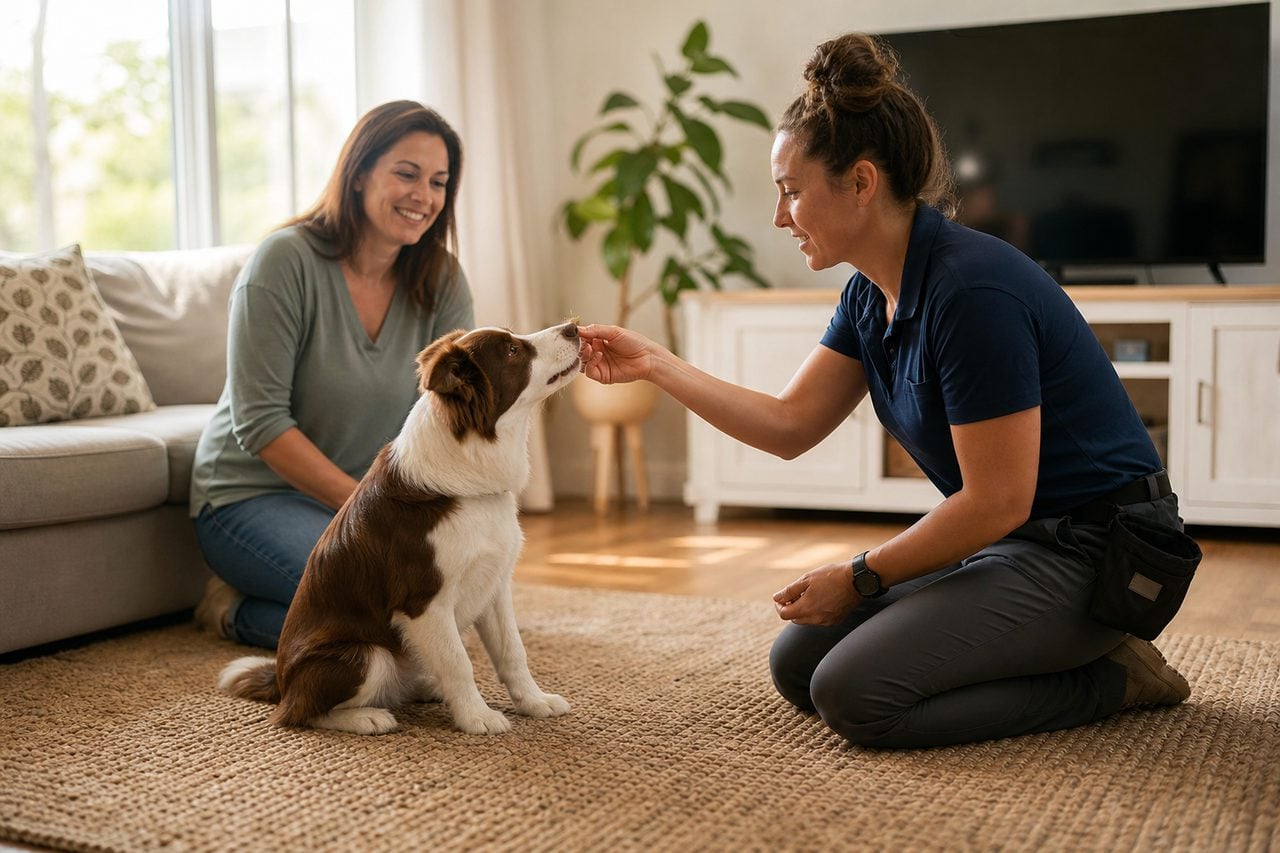
In-home training is the format that fits this metro’s geography best, and it is the one most owners here should start with.
The Fayetteville area is roughly seventy miles across. Sanford is thirty miles from the city, Laurinburg over forty, Southern Pines around thirty. The training facilities are clustered in three places — Fayetteville itself, Sanford, and the Harnett County towns — and everything in between is covered by trainers who drive. A number of businesses in this directory publish in-home training as a named service, and several more are mobile without labeling it.
There is a second reason beyond distance. Most of what owners actually want fixed happens at home. Jumping on visitors, stealing from counters, barking at the door, crate screaming, resource guarding a sofa, refusing to settle while you cook, two dogs squabbling in a kitchen — none of that reproduces in a training hall. A trainer standing in your hallway can change the setup as well as the dog, and the setup is usually half the problem.
This page covers who offers it around Fayetteville, what a session actually involves, what it costs, and when a facility is the better choice after all.
Who works in your home around Fayetteville
Several businesses publish in-home training by name, and their reach differs in ways that matter more than their marketing does.
The Sandhills franchise territory delivers all of its training in the client’s home and publishes a serving-area list that is the most specific in the metro: Aberdeen, Cameron, Candor, Carthage, Eagle Springs, Ellerbe, Foxfire, Hoffman, Pinebluff, Pinehurst, Raeford, Robbins, Sanford, Seven Lakes, Southern Pines, Taylortown, Vass, West End and Whispering Pines, with Fayetteville also in its published area.
A Raeford business publishes in-home courses alongside basic obedience, tracking and trailing and service-dog work, states that it serves “Fayetteville, NC and surrounding areas,” and publishes a full named team.
A Spring Lake pet resort publishes In-Home Training alongside board-and-train, play-and-train and private training, delivered by a named contracted training team.
A mobile trainer covering Cumberland and Hoke counties publishes owner-facing training built around obedience with ongoing owner support, and gives counties rather than an address.
Another mobile business states plainly that “we come to you,” and a mobile trainer with a law-enforcement canine-handler background operates on a come-to-you basis across the Fayetteville area, offering scent work, tracking, area searching and behavior modification.
A Laurinburg trainer’s published testimonials describe her returning to clients’ homes for follow-up sessions after a program had ended, which is the same service under another name.
What an in-home session actually looks like
The first session is usually as much assessment as training, and it should be.
A good in-home trainer spends the first part watching: how the dog greets at the door, where it sleeps, who feeds it, what the traffic pattern of the house is, where the crate sits, whether the children are part of the problem, whether there is another dog. Then the plan changes the environment as much as the dog — a gate here, the crate moved out of the hallway, the greeting moved off the threshold, food stopped from the table.
Later sessions typically split between indoor work and taking the dog out onto your own street, which is where leash manners actually have to work. This is the specific advantage of the format: the trainer is proofing in exactly the environment where the behavior has to hold.
Session length is usually an hour to ninety minutes.
Expect homework. Every credible in-home program is really a coaching relationship, and the sessions are checkpoints on work you do in between.
The problems in-home training solves best
Some problems are simply the wrong shape for a training hall, and these are the ones local in-home trainers see most.
Door and visitor behavior. Jumping, barking, bolting. It cannot be rehearsed anywhere else, because the doorbell is yours.
House training and crate work. Location-specific by definition.
Settling. A dog that will not switch off while you cook, work or watch television. The whole skill is about that room.
Resource guarding of household objects. The sofa, the bed, a spot under the table.
Multi-dog household friction. Feeding, doorways, narrow corridors, who gets the good spot.
Children and dogs. The handling changes have to happen where the children are, and the children have to be coached too.
Separation anxiety. Tied to one specific house and one specific departure routine. Most of the businesses here that publish separation anxiety work deliver in the home.
The reactive dog’s route. A trainer who walks out of your actual door with you can redesign the walk — the hour, the direction, the exit — which for leash reactivity is a large share of the treatment.
When a facility beats your living room
In-home is not always right, and the honest cases against it are worth stating.
When the problem is other dogs. You cannot supply the stimulus. A reactive or under-socialized dog eventually needs controlled exposure to dogs at managed distances, and that means a class or a facility. The Fayetteville obedience club, a Sanford business running group classes, and an Aberdeen facility all supply that.
When you want a group room. Learning around other dogs is a distinct skill and the class format is the product.
When you want sport. IGP at the Lillington club, rally and competition obedience at the Fayetteville club, dog sports at the Sanford learning center, gun-dog work on the Harnett County fields. All facility-bound.
When the household cannot be consistent. In-home training depends on the household doing the work between sessions. If the calendar genuinely will not hold that — a real constraint in this metro — a residential program may deliver more, and many local businesses publish one.
When you need equipment or space. Swimming, agility equipment, a large secure field. A canine pool program in Aberdeen and a 300-acre training facility in Lillington exist for reasons.
Coverage, travel and the outer towns
The single most useful question to ask a mobile trainer in this metro is not about method. It is: which towns do you actually drive to, and is travel included?
Published service areas here vary enormously. One Fayetteville business lists Fayetteville, Cameron, Raeford, Hope Mills, Rockfish, Spring Lake, Southern Pines, Sanford, Parkton, Lillington, Benson and Lumberton. Another lists Fayetteville, Fort Bragg, Spring Lake, Eastover, Vander, Hope Mills, Southern Pines, Lumberton, Elizabethtown and Whiteville. The Sandhills territory lists nineteen Moore County towns. A Lillington business lists Harnett County, Fuquay-Varina, Angier and Sanford. And several publish counties only — Cumberland, Hoke, Moore — with no town list at all.
Read those carefully against where you live, because the overlaps are uneven. Eastover, Vander and Stedman appear on some lists and not others. Coats and Dunn are better served from the I-95 side than from Fayetteville. Laurinburg and Scotland County sit at the edge of everyone’s range.
Ask also whether travel is billed. Nobody in this metro publishes a travel policy, and an hour’s round trip to Whispering Pines is a real cost that has to sit somewhere in the price.
Prices and packages
As everywhere else in this market, most in-home pricing is quoted rather than published, and almost every business offers a free consultation first — several by phone, which saves a drive.
That is the clearest number available for what an hour of a professional’s time costs locally.
Packages are the norm rather than single sessions, because behavior work does not fit into one visit. Ask how many sessions, over what period, and what happens if you need more. Ask whether phone or message support between sessions is included; one Lillington business advertises lifetime support with its programs and a Cumberland-and-Hoke mobile trainer lists ongoing owner support as part of what it offers.
One local business offers third-party financing for training packages, which is worth knowing exists if a multi-session program is the right answer and the up-front number is the obstacle.
Getting the most out of it
In-home training rewards preparation more than any other format, because you are buying a professional’s time in an environment only you can set up.
Have everyone there. The person who lets the dog on the sofa needs to hear the plan first-hand, not second-hand. Include the children if they are part of the picture.
Do not pre-tidy the problem. Let the trainer see the actual doorway chaos. A session where the dog behaves perfectly because you managed everything in advance is a wasted session.
Write down what happens. Ninety minutes is a lot of information and most of it is gone by Thursday.
Book the follow-up before the trainer leaves. Momentum is most of it.
Do the homework in short doses. Five minutes, three times a day, beats an hour on Sunday.
Be honest about the household. If nobody is going to walk the dog before work, say so, and let the plan be built around the truth rather than around an intention. The trainers here who do this well are used to households under pressure — several of them have lived it.
Reviewed In-Home Dog Training Trainers in Fayetteville
These reviewed Fayetteville-area trainers from our directory handle in-home dog training. Each links to a full profile with specialties, certified credentials, reviews, and contact info:
- Blue Cord K9 — 5.0★ (136 reviews)
- Midgard K9 Solutions — 5.0★ (35 reviews)
- Dog Training Elite of Sandhills — 5.0★ (10 reviews)
- National Barks Pet Resort — 4.5★ (23 reviews)
- Canine Coaching Services LLC
See all Fayetteville in-home dog training trainers →
Frequently Asked Questions
How much does in-home dog training cost near Fayetteville?
Most businesses quote after a free consultation rather than publishing rates, and several of those consultations happen by phone. Packages are the norm. Ask whether travel to your town is included – nobody here publishes a travel policy, and a round trip out to the Moore County towns is a real cost.
Which towns do in-home trainers cover around Fayetteville?
It varies a lot, so check before you assume. Published service areas in this directory include lists running from Fayetteville and Fort Bragg out to Southern Pines, Lumberton and Whiteville; a nineteen-town Moore County list covering Pinehurst, Southern Pines, Aberdeen, Vass, Seven Lakes and Whispering Pines; a Harnett County list including Fuquay-Varina, Angier and Sanford; and several businesses that publish counties only – Cumberland, Hoke, Moore. Eastover, Vander, Stedman, Coats and Laurinburg are the towns most likely to fall between coverage areas.
Is in-home training better than a class?
For different jobs. In-home wins for anything tied to your house – door behavior, house training, crate work, settling, resource guarding, multi-dog friction, separation anxiety, and redesigning a reactive dog’s walking route. A class wins for the one thing your living room cannot supply, which is other dogs at a managed distance. A lot of owners in this metro do both: private work first, then a class once the dog can cope with a room.
Does the trainer work with my dog or with me?
Both, and the second one is the point. Every credible in-home program is a coaching relationship – the trainer demonstrates, then hands you the leash, then gives you homework. One Coats business states that it prioritizes educating owners so they can handle their dog with confidence, and a Cumberland-and-Hoke mobile trainer lists ongoing owner support as part of what it sells. Get the whole household to the first session, including whoever breaks the rules.
Can in-home training fix aggression or reactivity?
It is often the right starting point, because a trainer who walks out of your actual door can change the route, the hour and the exit – which for leash reactivity is a large share of the treatment. What it cannot do on its own is supply controlled dog exposure at managed distances, so most reactivity plans move outdoors to open ground and, later, into a class. For a dog with a bite history, consider the certified applied animal behaviorist practicing in Southern Pines rather than starting with a general trainer.
How many sessions will I need?
Packages rather than single visits are the norm here, and four is the commonest published bundle. Straightforward manners work often lands in the three-to-five session range with homework between. Behavior cases – reactivity, anxiety, aggression – run longer and are better thought of in months than in sessions. Ask what happens if you need more, and whether message or phone support between sessions is included; some businesses in this metro advertise ongoing or lifetime support.
Related: read our complete in-home dog training guide or the full Fayetteville dog training overview.
Ready to find the right in-home dog training pro in Fayetteville?