
In-Home Dog Training in Glens Falls, NY
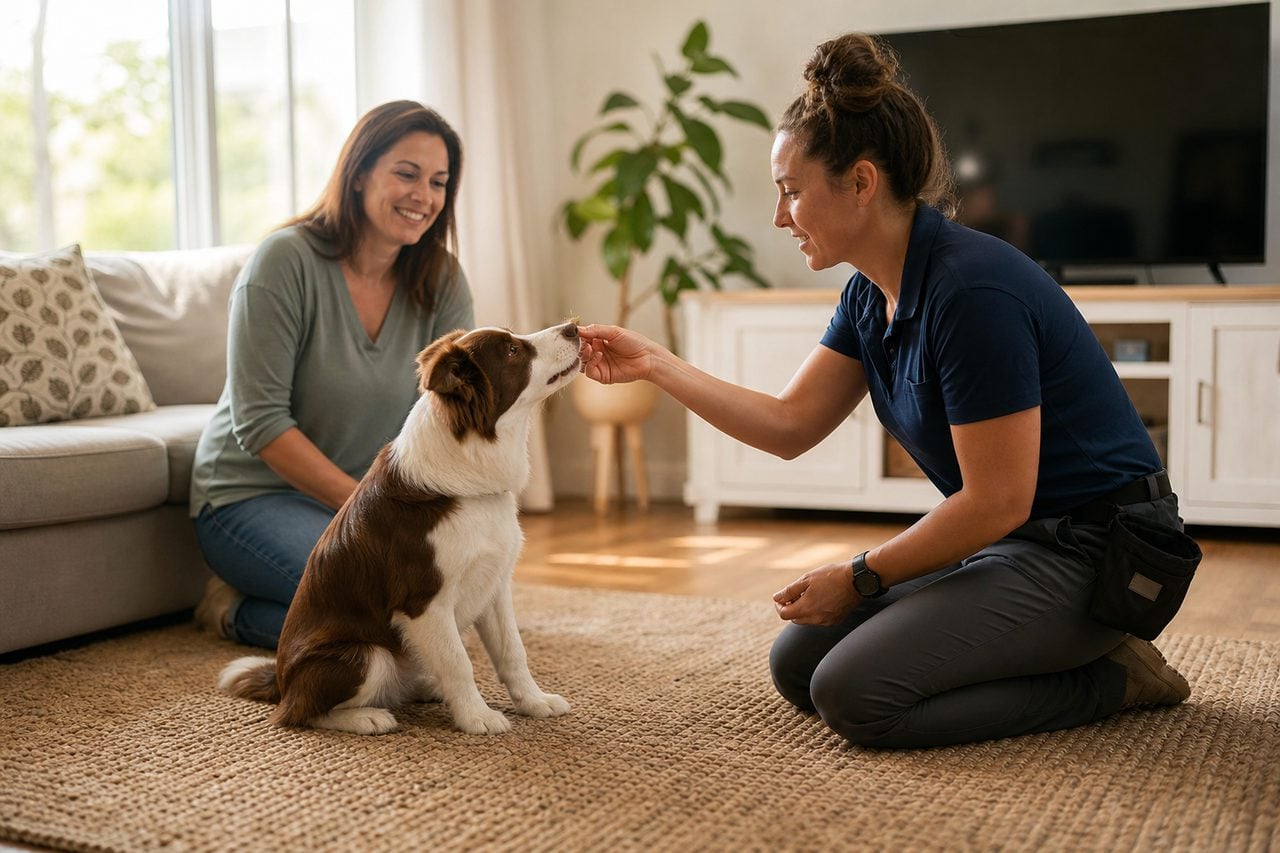
In-home training means a trainer drives to your house and works with your dog in the place the problems actually happen. It is not the same thing as a private lesson, and in this metro that distinction is worth money. Five local businesses advertise private or one-to-one work. Only two of them publish that they travel to the client: the Salem farm, whose service list includes at-your-home private training and whose stated catchment runs across the Glens Falls, Saratoga and Albany areas, and the enrichment center on Route 4 in Hudson Falls, which runs a mobile arm described plainly as coming to you. Everyone else offering private lessons means a one-to-one lesson at their own facility, which is a delivery format rather than a location.
- Private lesson or in-home: the distinction that costs people money
- The two providers who actually travel, and what they cover
- The problems that only a home visit solves
- Drive time, and why it decides more here than anywhere
- What a good home visit looks like
- When in-home is the wrong choice
- Reviewed trainers
- FAQ
So the first practical instruction on this page is to ask the question directly on the first call. Will you come to my house, and is that the same price? In a metro where the outer towns are half an hour from the nearest training hall, the answer changes which businesses are genuinely available to you.
The second thing worth knowing is why the in-home model fits this region so well. Two thirds of the population of these two counties lives outside the Glens Falls–Queensbury core, on properties with gravel drives, outbuildings, livestock next door and no sidewalk. The problems people call about — door barking, the delivery driver, the fence line, the cat, house training in a house with four exterior doors — are environmental, and they are close to impossible to reproduce in a hall on a Tuesday evening.
Private lesson or in-home: the distinction that costs people money
The training industry uses the words loosely and the directory software does too, which is why this page starts here. A private lesson is a session with one dog and one handler instead of a class. An in-home session is a session at your address. Those overlap often enough that people assume they are the same thing, and in this metro they are not: three of the five businesses advertising private work deliver it at their own facility, and two travel.
The practical consequence is a wasted phone call at best and a wasted evening at worst. If you live in Hudson Falls and the problem is that your dog goes berserk when the doorbell rings, a private lesson at a training hall fifteen minutes away can absolutely help you — the trainer teaches you a protocol and you go home and run it. But the trainer has not seen your hallway, your sightlines, the glass panel your dog can see through, or the fact that the door opens inward onto a rug the dog is standing on. Some problems do not survive that translation.
Conversely, plenty of problems do not need a house visit at all. Loose-leash walking, recall, a sit-stay, a structured heel and most obedience work transfer perfectly well from a hall, and the hall has advantages a kitchen cannot offer: other dogs, controlled distraction, space, and equipment.
Ask which kind you are buying, and pick for the problem rather than for the convenience.
The two providers who actually travel, and what they cover
The Salem farm is the more established of the two travel-to-you options and the one that reaches furthest. Its published services list at-your-home private training alongside kennel-free board and train, stay and play, behavioral consults, behavior modification, phone consults and herding, and it names its service area as Glens Falls, Saratoga Springs, Albany and Westchester County in New York plus southern Vermont. The trainer publishes CPDT-KA certification, professional membership of the APDT and a background as a former head trainer for the Monks of New Skete. For households out in the Washington County farm towns — Cambridge, Greenwich, Granville, Salem itself — this is the nearest professional training of any kind, and it comes to the door.
The Hudson Falls enrichment center runs the other one. That combination is useful: a household can start with a home visit, then move into a group class once the dog can handle a room, without changing provider.
Neither publishes a travel rate. Both should be asked, because the difference between a flat fee and a per-mile charge is meaningful if you are forty minutes out. And it is worth asking how far they will genuinely go — a published catchment that includes Albany does not necessarily mean an evening appointment in Whitehall.
The problems that only a home visit solves
House training in a rural house. Four exterior doors, a mudroom, a cellar stair the dog has discovered, and a schedule built around somebody leaving at six. A trainer who can see the actual route from the crate to the actual door will solve this in one visit; a trainer working from your description will be guessing at the one detail that matters.
The driveway and the door. This is the signature problem of these two counties. Two hundred feet of gravel gives a dog twenty seconds of warning, a truck arrives, a person gets out, the dog barks, the person leaves. Every single delivery rehearses the behavior and rewards it perfectly. Fixing it requires knowing where the dog first hears the vehicle, where it can see from, where you can intercept, and what the dog is allowed to do instead — all of which are facts about your property.
Multi-dog households and resource guarding around fixed furniture. Which sofa, which doorway, which feeding spot, who passes whom in a narrow hall: none of this is portable. Separation anxiety, which by definition only happens when you are not there and which needs a departure routine built out of your actual departure routine. Livestock and fence-line arousal, where the neighbor’s chickens or the cattle field over the wire are the trigger and cannot be brought to a hall. And multi-person households, where the real intervention is getting four people in one room agreeing on the same rules — far easier at their kitchen table than by asking them all to drive somewhere on a Tuesday.
Drive time, and why it decides more here than anywhere
The core of this metro is compact. Glens Falls to Queensbury is minutes, to Hudson Falls and Fort Edward is eight miles. Inside that band the in-home question is genuinely a preference, because getting to a hall is trivial.
Outside it, the arithmetic takes over. Granville to the nearest class venue is about forty minutes each way. Whitehall is roughly thirty-five. Chestertown is thirty-five, Warrensburg twenty-five, Lake George Village twenty. Take a six-week course from Granville: twelve trips, roughly eight hours in the car, two hundred and fifty miles, at a fixed hour on a fixed evening between November and February. It is not that people cannot do it. It is that missing weeks three and five to snow, which the local class calendar openly anticipates — one venue cancels whenever the Queensbury schools close — takes most of the value out of the course while keeping all of the cost.
For those households the honest comparison is one or two home visits against a course. A great many outer-town households would get more from that than from an evening class, and the two providers who travel exist because of exactly this arithmetic.
What a good home visit looks like
Expect the first session to be longer than you think and to involve a lot of talking. Local private sessions here run sixty to ninety minutes, and a competent first visit spends a substantial part of that on history and observation before anybody trains anything: what the dog does, when, what happens immediately before, what has already been tried, who lives here, and what the household actually wants. A trainer who starts drilling in the first ten minutes has decided what the problem is before looking at it.
Expect to be given homework and to be held to it. The local providers are direct about this — one publishes a whole page explaining that training without practice is money thrown away, and asks for clients who will do the action plan rather than hope. Expect the trainer to work with you rather than only with the dog; one local business describes spending as much time coaching people as training dogs, which is the correct ratio for in-home work.
Get everyone there. The commonest failure of a home visit is that one person attends, learns the protocol, and then cannot get the rest of the household to run it. If your teenager lets the dog on the sofa and your partner opens the door differently, the protocol is dead. Book the session for a time when the whole household can be present, even if that is a Saturday morning.
And expect a written plan. Every serious provider in this metro produces one in some form — an action plan, a set of notes, a follow-up email. If nothing arrives in writing, you will be running on memory within a week.
When in-home is the wrong choice
When the dog needs other dogs. Nothing in a kitchen teaches a dog to walk past another dog, settle in a room full of them, or read another dog’s signals. If your problem is social — an adolescent with no manners, a puppy that missed its window, a dog that is fine alone and impossible in company — you want a room, and this metro has two good ones plus a club with sixty years of practice at running them.
When the household will not do the homework. A home visit is a consultation, and a consultation with nobody to act on it is an expensive conversation.
When the house is the problem. Occasionally the environment genuinely cannot be fixed — a dog that cannot settle with three children under six, a guarding problem in a house with no way to separate, a reactive dog on a property with no space to work at distance. A good trainer will say so, and will move you to a facility or a residential program rather than sell you a fourth visit.
And when what you actually need is management rather than training. A better gate, a solid fence, a crate in the right room, a long line, a barrier at the window the dog barks from. Several of the calls that come in as training requests are solved by a hundred dollars of hardware and a rearranged hallway, and the trainers worth hiring in this metro are the ones who will tell you that instead of booking you in for three sessions.
Reviewed In-Home Dog Training Trainers in Glens Falls
These reviewed Glens Falls-area trainers from our directory handle in-home dog training. Each links to a full profile with specialties, certified credentials, reviews, and contact info:
- K9 Evolution — 5.0★ (22 reviews)
- Dog Days Farm — 5.0★ (7 reviews)
- PAWS Canine Enrichment Center — 4.9★ (15 reviews)
See all Glens Falls in-home dog training trainers →
Frequently Asked Questions
Which trainers near Glens Falls come to my house?
Two publish that they travel: the Salem-based farm trainer, whose service list includes at-your-home private training and whose stated catchment covers the Glens Falls, Saratoga Springs and Albany areas plus southern Vermont, and the Hudson Falls enrichment center, which runs a mobile arm described as coming to you. Three other local businesses advertise private or one-to-one lessons, but those are delivered at their own facilities. Ask directly, because the industry uses private and in-home interchangeably and they are not the same product.
How much does in-home training cost around Glens Falls?
Assume a travel charge on top for anything beyond the core towns and ask whether it is flat or per mile.
Is in-home training better than a class?
It is better for environmental problems and worse for social ones. House training, door and driveway barking, resource guarding around fixed furniture, separation anxiety, fence-line arousal and multi-person households all need the trainer to see the actual place. Leash manners, recall, obedience and anything requiring other dogs in the room are better served by a class, which can supply distraction and company that a kitchen cannot. Many households do both, in that order.
How far out will trainers travel?
One local provider publishes a catchment reaching Glens Falls, Saratoga Springs and Albany, which is a wide area, and another runs a mobile service across the counties it serves. That said, a published catchment is not a promise of a Tuesday evening appointment in Whitehall. Ask the specific question — will you come to this address, at what times, and at what extra cost — before you plan around it, particularly if you are in the Washington County farm towns or north of Lake George.
Who needs to be home for the session?
Everyone who handles the dog, which is the single most ignored piece of advice on this page. The commonest way a home visit fails is that one person learns the protocol and cannot get the rest of the household to run it. Local providers are explicit that every family member influences the dog and that agreement matters more than technique. Book the visit for a time when the whole household can be present, even if that means a weekend morning.
Can in-home training handle aggression?
Sometimes, and it depends on the type and the house. Fear-based and territorial aggression are often best addressed where they happen, and one of the traveling providers publishes behavioral consults and behavior modification. Start with an assessment and let the assessment choose.
Related: read our complete in-home dog training guide or the full Glens Falls dog training overview.
Ready to find the right in-home dog training pro in Glens Falls?