
In-Home Dog Training in Greenville, SC
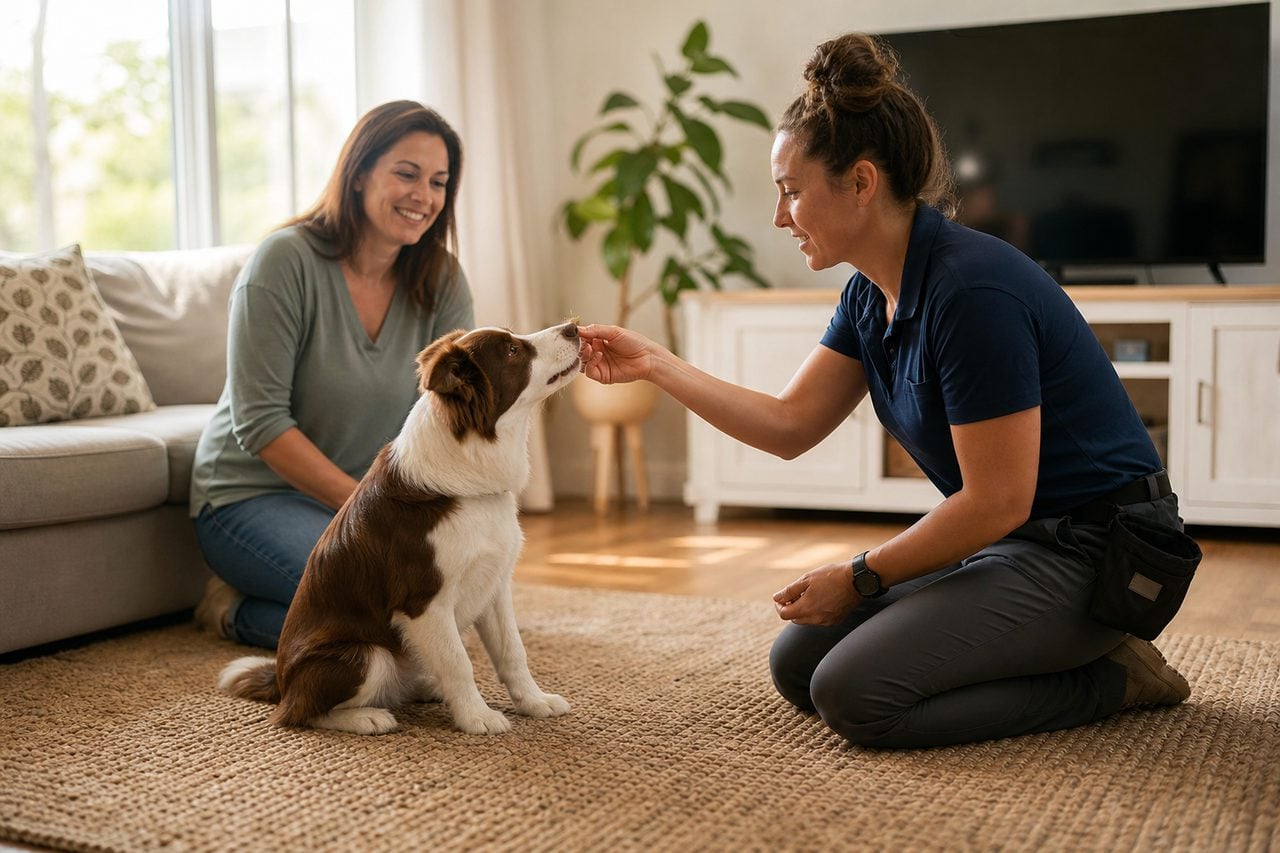
In-home dog training brings the trainer to your door instead of taking your dog to a facility. In the Greenville, South Carolina metro, many of the businesses here offer it in their own words, and for several of them it is the core of the business. It fits the metro’s shape well: the suburbs from Greer to Simpsonville and from Easley to Travelers Rest now form one continuous ring, and a trainer who drives between them as routine can reach households that would never make a weekly class across town.
This page explains why training at home often works better for everyday problems, who offers it locally, what a series of home sessions typically looks like, how it moves from the living room to Greenville’s streets and trails, and when a different format is the smarter choice.
Why the house is the right classroom
Most of the behaviors people want fixed happen at home: pulling on the leash from the front step, barking at the door, jumping on guests, stealing from counters, nipping children, panic when left alone. A dog that behaves perfectly in a training hall has not necessarily learned to behave in its own kitchen, because dogs do not generalize well from one place to another.
A trainer standing in your house also sees what you cannot describe on the phone: where the crate is, which window the dog watches the street from, how the family reacts when the doorbell rings. Small changes to the setup often matter as much as the training itself. And every member of the household can take part, which is usually where results succeed or fail. One in-home business puts it simply, saying it trains the dog and the owner together because most training falls apart when only the dog is trained.
Who offers in-home training in the metro
They come in three broad shapes.
Home-first specialists. An in-home franchise territory in Greenville teaches in your home, where it says your dog feels most secure, on your schedule, and describes methods based on respect, leadership and trust without bribes or punishment, with lifetime support after training. Another territory, with more than fifteen years of training across the Upstate, starts in your living room, yard and street and moves out once the dog is ready. A trainer based in Pauline offers in-home puppy sessions after an assessment, plus a one-day behavior session when she judges it necessary.
Trainers who mix home and residential work. A Greenville trainer runs a twice-weekly program at the client’s home with occasional field-trip lessons, alongside board-and-train in her own home and hourly lessons; she describes a play-based approach with flexible technique. An Upstate trainer offers in-home and board-and-train programs from basic obedience to behavioral correction and advanced work. A team serving the Upstate from Clemson to Mauldin trains in your home and in public, with an in-kennel option, after a free consultation; its owners previously ran a Colorado training business the site describes as more than twenty years old.
Franchise and facility programs with a home option. A Piedmont-based franchise territory centers on in-home training in Greenville, adds classes and boot camps, and starts with a free assessment. A veteran-founded franchise territory offers in-home training, stay-and-train and virtual lessons after an evaluation. And a kennel business with locations in the Mauldin/Greenville area and Five Forks lists in-home training among its options; every program there begins with an assessment at the facility, run by trainers with law enforcement, search-and-rescue, protection and companion-dog backgrounds.
What a series of home sessions looks like
Formats differ, but a sensible in-home program usually follows a pattern.
- The first visit. Questions about the dog’s history, routine and the problem, observation of the dog in its own space, and a few early exercises. Several local trainers offer this as a free evaluation or consultation.
- Early sessions. Foundation skills taught to the handlers: a marker or reward system, leash handling, a settle or place cue, and management changes around the house.
- Homework. Short daily practice between visits. The frequency of visits matters less than whether the family practices; one local program meets twice a week precisely to keep momentum.
- Moving outdoors. Driveway, then street, then busier places, adding distraction step by step.
- Tapering. Visits spread out as the family takes over, often with support by phone or a maintenance option afterward.
Ask each trainer to describe their own sequence and how they decide when to move to the next step.
Taking the work from the house to Greenville's streets
A home program should not end at the front door. The metro offers real-world proving grounds at every level. Augusta Road’s older neighborhoods and commercial strip test leash manners around traffic and other dogs. The residential streets near the Swamp Rabbit Trail on the north side of downtown bring a steady flow of cyclists and runners, useful for a dog that lunges at bikes. Main Street and Falls Park are the final exam: patios, festivals and crowds.
Several local in-home trainers plan for this explicitly. One territory moves dogs from the home to the Swamp Rabbit Trail or Main Street, where the real distractions are, once the dog is ready, and another team trains in the community and in public settings to create real-life learning experiences. Keep in mind that city ordinance requires a leash in public parks outside the designated off-leash areas, so outdoor sessions are leash work by default.
When another format is the better choice
In-home training is not always the answer. A dog that needs practice around other dogs will get more from a class or a trainer’s group sessions once it can cope. An owner who simply cannot find the daily practice time may be better served by board-and-train or day training, where the trainer lays the groundwork, followed by handover lessons at home; several of the in-home providers here offer residential options for this reason. And serious aggression or anxiety cases may call for a trainer who specializes in behavior, even if that trainer also works in homes.
Distance is the other practical factor. Ask whether your address falls inside a trainer’s regular area, particularly on the outer edges of the metro such as Gray Court, Pelzer or Lyman.
When you do speak to in-home trainers, a few questions help separate them:
- How is the first visit structured? Some local providers start with a free evaluation, consultation or assessment in the home; one kennel business holds its assessment at the facility first.
- What method will you use in my house? Ask for a plain description, including what happens when the dog gets it wrong.
- What support follows the last visit? Answers here range from lifetime support to a paid maintenance option.
- Is there a residential backup? Several in-home providers can switch to board-and-train or stay-and-train if progress stalls.
Reviewed In-Home Dog Training Trainers in Greenville
These reviewed Greenville-area trainers from our directory handle in-home dog training. Each links to a full profile with specialties, certified credentials, reviews, and contact info:
- Dog Training Elite Upstate SC — 5.0★ (336 reviews)
- Wavelength Canine — 5.0★ (15 reviews)
- Sally Said So Professional Dog Training Greenville — 5.0★ (10 reviews)
- Companion K9 Dog Training — 5.0★ (4 reviews)
- Paw & Order Dog Training Upstate SC — 4.9★ (93 reviews)
- Clemson Canine Academy, LLC — 4.8★ (26 reviews)
- Astro Kennels — 4.6★ (227 reviews)
- Bark Busters Home Dog Training – Greenville SC — 4.6★ (77 reviews)
- Greenville Humane Society Adoption Center — 4.5★ (2895 reviews)
- Astro Kennels — 4.5★ (489 reviews)
See all Greenville in-home dog training trainers →
Frequently Asked Questions
Is in-home training only for puppies?
No. Local in-home providers work with dogs of all ages, from puppies to adult dogs with leash, door or guarding problems. Puppies benefit because habits form at home, and older dogs benefit because the problem behavior usually happens there.
Do I need to be home for every session?
Yes, that is the point. The trainer teaches you and your household to handle the dog, so the people who live with the dog should attend. If your schedule rules that out, day training or board-and-train with handover lessons may fit better.
Will the trainer come to Greer, Easley or Travelers Rest?
Many will. In-home trainers here routinely drive across the metro, and some list wide service areas across the Upstate. Confirm that your address is covered before booking.
How is in-home training different from private lessons at a facility?
The trainer’s attention is the same, but the setting changes what you can work on. At home you can address doorways, visitors, counters and your actual walking route. At a facility you get controlled space and equipment, which suits some skills better.
Can in-home training handle serious behavior problems?
Often, yes. Home is where many problems are triggered, and some local in-home providers list aggression, separation anxiety and reactivity among their services. For severe cases, ask about the trainer’s specific experience with your problem and whether they would recommend residential work instead.
Related: read our complete in-home dog training guide or the full Greenville dog training overview.
Ready to find the right in-home dog training pro in Greenville?