
In-Home Dog Training in Jackson, MI
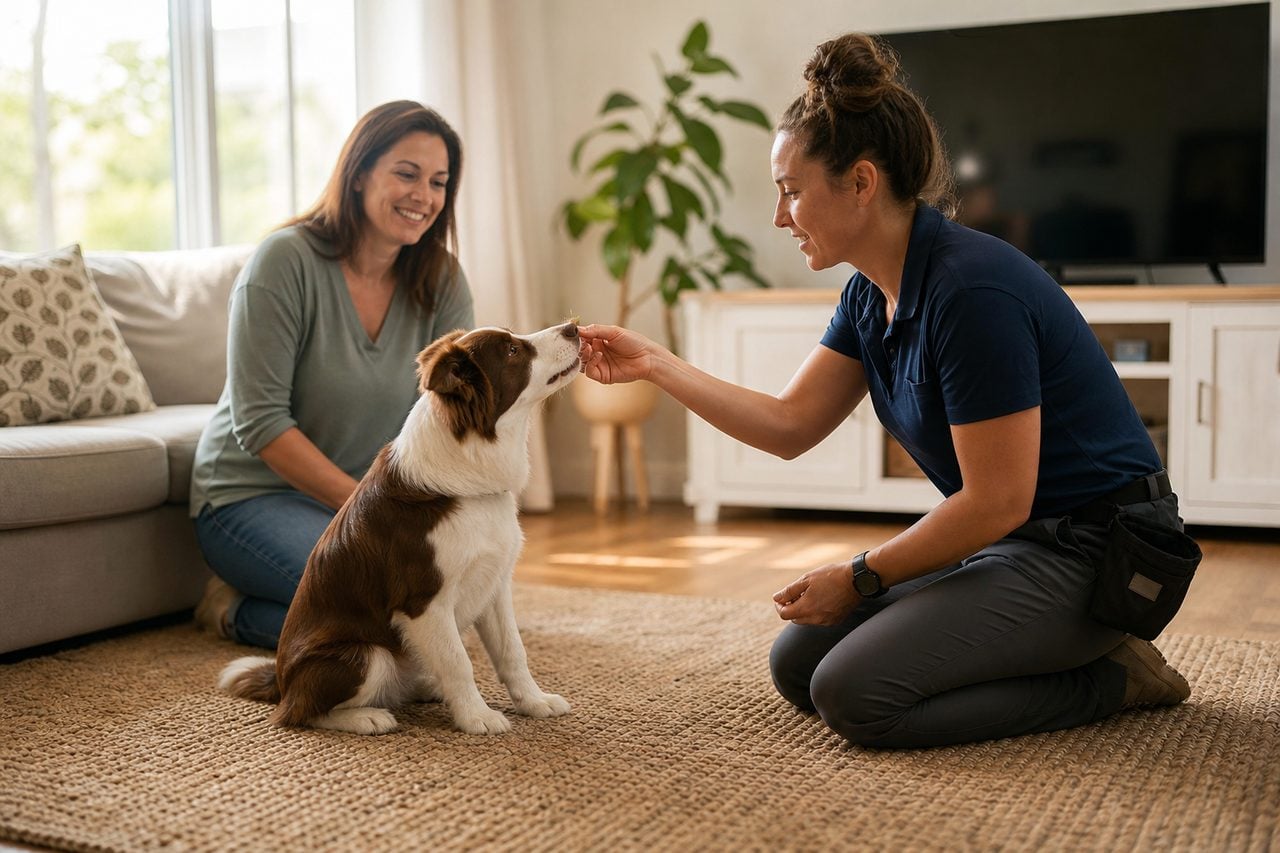
In-home dog training brings a professional trainer to your own front door, whether that door opens onto a bungalow near Ella Sharp Park, a farmhouse outside Concord, or a lake cottage on Clarklake. Instead of loading an over-excited dog into the car and hauling it to an unfamiliar facility, you and your dog learn together in the exact environment where the behavior actually happens. For many Jackson-area owners, that turns out to be the fastest, least stressful path to a calmer, more responsive dog.
Jackson County is spread out. From the city core along I-94, the area fans out to Spring Arbor, Napoleon, Brooklyn, Grass Lake, Michigan Center, Rives Junction, and the chain of lakes down toward the Irish Hills. Homes sit on everything from tight in-town lots to multi-acre parcels with livestock next door. A private, in-home program meets your dog where it lives, which matters a great deal when the problem is a doorbell, a backyard fence line, or a specific room in the house.
This guide explains how in-home training works, who it suits, what a typical program looks like across a rural-and-lake county like this one, and how to choose a trainer. Because qualified local supply can be thin in smaller Michigan markets, many households also look east toward the larger Ann Arbor and Detroit specialist pool for niche needs; the nearest specialists block below points that direction when it is warranted.
What In-Home Dog Training Actually Means
In-home or private training is one-on-one instruction delivered at your residence rather than in a group class or a boarding kennel. A trainer arrives on a scheduled visit, observes your dog in its normal setting, and coaches you and the household through a plan tailored to your specific goals. The dog stays home, sleeps in its own bed, and eats from its own bowl. You remain the primary handler the entire time, which is important because you are the person the dog has to listen to after the trainer drives away.
This model differs from two other common formats. Group classes gather several dogs in a shared space, which is excellent for socialization and distraction work but weak on household-specific problems. Board-and-train sends the dog away to live with a trainer for a stretch of days or weeks; the dog often returns with new skills, but the handoff back to the family is where results are frequently won or lost. In-home training keeps the human learning front and center from day one, so there is no fragile transfer step at the end.
Most reputable trainers today build programs around reward-based, positive-reinforcement methods paired with clear structure and consistent household rules. The dog earns things it wants, unwanted behaviors are managed and redirected rather than simply punished, and the whole family learns to be consistent. That consistency is the real product of an in-home program.
It is worth clearing up a common misconception: in-home training is not only for problem dogs. Plenty of owners bring in a trainer simply to raise a puppy well from the start, to smooth the transition of a newly adopted rescue into the household, or to add polish to a dog that is already pleasant but a little rough around the edges. Getting foundations right early is almost always easier than untangling entrenched habits later, and a few well-timed sessions at the beginning of a dog’s life in your home can prevent the very issues that lead people to call a trainer in the first place.
Why the Home Environment Changes Everything
Dogs are deeply context-bound learners. A dog that sits beautifully in a quiet training room may completely forget the cue when the mail truck rumbles up the driveway. Behavior is glued to the environment it was learned in, which is why a skill practiced only at a facility often fails to show up at home. Training in the actual location where the problem lives closes that gap.
Consider the behaviors Jackson-area owners most often call about. Door-dashing when guests arrive. Barking at the fence line when a neighbor’s dog appears. Counter-surfing in the kitchen. Pulling toward the water the moment the leash comes off at the lake. Reactivity toward deer, rabbits, or wild turkeys along a wooded property edge. None of those happen in a classroom. They happen at your address, triggered by your specific doorbell, your specific driveway, your specific yard. A trainer standing in your living room can see the real antecedents and build a plan around them.
The home setting also lets a trainer read the whole picture: where the dog sleeps, how it is fed, which family member accidentally reinforces the jumping, whether the crate is set up well, how the yard is fenced. These environmental details often explain a stubborn problem faster than any amount of obedience drilling. Fixing the environment is frequently half the solution, and you cannot fix an environment a trainer has never seen.
Problems In-Home Training Solves Best
Certain goals are almost tailor-made for a private, at-home approach. If any of the following sound familiar, an in-home program is worth serious consideration:
- Household manners. Jumping on guests, counter-surfing, stealing food, bolting through open doors, and general chaos when the doorbell rings are all location-specific and respond well to on-site coaching.
- Puppy foundations. House-training, crate training, settling, gentle handling, and early socialization are easier to build in the puppy’s own home before bad habits set in. In-home visits also protect a young, not-yet-fully-vaccinated puppy from unnecessary exposure.
- Leash skills for real routes. Loose-leash walking practiced on your own street, along the Falling Waters Trail, or around a lake loop transfers far better than leash work done only in a parking lot.
- Reactivity and fear. Dogs that lunge or bark at other dogs, strangers, or wildlife need careful, distance-managed work that often starts inside the home and yard where the handler can control intensity.
- Separation-related distress. These cases practically require in-home work, because the behavior only occurs when the dog is home alone. A trainer needs to see the departure routine and the space to build a real plan.
- Multi-dog households. Managing resources, feeding routines, and low-level tension between dogs is much clearer to assess where the dogs actually live together.
Group classes still shine for one thing in particular: practicing focus around the controlled distraction of other dogs and people. Many owners get the best of both worlds by starting with in-home foundations and later adding a group class or field trips for proofing once the basics are solid.
What a Typical In-Home Program Looks Like
Programs vary by trainer, but most follow a recognizable arc. Knowing the shape ahead of time helps you set realistic expectations and ask better questions during your first call.
The initial assessment
The first visit is usually a consultation. The trainer gathers history, watches the dog in the home, identifies triggers, and discusses your goals. Expect questions about diet, exercise, daily routine, prior training, medical history, and who in the household does what. This session ends with a proposed plan and a realistic timeline. It is also your chance to interview the trainer: watch how they handle your dog, whether they explain their reasoning in plain language, and whether the plan feels achievable for your household. A consultation that leaves you clear on what happens next, and why, is a good early sign.
The working sessions
Follow-up visits, often weekly or every couple of weeks, build skills in layers. A session might cover a new cue, troubleshoot the last one, and add difficulty as the dog succeeds. Crucially, the trainer coaches you to run the exercises, then leaves you with homework. The dog’s progress between visits depends on that daily practice, which is why the human coaching matters so much.
Generalization and proofing
Once a behavior is reliable in one room, it gets practiced in other rooms, in the yard, on the driveway, and eventually on real outings. This is where local geography earns its place in the plan: a trainer might have you proof a solid stay at Cascades Falls, work focus among distractions at Ella Sharp Park, or practice a calm leash walk along a stretch of the Falling Waters Trail.
Maintenance and follow-up
Good programs end with a maintenance plan so gains hold. Some trainers offer check-in visits, phone or video support, or a tune-up session weeks later. Behavior is never truly finished; it is maintained through consistent daily habits the household keeps up.
The Jackson County Radius: Trainers Who Travel
One practical reality of a spread-out county is travel. Jackson proper is compact, but a huge share of the population lives outside the city in townships and lake communities that can be twenty or thirty minutes apart. Napoleon to Grass Lake, Concord to Michigan Center, or the run down to Brooklyn and the Irish Hills all add up quickly on a map.
Because of that geography, many trainers who serve the area cover a wide radius, driving to homes across multiple townships and often into neighboring counties. When you contact a trainer, confirm a few logistics up front:
- Whether your specific town is inside their normal service area, or whether a travel fee applies for outlying addresses like Clarklake, Rives Junction, or the far side of the chain of lakes.
- How scheduling works around drive time, since a trainer covering a broad rural territory may batch visits by region on certain days.
- Whether some sessions can be run by video call between in-person visits, which many trainers now use to keep momentum without the windshield time.
Thin local supply is worth naming honestly. Jackson is a mid-sized market, and for common goals like manners, puppy work, and leash skills, you can usually find a capable local trainer who will come to you. For narrower specialties, the pool naturally widens as you look east: the Ann Arbor area is roughly forty minutes down I-94, with the broader Detroit region beyond it, and some owners travel that direction, or bring an out-of-area specialist in, when a particular expertise is not available closer to home.
How to Choose an In-Home Trainer
Dog training is an unregulated field in the United States. There is no license required to hang out a shingle, which means the burden of vetting falls on you. A little diligence up front saves a lot of frustration later. Look for the following:
- Transparent methods. A good trainer can explain, in plain language, what they will do and why. Be cautious of anyone who is vague, promises guaranteed results on a fixed date, or relies heavily on fear, pain, or intimidation. Modern, reward-based methods are both humane and effective for the vast majority of pet dogs.
- Relevant experience. Ask how many cases like yours they have handled. A trainer strong in puppy manners is not automatically the right fit for serious aggression, and vice versa.
- Professional development. Certifications from recognized organizations, continuing education, and membership in professional bodies are positive signals, though no certificate guarantees skill on its own.
- Clear expectations for you. Honest trainers tell you that your daily practice is the engine of progress. If someone implies you can be passive while they fix the dog, be skeptical, especially with in-home work.
- References and reviews. Talk to past clients if you can, and read reviews with an eye for how the trainer handled tough cases and communicated.
For behavior involving aggression, severe anxiety, or any bite history, raise the bar further. Those cases can warrant a veterinary behaviorist or a trainer with specific credentials in behavior modification, and that is another situation where casting a wider net toward the Ann Arbor and Detroit area may be the responsible move. When in doubt, start with a conversation with your veterinarian, who can rule out medical contributors and point you toward reputable help.
Setting Your Household Up for Success
The homes that get the most out of in-home training tend to do a few things well, and none of them are complicated. Getting the whole household on the same page is the single biggest predictor of results. If one person enforces a rule and another quietly breaks it, the dog simply learns that outcomes are unpredictable, and progress stalls.
Practical ways to prepare and follow through:
- Decide the house rules as a family before training starts, and agree everyone will hold the line, including kids and visiting relatives.
- Keep sessions short and frequent. A few five-minute reps sprinkled through the day beat one long, tiring session, and they fit easily around work and school.
- Meet the dog’s baseline needs first. Adequate exercise, mental enrichment, sleep, and a predictable routine make a dog far more trainable. A bored, under-exercised dog in a big rural yard can still be under-stimulated if nothing engages its mind.
- Manage the environment while you train. Baby gates, crates, leashes indoors, and simply putting the trash behind a closed door prevent the dog from rehearsing the behavior you are trying to eliminate.
- Track progress honestly. Note what improved and what did not between visits so your trainer can adjust.
Finally, a note on the outdoors, since so much of life here revolves around lakes, trails, and open land. Michigan has no statewide leash law, so requirements vary by local ordinances across the Jackson area and by the rules of specific parks and trails. A reliable recall and calm leash manners are not just training goals, they are safety essentials near water, roads, wildlife, and other dogs. Building those skills at home first, then proofing them in the places you actually go, is exactly what in-home training is built to do.
It also helps to think seasonally, because Jackson living changes with the calendar. Summer brings lake traffic, boat launches, cookouts, and a parade of visitors and other dogs, all of which test a dog’s manners and recall. Fall and winter bring deer movement, hunting season, ice on the driveway, and long stretches of indoor time that can leave an under-exercised dog restless and harder to train. A trainer who works in your home can build a plan that anticipates these swings rather than reacting to them, scheduling more indoor enrichment and impulse-control work in the cold months and more real-world proofing once the trails and lakeshores fill up again. Matching the training rhythm to the way you actually live in this county is one of the quiet advantages of keeping the work at home.
In-Home Dog Training in Jackson: Local Options & Nearest Specialists
Right now there are no listed Jackson trainers focused specifically on in-home dog training. Many general Jackson dog trainers can help you get started, and the nearest specialists for this focus are below.
Nearest in-home dog training specialists — Ann Arbor
For complex cases, some families travel to the larger pool of specialists in the Ann Arbor area for an assessment or a board-and-train stay. Top-reviewed options:
- Attaboy Dog Training — 4.8★ (62 reviews)
- Longsnouts [Dog Training] — 3.4★ (14 reviews)
See all Ann Arbor in-home dog training trainers →
Frequently Asked Questions
How many in-home sessions will my dog need?
It depends entirely on the goal, the dog, and how consistently the household practices between visits. Basic manners and puppy foundations often show real progress within a handful of sessions spread over several weeks, while reactivity, fear, or separation-related issues typically take longer and are worked in stages. A good trainer will give you a realistic estimate after the initial assessment rather than a one-size-fits-all number, and will adjust as your dog progresses.
Is in-home training better than a group class?
Neither is universally better; they solve different problems. In-home training excels at household-specific issues and at building foundations in the environment where behavior actually happens. Group classes are excellent for practicing focus around the controlled distraction of other dogs and people. Many owners get the best results by starting with in-home foundations, then adding a class or supervised outings to proof the skills once the basics are solid.
Do trainers actually travel to towns outside the city of Jackson?
Many do. Because Jackson County is spread out across townships and lake communities, trainers who serve the area commonly cover a wide radius, reaching places like Spring Arbor, Napoleon, Concord, Grass Lake, Brooklyn, and Clarklake. Confirm your specific address is inside a trainer’s normal service area when you call, and ask whether a travel fee applies for outlying locations or whether some check-ins can be handled by video between in-person visits.
Do I need to participate, or can the trainer just fix my dog?
With in-home training, your participation is the whole point. The trainer coaches you to run the exercises so that the dog learns to respond to you, not just to the trainer. Progress between visits comes from your daily practice, and getting the entire household consistent is the biggest predictor of lasting results. Be cautious of anyone who implies you can stay passive while they handle everything.
My dog behaves at the training facility but not at home. Why?
Dogs are strongly context-bound learners, so a skill practiced only in one location often fails to appear elsewhere. A sit learned in a quiet training room may vanish when your doorbell rings. Training in the actual home closes that gap by teaching the behavior where you need it, then generalizing it to other rooms, the yard, and real outings. This is one of the core advantages of the in-home approach.
What should I do about off-leash areas and leash rules locally?
Michigan has no statewide leash law, so requirements vary by local ordinances across the Jackson area and by the posted rules of individual parks and trails such as those around Cascades Falls, Ella Sharp Park, and the Falling Waters Trail. Always check the rules for the specific place you plan to visit. Regardless of the letter of the law, a dependable recall and calm leash manners are essential for safety near water, roads, and wildlife, and they are exactly what a good in-home program helps you build.
Related: read our complete in-home dog training guide or the full Jackson dog training overview.
Ready to find the right in-home dog training pro in Jackson?