
In-Home Dog Training in Johnstown, PA
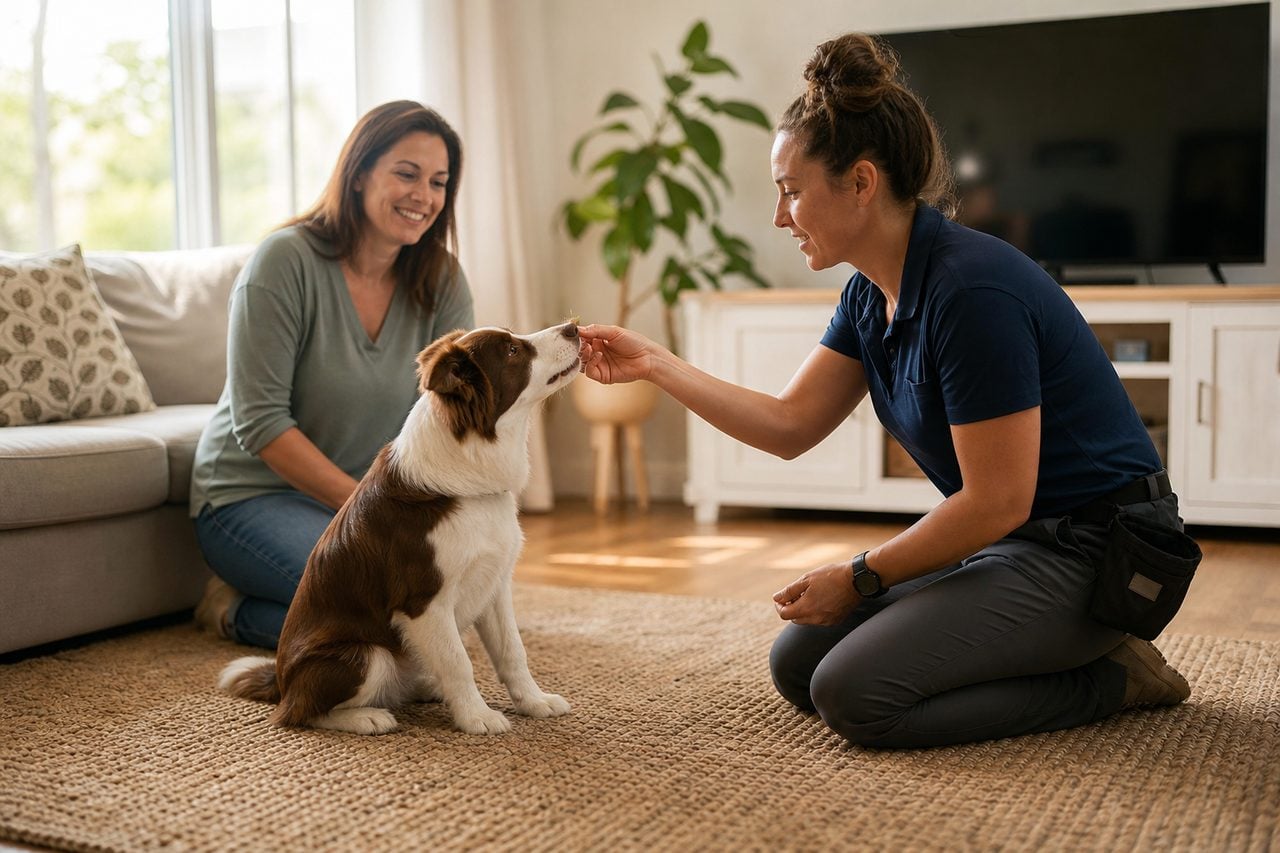
In-home dog training brings a professional trainer to your door, working with your dog in the exact environment where its behavior actually happens — your living room, your entryway, your yard, your street. For many Johnstown households, that context is the whole point. A dog that lunges at the mail carrier from a downtown rowhouse porch, bolts out the door of a Westmont hillside home, or ignores every cue in the chaos of a busy Richland kitchen is showing you problems that are tied to specific rooms, doorways, and routines. Fixing them where they occur is often faster and more durable than practicing in a neutral classroom and hoping the skill travels home.
Cambria County’s layout makes the in-home model especially practical here. The population is spread across a wide valley-and-ridge landscape — the city core at the confluence of the Stonycreek and Little Conemaugh, the hilltop suburbs, the eastern developments around Geistown and Richland, ridge towns like Ebensburg, the old coal-patch boroughs, and the southern highlands around Windber. Getting to a central class location can mean a real drive for families on the far edges of that map, and a trainer who travels to you removes that barrier entirely.
This guide covers what in-home training is well suited for, what it is not, how sessions typically run, and how to think about coverage across the Johnstown valley. Because good in-home trainers travel a wide radius here — and because larger nearby markets offer more selection for specialized needs — it also explains when to look locally first and when reaching toward Pittsburgh or Altoona makes sense.
Along the way it walks through how a typical session runs, how to vet a trainer in a state where the industry is unregulated, and how in-home work fits alongside group classes and real-world proofing on the Path of the Flood Trail or a downtown sidewalk near the rivers. The aim is to help you decide whether the in-home format fits your dog, your household, and your corner of the valley — from the riverfront up to Westmont, out to Richland and Geistown, and south toward Windber.
What In-Home Training Is Best For
In-home training shines whenever the problem is anchored to your specific environment. Household manners top the list: door-dashing, counter-surfing, jumping on guests, demand barking, resource guarding a particular couch or food bowl, and rough behavior with kids all happen in rooms and doorways that a trainer can address directly. So do house-training gaps, crate resistance, and settling on a mat while the family eats dinner. These are context problems, and the context is your home.
It also suits dogs and owners who struggle in group settings. A reactive or fearful dog that cannot think straight surrounded by other dogs in a class often does far better one-on-one in a quiet, familiar space. Puppies get a strong start when foundation skills and early socialization plans are built around the actual household routine. And owners with mobility limits, small children, tight work schedules, or transportation challenges — common realities across the Johnstown area — get coaching that fits their life instead of forcing their life around a class schedule. The trainer sees the real conditions and coaches the real humans who live there, which is often where lasting change actually comes from.
What In-Home Training Is Not Ideal For
The home’s greatest strength — its familiarity and quiet — is also its limit. A dog that behaves beautifully in the living room may fall apart the moment it hits a busy sidewalk, a store parking lot, or a park full of distractions. Skills learned in-home eventually need proofing in the wider world, which means some sessions should move to a downtown street near the rivers, the Path of the Flood Trail, or a quiet stretch of Stackhouse Park to build reliability under real distraction. A trainer who only ever works in your living room is not finishing the job.
Group socialization is another gap. Puppies and under-socialized dogs benefit from structured, safe exposure to other dogs and unfamiliar people — something a solo in-home session cannot fully replicate. Many owners blend the two: in-home work to build the foundation and fix household-specific problems, plus a well-run group class or public outing to generalize the skills. Finally, certain specialized cases — severe aggression with a bite history, complex fear cases — may call for a behavior professional with credentials and facilities beyond what a general in-home trainer offers, which is where the larger nearby markets come into the picture.
How an In-Home Session Typically Works
A first in-home visit usually starts with an interview and observation. The trainer asks about the dog’s history, health, diet, daily routine, and the specific behaviors that prompted the call, then watches how the dog moves through its own space — how it greets visitors at the door, whether it settles or paces, where the flashpoints are. This assessment in context often surfaces causes that would never show up in a classroom, such as a doorway sightline that fuels barking or a feeding setup that drives guarding.
From there the trainer demonstrates handling and technique, then coaches you and other household members to do it yourselves, because in-home training is as much about training the humans as the dog. You will typically leave each session with a short set of homework exercises to practice between visits, since the daily repetitions you do are what actually build the behavior. Sessions commonly run around an hour, spaced a week or two apart to give you time to practice. Expect the trainer to adjust the plan based on what your homework video and reports show — the plan is a living thing, revised to fit your dog and your household rather than a fixed curriculum.
Coverage Across the Johnstown Valley
Because in-home trainers here travel to clients, coverage is really a question of radius rather than a single location. A trainer based near the city can typically reach a wide swath of Cambria County — downtown and the riverfront neighborhoods, up the hill to Westmont, out east to Geistown and Richland, and often the closer boroughs. Trainers willing to range farther cover the ridge around Ebensburg, the coal-patch boroughs, and the southern highlands toward Windber. When you contact a trainer, confirming their travel radius and any trip fee for the outer edges of the valley is a reasonable first question.
Geography does shape logistics. The valley-and-ridge terrain means drive times between towns are longer than the map distances suggest, and winter weather in the Laurel Highlands can complicate scheduling on the ridges. Some trainers offer virtual coaching for follow-up sessions to keep momentum between in-person visits, which works well for households on the far edges. The practical upshot: households anywhere from the rivers to Windber can usually find in-home coverage, but confirming radius, fees, and scheduling flexibility up front avoids surprises.
Local First, Then Pittsburgh or Altoona
For the great majority of in-home needs — puppy foundations, manners, house-training, mild-to-moderate reactivity, general obedience — a qualified local trainer who travels the Johnstown valley is the right starting point. Local trainers know the area, cut your travel to zero, and see your dog in the environment that matters. Starting local keeps things simple and usually gets the job done.
Reaching toward the larger nearby markets makes sense when your case is specialized or when you simply want more choice. Pittsburgh, roughly an hour and fifteen minutes west, and Altoona, about forty minutes north, both have deeper benches of trainers and behavior professionals than Johnstown itself, including credentialed specialists for serious aggression, complex fear cases, or specific methods you may prefer. Some of those professionals will travel out to Cambria County for the right case, and some offer virtual consults. The sensible sequence is local-first for everyday training, then widen the search to Pittsburgh or Altoona when the situation calls for specialized expertise or a larger pool to choose from.
How to Vet an In-Home Trainer
The dog-training industry is unregulated in Pennsylvania, meaning anyone can call themselves a trainer without credentials or oversight. That puts the burden of vetting on you. Ask about the trainer’s methods in plain language: reward-based, modern trainers should be able to explain what they will do when the dog gets it right and what they will do when it gets it wrong, without relying on fear or pain. Ask what tools they use and why. Ask about experience with your specific issue, and request references or reviews from past clients in the area.
Because the trainer will be entering your home and working around your family, comfort and communication matter as much as technique. A good trainer explains the plan clearly, coaches the humans patiently, sets realistic expectations, and does not promise overnight miracles. Be wary of anyone who guarantees results, refuses to explain their approach, or leans on harsh corrections as a first resort. Watching how the trainer interacts with your dog in that first session tells you a great deal — a dog that stays engaged and willing is a good sign, while one that shuts down or grows fearful is a red flag worth heeding.
Combining In-Home With Other Training
In-home training does not have to stand alone, and often it should not. A common and effective pattern is to use in-home sessions to build the foundation and resolve household-specific problems, then layer in other formats to round out the dog’s education. Once your dog is reliable at home, adding public-access practice — a downtown sidewalk, a trailhead, a store parking lot — proofs the skills against the real-world distractions that home simply cannot provide.
For dogs that need social exposure, pairing in-home foundation work with a well-run group class or structured socialization outing gives the best of both: individualized attention plus generalization around other dogs and people. Owners tackling separation anxiety should note that that specific problem is treated through its own home-based desensitization protocol rather than general in-home obedience, and it is worth handling as a distinct track. Think of in-home training as the base layer — the place where the core skills and household manners are built — onto which you add real-world proofing and, where needed, group work and specialized help. Blending formats to fit your dog and your life across the Johnstown valley usually beats relying on any single approach.
In-Home Dog Training in Johnstown: Local Options & Nearest Specialists
A few Johnstown-area trainers can help with milder in-home dog training needs:
- Lead Me On Professional Dog Training, Daycare, Grooming & Resort — 4.4★ (69 reviews)
Nearest in-home dog training specialists — Pittsburgh
For complex cases, the closest metro with dedicated in-home dog training trainers is Pittsburgh (an easy drive for an assessment or a board-and-train stay). Top-reviewed options:
- FurEver Good Dog Training — 5.0★ (96 reviews)
- H-D Interactions Dog Training Co. — 5.0★ (72 reviews)
- Paw & Order Dog Training Westmoreland — 5.0★ (66 reviews)
- Paw & Order Dog Training Washington PA — 5.0★ (64 reviews)
- Suburban K9 Dog Training — 5.0★ (53 reviews)
- Paw & Order Dog Training Harmony — 5.0★ (38 reviews)
- McWreath Dog Training – Washington, PA — 5.0★ (36 reviews)
- Happy Pets Training — 5.0★ (31 reviews)
See all Pittsburgh in-home dog training trainers →
Frequently Asked Questions
What kinds of problems is in-home training best for?
In-home training is best for behaviors tied to your specific environment: door-dashing, jumping on guests, counter-surfing, house-training gaps, crate issues, resource guarding, demand barking, and settling during family meals. It also suits reactive or fearful dogs that struggle in group classes, puppies needing a routine-based foundation, and owners with mobility, schedule, or transportation constraints common across the Johnstown area. The trainer coaches you and your dog in the exact place the problems occur.
What is in-home training not good for?
Skills learned in a quiet home need proofing in busier settings, so some sessions should eventually move to a downtown street, a trail, or a park to build reliability under real distraction. In-home sessions also cannot fully provide group socialization with other dogs, and severe aggression or complex fear cases may need a credentialed specialist. Many owners blend in-home foundation work with group classes and public outings to cover these gaps.
Do in-home trainers cover the whole Johnstown valley?
Generally yes, but coverage is a matter of travel radius rather than a fixed location. A trainer near the city can usually reach downtown, Westmont, Geistown, Richland, and closer boroughs, while those willing to range farther cover Ebensburg, the coal-patch boroughs, and Windber. Because the valley-and-ridge terrain makes drive times longer than they look, confirm a trainer’s travel radius and any trip fee for the outer edges when you first contact them.
How does a typical in-home session work?
A first visit usually begins with an interview about the dog’s history and routine, followed by observation of the dog in its own space to spot causes a classroom would miss. The trainer then demonstrates technique and coaches the household to do it, leaving you with homework to practice between visits. Sessions commonly run about an hour, a week or two apart, with the plan adjusted based on how your practice goes.
Should I hire locally or look toward Pittsburgh or Altoona?
For most needs — puppy foundations, manners, house-training, general obedience, mild reactivity — a qualified local trainer who travels the Johnstown valley is the right starting point and saves you all travel. Reach toward Pittsburgh (about an hour and fifteen minutes west) or Altoona (about forty minutes north) when your case is specialized, such as serious aggression or complex fear, or when you simply want a larger pool of professionals to choose from.
How do I know if an in-home trainer is qualified?
Dog training is unregulated in Pennsylvania, so vetting is on you. Ask the trainer to explain their methods in plain terms — what they do when the dog succeeds and when it errs — and what tools they use and why. Ask about experience with your specific issue and request references. Favor reward-based trainers who set realistic expectations, and be wary of anyone who guarantees results, refuses to explain their approach, or relies on harsh corrections first.
Related: read our complete in-home dog training guide or the full Johnstown dog training overview.
Ready to find the right in-home dog training pro in Johnstown?