
In-Home Dog Training in Kokomo, IN
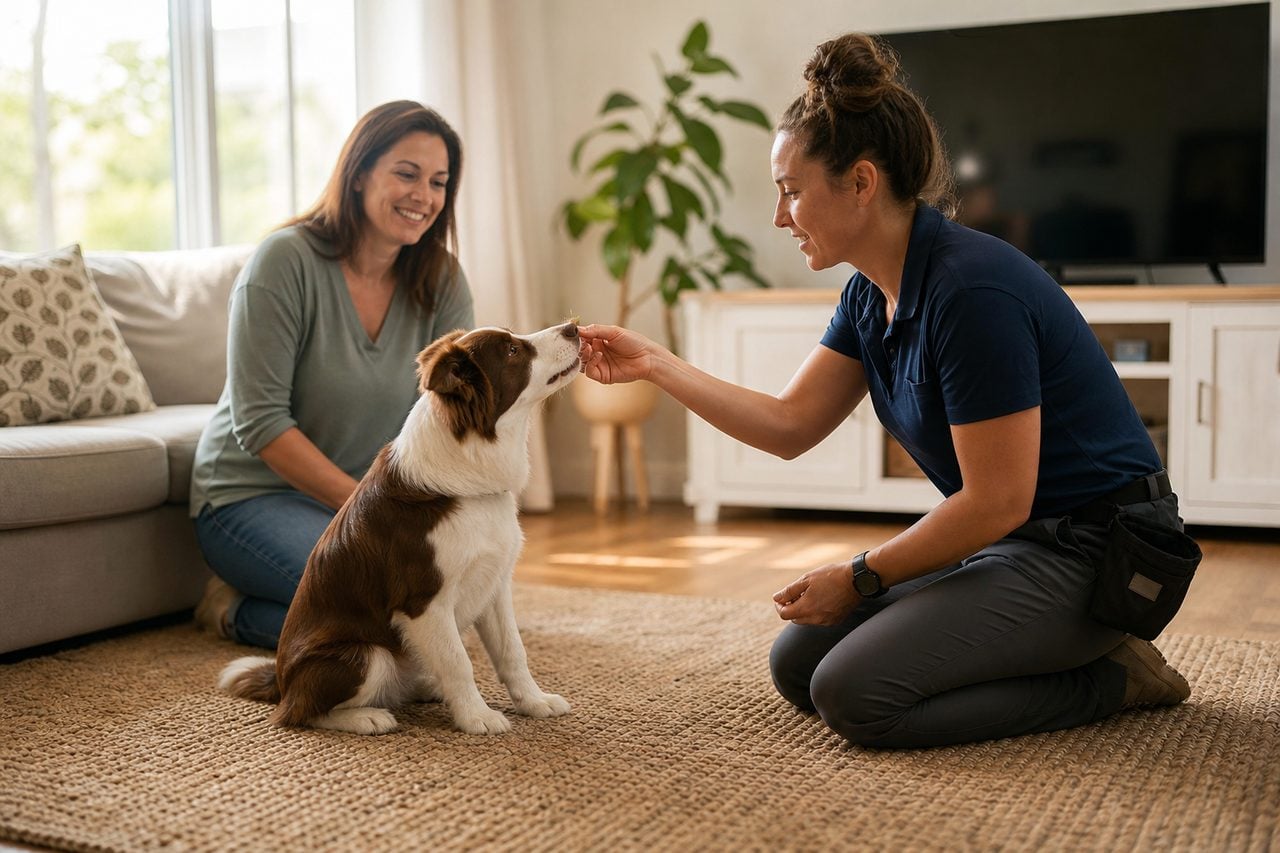
In-home dog training brings a professional trainer to the place where your dog actually lives, eats, sleeps, and misbehaves: your own house and yard in Kokomo or one of the surrounding Howard County towns. Instead of loading the dog into the car and driving to a strange facility, the lessons happen at the front door where the barking starts, on the stairs where the puppy has an accident, and in the kitchen where the counter-surfing happens. For a lot of north-central Indiana families, that convenience is not just a nicety; it is the difference between training that sticks and training that falls apart the moment everyone gets home.
This part of Indiana is spread out. Kokomo sits about an hour north of Indianapolis on US-31, and the households that need training help are scattered across Howard County and out into the farm towns of Tipton, Greentown, Russiaville, and Windfall, up toward Peru and Logansport, and east toward Marion and Gas City. Driving a reactive dog forty-five minutes to a group class in another county is a hard sell. Bringing the trainer to the dog solves the geography problem, and it happens to be the most effective way to teach the skills that matter most at home anyway.
This guide explains what private, in-home training looks like in the Kokomo area, the problems it solves best, what to expect from a first session, and how to choose a trainer whose travel radius and methods fit your household. Because qualified private trainers are thinner on the ground in rural counties than in a big metro, some owners in the region also travel south to Indianapolis for specialized help, and this guide notes when that is worth considering.
Why In-Home Training Fits North-Central Indiana
The single biggest advantage of in-home training is context. Dogs are not great at generalizing what they learn. A dog that sits politely in a quiet training room does not automatically sit politely when the doorbell rings at home, because the two situations feel completely different to the animal. When the lessons happen in the exact environment where the behavior needs to occur, you skip the hardest step in dog training entirely: transferring the skill from a classroom to real life.
The Kokomo region makes this even more compelling because of how spread out it is. A family on a few acres near Greentown, a household in a Kokomo neighborhood off Sycamore Street, and an apartment renter near the Markland Avenue corridor all face different real-world triggers. The rural property has deer, farm equipment, and a long driveway; the neighborhood has fence-line dogs and mail carriers; the apartment has shared hallways and thin walls. In-home training lets a trainer see the actual triggers and build a plan around them rather than guessing.
There is also a practical travel reality here. Because the population is spread across Howard, Grant, Miami, Cass, and Tipton counties, many area trainers already work as mobile, driving a wide radius to reach clients rather than expecting everyone to come to one central spot. That mobile model is well suited to how people actually live in north-central Indiana. When you contact a trainer, one of the first useful questions is simply how far out they travel, because a trainer based in Kokomo may or may not routinely drive to Wabash, Rochester, or Marion.
Finally, in-home work reduces stress for dogs that do not travel well or are anxious in new places. A fearful dog spends the first twenty minutes of any away-from-home lesson just adjusting to the new environment. At home, that dog can start learning immediately, which means you get more value from every session.
What a Private, In-Home Session Actually Looks Like
A first in-home session usually starts with a conversation, not with the dog. A good trainer will want to understand the whole picture: who lives in the house, what the daily routine is, what the dog eats and when, where it sleeps, what specifically is going wrong, and what you want life to look like when training is done. This intake matters because most behavior problems are tangled up with the household routine, and the fix often involves changing how the humans do things as much as teaching the dog new commands.
After the intake, the trainer typically watches the dog in its normal environment. They might ask you to demonstrate the problem, ring the doorbell, or walk the dog down your street so they can see the pulling or reactivity firsthand. This live observation is something a group class simply cannot offer, because in a classroom your dog is out of its normal context and often on its best or worst behavior for reasons that will not repeat at home.
From there, the session moves into coaching. This is a key point that surprises many first-time clients: in-home private training is largely about teaching you, the owner, not just the dog. The trainer is only in your home for an hour or two a week at most. The dog learns from the person who is there all day, every day. So a strong trainer spends the session showing you exactly how to hold the leash, when to mark and reward a behavior, how to time your responses, and how to stay consistent when the dog tests the new rules.
Homework between visits
Expect to be given specific exercises to practice between sessions, usually short daily drills of a few minutes each rather than long marathon sessions. Progress in dog training comes from frequent, short, consistent repetition woven into normal life: a sit before the food bowl goes down, a wait at the door before a walk in the neighborhood, a settle on a mat while the family eats dinner. The trainer returns, reviews the homework, troubleshoots what is not working, and layers on the next skill.
Typical program length
Some issues resolve in a handful of sessions; others, especially deeply rooted behavior problems, take a longer program spread over weeks or months. Many trainers offer packages of several sessions rather than one-offs, because behavior change is a process, not a single appointment. Be wary of anyone promising to completely fix a serious problem in a single visit.
Puppy Foundations, Done at Home
The best time to bring a trainer into your home is when you first bring a puppy into it. The window between roughly eight and sixteen weeks of age is a critical socialization period, and the habits and associations a puppy forms during this time tend to last a lifetime. Early in-home guidance can prevent the exact problems that adult-dog clients later pay far more to undo.
House-training is the obvious first target, and it is one where the home environment is essential. A trainer working in your actual house can look at where the crate is, how the doors and yard are laid out, and how your schedule runs, then build a realistic potty routine around it. Crate training, which is the backbone of reliable house-training and safe alone-time, is also much easier to teach where the crate actually lives.
Beyond potty and crate work, early foundations include gentle handling so the puppy tolerates nail trims and vet exams, bite-inhibition so the normal puppy mouthing does not turn into a problem, name recognition, and the first version of a recall. A frequently overlooked piece is teaching a puppy to be calm and content when alone, which heads off separation anxiety before it develops. All of this is easier and more durable when taught in the environment where the puppy will practice it every day.
Socialization does need to extend beyond the house, and a good trainer will coach you on safely exposing your puppy to the wider world at an appropriate pace: the sounds of a farm town, traffic on US-31, other friendly dogs, people in hats, wheelchairs and strollers, and car rides. But the calm, confident base that makes all of that go well is built at home first.
The Behavior Problems In-Home Training Solves Best
Certain problems are almost impossible to address anywhere except the home, because the home is where they happen. If your dog is fine in public but a nightmare at the front door, no amount of training in a neutral facility will fix it. These home-specific issues are exactly where private in-home work shines.
- Door and doorbell chaos. Barking, bolting, and jumping when someone arrives is one of the most common calls. It has to be trained at your actual door, with your actual doorbell, and ideally with a helper playing the role of the visitor.
- Territorial and fence-line barking. In neighborhoods around Kokomo where yards back up to one another, and on rural properties with long sightlines, dogs often develop barking routines tied to specific windows, fences, and passing triggers. The trainer needs to see the actual layout.
- Counter-surfing, garbage raiding, and stealing. These are environmental habits reinforced by the payoff of food. Managing the space and retraining the behavior only makes sense in the real kitchen.
- Separation-related distress. A dog that panics, destroys, or howls when left alone can only be assessed and treated in the home where it is left alone, often with video review of what the dog does after you leave.
- Household-specific manners. Not jumping on the family, settling calmly during dinner, staying off the furniture if that is your rule, and greeting guests politely are all house rules that make the most sense to train in the house.
Leash reactivity, pulling, and poor recall are a slightly different category. They start with foundation work at home and in the yard, then progressively move out into the neighborhood, to quieter spots like Highland Park or the Nickel Plate Trail, and eventually to busier environments. A trainer who comes to you can build that ladder starting from your own driveway, which is exactly where the dog needs to first learn to stay calm.
Choosing the Right Private Trainer and Confirming Travel Radius
Dog training is an unregulated field. Anyone can call themselves a trainer, so the burden is on you to vet the person you invite into your home. The good news is that a few pointed questions will tell you most of what you need to know.
Ask about methods first. Look for a trainer who leans on reward-based, positive-reinforcement techniques and can clearly explain how they teach a behavior and how they handle mistakes. Be cautious of anyone who relies heavily on intimidation, pain, or fear, or who cannot explain their approach in plain language. Ask what happens when the dog gets it right and what happens when it gets it wrong; the answers reveal a lot.
Ask about experience with your specific problem. A trainer who is excellent with basic puppy manners may not be the right fit for serious aggression or severe separation anxiety, and a responsible trainer will tell you honestly when a case is outside their wheelhouse or when a veterinary behavior consult is warranted. Signs of quality include continuing education, membership in professional organizations, and a willingness to give references.
Confirm the geography
Because the region is rural and spread out, always confirm that a trainer actually serves your town before you get attached. A Kokomo-based trainer may cover all of Howard County plus Tipton, Greentown, and Russiaville routinely, but reaching Wabash, Peru, Logansport, Rochester, or the Marion and Gas City area in Grant County may involve a longer drive or a travel fee. Many area trainers do cover a wide radius precisely because clients are so dispersed, but it is worth asking upfront rather than assuming.
What to expect on price and structure
Private, in-home training generally costs more per hour than group classes, because you are paying for one-on-one attention and the trainer’s travel time. What you get in return is a plan built entirely around your dog and your home. Ask whether the trainer sells single sessions or packages, what is included in follow-up support, and whether they are reachable between visits for quick questions. A trainer who cares about outcomes usually wants to stay connected while you do the homework.
Setting Your Household Up to Succeed
Training works far better when the whole household is on the same page. Dogs thrive on consistency, and the fastest way to confuse a dog is to have one person enforce a rule while another person quietly breaks it. Before your trainer arrives, it helps to get everyone in the home to agree on the basics: what the dog is and is not allowed to do, what words you will all use for commands, and who is responsible for the daily practice.
In-home training also gives you a chance to fix the environment, not just the dog. A trainer standing in your kitchen can spot the management changes that make life easier immediately: moving the trash to a closed pantry, using baby gates to manage access, setting up a designated calm spot with a bed or mat, and removing the temptations that keep rewarding bad habits. This kind of environmental management does half the work before any formal training begins.
Realistic expectations are the last piece. Dogs are not machines, and progress is rarely a straight line. There will be good days and off days, and there will be moments where the dog seems to forget everything it learned. That is normal. The families who get the best results are the ones who keep the practice short, frequent, and consistent, celebrate small wins, and stay patient through the plateaus. A good in-home trainer is not just teaching your dog; they are coaching you through this process so that when the sessions end, you have the skills to keep the momentum going on your own.
For most Kokomo-area households, the combination of convenience, real-world context, and one-on-one coaching makes in-home private training the most practical path to a well-behaved dog. And when a case calls for a level of specialization that is hard to find locally, the larger Indianapolis market an hour south offers additional options worth exploring.
In-Home Dog Training in Kokomo: Local Options & Nearest Specialists
A few Kokomo-area trainers can help with milder in-home dog training needs:
- Perspective K9 Training — 5.0★ (44 reviews)
Nearest in-home dog training specialists — Indianapolis
For complex cases, some families travel to the larger pool of specialists in the Indianapolis area for an assessment or a board-and-train stay. Top-reviewed options:
- Nate Schoemer Dog Training — 5.0★ (188 reviews)
- Good Bones K9 Training — 5.0★ (31 reviews)
- Steven’s Bootcamp Dog Training Indianapolis — 5.0★ (9 reviews)
- Brooks Canine Training Services — 5.0★ (1 review)
- Indy K-9 — 4.9★ (123 reviews)
- Big N’ Small Paws 317 — 4.9★ (97 reviews)
- Indiana Canine Assistant Network — 4.9★ (68 reviews)
- First Friend K-9 Training — 4.6★ (409 reviews)
See all Indianapolis in-home dog training trainers →
Frequently Asked Questions
Is in-home training better than group classes?
Neither is universally better; they solve different problems. Group classes are excellent for basic obedience and for socializing a confident dog around other dogs and people, and they are usually more affordable. In-home training is better for problems that only happen at home, for dogs that are anxious or reactive in new places, for busy or rural households where travel is a barrier, and for anyone who wants a plan built entirely around their specific dog and living situation. Many owners in the Kokomo area use both: in-home work for the household-specific issues and a class for social exposure.
How many sessions will my dog need?
It depends entirely on the goal and the dog. Basic manners and puppy foundations might come together in a handful of sessions with consistent homework, while deeply rooted issues like severe reactivity or separation-related distress can take a longer program spread over weeks or months. Behavior change is a process built on repetition, so most of the actual learning happens in your daily practice between visits, not during the appointment itself. A trainer should be able to give you a rough estimate after the first session, and be honest that it is an estimate.
Do trainers travel to the smaller towns around Kokomo?
Many do, because the region is spread out and a mobile model fits how people live here. That said, coverage varies by trainer. Someone based in Kokomo may routinely serve all of Howard County plus nearby towns like Tipton, Greentown, Russiaville, and Windfall, while reaching Wabash, Peru, Logansport, Rochester, or the Marion and Gas City area may involve a travel fee or a longer lead time. Always confirm that a trainer serves your specific town before booking, and ask whether travel affects the price.
What is the best age to start in-home training?
As early as possible. The socialization window between roughly eight and sixteen weeks of age is the ideal time to lay foundations, and early guidance can prevent problems that are much harder to fix in an adult dog. That said, it is never too late. Adult and senior dogs learn well too, and in-home training is often the most effective route for an older dog with established habits, because the work happens right where those habits live.
Will the trainer fix my dog, or do I have to do the work?
You do the work, with the trainer coaching you. This is one of the most important things to understand about in-home private training. The trainer is only present for an hour or two a week, while your dog learns most from the person it lives with every day. A quality trainer spends the session teaching you the mechanics, timing, and consistency needed to get results, then gives you homework to practice. The families who commit to short, daily practice are the ones who see lasting change.
What should I look for when choosing a private trainer?
Start with methods: look for reward-based, positive-reinforcement techniques and a trainer who can clearly explain how they teach behaviors and handle mistakes. Be cautious of anyone relying on fear, pain, or intimidation. Ask about experience with your specific issue, since a good trainer will refer you elsewhere, or to a veterinary behavior professional, when a case is outside their expertise. Signs of quality include continuing education, professional memberships, references, and honest communication about timelines. Finally, confirm they serve your town and that their personality is a good fit, since you will be working closely with this person in your own home.
Related: read our complete in-home dog training guide or the full Kokomo dog training overview.
Ready to find the right in-home dog training pro in Kokomo?