
In-Home Dog Training in Lansing, MI
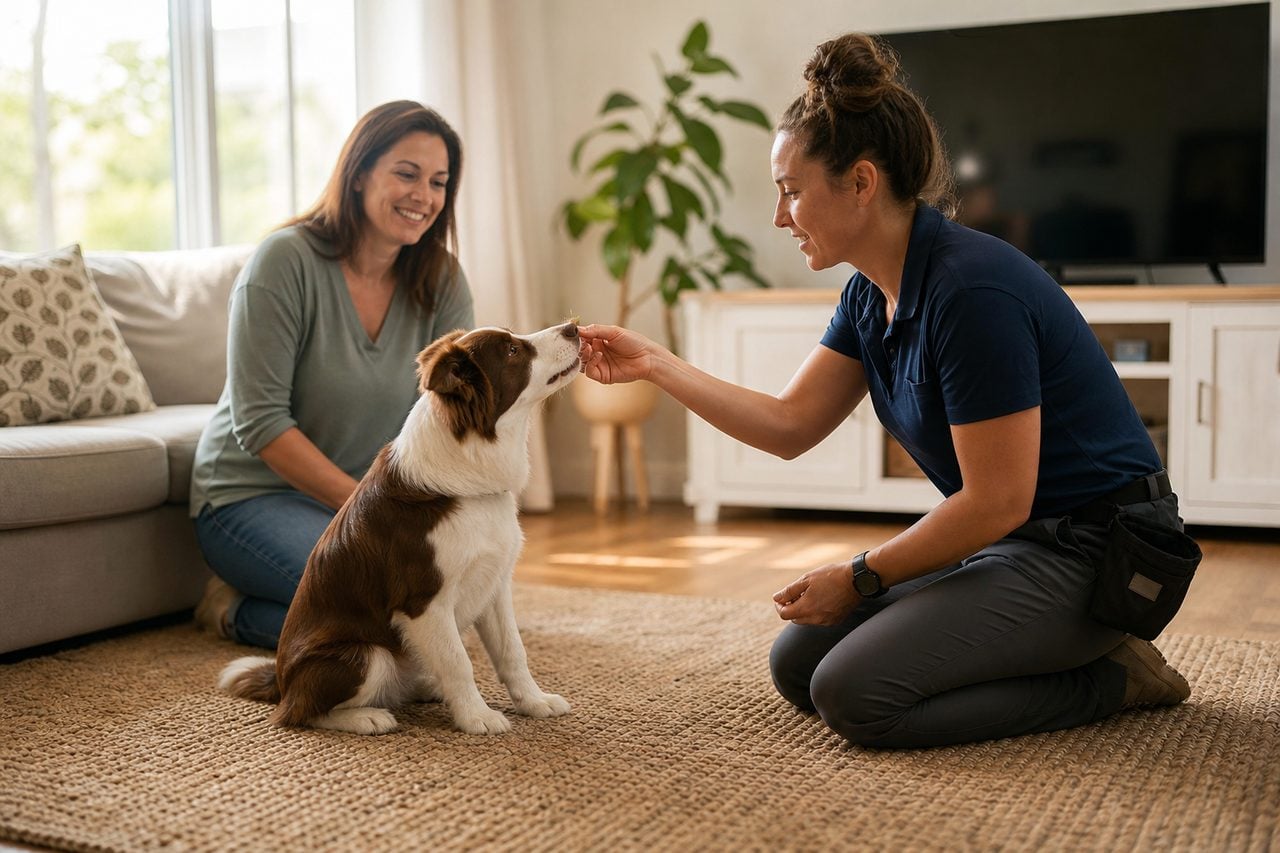
In-home dog training brings the trainer to you, working with your dog in the exact environment where most behavior problems actually happen — your house, your yard, and your own neighborhood. For many Lansing-area owners, this is the most practical and effective format, especially for issues tied directly to the home: housetraining, door manners, jumping on guests, counter-surfing, or settling calmly while you work. Instead of teaching your dog to behave in an unfamiliar training facility and hoping the lesson somehow transfers home, in-home training builds the skills right where you need them from day one.
- What In-Home Training Is and How It Works
- When In-Home Training Is the Right Choice
- What a Typical In-Home Program Covers
- How to Choose an In-Home Trainer
- Finding In-Home Services Around Lansing
- Getting the Most Out of In-Home Training
- Preparing Your Home and What to Expect From a Visit
- Reviewed trainers
- FAQ
This guide explains how in-home training works, when it is the right choice, what a typical program looks like, and how to get the most out of it. It is written to be vendor-neutral so you can use it to evaluate any provider serving the Lansing metro, from the Capital neighborhoods out to Okemos, Haslett, Williamston, Holt, DeWitt, and Grand Ledge.
In-home training is a more specialized service than drop-in group classes, and the number of trainers who focus on it in the immediate Lansing area is relatively small — so this guide also covers how to search effectively and when it may make sense to look beyond the immediate area for a strong fit.
What In-Home Training Is and How It Works
In-home training is private, one-on-one instruction delivered at your residence rather than at a facility. The trainer typically starts with an assessment visit: observing your dog in its normal setting, watching how your household interacts with the dog, and identifying the specific behaviors you want to change. From there they build a customized plan and coach you through it over a series of visits, adjusting as your dog progresses.
A crucial point that surprises many owners: in-home training is largely about training you. The trainer is only in your home for an hour or two at a time, so most of the actual practice — and therefore most of the learning — happens when you work with your dog in the days between visits. The trainer’s real job is to teach you the mechanics, watch and refine your timing, correct your handling in real time, and adjust the plan as circumstances change. This coaching model is precisely why in-home training transfers so well to daily life: you are not outsourcing your dog’s behavior, you are becoming your dog’s trainer, which is what actually produces lasting change.
Sessions commonly address real household scenarios directly rather than in the abstract. Instead of practicing a generic “stay,” you might work on your dog holding a settle on its bed while the doorbell rings, because that specific moment is the actual problem you live with. Instead of a textbook recall, you practice calling your dog off the fence in your own yard. This context-specific practice, aimed squarely at the situations that frustrate you, is the core advantage of the in-home format and the reason many owners find it so efficient.
When In-Home Training Is the Right Choice
In-home training is not automatically better or worse than a group class — it is better for certain situations and less ideal for others. It tends to be the strong choice when:
- The problem is location-specific. Housetraining, chewing, counter-surfing, door-dashing, jumping on visitors, and settling calmly at home are all far easier to fix in the place where they actually occur, with the actual triggers present.
- Your dog struggles in group settings. Fearful, over-aroused, or reactive dogs often cannot learn effectively in a room full of other dogs — they are too overwhelmed to absorb anything. Starting at home in a calm, familiar environment lets them succeed and build confidence first.
- You want a fully tailored plan. One-on-one attention means the entire session is devoted to your dog and your specific goals, with no splitting of the trainer’s focus across other teams.
- Scheduling or logistics are difficult. Busy households, several dogs at once, young children, or difficulty traveling to a facility all make the come-to-you model genuinely appealing.
- You have a new puppy. In-home sessions can establish housetraining, crate training, and early manners from the very first days, before bad habits ever have a chance to form — which is far easier than undoing them later.
By contrast, if your main goals are broad socialization and learning to work around the distraction of other dogs, a group class may serve you better, or serve as a valuable next step after an in-home foundation is in place. There is no need to treat the choice as either-or. Many owners in the Lansing area deliberately combine the two: in-home work to fix the pressing household issues, then a group class to generalize the skills to busy, distracting environments. Matching the format to your actual need is what matters most.
What a Typical In-Home Program Covers
Programs vary by trainer and by the needs of the dog, but most in-home training in the Lansing metro touches on a consistent set of everyday skills and problems. Knowing the typical scope helps you set an agenda for your sessions.
- Housetraining and crate training — establishing a reliable, predictable routine, which is dramatically easier to teach in the home where it actually happens and where the trainer can see your specific setup.
- Basic obedience — sit, down, stay, place, recall, and loose-leash walking, built first in your living room and yard, then gradually taken out to your street and neighborhood as the dog becomes reliable.
- Manners and impulse control — not jumping on guests, waiting politely at doors instead of bolting through, leaving food and counters alone, and calm greetings for both people and other dogs.
- Settling and relaxation — teaching the dog to genuinely relax on a mat or bed on cue, which makes the whole household calmer and is especially valuable for dogs who never seem able to switch off.
- Nuisance behaviors — chewing, digging, excessive barking, and counter-surfing addressed directly at their source, in the environment where they occur.
Good in-home trainers extend beyond your four walls once the foundation is set, because a dog that behaves at home also needs to behave out in the world. Expect to progress to practicing loose-leash walking on your own street, recall in your fenced yard with real distractions, and eventually skills in nearby public spots — a quiet corner of Hawk Island Park, a calm stretch of the Lansing River Trail, or the sidewalks of your own neighborhood in Haslett, Holt, or Grand Ledge — so the behaviors generalize to the places you and your dog actually go together.
How to Choose an In-Home Trainer
Because the trainer is coming into your home and coaching your family directly, fit and communication matter even more than they would in a group setting. You will be working closely with this person in your personal space, so it is worth evaluating carefully before you commit.
- Methods. Ask how they train and specifically what they do when a dog gets something right or wrong. Reward-based, low-stress approaches are the standard of good practice and are appropriate for the great majority of pet dogs. Be wary of anyone who relies primarily on intimidation or corrective tools for ordinary manners and obedience.
- Service area. Confirm they actually cover your part of the metro — a trainer based near central Lansing may or may not travel out to DeWitt, Laingsburg, Williamston, Dimondale, or Potterville. Ask directly about coverage and about any travel fees before booking.
- Program structure. Clarify how many sessions are included, what each one covers, how homework is assigned, and how they support you between visits. A vague, open-ended arrangement is harder to evaluate and budget for.
- Experience with your specific issue. If you have a particular problem — say resource guarding, separation-related behavior, or a serious housetraining struggle — ask about their concrete experience with it rather than assuming general skill covers everything.
- Communication style. You should feel comfortable asking questions and confident that they can explain things clearly to everyone in the household, including children. If their explanations confuse you, the training will be harder to carry out.
Ask whether the whole family should be present for sessions. Consistency across everyone the dog lives with is one of the single biggest predictors of success, so a trainer who actively wants the household involved — rather than working with the dog in isolation while everyone else watches TV — is usually a good sign. In-home training only works if the people carry it forward between visits.
Finding In-Home Services Around Lansing
In-home training is a more specialized offering than drop-in group classes, and the number of trainers focusing on it in the immediate Lansing area is relatively thin. That means it is worth casting a slightly wider net, asking the right questions up front, and being a bit patient in your search rather than grabbing the first name you find.
Start by checking which trainers explicitly offer at-home or private in-home sessions, as opposed to only facility-based group classes, and confirm they serve your specific community. Coverage can differ noticeably across the metro — between central Lansing and the Capital neighborhoods, the Okemos–Haslett–Williamston corridor to the east, the Holt and Dimondale area to the south, the Grand Ledge and Potterville area to the west, and the DeWitt and Laingsburg north country. A trainer’s travel radius is a practical, concrete thing to nail down before you book, and it is a fair question to ask on the very first call.
If you have a complex behavioral case and genuinely can’t find a strong in-home specialist locally, the wider region is worth considering. The Ann Arbor area, for instance, has a deeper pool of private and behavior-focused trainers, some of whom travel for clients or offer hybrid programs that combine virtual coaching with occasional in-person visits for people across mid-Michigan. That can be a reasonable option for a difficult case that local providers aren’t equipped for. For most everyday in-home needs, though — housetraining, everyday manners, basic obedience, and common nuisance behaviors — competent local help is available. A clear, upfront conversation about methods, service area, program structure, and cost will point you to the right fit without needing to look far.
Getting the Most Out of In-Home Training
The families who see the best results from in-home training understand a simple truth: the trainer’s visits are coaching sessions, and the days in between are where the real work happens. Treating it that way is the difference between a program that transforms your household and one that fizzles. A few habits make an outsized difference.
Practice daily, in short sessions. Five to ten minutes a few times a day beats one long, effortful weekly session, and it fits naturally into home life. Because you are training right in the flow of normal routines, you can weave practice into things you already do — a sit before every meal, a settle during dinner, a recall in the yard before coming inside, a wait at the door on every outing. These small, frequent reps add up fast.
Get the whole household on the same page. If one person allows the dog on the couch and another forbids it, or one person tolerates jumping while another pushes the dog down, the dog stays confused and progress stalls. Agree as a household on cues, rules, and rewards so everyone is consistent. This is especially important with children and in multi-generational homes where habits differ.
Manage the environment between lessons. Prevent your dog from rehearsing unwanted behaviors while you are still teaching the alternatives. Use baby gates, crates, leashes, and simple management — like putting food away from the counter’s edge — to set the dog up to succeed rather than relying on willpower and correction. Every prevented mistake is a small win.
Communicate openly with your trainer. Report what is working and what isn’t so the plan can be adjusted between visits. In-home training is collaborative by nature, and the more honest feedback you give, the better the trainer can tailor the program to your dog, your home, and your family’s real routine. The owners who ask questions and share their struggles get the most value from every session.
Preparing Your Home and What to Expect From a Visit
Because in-home training happens in your space, a little preparation before the trainer arrives helps each session run smoothly and lets you get more out of the time. You do not need to stage a perfect home — a trainer wants to see your dog’s real environment, quirks and all — but a few simple steps make the visits more productive.
Before the first visit, jot down the specific behaviors that concern you and any patterns you have noticed: when the jumping happens, which visitors trigger it, what time of day the housetraining accidents occur, where the counter-surfing tends to strike. Concrete observations help the trainer diagnose faster than a general “he’s just wild.” Have your dog’s basic information and vaccination records handy, decide which family members should be present, and think about a relatively calm time of day for the appointment so your dog isn’t already over-excited when the session begins.
During a typical visit, expect the trainer to spend the first session largely observing and asking questions — watching how your dog moves through the home, how it greets a newcomer at the door, and how family members currently respond to problem behaviors. This assessment is doing real work even when it doesn’t look like training yet, because it reveals the patterns that need to change. From there, the trainer will demonstrate a technique, then hand it to you and coach your form, since the point is for you to be able to do it after they leave. Expect to be given clear homework and a plan for the days ahead.
A note on your dog’s behavior with a stranger present. Some dogs are on their best behavior when a new person is in the house and won’t show the very problems you called about; others are the opposite and act up more. Both are normal, and a good trainer reads through it either way, relying on your description of everyday reality rather than only what happens in the hour they’re watching. Be honest about what your dog is really like when no guest is around — that candor makes the plan far more accurate.
Between visits, the home itself becomes your training tool. Set up the management the trainer recommends — gates across the kitchen, a dedicated settle mat in the living room, a crate or pen for the puppy — and keep the environment consistent so your dog isn’t relearning the rules every day. A prepared, consistent home is where in-home training does its best work, quietly, in the ordinary moments between the trainer’s visits.
In-Home Dog Training in Lansing: Local Options & Nearest Specialists
A few Lansing-area trainers can help with milder in-home dog training needs:
- Amstel K9 — 5.0★ (5 reviews)
- Sam’s Train, Play and Stay — 4.1★ (37 reviews)
Nearest in-home dog training specialists — Ann Arbor
For complex cases, some families travel to the larger pool of specialists in the Ann Arbor area for an assessment or a board-and-train stay. Top-reviewed options:
- Attaboy Dog Training — 4.8★ (62 reviews)
- Longsnouts [Dog Training] — 3.4★ (14 reviews)
See all Ann Arbor in-home dog training trainers →
Frequently Asked Questions
How is in-home training different from a group class?
In-home training is private, one-on-one instruction at your house, tailored to your dog and the problems that happen in your home. Group classes are more economical and provide socialization and distraction from other dogs. In-home is ideal for housetraining, manners, and dogs who struggle in busy settings; many owners use in-home first, then a group class to generalize the skills to distracting environments.
Does the trainer work with my dog or with me?
Both, but mostly with you. Because the trainer is only present for an hour or two at a time, most practice happens when you work with your dog between visits. The trainer’s job is to teach you the mechanics, refine your timing and handling, and adjust the plan as your dog progresses. This coaching model is exactly why in-home training transfers so well to daily life.
Should my whole family be present for sessions?
Ideally, yes. Consistency across everyone the dog lives with is one of the biggest predictors of success. If different people use different cues or enforce different rules, the dog stays confused and learns more slowly. Many trainers specifically want the household involved, including children, so everyone learns to handle the dog the same way and reinforce the same behaviors.
Will an in-home trainer travel to my community?
It depends on the individual trainer’s service area, so confirm this before booking. Coverage can differ across central Lansing, the Okemos–Haslett–Williamston corridor, Holt and Dimondale, Grand Ledge and Potterville, and the DeWitt and Laingsburg area. Ask directly whether they serve your location and whether travel fees apply, ideally on your first call so there are no surprises.
What problems is in-home training best for?
It excels at location-specific issues: housetraining, crate training, chewing, counter-surfing, door-dashing, jumping on guests, excessive barking, and teaching a dog to settle calmly at home. It’s also strong for new puppies, where you can build good habits from day one, and for dogs who can’t yet learn effectively around other dogs in a busy group setting.
There aren't many in-home trainers near me — what are my options?
In-home training is more specialized than group classes, so the local pool is thinner. Check which trainers explicitly offer at-home sessions and confirm they serve your specific area. For complex behavioral cases, the wider region is worth considering — the Ann Arbor area has more private and behavior-focused trainers, some offering travel or hybrid virtual-plus-in-person programs — but most everyday needs can be met locally.
Related: read our complete in-home dog training guide or the full Lansing dog training overview.
Ready to find the right in-home dog training pro in Lansing?