
In-Home Dog Training in New Albany, IN
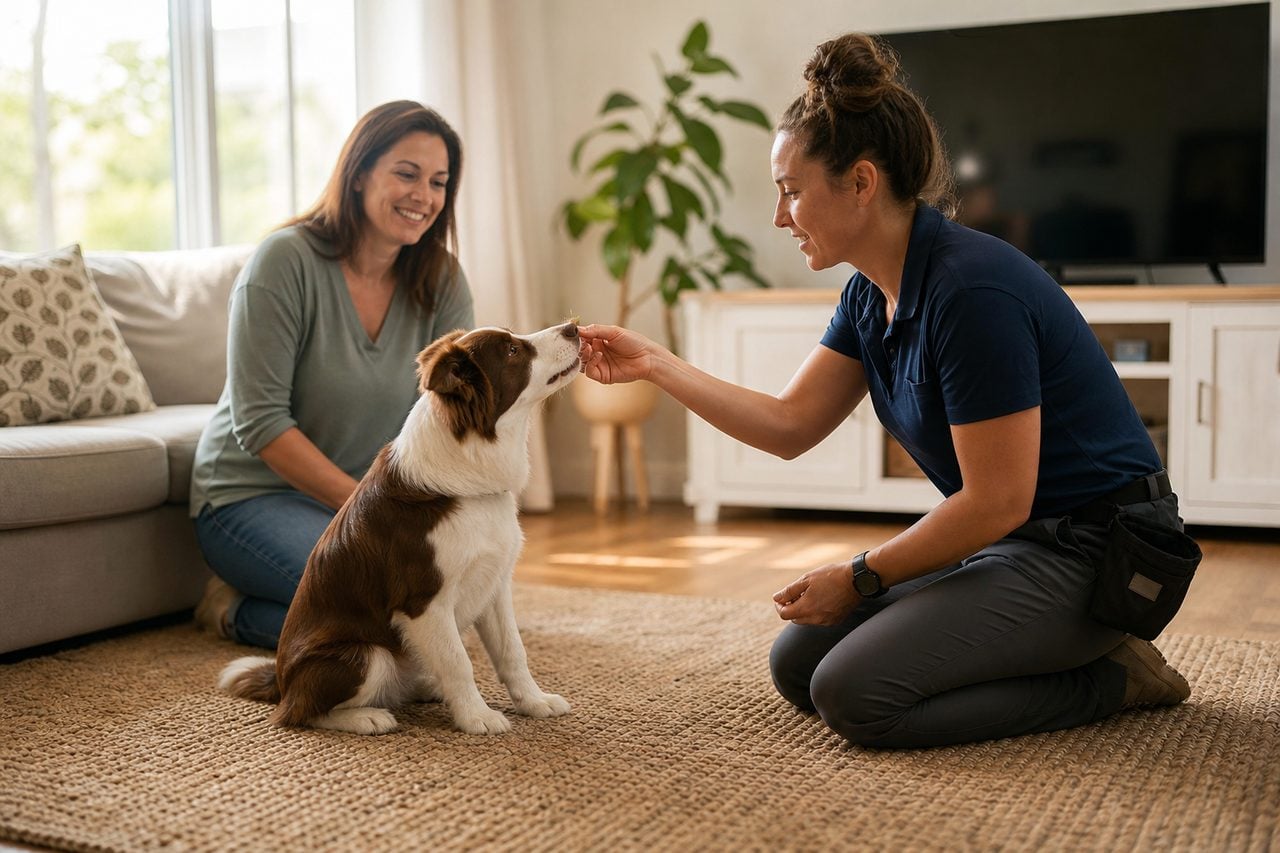
In-home dog training brings a professional trainer to the place where your dog actually lives, eats, sleeps, and misbehaves — your house, your yard, and the sidewalks of your own New Albany neighborhood. For families across Floyd County and the wider Kentuckiana region on the Indiana side of the Ohio River, this format solves a problem that group classes and drop-off programs often cannot: the dog that is calm and attentive in a training center but wildly different at home. When the lessons happen in the environment where the problem behaviors occur, the results tend to stick.
- What In-Home Dog Training Actually Is
- Why Training in Your Dog’s Own Environment Works
- Which Dogs and Problems Suit In-Home Training Best
- How Trainers Cover the New Albany Area
- What to Expect During a Session
- Practicing Around New Albany Once the Basics Are Solid
- Cost, Scheduling, and Getting the Most From Your Investment
- Reviewed trainers
- FAQ
This guide explains how private, in-home training works, what it is genuinely good at, and how to think about it if you live in New Albany, Jeffersonville, Clarksville, Floyds Knobs, Sellersburg, or the surrounding towns. Because in-home instruction is a service that trainers deliver on the road rather than at a fixed storefront, local availability can be uneven — some households find a good fit close to home, while others may need to work with a specialized program in a larger metro. Where that applies, this page will point you toward how to widen your search.
What In-Home Dog Training Actually Is
In-home dog training is one-on-one instruction delivered at your residence rather than at a facility. A trainer arrives at a scheduled time, works directly with you and your dog in your living room, kitchen, hallway, backyard, or on a walk through your own street, and coaches you through handling the exact situations that come up in daily life. It is sometimes called private training, in-home private lessons, or concierge training.
The core difference from a group obedience class is focus. In a group setting, an instructor divides attention across six or eight teams and teaches a fixed curriculum at a shared pace. In your home, the entire session is built around your dog and your goals. If your specific issue is a dog that bolts through the front door, or one that loses its mind when the doorbell rings, or a puppy that will not settle when the family sits down for dinner, the session is spent on precisely that — not on a generic sit-stay drill that everyone happens to be doing that week.
Most in-home programs are sold as packages rather than single visits. A typical structure is an initial assessment session followed by a series of weekly lessons, with the trainer assigning homework between visits. The trainer does the teaching, but you do the daily repetitions, which is exactly the arrangement that produces lasting change.
It also helps to understand what in-home training is not. It is not a magic pill, and it is not a service where you hand off the dog and receive it back reprogrammed a week later — that is board-and-train, a different model with its own trade-offs. The strength of the private in-home approach lies precisely in the opposite: the trainer stays alongside you in your own space, coaching you to become an effective handler so that the improvements continue long after the last scheduled visit. For most family dogs and most everyday behavior problems, that hands-on partnership is what turns a short burst of progress into a permanent change in how the household and the dog live together.
Why Training in Your Dog’s Own Environment Works
Dogs are famously context-dependent learners. A behavior practiced in one location does not automatically transfer to another — a phenomenon trainers call the need to generalize. This is why so many owners report that their dog performs beautifully at the training center on Tuesday night and then ignores every cue the moment they get home. The dog is not being stubborn; it genuinely learned the behavior as something that happens in that room, with those smells, around those people.
In-home training flips this in your favor. When the lessons happen where the behavior needs to live, there is no transfer gap to bridge. The dog learns to settle on its own bed, greet guests at its own door, and walk politely down its own block.
The environment advantage shows up in several specific ways:
- Real triggers, not simulations. The trainer sees the actual mail carrier, the actual neighbor’s dog behind the fence, the actual squirrel that sets your dog off — and can build a plan around the real thing rather than a stand-in.
- The whole household participates. Everyone who lives with the dog can be coached to handle cues the same way, which prevents the mixed-signals problem that undoes so much training.
- Comfort and honesty. A stressed dog in a strange facility may shut down or act out in ways that mask its normal behavior. At home, the trainer sees the true baseline.
- Management built into the space. The trainer can look at your actual gates, crates, doorways, and yard and give concrete advice on arranging the environment to set the dog up to succeed.
Which Dogs and Problems Suit In-Home Training Best
In-home training is a flexible format, but it is an especially strong choice for certain dogs and certain problems. Consider it seriously if any of the following describe your situation.
Puppies in the foundation stage. New puppies benefit enormously from house-specific coaching on crate training, potty routines, chewing, nipping, and early manners — all of which are inherently home problems. Starting good habits in the actual home avoids having to re-teach them later.
Dogs that behave differently at home. If your dog is a model citizen in public but rules the roost at home — guarding the couch, ignoring cues, barking at every sound — the problem is location-bound and needs a location-bound solution.
Reactive or nervous dogs. A dog that is fearful, over-aroused, or reactive toward other dogs or strangers can be very hard to work with in a crowded class where triggers are everywhere and uncontrolled. A private setting lets the trainer control distance and intensity carefully.
Households with specific logistics. Multi-dog homes, families with young children, busy schedules, or owners without reliable transportation all find the come-to-you model far more workable than a fixed weekly class across town.
Newly adopted or rescue dogs. A dog still decompressing after a shelter stay often does best learning to trust its new home before being asked to perform in a busy public class.
Group classes still have real value — particularly for socialization and for practicing focus around distractions — and many owners eventually do both. But when the goal is fixing home-based behavior or building a foundation from scratch, the private in-home route is hard to beat.
How Trainers Cover the New Albany Area
Because in-home training is delivered wherever you live, geography works differently than it does for a brick-and-mortar facility. A trainer does not need a storefront near you; they need to be willing and able to drive to you. Many independent trainers who serve the Indiana side of the Louisville metro cover a wide radius, routinely traveling across Floyd and Clark counties and into the surrounding communities.
In practice, that service area often stretches across:
- New Albany, Jeffersonville, and Clarksville — the urban core on the river
- Floyds Knobs, Georgetown, and Greenville in the Floyd County knobs
- Sellersburg, Charlestown, and the northern Clark County towns
- Corydon and Harrison County to the west
- Scottsburg and the communities up the I-65 corridor
When you contact a trainer, one of the first practical questions is simply whether your address falls inside their normal travel range. Some trainers charge a modest travel fee for the outer edges of their radius or set a minimum distance; others fold travel into the package price. It is worth asking up front so there are no surprises.
Because private in-home instruction is a road-based service rather than a location you drive to, the depth of local supply can vary. If you have trouble finding a trainer with strong availability who covers your specific corner of the region, it may mean working with a specialized program in a larger metro — Indianapolis about two hours north, or the Louisville area right across the river — where the pool of full-time professional trainers is deeper. A trainer based in a bigger market who is willing to travel, or who offers a hybrid of in-home and virtual sessions, can be a perfectly good solution.
What to Expect During a Session
Knowing the shape of a typical in-home program helps you get the most out of it and spot a professional who works methodically.
The initial consultation. The first visit is usually part interview, part observation. The trainer will ask about your dog’s history, health, diet, daily routine, and the specific behaviors you want to change. They will watch how the dog moves through the home and interacts with the family. By the end, you should have a written or clearly explained plan with realistic goals.
Teaching sessions. Subsequent visits introduce and refine skills in short, focused blocks. A good trainer breaks each behavior into small steps, demonstrates it, then hands the leash to you so you learn to do it yourself. That coaching of the human is the whole point — you are the one who will practice with the dog all week.
Homework and follow-up. Expect clear assignments between sessions: a few minutes of practice several times a day, plus management changes to prevent the dog from rehearsing the unwanted behavior. Many trainers stay reachable by text or email between visits to troubleshoot.
Generalization and proofing. As skills solidify at home, the trainer will gradually add distractions and move practice to new places — the driveway, the front yard, then a quiet public spot — so the behavior holds up in the real world.
A word on method: look for trainers who describe their approach in terms of reward-based or positive-reinforcement training, who are transparent about their techniques, and who are comfortable explaining what they will do and why. Be cautious of anyone who guarantees a permanent fix in a single visit, refuses to let you watch, or relies heavily on pain or intimidation. Dog training is unregulated in Indiana, so credentials, references, and a clear philosophy matter more than any title.
Practicing Around New Albany Once the Basics Are Solid
One of the quiet advantages of in-home training is how naturally it extends into your community. Once your dog has reliable manners at home, the New Albany area offers plenty of low-pressure places to practice generalizing those skills in the real world — ideally with your trainer’s guidance on picking spots that match your dog’s current level. Generalization is not an afterthought; it is the stage where a well-trained dog becomes a dog that behaves anywhere, and the surrounding towns give you a natural ladder of difficulty to climb.
- The Ohio River Greenway gives you a long, flat, paved path linking New Albany, Clarksville, and Jeffersonville along the river — excellent for practicing loose-leash walking with a steady, predictable stream of mild distractions like cyclists, joggers, and other leashed dogs at a distance.
- Falls of the Ohio State Park in Clarksville offers open space and river views where a dog can work on staying focused around new sights and sounds.
- Sam Peden Community Park in New Albany is a convenient neighborhood option for short training walks and settling exercises on a bench.
A sensible progression is to master a skill at home, then rehearse it in the driveway and front yard, then in a quiet corner of a park, and only then in busier settings. Rushing a dog from the living room straight into a crowded environment is one of the most common reasons training appears to fall apart — the dog simply has not been given the intermediate steps.
When you take training into public spaces, keep your dog leashed and under control and clean up after it. Indiana has no statewide leash law, so what governs you are the local ordinances across the New Albany area, which commonly require dogs to be leashed and owners to pick up waste in parks and on public paths. Following those rules is not only courteous but part of raising the calm, well-mannered dog that in-home training is meant to produce. Bringing the skills full circle — from your living room to the Greenway — is exactly how a private program pays off over the long run.
Cost, Scheduling, and Getting the Most From Your Investment
Because in-home training is a customized, one-on-one service delivered at your door, it is generally priced differently than a group class. Most trainers sell it as a package of sessions rather than by the single visit, and the total reflects the trainer’s time, travel, and expertise. Rather than focusing on any single number, it helps to think about value: a private program that resolves a stubborn problem in a handful of focused sessions can be more efficient than months of a generic curriculum that never addresses your dog’s actual issue.
A few practical points make any in-home investment go further:
- Be clear about your goals up front. The more specifically you can describe what a successful outcome looks like — a dog that greets guests calmly, walks without pulling, or settles during dinner — the better a trainer can tailor the plan and estimate how many sessions it will take.
- Do the homework. The single biggest predictor of results is whether the daily practice actually happens between visits. A few short, consistent sessions each day beat one long weekend cram.
- Involve the whole household. Everyone who interacts with the dog should handle cues the same way. When one family member undoes the training, progress stalls.
- Ask about follow-up. Find out whether the trainer offers between-session support by text or email and whether refresher visits are available later. Behavior can drift over time, and a quick tune-up is easier than starting over.
It is also worth confirming the logistics before the first visit — the trainer’s travel radius and any associated fee, what you should have ready at home, such as treats and a suitable leash, and whether children or other pets should be present or kept separate during sessions. A short conversation about expectations prevents wasted time and sets a professional tone. Handled this way, in-home training is not just a purchase but a partnership, and the household that treats it as one tends to see the most durable results.
In-Home Dog Training in New Albany: Local Options & Nearest Specialists
Local New Albany-area options for in-home dog training:
- Rovan Dogs LLC — 5.0★ (7 reviews)
Nearest in-home dog training specialists — Louisville
For complex cases, some families travel to the larger pool of specialists in the Louisville area for an assessment or a board-and-train stay. Top-reviewed options:
- The Life of Riley — 5.0★ (97 reviews)
- Heel Stay Play LLC — 5.0★ (8 reviews)
- Carter K9 Training LLC — 5.0★ (8 reviews)
- New Tricks Dog Training — 5.0★ (6 reviews)
- Trail & Heel – Louisville Dog Training — 5.0★ (5 reviews)
- Desert Dog Training — 5.0★ (1 review)
- Bark Busters of Louisville — 4.9★ (207 reviews)
- The Clever Canine Training Center — 4.9★ (40 reviews)
See all Louisville in-home dog training trainers →
Frequently Asked Questions
How is in-home training different from a group obedience class?
In-home training is one-on-one instruction delivered at your house and tailored entirely to your dog and your goals, while a group class teaches a fixed curriculum to several dogs at once at a facility. The private format is better for home-specific problems, nervous or reactive dogs, and busy households, because the lessons happen exactly where the behavior needs to work. Group classes remain valuable for socialization and practicing focus around distractions, and many owners eventually use both.
Will my dog listen once the trainer leaves?
That is precisely why the in-home format works so well. A good private trainer spends much of each session coaching you, not just the dog, so that you can carry out the daily practice yourself. Dogs learn behaviors tied to a specific context, and because the training happens in your own home, there is no transfer gap to bridge. The lasting results come from the homework you do between visits, so consistency from the whole household is the key factor.
Do trainers travel to New Albany, Jeffersonville, and the surrounding towns?
Many independent trainers who serve the Indiana side of the Louisville metro cover a wide radius, routinely traveling across Floyd and Clark counties and into communities such as Sellersburg, Charlestown, Floyds Knobs, Corydon, and Scottsburg. When you reach out, ask whether your address falls inside a trainer’s normal travel range and whether a travel fee applies to the outer edges of that range, so there are no surprises.
What if I cannot find an in-home trainer near me?
Because private in-home training is a road-based service rather than a fixed location, local availability can be uneven. If you cannot find a trainer with good availability who covers your specific area, it may mean working with a specialized program in a larger metro — Indianapolis about two hours north, or the Louisville area across the river — where the pool of full-time professional trainers is deeper. A trainer from a bigger market who is willing to travel, or who offers a hybrid of in-home and virtual sessions, can be an excellent solution.
What kinds of problems can in-home training address?
In-home training suits puppy foundations such as crate training, potty routines, and chewing; everyday manners like polite greetings, door behavior, and settling; and dogs that behave differently at home than in public. It is also a strong choice for nervous or reactive dogs, because the trainer can control distance and intensity in a private setting rather than a crowded class. Newly adopted rescue dogs often do best learning to trust a new home before performing in a busy public environment.
How do I choose a good in-home trainer in Indiana?
Dog training is unregulated in Indiana, so credentials, references, and a clear training philosophy matter more than any title. Look for trainers who use reward-based, positive-reinforcement methods, who explain their techniques openly, and who are comfortable letting you observe and participate. Be cautious of anyone who guarantees a permanent fix in one visit or relies on pain and intimidation. Ask about their assessment process, the structure of their packages, and how they handle follow-up between sessions.
Related: read our complete in-home dog training guide or the full New Albany dog training overview.
Ready to find the right in-home dog training pro in New Albany?