
In-Home Dog Training in Tallahassee, FL
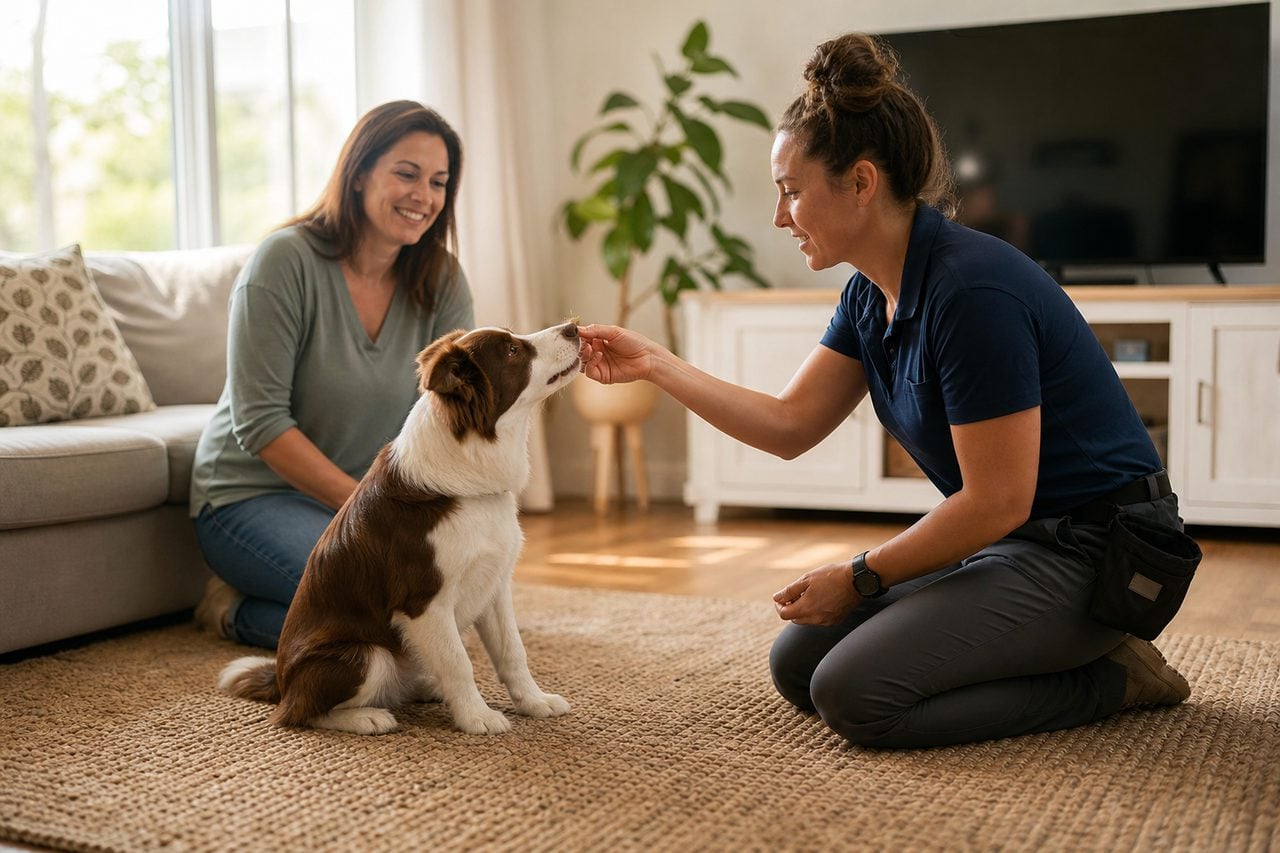
In-home dog training in Tallahassee brings the trainer to the place where most problems actually happen: the front door when a guest knocks, the kitchen counter at dinnertime, the backyard fence and the sidewalk outside your own house.
Instead of learning a skill in a classroom and trying to transfer it home, you practice it in the real setting with a coach watching. That makes in-home lessons a strong fit for puppies, house manners, multi-dog households and behavior problems tied to the home. This guide covers how in-home training works, who offers it around Tallahassee and the surrounding North Florida counties, what it handles well, and how to compare trainers.
How in-home training works
Most in-home trainers start with a conversation about your goals and your dog’s history, often by phone. The first visit is usually an assessment: the trainer watches how the dog behaves in its own space, how the household responds, and where routines are working against you.
From there, sessions follow a pattern. The trainer demonstrates a skill, coaches you and other family members as you practice it, and leaves homework for the days in between. Later sessions often move outside, to the driveway, the street or a public place, so the dog learns to respond away from the living room as well.
The defining feature is that you are trained alongside the dog. A trainer can teach a dog a cue in a single visit, but the dog will only keep using it if the people it lives with ask for it consistently. That is why one local practice has owners attend and take part in every session, and why another compares a trainer to a coach: the owner sets the goals and the trainer helps reach them.
Who comes to your home around Tallahassee
Four trainers in the area describe in-home training among their own services, and they cover a range of methods and service areas.
- A science-based behavior practice in Tallahassee. Its owner is described as a certified behavior consultant through the IAABC, and the practice says all of its trainers are CPDT-KA and Fear Free certified. Private one-on-one sessions take place at the owner’s home for puppies, adolescents and adult dogs, covering basic obedience, potty training, leash skills, separation and other anxiety, barking, reactivity, aggression, fears, off-leash recall, resource guarding and cooperation with vets and groomers. It follows the LIMA principle and begins with a free 15-minute phone consultation.
- An in-home trainer based in Crawfordville. Holding an IACP-CYNX-L credential, the trainer serves Wakulla County and the greater Tallahassee area with puppy training, obedience and behavior modification, working around the owner’s schedule. The approach is play-based, drawing on a dog-sports program in which the trainer is an officer and a certified social responsibility judge, and the trainer writes of attending seminars to stay current. New clients start with a free consultation, and owner and trainer set the lesson plan together.
- A boarding and training center with home visits. Its trainer cites more than 20 years of training and working with dogs, lists CPDT-KA, CPDT-KSA and AKC credentials and calls herself an ABCDT graduate. The one-on-one program runs four weeks at the facility or the owner’s home and covers sit, down, come, touch, heel, loose leash and an implied stay, taught with a balanced, positive-reinforcement-led approach that uses play inside training.
- A balanced trainer serving Tallahassee and Monticello. Sessions take place at its own location, at the owner’s home or in public settings. It uses balanced methods tailored to each dog, offers positive-reinforcement-only training on request, discusses methods, tools and safety before starting, and can train commands in any language. Puppy training typically runs six to ten sessions, and the menu extends to off-leash work and behavior modification for reactivity, aggression and separation anxiety.
What in-home training handles well
Home visits shine when the problem is tied to a place, a routine or the people in the house.
- Puppy foundations. Potty training, crate routines, mouthing and early manners, set up around your actual schedule and floor plan.
- Door and guest manners. Barking at the knock, rushing the door and jumping on visitors, practiced with real arrivals.
- Household rules. Counter surfing, furniture, settling during meals and quiet time, taught where they apply.
- Multi-dog and family dynamics. Tension between housemates and children who need to learn how to interact safely with the dog.
- Dogs that struggle in classes. Reactive or fearful dogs that cannot yet focus around other dogs can build skills at home first.
- Cooperative care. Getting a dog comfortable with handling for grooming and vet visits, which one local practice lists as its own topic.
In-home lessons are less suited to practicing around other dogs, so many owners pair them with a group class later. Once your dog’s skills hold at home, Tallahassee’s dog parks, from the Bradfordville Dog Park at the community center to the dog park in J. Lee Vause Park, are open during daylight for testing them in a busier setting, if your trainer agrees the dog is ready.
Preparing your home and household
A little preparation makes each visit count.
- Clear goals. Write down the three behaviors that bother you most and what you would like to see instead.
- Everyone present. Ask every adult who handles the dog, and older children where appropriate, to attend at least the first sessions.
- Supplies ready. Have a leash, the dog’s usual collar or harness, small soft treats, toys and any gates or crates you use.
- Evidence. Short videos of the problem help, because many dogs behave differently when a stranger is in the room.
- Practice time. Block a few short sessions into each day between visits; the homework is where the change happens.
Tell the trainer about anything that affects safety, such as a bite history or a dog that guards certain rooms, before the first visit rather than at the door.
Comparing in-home trainers
Start with practical fit, then method. Confirm the trainer serves your area: one is based in Crawfordville and covers Wakulla County and greater Tallahassee, and another serves Monticello and surrounding North Florida communities. Ask how scheduling works, since some trainers fit visits around the owner’s calendar while others run set programs of a fixed length.
Then ask about method and tools. The local in-home options span a practice that calls shock, pinch, collar jerks and choke techniques unnecessary, a play-based trainer, a balanced trainer that offers positive-only work on request, and a balanced, positive-reinforcement-led center. All of these are legitimate choices, but you should know which one you are hiring.
Finally, compare structure: how long each visit lasts, how many visits a plan usually needs, whether written notes or messages between visits are included, and how travel affects the quote. A free first consultation, offered by several of these trainers, is the easiest place to ask.
Reviewed In-Home Dog Training Trainers in Tallahassee
These reviewed Tallahassee-area trainers from our directory handle in-home dog training. Each links to a full profile with specialties, certified credentials, reviews, and contact info:
- Pawsitive Practice Training & Behavior Consulting — 5.0★ (125 reviews)
- Livable Dog, LLC — 5.0★ (1 review)
- K-9 Comfort Boarding and Training — 4.8★ (17 reviews)
- Tally K9 Dog Boarding and Training
See all Tallahassee in-home dog training trainers →
Frequently Asked Questions
Is in-home training better than a group class?
It depends on the goal. In-home lessons focus on your dog’s specific problems in the setting where they happen, while group classes give practice around other dogs and people. Many owners use both, starting at home and moving to a class once the dog can focus.
Do I need to be home during sessions?
Yes, in most cases. In-home training is built around coaching the owner, and at least one Tallahassee practice has owners attend and take part in every session. If you want the trainer to work the dog without you, ask about day training or board-and-train instead.
How many in-home sessions will my dog need?
It varies with the dog and the goal. One local trainer says puppy training typically takes six to ten sessions, and a boarding and training center runs its one-on-one program over four weeks. Behavior cases often need longer, with spacing between visits for practice.
Do in-home trainers come to Crawfordville, Monticello or Quincy?
Some do. An in-home trainer based in Crawfordville serves Wakulla County and the greater Tallahassee area, and a balanced trainer serves Monticello and surrounding North Florida communities. Always confirm coverage for your address and whether travel changes the quote.
Can in-home training help with aggression or separation anxiety?
It can be a good setting for both, since those problems usually show up at home. Two of the in-home trainers around Tallahassee list aggression and separation anxiety among their services. No trainer can guarantee an outcome, so ask about the plan, the safety steps and how progress will be measured.
Related: read our complete in-home dog training guide or the full Tallahassee dog training overview.
Ready to find the right in-home dog training pro in Tallahassee?