
In-Home Dog Training in Toledo, OH
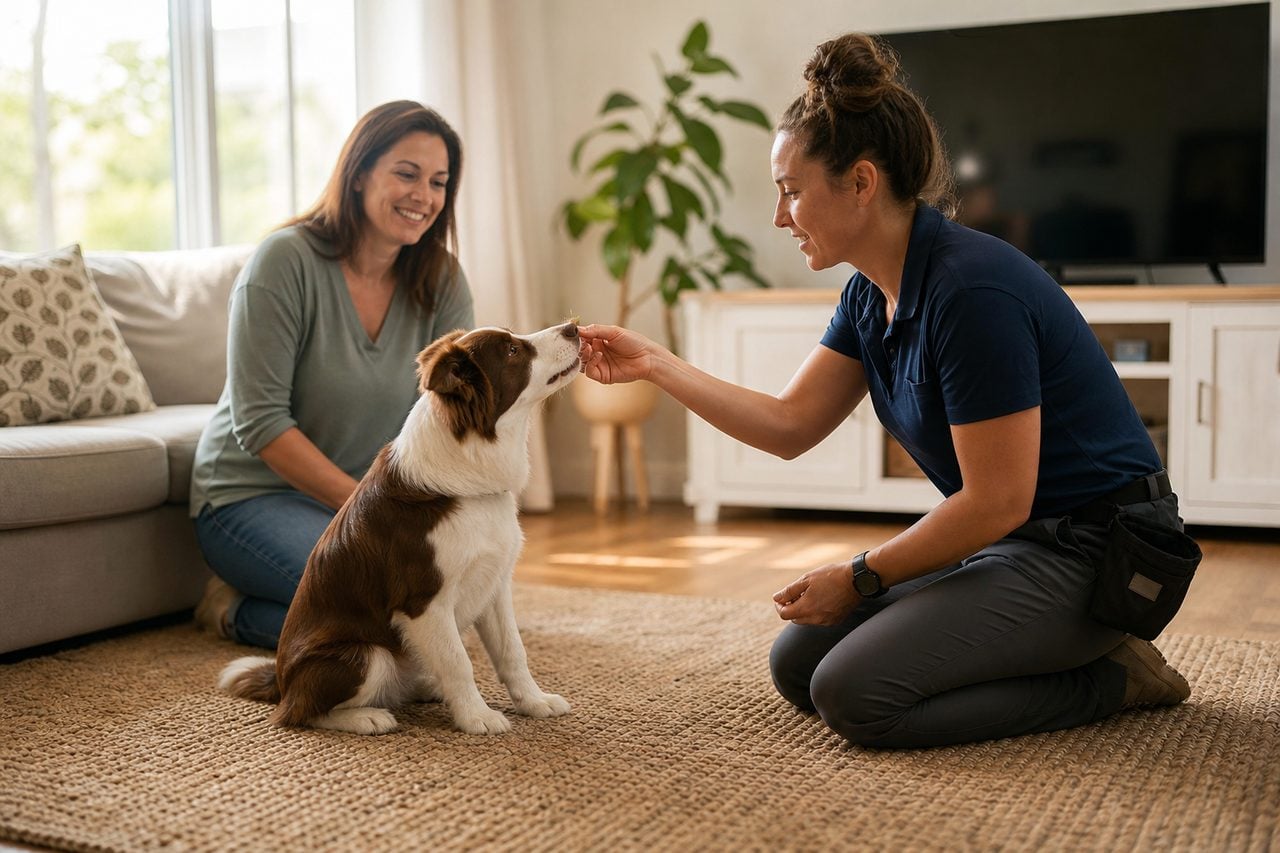
There is a reason so many busy Toledo families are choosing to have a dog trainer come to them rather than loading the dog into the car and driving across town to a class. Life in the Glass City moves fast. Between commutes to downtown offices, shifts at the region’s hospitals and manufacturing plants, kids’ activities, and the simple reality of long northwest Ohio winters, finding time for a weekly group class at a fixed location is harder than it sounds. In-home dog training removes that friction entirely by bringing a professional directly to your living room, your backyard, and your actual front door.
In-home training is private, one-on-one instruction delivered in the environment where your dog actually lives and where the problems actually happen. Instead of teaching your dog to sit politely in a sterile training room and then hoping that translates to your house in Sylvania or Maumee, the trainer works on the real behaviors in the real place: the jumping at the door when guests arrive, the leash pulling on your Point Place street, the counter-surfing in your own kitchen. This service-area model spans Lucas and Wood County, with trainers driving to families across the suburbs and city neighborhoods.
This guide walks through who in-home training is best suited for, what a typical session looks like, the specific advantages of training in your own Toledo environment, realistic costs across the metro area, and how to choose the right professional. If you are a working family who wants results without rearranging your entire week, this is the model worth understanding.
Who In-Home Training Is Best For
In-home training is a natural fit for busy and working families, which describes a large share of Toledo households. If your evenings are already a blur of work, school pickups, and getting dinner on the table, the idea of committing to a fixed group class at a facility across the metro can be the very thing that stops you from training at all. When the trainer comes to you, the logistical barrier disappears. You are not packing the dog into the car, fighting traffic on the Anthony Wayne Trail, or trying to make a 6 p.m. class after a long shift. The session happens at your home, often on a schedule that flexes around your life.
It is also the right model for dogs that struggle in busy, stimulating environments. Some dogs are so over-aroused or anxious in a room full of other dogs that they cannot learn anything useful there. A reactive dog that lunges at every other dog in a class is not absorbing the lesson; it is just rehearsing the reactivity. For these dogs, starting the work in the calm, familiar setting of their own home, where they can actually think, is far more productive. The trainer can then gradually add challenge in a controlled way rather than throwing the dog into chaos on day one.
Families with specific household problems benefit enormously too. Group classes teach a standardized curriculum, which is great for general manners but less helpful when your actual issue is that the dog bolts out the front door, guards the couch, wakes the baby with barking, or terrorizes the mail carrier in your Oregon neighborhood. These are context-specific behaviors that are best addressed where they occur. An in-home trainer sees your exact setup, your exact triggers, and your exact family dynamic, and tailors the plan to fix the problem you actually have.
Finally, it suits households with multiple family members who all need to be on the same page. In a group class, usually one person attends and then tries to relay everything to everyone else at home, with predictable inconsistency. With in-home training, the whole household can take part, so the kids, the partner, and anyone else who interacts with the dog all learn the same cues and rules together. Consistency across handlers is one of the biggest predictors of training success, and the in-home model builds it in from the start.
What a Typical In-Home Session Looks Like
The first session is usually a combination of consultation and assessment. The trainer arrives, meets the dog in its own territory, and spends time understanding the full picture: the dog’s history, the family’s routine, the specific behaviors that prompted the call, and the goals you actually care about. Because they are standing in your home, they notice things a remote conversation never would, like the fact that the dog has free run of the couch by the window where it barks at every passerby, or that the food bowl sits in a high-traffic doorway. This environmental read shapes a plan grounded in your real life rather than a generic template.
From there, sessions become hands-on coaching. The trainer demonstrates a technique, then hands it off to you and the family, correcting your timing, your body position, and your reward delivery in real time. This is a key advantage of the private model: the instruction is entirely about you and your dog, with no waiting your turn or competing for attention. If your dog masters a skill quickly, you move on; if something needs extra repetition, you stay with it. The pace is yours.
Real-world rehearsal is where in-home training shines. Rather than practicing a polite greeting in the abstract, the trainer can stage the actual scenario, having someone knock on your real front door while you practice managing the dog’s response. Leash work happens on your actual sidewalk in your actual neighborhood, with the real squirrels, the real neighbor dogs, and the real distractions your dog faces every day. This means the skills are built where they need to work, not in an artificial setting that the dog never has to navigate again.
Most in-home programs run as a series of sessions spaced out over several weeks, with homework in between. The trainer leaves you with specific exercises to practice, then returns to check progress, troubleshoot what is not working, and layer in the next skill. This spacing is intentional, because dogs and humans both need time to consolidate learning through daily repetition. A good trainer will also stay reachable between visits so you are not stuck if a question comes up while practicing in the days between sessions.
The Home-Environment Advantage
The single biggest reason in-home training works so well is a concept dog trainers call generalization, or rather the problem of it. Dogs do not automatically transfer a skill learned in one place to every other place. A dog that sits beautifully in a training facility may completely ignore the same cue in your kitchen, because to the dog these are two different situations. When the training happens in the home from the very beginning, you skip the entire frustrating step of trying to bridge the gap between the classroom and reality. The behavior is built directly into the environment where you need it.
Training in the home also means the trainer addresses the actual triggers rather than approximations of them. If your dog loses its mind when the doorbell rings, an in-home trainer works with your doorbell. If it guards a specific spot on the stairs or barks at the gap in the fence where it can see the neighbor’s yard, the trainer sees and works with that exact feature. This precision is impossible in a facility, where the trainer can only guess at your home’s particular landscape of triggers and quirks based on your description.
There is a comfort factor that benefits anxious, fearful, or under-socialized dogs as well. A dog that finds new places frightening will spend much of a facility class simply coping with the unfamiliar environment, leaving little mental bandwidth for learning. At home, the dog is relaxed and confident, which is exactly the state in which learning happens best. The trainer can then deliberately and gradually expand the dog’s comfort zone, adding new challenges step by step, rather than overwhelming it all at once.
For Toledo specifically, the home-environment model also sidesteps the weather problem that plagues so much of the year. Lake-effect snow and bitter cold off Lake Erie make winter commutes to a class genuinely miserable, and the flat, exposed terrain of the region offers little shelter from the wind. With in-home training, the worst the weather does is affect the trainer’s drive, not your willingness to participate. Sessions continue through the seasons in the warmth of your own home, which means your dog’s progress does not stall every December through March the way a facility-based schedule often does.
Common Issues In-Home Training Tackles Well
Everyday manners are the bread and butter of in-home work. Polite leash walking, reliable sit and stay, coming when called, settling on a mat, and waiting at doorways are all foundational skills that are far more meaningful when practiced in context. Teaching a solid recall is more useful when it is done in your own fenced Sylvania backyard and then on your own street than when it is rehearsed only in a training hall. The trainer builds these behaviors into your daily routine so they actually stick.
Household management problems are another sweet spot. Jumping on guests, counter-surfing, stealing food, bolting out the front door, excessive barking at the window, and getting on furniture you would rather keep dog-free are all behaviors tied to the specifics of your home. Because the trainer can see your layout and your routine, they can offer practical management solutions, such as where to put a gate, how to rearrange a sightline that triggers barking, or how to set up a reliable station for the dog when guests arrive, alongside the actual training.
Puppy training is exceptionally well suited to the in-home model. A new puppy in a Perrysburg or Maumee household needs house-training, crate training, bite-inhibition work, and early socialization, much of which is intensely tied to your specific home and schedule. An in-home trainer can set up your crate in the right spot, build a realistic potty routine around your family’s comings and goings, and coach the whole household on consistent rules before bad habits ever form. Starting a puppy off right at home is one of the highest-value uses of private training.
Many in-home trainers also handle mild to moderate behavior concerns like leash reactivity, mild resource guarding, and fearfulness, particularly when starting in the calm of the home gives the dog the headspace to learn. For more severe behavioral cases, a good trainer will be honest about whether an in-home generalist is the right fit or whether a specialist is warranted. That honesty is a feature, not a limitation, and it is one of the things to look for when choosing who to invite into your home.
Costs and Coverage Across Lucas and Wood County
In-home training is priced as a premium service relative to group classes, and for good reason: you are paying for one-on-one expertise plus the trainer’s travel time to your door. Rather than a flat per-class fee, most in-home trainers sell packages of several sessions, which spreads the cost and reflects the reality that meaningful change takes more than a single visit. When comparing options, look at the total program cost and what is included, such as the number of sessions, between-visit support, and any written plans, rather than fixating on a single hourly number.
Where you live in the metro can affect both pricing and availability. The west-side suburbs, including Sylvania, Ottawa Hills, Perrysburg, Maumee, and Waterville, tend to support somewhat higher rates than the east side and the city’s north and south neighborhoods, in line with the broader cost-of-living pattern across northwest Ohio. Travel distance matters too: a trainer based near central Toledo may charge a little more, or have limited availability, for trips out to Whitehouse, Swanton, Rossford, or Bowling Green simply because of the drive time involved.
The good news for the region is that the service-area model is designed around exactly this geography. Trainers who offer in-home work typically define a coverage radius across Lucas County and into Wood County, so families from Holland to Oregon to Perrysburg can usually find someone willing to come to them. When you reach out, confirm that your specific town is within a trainer’s service area and ask whether any travel fee applies for outlying locations. Most are upfront about their radius and pricing.
It is worth weighing the value rather than just the sticker price. The convenience of not having to transport your dog, the efficiency of fully personalized instruction with no wasted time, the ability to involve the whole family, and the fact that the skills are built where you actually need them all add up to a strong return. For a busy Toledo household, the real comparison is not in-home training versus a cheaper class; it is in-home training versus never quite getting around to training at all because the logistics never line up.
How to Choose the Right In-Home Trainer in Toledo
Start by matching the trainer’s focus to your actual needs. Some in-home trainers excel at puppy foundations and basic manners, others lean toward behavior concerns like reactivity or fear. Be clear about your goals when you reach out, whether that is a well-mannered family dog, a smooth start for a new puppy, or help with a specific problem, and ask whether that is squarely in the trainer’s wheelhouse. A good professional will tell you honestly if your needs fall outside what they do best.
Pay close attention to training methods. The current consensus among qualified behavior professionals favors reward-based, force-free techniques that build a dog’s confidence and a strong relationship with the family, rather than methods that rely on intimidation or pain. This matters even more in your home, where the relationship between your dog and your family is on the line. Ask a prospective trainer to describe their approach in plain language, and be wary of anyone who leans heavily on corrections or quick-fix promises for complex problems.
Because you are inviting this person into your home, often around children and other pets, the human factor matters a great deal. You want someone professional, punctual, clear in their explanations, and genuinely good at coaching people, not just dogs. The best in-home trainers are excellent teachers of humans, because ultimately they are equipping your whole family to maintain the training long after the sessions end. A brief phone consultation before booking will tell you a lot about whether the communication style fits your household.
Finally, use the directory as a way to find local trainers who serve your part of the metro, then have a real conversation before committing. Confirm the service area covers your town, clarify the package structure and total cost, and make sure their methods and personality are a fit. The right in-home trainer becomes a trusted guide who knows your dog and your home, and that working relationship is what turns a few weeks of sessions into a calmer, better-behaved companion for years to come.
Reviewed In-Home Dog Training Trainers in Toledo
These reviewed Toledo-area trainers from our directory handle in-home dog training. Each links to a full profile with specialties, verified credentials, reviews, and contact info:
- Ready, Set…Train! — 5.0★ (46 reviews)
- A Promised Friend LLC — 5.0★ (43 reviews)
- Randy’s Dog Training — 5.0★ (21 reviews)
- Heblers Dog Care — 5.0★ (6 reviews)
- Raising Your Pets Naturally with Tonya Wilhelm — 5.0★ (2 reviews)
- Sit Happens — 5.0★ (2 reviews)
- Canine Karma — 4.9★ (67 reviews)
- Let’s Train! Dog Training — 4.8★ (157 reviews)
- Toledo’s PET Bull Project — 4.4★ (188 reviews)
- Sit Means Sit Dog Training Toledo — 4.1★ (19 reviews)
See all Toledo in-home dog training trainers →
Frequently Asked Questions
What areas around Toledo do in-home trainers cover?
Most in-home trainers operate on a service-area model spanning Lucas and Wood County, which includes the city’s neighborhoods plus suburbs like Sylvania, Ottawa Hills, Maumee, Perrysburg, Oregon, Holland, Rossford, Waterville, Whitehouse, Swanton, and Bowling Green. Each trainer defines a coverage radius, so when you reach out, confirm your specific town is within their service area and ask whether any travel fee applies for outlying locations.
Is in-home training better than a group class?
It depends on your situation, but in-home training has real advantages for busy families, dogs that struggle in stimulating environments, and household-specific problems like door-bolting or counter-surfing. The instruction is fully personalized, the skills are built where you actually need them, and the whole family can participate. Group classes still offer valuable structured socialization, so the best choice depends on your goals and your dog’s temperament.
How much does in-home dog training cost in the Toledo area?
In-home training is a premium service because you are paying for one-on-one expertise plus the trainer’s travel, and it is usually sold in multi-session packages rather than single visits. Toledo’s cost of living sits at or just below the national average, and west-side suburbs like Sylvania and Perrysburg tend to run somewhat higher than the east side. Compare the total program cost and what is included rather than focusing only on an hourly rate.
What kinds of problems can in-home training fix?
It handles everyday manners like leash walking, recall, and settling, plus household issues such as jumping on guests, counter-surfing, door-bolting, and barking at the window. It is also excellent for puppy foundations like house-training, crate training, and early socialization. Many trainers handle mild to moderate behavior concerns too, and a good one will be honest if a particular case calls for a specialist instead.
Should the whole family be present for in-home sessions?
Yes, and that is one of the biggest benefits of the model. Consistency across everyone who interacts with the dog is a major predictor of training success. When the whole household learns the same cues and rules together, you avoid the inconsistency that happens when one person attends a class and tries to relay everything to everyone else. In-home training builds that shared understanding directly into the process.
Does in-home training work for puppies?
It is one of the best uses of the model. A new puppy needs house-training, crate training, bite-inhibition work, and early socialization, much of which is tightly tied to your specific home and routine. An in-home trainer can position the crate correctly, build a realistic potty schedule around your family’s comings and goings, and coach everyone on consistent rules before bad habits form, giving the puppy the strongest possible start.
Related: read our complete in-home dog training guide or the full Toledo dog training overview.
Ready to find the right in-home dog training pro in Toledo?