
Service Dog Training in Columbus, OH — Programs, Requirements & Costs
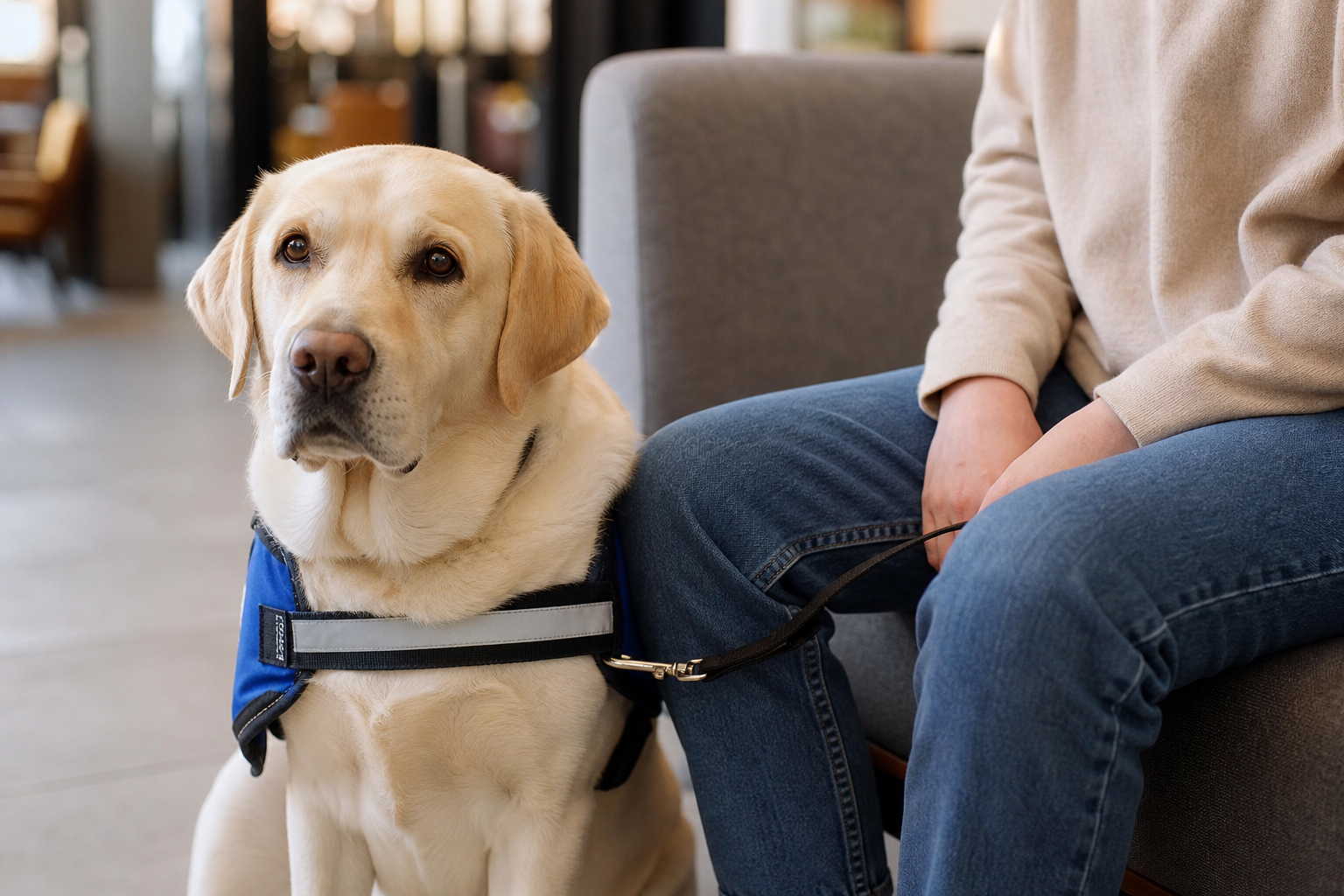
Service dog training in Columbus is a serious 1-to-2-year commitment — and the path is full of misinformation. Online “registries” that sell certificates for $50 are scams, and the legal requirements are different from what most people assume.
Service dogs change lives — they guide people who are blind, alert to seizures, provide mobility assistance, and interrupt psychiatric episodes. This guide covers how service dog training works in Columbus, what it costs, the legal framework, and how to navigate the process without getting taken advantage of. For other specialized programs, see our Columbus dog training hub.
What Qualifies as a Service Dog
Under the Americans with Disabilities Act (ADA), a service dog is a dog individually trained to perform specific tasks directly related to a person’s disability. That’s it. No registration required. No certification. No special ID card. No vest (though many handlers use one for practical reasons).
Key legal points
- The dog must be trained to perform a specific task. Emotional support alone does not qualify — the dog must do something: alerting to a medical condition, guiding, retrieving, bracing, interrupting harmful behaviors.
- Any breed can be a service dog. There is no breed restriction under federal law.
- You do not need a doctor’s letter to have a service dog (though it may help for housing and air travel, which fall under different laws).
- Businesses can only ask two questions: (1) Is this a service animal required because of a disability? (2) What task has the dog been trained to perform? They cannot ask about your disability, demand documentation, or require a demonstration.
- “Emotional support animals” (ESAs) are covered under the Fair Housing Act for housing but do NOT have public access rights under the ADA. A dog that provides comfort but isn’t trained for a specific task is an ESA, not a service dog.
Types of Service Dogs
- Mobility assistance dogs. Retrieve dropped objects, open doors, provide balance support, pull wheelchairs, press elevator buttons.
- Guide dogs. Trained for people who are blind or visually impaired — navigate obstacles, stop at curbs, find doors and seats.
- Hearing/signal dogs. Alert people who are deaf or hard of hearing to doorbells, fire alarms, phones, approaching vehicles.
- Medical alert dogs. Detect changes in blood sugar (diabetic alert), oncoming seizures, or other conditions — alerting before the event so the handler can take action.
- Psychiatric service dogs (PSDs). Interrupt self-harm, perform deep pressure therapy during panic attacks, clear rooms for PTSD, wake handlers from nightmares, create physical space in crowds.
Paths to Getting a Service Dog in Columbus
Path 1: Program-trained service dog
Organizations breed, raise, and train service dogs and place them with qualified applicants. The dog arrives fully trained with follow-up support.
Pros: Highest reliability, professional temperament testing, extensive socialization, ongoing support. Cons: Long waitlists (1 to 3 years), limited control over dog selection, may not fit needs outside the program’s specialization. Cost: Many nonprofits provide dogs at no cost or heavily subsidized ($0 to $5,000); actual training cost is $25,000 to $50,000, covered by donations. For-profit programs charge $15,000 to $35,000.
Path 2: Owner-trained service dog
You select and train your own dog, typically with professional guidance. This is legal under the ADA — there is no requirement that a service dog be trained by a professional organization.
Pros: You choose the dog, control the training, customize tasks, no waitlist. Cons: Significant time commitment (12 to 24 months), risk the dog washes out, costs add up; you bear full responsibility for quality. Cost: $5,000 to $15,000+ over the full period (dog, vet care, supplies, professional help); expect $3,000 to $8,000 on professional training assistance alone. This often starts with solid puppy training.
Path 3: Professional trainer trains your dog
A middle path — you select the dog, but a professional handles the bulk of training (obedience foundation, public access, task work), then transfers to you.
Pros: Faster than full owner-training, professional quality, you still choose the dog. Cons: Most expensive path ($8,000 to $20,000+), requires a trainer with genuine service dog experience, and the transfer phase still requires owner commitment.
What Service Dog Training Involves
Regardless of path, service dog training follows a progression:
- Phase 1: Foundation obedience (months 1–4). Rock-solid basics — sit, down, stay, come, heel, leave it — reliable in any environment before public access begins.
- Phase 2: Public access training (months 3–8). Behaving appropriately in restaurants, stores, medical offices, transit — ignoring food on the ground, not soliciting attention, staying focused in chaos.
- Phase 3: Task training (months 6–14). The specific tasks related to the disability. Medical alert uses scent detection and can take months; mobility tasks like bracing and retrieving train faster.
- Phase 4: Proofing and generalization (months 10–18). Testing reliability in new environments and under stress — performing in places they’ve never been, during medical episodes when the handler can’t direct them.
- Phase 5: Ongoing maintenance. Service dogs need regular maintenance throughout their working life (typically 8 to 10 years).
Temperament Matters More Than Breed
Not every dog can be a service dog. The washout rate in professional programs is 30 to 50% — and these are dogs bred specifically for the work. For owner-trained service dogs using pet-bred dogs, the rate is higher.
✅ Good candidate traits
- Calm, stable temperament — not easily startled, recovers quickly
- Moderate energy level — not hyperactive, not lethargic
- Social but not demanding — friendly without jumping or soliciting
- Food and toy motivated, but not obsessive
- Sound tolerant — handles loud noises, crowds, medical equipment
- Handler focus — naturally oriented toward their person
🚩 Watch for
- Easily startled or slow to recover from surprises
- Hyperactivity or extreme low energy
- Pushy attention-seeking, jumping, licking
- Sound or environmental sensitivity
Common breeds for service work: Labrador Retrievers, Golden Retrievers, Standard Poodles, and crosses — but any breed or mix with the right temperament can succeed. If owner-training, have the dog temperament-tested by a professional before investing. A good Columbus trainer can evaluate a puppy at 8 to 10 weeks or an adult at any age and give an honest assessment. A behaviorist can help with borderline cases.
Finding Service Dog Training Help in Columbus
Service dog training is a specialty — most obedience trainers don’t have the expertise for public access and task phases. When looking for help:
- Ask specifically about service dog experience. How many have they trained or helped train? What types? References from previous service dog clients?
- Look for ADI membership or similar. Assistance Dogs International is the gold standard for programs. For individuals, CPDT-KA with service dog specialization or IAADP membership shows commitment.
- Verify their understanding of the legal framework. A trainer who confuses service dogs with ESAs, recommends online “registration,” or doesn’t understand public access rights is not qualified.
- Ask about their washout protocol. A good trainer identifies issues early and gives honest feedback rather than dragging out training on a dog that won’t succeed.
Beware of Scams
🚩 Scam warning signs
- Online registries that “certify” your dog for $50–$150 — there is no legitimate US service dog registry; these certificates have no legal standing
- Programs guaranteeing placement in under 6 months with minimal vetting
- Trainers promising a fully trained service dog in 4 to 6 weeks — not realistic for any type
- Vest + certificate combos sold online — a vest doesn’t make a dog a service dog; training does
Frequently Asked Questions
Do I need to register my service dog?
No. There is no legitimate service dog registry in the United States. Under the ADA, your dog’s training is what qualifies them — not a certificate, ID card, or registration.
Can I train my own service dog?
Yes. The ADA does not require service dogs to be trained by a professional organization. You can owner-train with professional guidance. Many handlers in Columbus work with local trainers for obedience and public access while doing task-specific training themselves.
How long does it take to train a service dog?
12 to 24 months for a full program. Task-specific training on an already well-trained dog can take 6 to 8 months, but public access reliability and task proofing take time.
Can my landlord charge a pet deposit for my service dog?
No. Under the Fair Housing Act, landlords cannot charge pet deposits or pet rent for service dogs or emotional support animals. They can charge for actual damage caused by the animal.
What if my service dog in training is denied access to a business?
Service dogs in training do NOT have federal public access rights under the ADA — only fully trained ones do. However, Ohio law provides some protections for service dogs in training when accompanied by a trainer. Know your state law and be prepared to educate business owners politely.
My dog is an emotional support animal — can they become a service dog?
If the dog has the right temperament and can be trained to perform a specific task related to your disability, yes. But the ESA designation doesn’t carry over — the dog needs to meet service dog training standards. Have the dog evaluated by a professional trainer.
Get good information and connect with experienced professionals — that’s the first step.
Service-dog training trainers in Columbus
Reviewed local trainers from our directory who handle service-dog training:
See all dog trainers in Columbus or read the related training guides.