
Dog Boot Camp in the Quad Cities, IL
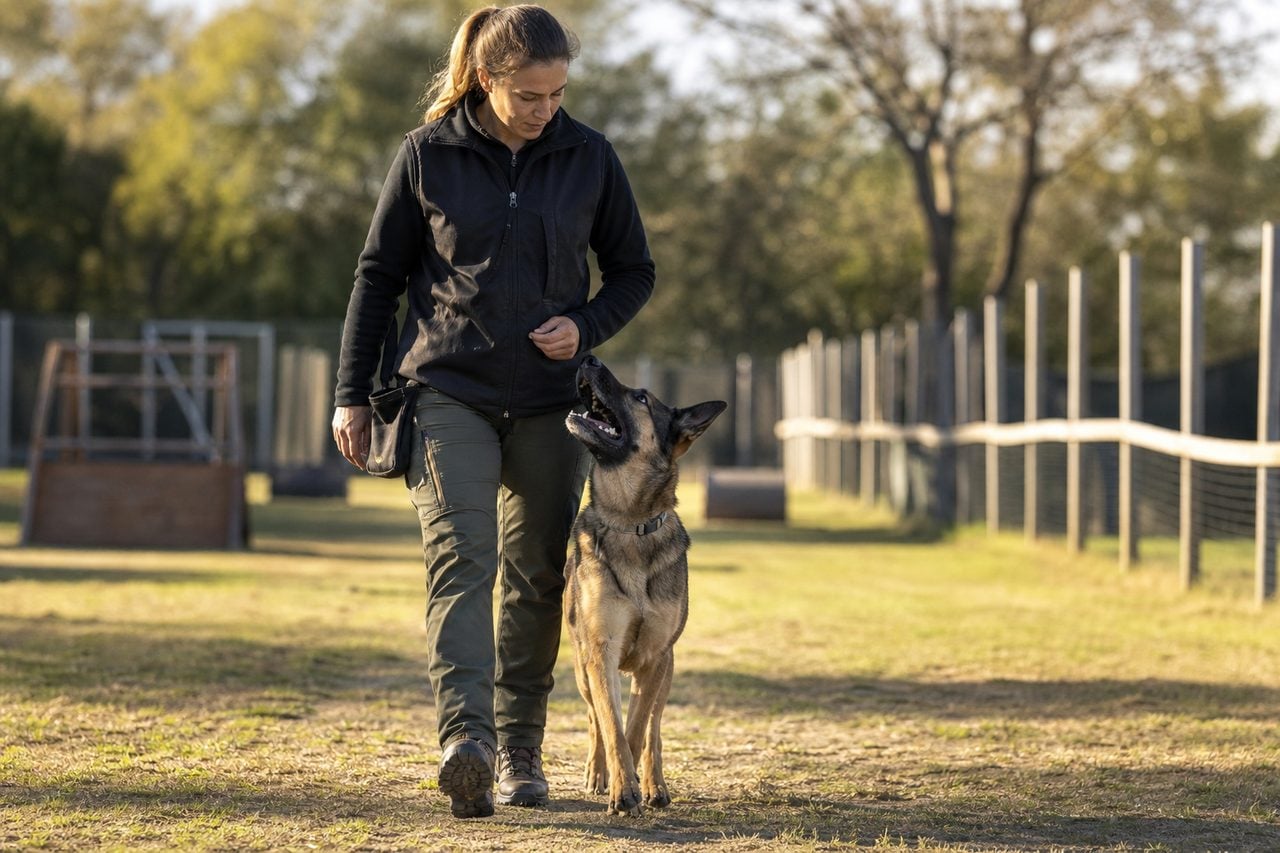
‘Dog boot camp’ is a marketing phrase rather than a training discipline, and understanding that is most of what a Quad Cities owner needs in order to shop for one sensibly. There is no accreditation behind the term, no defined curriculum, and no method it implies. Two facilities in this metro could both advertise a boot camp and mean entirely different things: one a four-week positive-reinforcement residency with daily handling and a structured handover, the other a fortnight of compulsion-based obedience with an e-collar and a demonstration at the end. Both would be using the phrase accurately, because the phrase means nothing.
What the phrase does reliably signal is residency — the dog goes away and lives with the trainer. On the Illinois side of the Quad Cities that describes three operations: a Port Byron kennel running twenty-eight-day in-house programs, a Mercer County practice at Viola running three parallel residency tracks, and an East Moline training facility that offers board-and-train alongside its class schedule. None of them market themselves as a boot camp; they use the plainer language. That is itself worth noticing.
This page is about decoding the term, working out what is actually on offer behind it, and deciding whether intensive residency is the right instrument for the problem you have.
What the phrase is doing
‘Boot camp’ borrows its authority from military basic training, and the borrowed connotation is deliberate: discipline, transformation, hard work, a changed individual at the end. It sells extremely well to an owner at the end of their patience, which is precisely the state most people are in when they start searching for it.
The problem is that the connotation and the modern evidence base point in opposite directions. Military basic training works on humans who understand why they are there. A dog does not, and there is a substantial body of veterinary-behavior research indicating that aversive-heavy training methods increase rather than decrease the incidence of fear and aggression in companion dogs. That is not a moral argument, it is an outcome argument: the harsher approach frequently produces the behavior the owner came in to eliminate.
None of which means every operation using the phrase is doing anything wrong. Plenty of trainers use it simply because it is what people type into a search box. It does mean the word tells you nothing, and you have to ask.
The question that actually separates them
Ask this, in these words: what happens when my dog gets it wrong?
Every trainer, of every persuasion, has an answer, and the answer is diagnostic in a way that method labels are not. Good answers are specific and describe adjusting the exercise: we reset and try again; we make it easier; we lower the criteria; we go back a step and add distance; we look at whether the dog is over threshold. These describe someone thinking about why the dog failed.
Answers that should slow you down are the ones that describe correcting the dog rather than the exercise, and especially any answer built on dominance, pack leadership or the dog ‘testing’ you. That framework was discarded by behavioral science decades ago, its originator disavowed the popular version of it, and it survives almost entirely in dog training marketing.
Follow up with: what tools do you use, and would you use them on my dog? There is legitimate, skilled electronic-collar work in this part of Illinois, largely in the sporting and working-dog world. Whether it belongs on a family pet with a pulling problem is a different question, and a trainer who cannot articulate when they would not use a tool is one to be careful of.
Two weeks, four weeks, and what the difference buys
Program length is the most concrete thing you can compare across operations, and it maps onto capability more directly than the marketing does.
Subtract three to five days of decompression from any residency — a dog in a new place is settling, not learning. A fourteen-day program is therefore nine or ten working days. That is genuinely enough for foundation obedience on a straightforward, biddable dog: recall, place, a duration down, loose-lead walking. It is not enough for behavior modification on a reactive or aggressive one, because that work proceeds in small increments over repeated exposures and there simply are not enough of them in nine days.
A twenty-eight-day program, which is what the Port Byron operation runs for both its obedience and its behavior tracks, gives you roughly a fortnight of core work plus a week of generalization — taking behaviors out of the training room into parking lots, sidewalks and distraction. That last week is what determines whether the training survives contact with a Moline sidewalk.
If someone offers you a two-week fix for a behavior case, that is the moment to ask what happens in the second half of the program.
The regression problem, and why it is not the dog's fault
Every residency trainer has watched this happen: the dog goes home transformed, and within a month and a half most of it is gone. Owners read this as the training not working. It is more specific than that.
Dogs are exceptional discriminators. A dog that has spent four weeks in an environment with one handler, consistent criteria and reliable consequences will very quickly work out that the rules at home are different — because they are. At the kennel the down meant down; at home it means down until something interesting happens. The dog is not being defiant, it is correctly reading two different sets of rules.
Which is why the handover matters more than the program. What you want, in order: a substantial session with you at collection where you are taught the mechanics and the marker words; a follow-up a week or two later in your own environment; something written; and a route back when it slips. One local program frames its residency explicitly around teaching the owner what they need to know rather than returning a finished dog, and that is the right framing regardless of which operation you choose. When you enquire, get the handover schedule in specific terms before you discuss price.
Where a Quad Cities dog actually goes
Because residency means the dog lives somewhere for a month, the somewhere is worth a visit rather than a website.
The three Illinois-side options sit at three points on the map: Port Byron, twenty minutes upriver from Moline on IL-84; East Moline, in the middle of the built-up strip; and Viola, about half an hour south into Mercer County. Geographically this is convenient — nowhere in the metro is far from at least one — and residency is the one training format where the fifteen-mile length of this metro genuinely does not matter, because you make the drive twice rather than weekly.
What to look at when you visit: where the dogs sleep, how much of the day is structured, whether there is indoor training space (relevant for a January intake in this climate), how many dogs one handler is running, and whether the operation is willing to show you all of it. A facility that will not show you the kennel area is answering the question.
Ask also about the outdoor situation. A Quad Cities January is genuinely hard on outdoor programs, and a residency that relies on outdoor sessions will lose days to weather that you are still paying for.
The cases where intensive residency is the wrong tool
Normal adolescence. An eight-to-fourteen-month dog that pulls, jumps and ignores you is not broken; it is an adolescent. A six-week class and consistent handling addresses this for a fraction of the cost, and the metro has good class capacity for it.
Separation distress. Sending a dog that cannot cope with being left away for a month is a strange way to teach it that being left is fine. This work belongs in the dog’s own home.
A frightened dog. Residency is a stressor. For some anxious dogs a month away from their people is four weeks of low-grade stress during which little learning happens. A trainer who will assess your dog and tell you it is not a good residency candidate is worth more than one who takes the booking.
Household-maintained behavior. If four people in your house have four sets of rules, the training will not survive the return regardless of length or quality. Fix the household first; a good in-home trainer will do that with you for far less money.
You want to skip the work. There is no version of dog training in which you do not end up handling the dog. Residency changes when you do the work, not whether.
Dog Boot Camp in the Quad Cities: Local Options & Nearest Specialists
Right now there are no listed the Quad Cities trainers focused specifically on dog boot camp. Many general the Quad Cities dog trainers can help you get started, and the nearest specialists for this focus are below.
Nearest dog boot camp specialists — Peoria
For complex cases, some families travel to the larger pool of specialists in the Peoria area for an assessment or a board-and-train stay. Top-reviewed options:
See all Peoria dog boot camp trainers →
Frequently Asked Questions
Is a dog boot camp the same as board and train?
Effectively yes — both mean the dog goes to live with a trainer for a fixed period. ‘Boot camp’ is a marketing phrase with no accreditation, curriculum or method behind it, and none of the three Illinois-side Quad Cities residency operations actually use it; they use plainer language. Because the term signals nothing about how a dog will be handled, you have to ask directly.
Are boot camp methods harsh?
Some are and some are not, and the phrase does not tell you which. The single most useful question is ‘what happens when my dog gets it wrong?’ — a good answer describes adjusting the exercise (reset, lower the criteria, add distance), while an answer built on dominance or pack leadership describes a framework behavioral science discarded decades ago. Veterinary-behavior research consistently links aversive-heavy methods to increased fear and aggression.
How long should an intensive program be?
Subtract three to five days of decompression from whatever number you are quoted. Fourteen days is therefore nine or ten working days — enough for foundation obedience on a straightforward dog, not enough for behavior modification. Twenty-eight days, which is what the local Port Byron programs run, gives roughly a fortnight of core work plus a week of generalizing it to real distraction.
Why did my dog regress after coming home?
Because dogs discriminate between environments extremely well, and the rules at home genuinely were different from the rules at the kennel. This is a handover failure rather than a training failure. Before booking any residency, get the transfer schedule in specific terms: how many sessions with you, over what period, and whether any of them happen in your own home.
Where do the Quad Cities residency programs actually run?
Three points on the Illinois side: a kennel at Port Byron twenty minutes upriver on IL-84, a training facility in East Moline in the middle of the built-up strip, and a practice at Viola about half an hour south in Mercer County. Visit before booking. A facility unwilling to show you where dogs sleep has answered the question.
Is residency training a good idea in a Quad Cities winter?
Ask about indoor space specifically. Programs that rely on outdoor sessions lose days to a Quad Cities January that you are still paying for, and ice makes some work impossible rather than merely unpleasant. An operation with a heated indoor room runs the same program in February as in June; one without it does not, whatever the schedule says.
Related: read our complete dog boot camp guide or the full the Quad Cities dog training overview.
Ready to find the right dog boot camp pro in the Quad Cities?