
Dog Boot Camp in Hampton Roads, VA
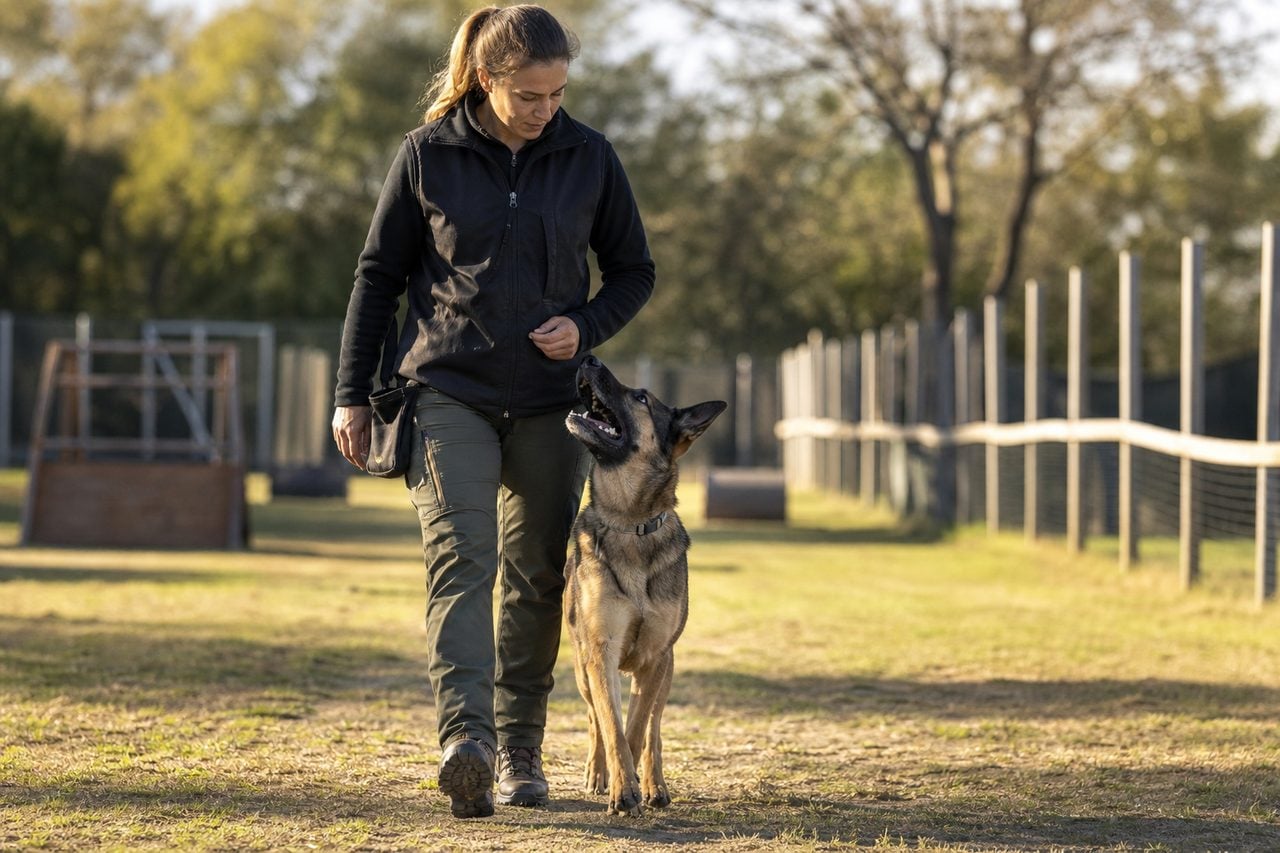
‘Boot camp’ is a phrase Hampton Roads takes more literally than most places, and that produces a small problem of translation. In a region with this much military presence the term carries a specific connotation, and a lot of households use it to mean ‘the intensive one’ without knowing what they are actually buying. In dog training it means a residential intensive — the dog lives with the trainer and works several times a day — and the honest position is that only three businesses in this region publish the words in their own materials.
- What the term means locally, and what it does not
- Puppy boot camps: the common local version
- Adult intensives: what three weeks can genuinely change
- Why this product is over-supplied in a Navy town
- Reading a program honestly before you book
- The alternatives most people should consider first
- After the intensive: the two weeks that decide everything
- Reviewed trainers
- FAQ
That number matters. The supply of programs marketed specifically as a boot camp here is thin, while the supply of residential board-and-train is deep: thirty businesses publish one. In practice, most households asking for a boot camp are asking for a board-and-train, and the small number of operators who use the boot-camp label are usually describing either a puppy intensive or a short, high-intensity obedience residency.
Two of the three local operators using the term publish a puppy version explicitly — an immersive three-week program covering socialization, house training and foundation obedience — and one publishes an adult intensive combining twice-daily training with socialization and on-site owner lessons. That is a useful clue about what the word actually means in this market.
What the term means locally, and what it does not
Used precisely, a boot camp is a residential program with a high daily session count and a compressed timeline. The distinguishing feature is intensity rather than duration: multiple structured sessions a day rather than one, and a deliberate emphasis on repetition under increasing pressure.
What it does not mean, in the hands of the reputable operators in this region, is harshness. One local program using the term publishes twice-daily intensive training alongside socialization and owner lessons held on site while the dog is in residence — a structure that is about contact hours, not severity. Another uses it for a puppy program built around confidence and foundation skills, which is about as far from a drill sergeant as training gets.
It is worth being blunt about the alternative reading, because the phrase does attract it. If a program’s selling point is that it is tough, that it will break a stubborn dog, or that it guarantees an outcome in a fixed number of days, treat that as a warning rather than a feature. Guarantees about the behavior of a living animal are not something a careful professional offers, and one local trainer says exactly that on their own site: it is impossible and unethical to guarantee the behavior of another living being.
Puppy boot camps: the common local version
The most frequently published boot-camp product in Hampton Roads is a puppy intensive, typically three weeks, and it exists for a specific regional reason: the socialization window does not wait for a PCS.
A family arriving mid-move with an eleven-week-old has perhaps five usable weeks of the critical period left, and those five weeks coincide with unpacking, housing inspections and a spouse reporting in. A three-week residential puppy program run by someone whose whole job that month is exposure, house training and foundation work converts a window that would otherwise be lost.
The local versions publish a consistent content list: obedience foundations, socialization, house training, crate routine, and early manners. One describes it as building a strong foundation in obedience, socialization and essential skills like potty training, in a structured environment.
The trade-off is real and worth stating. A puppy forms its attachments during these weeks, and three of its most formative weeks will be spent forming them with somebody else. That is not a disqualifier — puppies bond readily and the foundation is genuinely portable — but it raises the value of owner involvement. Ask how much of the three weeks includes you, and prefer a program that brings you in during the residency rather than only at the end. Day training, where the puppy goes to the trainer daily and sleeps at home, achieves much of the same effect without the separation and is available from several operators here.
Adult intensives: what three weeks can genuinely change
For an adult dog, an intensive residency is best understood as compressing three or four months of consistent daily practice into three weeks. That is a real acceleration and it is the honest case for the product.
What compresses well: mechanical behaviors. Sit, down, place, a reliable stay with duration, loose-lead walking, door manners, crate tolerance, coming when called on a long line. These are skills, they respond to repetition, and a professional running four short sessions a day will install them faster than an owner managing one distracted session in the evening.
What compresses badly: emotional change. A frightened dog, a dog with genuine separation distress, a dog with a bite history — these need repeated experience at a sub-threshold intensity over time, and time is the ingredient a compressed program cannot supply. The local operators who take that work seriously price it as a longer program for exactly this reason; one publishes a four-to-five-week aggression and behavior-modification residency distinct from its three-week obedience option.
The middle case is adolescence, which is where most enquiries actually come from. A ten-month-old that has stopped listening is usually not broken; it is rehearsing, and it has a lot of energy and no structure. That responds very well to an intensive, provided the household changes what it does afterwards.
Why this product is over-supplied in a Navy town
Residential intensives exist everywhere. They are disproportionately common here because of three specific pressures.
Deployment is the first. A household that loses one of its two adults for six months at short notice cannot run a weekly program and often cannot run daily practice either. An intensive is the only shape of training that works when the constraint is hours rather than money.
The tunnels are the second. A residential drop-off and collection means crossing the water twice. A weekly class for eight weeks means crossing it sixteen times, at least half of them at peak. Households on the Peninsula routinely choose a Southside residency over a Southside class for exactly this reason, and vice versa.
Land is the third. Hampton Roads has expensive urban cores and genuinely cheap rural acreage within forty minutes of them — western Suffolk, Isle of Wight, Southampton, the Chesapeake side of the Dismal Swamp, and the agricultural reserve inside Virginia Beach’s own boundary. A residential operation needs land and a class operation needs retail frontage, and in this region the first is far easier to obtain than the second. That is why so many of the intensives here are on farms.
Reading a program honestly before you book
Because the label is loose, read the specification rather than the name.
Ask how many training sessions a day and how long each is. ‘Intensive’ should mean a number. Two sessions of thirty focused minutes is a real answer; ‘all day’ is not, because no dog trains productively all day.
Ask what the dog does between sessions. Turnout, structured rest, enrichment, crate time, pack walks — a good answer covers all four. A dog kennelled for twenty-two hours between two sessions is not in an intensive; it is in boarding with two lessons.
Ask where the work happens. The programs that produce dogs which behave in public are the ones that go to public during the residency. Several local operators publish off-site work, pack walks and field trips as part of the program; that is what you are looking for.
Ask what is included at the end. Equipment, owner sessions, written or video instructions, follow-up. One local operator publishes that the owner receives verbal and written training instructions formatted for their specific dog, plus behavior counselling. That is the shape of a program that expects you to succeed after pick-up.
And ask about heat and emergencies, as with any residency here. A three-week intensive in July on rural acreage is a genuine heat-management problem and the operator should have an immediate, specific answer.
The alternatives most people should consider first
Because only three businesses in the region publish a boot camp by name, and because the phrase usually turns out to mean something else, it is worth knowing the neighboring options before you go looking.
Board-and-train is the same product under the commoner name and thirty local businesses publish it. If what you want is an intensive residency, this is the category to search.
Day training gives multiple professional sessions a day with the dog sleeping at home. For anxious dogs, puppies, and households that want to stay involved, it delivers much of the intensity with none of the separation.
An intensive private package — several sessions a week for a fortnight rather than one a week for two months — is available from most in-home trainers here if you ask, and is rarely advertised. It compresses the timeline while keeping the owner doing the handling, which is where the long-term reliability lives.
A structured group course at one of the region’s AKC-affiliated clubs is the cheapest structured option by a wide margin and is progressive, but it is a fixed weekly evening for seven to nine weeks, which is precisely the commitment an intensive exists to avoid.
The right question is not which product sounds most serious. It is which constraint is actually binding on your household — hours, geography, money, or the dog — and then buying the shape that relieves it.
After the intensive: the two weeks that decide everything
An intensive returns a dog operating at a level the household has never seen. The temptation is to relax, and relaxing is exactly what undoes it.
The first fortnight home should be the most structured fortnight the dog has ever had at home. Same rules, same words, same expectations, short sessions daily, and the crate and place routine maintained rather than quietly dropped. The dog is not testing you out of spite; it is discovering, reasonably, whether the new rules apply here too.
Expect a dip in week two or three. Every trainer in this region will tell you it comes. The behaviors look worse, the owner concludes the program did not work, and the dog is simply probing the edges of a system it has just moved into. Holding the line through that fortnight is the difference between a lasting result and an expensive holiday.
And use the support you paid for. If the program includes follow-up sessions or ongoing access, book the first one for about three weeks after pick-up rather than saving it for a crisis. That is when the questions are real, the handler’s timing has started to slip in specific identifiable ways, and a single session does the most good.
Reviewed Dog Boot Camp Trainers in Hampton Roads
These reviewed Hampton Roads-area trainers from our directory handle dog boot camp. Each links to a full profile with specialties, certified credentials, reviews, and contact info:
- K9 Functional Training — 5.0★ (70 reviews)
- Obedient Paws — 4.9★ (125 reviews)
See all Hampton Roads dog boot camp trainers →
Frequently Asked Questions
How many boot-camp programs are there in Hampton Roads?
Only three of the region’s listed businesses publish the words ‘boot camp’ in their own materials, two of them for puppy programs. If you are looking for an intensive residential program, search board-and-train instead — thirty local businesses publish that, and it is the same product under the name the industry actually uses.
Is a boot camp harsher than ordinary training?
It should not be, and among the local operators using the term it is not — the programs published here are defined by session frequency, not severity, and two of the three are puppy programs built around confidence and socialization. If a program markets itself on toughness or guarantees a result in a fixed number of days, treat that as a reason to look elsewhere rather than a selling point.
How long is a typical intensive here?
Three weeks is the most commonly published length for the puppy version and two to four weeks for adult residencies. Behavior-modification work, where local operators take it on, runs four to five weeks and is priced and named separately, which is an honest reflection of the fact that emotional change does not compress the way skill acquisition does.
Will an intensive fix my adolescent dog?
It will usually improve it dramatically and it will not finish the job on its own. Adolescence is the single commonest reason households here call a trainer, and an intensive is a very efficient way to install structure into a seven-to-eleven-month-old. What determines whether it lasts is the fortnight after pick-up and the maintenance routine the household actually keeps.
What is the alternative if I do not want to send my dog away?
Day training, which several local businesses publish. The dog goes to the trainer for the day, gets multiple professional sessions, and comes home at night. You get most of the intensity, the dog gets no separation, and the handover happens gradually rather than in one afternoon. It is also the better option for anxious dogs and young puppies.
What should be included at the end of an intensive?
At minimum: one or more substantial owner sessions, written or video instructions specific to your dog, and a way to get hold of the trainer afterwards. Better programs here publish several owner sessions, equipment you keep, and ongoing support. Get all of it in writing before the dog goes, because it is much harder to negotiate afterwards.
Related: read our complete dog boot camp guide or the full Hampton Roads dog training overview.
Ready to find the right dog boot camp pro in Hampton Roads?