Dog Trainers in Hampton Roads, VA
Hampton Roads is one market by name and about eight by practice, and the water is the reason. The harbor splits the region into a Southside — Virginia Beach, Norfolk, Chesapeake, Portsmouth, Suffolk — and a Peninsula — Hampton, Newport News, Poquoson, York County and Williamsburg — joined by tunnels that decide, more than any other single factor, which trainer a household can realistically use. A twenty-minute drive from Ghent to Kempsville is ordinary. The same twenty minutes from Ghent to Hampton becomes fifty on a Friday afternoon at the Hampton Roads Bridge-Tunnel, and a weekly group class on the wrong side of it quietly becomes a class you stop attending in week three. Nearly every experienced trainer here works one side of the water and says so on their own site; the ones who travel the whole region charge for the drive or run board-and-train instead.
The second thing that shapes dog training here is the Navy. Naval Station Norfolk is the largest naval base in the world, and Oceana, Langley, Fort Eustis, Little Creek and the Coast Guard Training Center sit inside the same commute. That produces a dog population with a particular profile: households that arrived eighteen months ago and will leave in two years, apartments and rentals rather than fenced yards, deployments that leave one handler doing the work of two, and a steady flow of dogs rehomed or adopted mid-PCS who arrive with no history at all. It is why board-and-train is unusually well represented here for a market this size — thirty of the region’s listed trainers publish a residential program — and why so many trainers publish military and first-responder discounts without being asked.
Geography does the rest. The Southside cities are flat, new and wide: Virginia Beach and Chesapeake are large-lot, cul-de-sac, six-lane-arterial places where a dog’s whole world is a back garden and a car, and where the problems that come up first are recall, door manners and a dog that has never met anything. Norfolk and Portsmouth are old port cities with narrow streets, alleys, terraced blocks and constant pedestrian traffic, and they produce leash dogs — reactivity at close quarters, barking at a shared fence line, settling on a patio. The Peninsula is different again, running from the dense Denbigh and Wythe corridors out through York County into genuinely rural Isle of Wight and Southampton, where trainers keep farms and the dog problem is a fence, a road and a hunting season. Nothing that works in all three is written for any of them.
- Top-Rated Dog Trainers in Hampton Roads
- What Kind of Training Does Your Dog Need?
- Training Formats and Typical US Dog-Training Prices
- Dog Training Schools & Classes in Hampton Roads
- How to Pick the Right Trainer
- Dog Training by Hampton Roads Neighborhood
- Hampton Roads Dog Training Resources
- Common Questions About Dog Training in Hampton Roads
- Start Here
This page is your starting point. Whether you need puppy socialization, basic obedience, off-leash training, or help with a serious behavior problem, we’ll help you understand your options, what to expect, and how to connect with the right professional in Hampton Roads.
Top-Rated Dog Trainers in Hampton Roads
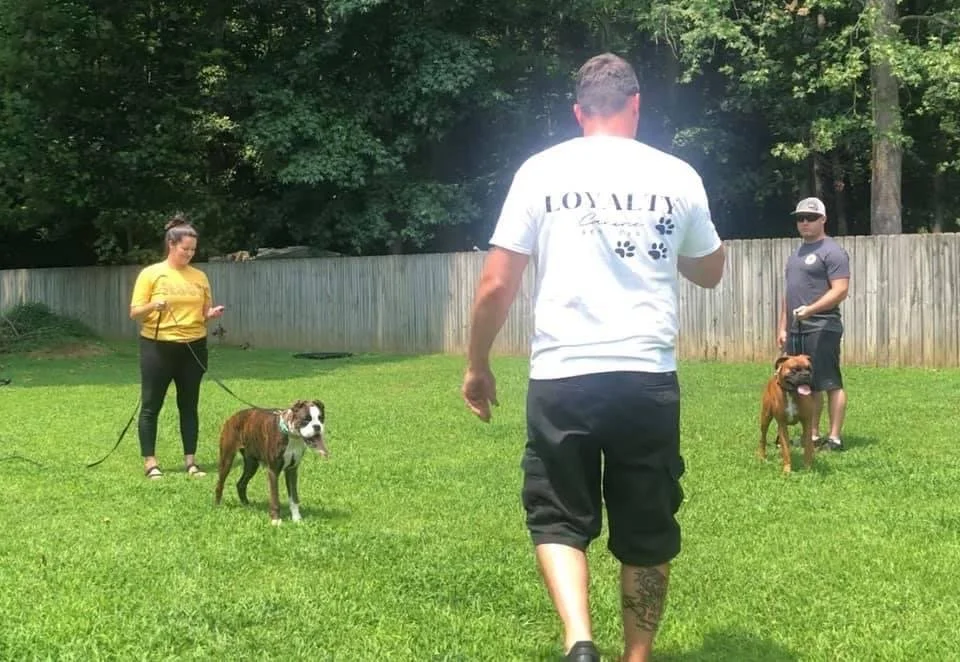
Compare Hampton Roads’s top-rated dog trainers below — each listing shows real Google reviews and, where we’ve checked them, certified credentials, so you can reach out with confidence.


What Kind of Training Does Your Dog Need?
Before you start comparing trainers, figure out which category your dog falls into. This determines the type of training, the format, and the realistic timeline.
Puppy (8 weeks to 5 months)
Priority: socialization and foundation habits. This is the most time-sensitive stage — the critical socialization window closes around 16 weeks, and what your puppy is exposed to during this period shapes their temperament permanently. Group puppy classes are ideal. Read our full guide: Puppy Training in Hampton Roads.
Adolescent dog (5 to 18 months)
Priority: obedience and impulse control. This is the stage where most owners hit the wall — the cute puppy has turned into a teenager who jumps on guests, pulls on the leash, and has developed selective hearing. Group obedience classes or private lessons work well here. Consistency is everything.
Adult dog — new to training
Priority: basic obedience and household manners. It’s never too late. Adult dogs are often faster learners than puppies because they have longer attention spans.
Adult dog — specific behavior issue
Priority: targeted behavior modification. Reactivity, aggression, separation anxiety, resource guarding, excessive barking. These issues need a qualified trainer or behaviorist — not a group class. Start with a behavior consultation.
Any dog — intensive training needed fast
Priority: results on a compressed timeline. Board-and-train programs offer intensive daily training over 2 to 6 weeks — the fastest path to results when done right.
Training Formats and Typical US Dog-Training Prices
The formats below are the same everywhere; the figures are national ranges, not Hampton Roads rates. Prices vary by city and by trainer — confirm directly with the trainer before you book.
Group classes
Best for socialization and foundation obedience. Meet once a week for 5 to 6 weeks with other dogs. Most affordable option. Typical US range: $150 to $300 for a full course.
Private lessons
One-on-one with a trainer at their facility or your home. Best for specific goals, reactive dogs, or customized plans. Typical US range: $100 to $175 per session (facility) or $125 to $200 (in-home).
Day training
Your dog goes to the trainer during the day and comes home at night. Great for working professionals. Typical US range: $75 to $125 per day.
Board and train
Your dog stays with the trainer for 2 to 6 weeks. Most intensive option. Typical US range: $1,500 to $6,000+ depending on length and complexity.
Behavior consultation
A diagnostic assessment for serious behavioral issues — a professional evaluation that produces a treatment plan. Typical US range: $200 to $400 for the initial assessment.
Dog Training Schools & Classes in Hampton Roads
Looking for a dog training school or group obedience classes in Hampton Roads? Plenty of local trainers and facilities run weekly group classes — a structured, affordable way to cover socialization and basic obedience alongside other dogs. Browse dog obedience classes in Hampton Roads, or use the trainer directory above to compare every dog school and trainer in the Hampton Roads area by specialty, reviews and price.
How to Pick the Right Trainer
Choosing a dog trainer is a lot like choosing a doctor — credentials matter, but so does communication style, philosophy, and whether you trust them with someone you care about.
Training methodology
This is the most important factor and the one most people skip. Dog training ranges from purely positive reinforcement (rewards only) to balanced training (rewards plus corrections). There is no single “right” approach — but there IS a right approach for your dog. A fearful rescue needs a different approach than a confident, drive-y working breed. Ask every trainer what tools and methods they use, and don’t commit until you understand and agree with their philosophy.
Credentials
Look for recognized certifications — CPDT-KA (Certified Professional Dog Trainer), KPA-CTP (Karen Pryor Academy), IACP, AKC CGC Evaluator, or for complex behavior, a CAAB or veterinary behaviorist. Credentials aren’t everything — some of the best trainers built their skills through decades of hands-on experience — but a trainer with no credentials AND no verifiable track record is a risk.
Transparency — red flags and green flags
Red flags: won’t let you observe a class or tour the facility, gets defensive about methodology, guarantees specific results, pressures you to sign up immediately, or trash-talks every other trainer. Green flags: welcomes questions, offers to let you observe a class first, gives references, is honest about what training can and cannot achieve, and tells you upfront if your dog’s issue is outside their expertise.
Dog Training by Hampton Roads Neighborhood
The Hampton Roads metro is large, and driving 45 minutes for a weekly class isn’t sustainable for most people. Here’s a quick overview of training availability by area:
Virginia Beach — the Oceanfront, Hilltop, Great Neck and Town Center
The largest concentration of trainers in Virginia sits inside one city, and it is not evenly spread. The resort strip and Hilltop end is where the facility-based operators cluster — class buildings off Virginia Beach Boulevard, Laskin Road and the Landstown Center corridor — because that is where retail space and parking exist together. Great Neck and Alanton are large-lot residential and produce in-home clients almost exclusively. Town Center and Pembroke have added apartment blocks fast enough that the lift-and-lobby problem now shows up here the way it does in Ghent. The Oceanfront itself is a training resource rather than a catchment: the boardwalk in April is the most reliable place in the region to test whether a settle, a loose leash or a recall actually holds under crowd pressure, and half the trainers on this list use it.
Virginia Beach — Kempsville, Princess Anne, Red Mill and Sandbridge
South and east of the interstate the city thins into large lots, farm edges and the Back Bay. Kempsville is the dense middle — postwar neighborhoods, small gardens, a lot of first dogs. Princess Anne and Red Mill run out to the agricultural reserve, where several board-and-train operators keep acreage because it is the only affordable land inside the city limits. Sandbridge is a narrow barrier-island strip whose off-season beach is one of the few genuinely low-distraction outdoor spaces in the metro, and whose summer is the opposite. Expect trainers here to work out of their own property and to travel to clients rather than run weekly evening classes.
Norfolk — Ghent, Larchmont, Colonial Place and Ocean View
Norfolk is the region’s leash-dog city. Ghent and Freemason are tight nineteenth-century grids with shared stoops, alleys, narrow pavements and dogs meeting each other at a distance of four feet whether anyone planned it or not; the problems that walk in the door are dog-to-dog reactivity, barking at hallway noise and a dog that cannot settle on a patio. Larchmont and Colonial Place are quieter, leafier and full of students and young families. Ocean View along the Chesapeake Bay is a different market again — rentals, transient Navy households, a beach that permits dogs outside summer hours. Facility space inside Norfolk is expensive, so most Norfolk trainers travel to the client.
Chesapeake — Greenbrier, Great Bridge, Western Branch and Deep Creek
Chesapeake is geographically the largest city in the region and behaves like four towns. Greenbrier is commercial and is where the city’s facility-based daycare-plus-training operations sit. Great Bridge is settled, affluent, heavily dog-owning and has the highest density of independent trainers in the city. Western Branch faces Portsmouth and Suffolk and shares their traffic rather than Virginia Beach’s. Deep Creek and the Hickory end run to farmland and the Dismal Swamp, where the residential and sport trainers keep land — the region’s schutzhund club, its long-standing obedience schools and several board-and-train farms are all on this side of the city.
Portsmouth and the Western Branch corridor
Portsmouth is compact, historic and under-served: Olde Towne’s street grid is as tight as Ghent’s, Churchland is suburban and sits on the Suffolk line, and the city’s trainers are few but long-established — an obedience club founded in 1949 still runs weekly classes off Portsmouth Boulevard. Because the city is small and the tunnels bound it on two sides, Portsmouth households in practice draw on Chesapeake and Suffolk trainers as much as their own, and the drive-time maths is genuinely different from the map.
Suffolk — downtown, Harbor View and the rural west
Suffolk covers more ground than any other city in Virginia, and the training market splits along the same line the city does. Harbor View and North Suffolk are new, fast-growing and effectively part of the Western Branch commute. Downtown Suffolk is small-town. West of it the city becomes peanut and cotton country running toward Windsor, Zuni and Southampton, and that is where the acreage operations are — residential programs on working farms, gun-dog and retriever training, and trainers who will drive forty minutes to a client because the alternative is no clients.
Hampton and Newport News — the Peninsula
The Peninsula is a single dense ribbon along the James, from Phoebus and Buckroe at the tip through Coliseum Central, Wythe and Hilton Village to Denbigh and the Newport News Park end. It is older housing, smaller lots and a heavy military footprint — Langley, Fort Eustis and the shipyard — and it is separated from the Southside by two tunnels. Peninsula trainers overwhelmingly serve the Peninsula only; the two AKC clubs and most of the in-home operators here list Hampton, Newport News, York County and Poquoson and stop there. If you live on the Peninsula, treat the Southside list as a last resort rather than an option.
York County, Poquoson and Greater Williamsburg
North of Newport News the region turns green. York County, Grafton, Tabb and Seaford are suburban but wooded, Poquoson is a small waterfront city almost entirely surrounded by marsh, and Williamsburg and James City County add a tourist economy on top of a residential one. It is the part of Hampton Roads with the most facility-based training per head after Virginia Beach, partly because commercial rent is lower and partly because the catchment reaches up to New Kent and Gloucester. Drive-times here are honest — no tunnels — which is why several Williamsburg operators legitimately serve Newport News as well.
Isle of Wight, Smithfield and the rural south
Across the James from the Southside, Isle of Wight County, Smithfield, Carrollton, Windsor and Zuni are small towns with genuinely rural gaps between them. Supply here is thin but real, and the trainers who work it tend to publish a service area rather than a class schedule — group classes do not fill in a town of two thousand. Expect private lessons, home visits and residential programs, and expect to drive to Suffolk or Chesapeake for anything specialized.
Gloucester and the Middle Peninsula
Gloucester sits at the far northern edge of the metro, across the York River from Yorktown and roughly forty minutes from Newport News. It is a separate community in every practical sense, with its own small supply of trainers who travel to clients across Gloucester, Mathews and lower Middlesex. Households here should read the Gloucester trainers as their local market and the Peninsula as the specialist backstop, not the other way round.
Hampton Roads Dog Training Resources
Beyond professional training, Hampton Roads has some excellent resources for dog owners.
Parks and off-leash areas
- First Landing State Park, Virginia Beach — Roughly 2,900 acres of cypress swamp and maritime forest between the Chesapeake Bay and Broad Bay, with about nineteen miles of trail. Dogs are allowed on a leash of six feet or less on most trails, which makes the Bald Cypress and Long Creek loops the standard place in the region to proof loose-leash walking over roots, boardwalk and narrow passing points — conditions a pavement walk never produces. It is busy at weekends and quiet on a weekday morning, so it doubles as both a distraction test and a calm first outing.
- Mount Trashmore Park, Virginia Beach — A 165-acre park built over a capped landfill, with two man-made lakes, a long paved loop and a fenced dog park. The hill is the point: the paved climb and the open lawn give a trainer somewhere to work recall and heel at distance with clear sight lines, and the fenced enclosure sits far enough from the loop that a reactive dog can be worked at a chosen distance from other dogs rather than ambushed by them. It is one of the busiest parks in the city at weekends.
- Virginia Beach Boardwalk and the Oceanfront — Three miles of separated boardwalk and bike path along the resort strip. Dogs are restricted on the beach during the summer season but the boardwalk is usable year-round, and in the shoulder months it is the single most useful proofing environment in Hampton Roads: pedestrians, cyclists, prams, skateboards, buskers, other dogs and food smells, all inside a few hundred meters, with nowhere to hide. Trainers here routinely use it as the final stage of a program rather than the first.
- Elizabeth River Trail, Norfolk — About ten and a half miles of urban trail running from Norfolk’s west side through Ghent and downtown to the harbor. It is the Southside’s best example of genuinely urban walking — road crossings, bridges, cyclists, joggers and blind corners — and it is where Norfolk trainers take leash-reactive dogs once distance work is holding, because the trail gives you a predictable, repeatable route with measurable passing distances.
- Northwest River Park, Chesapeake — A 763-acre park on the North Carolina line with campground, lake, equestrian trails and a genuinely quiet interior. Dogs are permitted on a leash. Its value is the opposite of the boardwalk’s: it is one of the few places in the metro where a nervous or reactive dog can be worked outdoors for an hour and plausibly meet nothing at all, which is what early behavior-modification work actually requires.
- Sandy Bottom Nature Park, Hampton — A 456-acre reclaimed sand-mining site in Hampton with lakes, wooded trail and a nature center. It is the Peninsula’s equivalent of Northwest River — wide, leafy, moderately trafficked, close enough to Coliseum Central and Fox Hill to be a weekly habit rather than an expedition — and it is the default outdoor venue for Peninsula in-home trainers who need somewhere neutral to meet a client.
- Newport News Park — One of the largest municipal parks in the United States at roughly 7,700 acres, straddling Newport News and York County, with about thirty miles of trail and a large reservoir. Dogs are allowed on a leash. The scale is the feature: a trainer can find a trailhead with cars and people, and then within ten minutes find a stretch with nobody on it, which lets a single session move from proofing to recovery without getting back in the car.
- New Quarter Park, Yorktown — A 545-acre York County park on Queens Creek with mountain-bike and walking trails and open field. It is quieter than Newport News Park, has genuinely varied footing, and is the usual meeting point for Williamsburg and York County trainers running field sessions. Leash rules apply throughout.
- Bennett’s Creek Park, Suffolk — A waterfront park in North Suffolk on Bennett’s Creek with trail, playing fields and a boat ramp. It is the practical outdoor venue for the Harbor View and Western Branch end of the market — close, free, and busy enough on a weekend afternoon to be a real distraction test without being overwhelming.
- Windsor Castle Park, Smithfield — About 208 acres on the Pagan River at the edge of Smithfield, with several miles of trail, a fenced dog park and river frontage. For Isle of Wight households it is the only park in the county with enough space and enough foot traffic to serve both purposes — a quiet weekday session and a busy weekend proofing walk — and it is where the county’s trainers meet clients.
These parks are great for socialization practice AFTER your dog has a foundation of training. Taking an untrained dog to an off-leash park is asking for trouble.
Veterinary behaviorists
For complex behavior cases that may require medication alongside training, ask your primary vet for a referral to a veterinary behaviorist serving the Hampton Roads area.
Dog Trainers by Community in the Hampton Roads Area
Looking for a trainer in a specific Hampton Roads-area community? Here are the local options town by town.
Dog Trainers in Virginia Beach, VA
- Crossfire K9 LLC — 5.0★ (119)
- K9 Functional Training — 5.0★ (70)
- Lucky Pup and Co. — 5.0★ (52)
- K9 Obedience Unleashed — 5.0★ (35)
- Oceanfront Dog Training — 5.0★ (30)
- Doggy Decorum, LLC — 5.0★ (24)
- Honest k9 — 5.0★ (22)
- Southeastern K9 — 5.0★ (20)
Also in Virginia Beach: Cobra Canine, Lead K9, Thrive & Trust K9 Training, Tails of Success Dog Training, Right On Training, Dog Gone Good Dog Training, Soulful Strut K9, The Balanced Canine Dog Training, Hampton Roads Dog Training, Obedient Paws, Zoom Room Dog Training, Canine Obedience Training at Hunt Club, The Refined Wolf, Hampton Roads Obedience Training Club, Coastal K9 Academy, Playful Pups & Performance Training, Inc., Dutch East Dog Training Center, Montybello Dog Training, Obedient K9 Service Dog Training
Dog Trainers in Chesapeake, VA
- Anchor Up K9 Academy — 5.0★ (59)
- Half Moon Bay Canine Training — 5.0★ (22)
- We train dogs llc — 5.0★ (15)
- The Ruff House Stay & Play at Greenbrier — 4.9★ (571)
- Freak On A Leash Dog Training — 4.9★ (188)
- Canine Training Unlimited — 4.9★ (94)
- Shades Of Blu Dog Training INC — 4.9★ (56)
- Family Dog Club — 4.3★ (72)
Also in Chesapeake: Tidewater Schutzhund Club, AEGK9Academy
Dog Trainers in Williamsburg, VA
- Misfits dog training — 5.0★ (42)
- Colonial Dog School — 5.0★ (7)
- Zoom Room Dog Training — 4.9★ (167)
- Thoughtful Dogs — 4.9★ (31)
- Ridgeside K9 Tidewater — 4.8★ (90)
- Stateline Canine — 4.7★ (21)
- Next-Door Dog Training-Williamsburg
Dog Trainers in Norfolk, VA
- Transformational k9 — 5.0★ (3)
- K9Aholics Dog Training — 4.9★ (303)
- Tailored K9 Training — 4.9★ (34)
- Clever Critters, LLC — 4.6★ (24)
- The Freckled Paw Dog Training — 4.5★ (36)
Dog Trainers in Hampton, VA
- Take The Leash K9 Training — 5.0★ (38)
- Happy Dog Academy LLC — 5.0★ (33)
- Bravo Zulu Dog Training — 5.0★ (7)
- Off Leash K9 Training Hampton Roads — 4.8★ (1173)
- Merrimac Dog Training Club — 4.7★ (56)
Dog Trainers in Newport News, VA
- On Command Dog Training LLC — 5.0★ (649)
- Durben Dog Training and More, LLC — 5.0★ (49)
- Canine Obedience And Correction Agency, COACA LLC — 5.0★ (27)
- Simply Human Dog Training — 5.0★ (9)
- Peninsula K9 Training
Dog Trainers in Suffolk, VA
- Dean’s List K9 Training LLC — 5.0★ (126)
- Town and Country K9 — 5.0★ (36)
- Endless Pawsibilities Dog Training, LLC. — 5.0★ (23)
- True Potential Dog Training LLC — 5.0★ (3)
Dog Trainers in Gloucester, VA
- Loyalty Canine Services — 5.0★ (49)
- Shared Joy Dog Training — 5.0★ (18)
- Belroi Agility & Obedience Center — 4.9★ (7)
- Bay Haven Boarding and Training — 4.8★ (17)
Dog Trainers in Portsmouth, VA
- Portsmouth Chesapeake Obedience Training Club — 5.0★ (2)
- T.C. Canines, LLC — 4.5★ (34)
Dog Trainers in Yorktown, VA
- The Good Dog Yorktown — 5.0★ (265)
- Pawsitive Training Service Dog Solutions — 3.7★ (3)
Dog Trainers in Poquoson, VA
- Plot Twist K9 Services — 5.0★ (16)
- On the Line K9 — 5.0★ (1)
Dog Trainers in Windsor, VA
- West Wind Retrievers and Training — 5.0★ (60)
- The Kennel At Five Forks — 4.9★ (43)
Dog Trainers in Smithfield, VA
- Main Street Dogs — 5.0★ (33)
Dog Trainers in Carrollton, VA
- Pawsitive Attitudes, LLC — 4.9★ (56)
Dog Trainers in Zuni, VA
- K9 Pawsibilities — 4.9★ (36)
Dog Trainers in Newsoms, VA
- Buck’s Dog Training Virginia — 5.0★ (154)
Dog Training by Specialty in Hampton Roads
Hampton Roads-specific guides for each type of training:
- Puppy Training
- Puppy Socialization
- Dog Obedience Classes
- Dog Boot Camp
- Aggressive Dog Training
- Leash-Reactive Dog Training
- Off-Leash Dog Training
- Separation Anxiety Training
- In-Home Dog Training
- Protection & K9 Training
- Service Dog Training
- Therapy Dog Training
Also live across Virginia: Arlington · Charlottesville · Fredericksburg · Harrisonburg · Leesburg · Lynchburg · Reston · Richmond · Roanoke · Staunton.
Common Questions About Dog Training in Hampton Roads
How many dog trainers serve Hampton Roads?
GetDogSchool lists 79 across the Southside and the Peninsula, and the composition matters more than the count. The large majority are independent one- and two-person operations that travel to the client rather than facilities you drive to, because commercial space inside Virginia Beach and Norfolk is expensive and the catchment is spread over nine cities. A minority run a building: the two long-standing AKC clubs, a handful of class facilities in Virginia Beach and Chesapeake, several daycare-plus-training operations, and a small number of national franchise locations. Roughly a third publish a residential board-and-train program, which is high for a market this size and is a direct consequence of the military population.
Does the tunnel really matter when choosing a trainer?
Yes, and it is the single most common reason a training plan fails here. The Hampton Roads Bridge-Tunnel and the Monitor-Merrimac are the only two crossings between the Southside and the Peninsula, both are single points of failure, and both routinely add thirty to sixty minutes at peak or after an incident. A weekly group class is a six-to-nine-week commitment; if it sits on the far side of a tunnel, plan for the evening where you simply do not make it. In practice, if you live in Hampton, Newport News, Poquoson or York County, choose from the Peninsula list; if you live in Virginia Beach, Norfolk, Chesapeake, Portsmouth or Suffolk, choose from the Southside list. Board-and-train is the exception — you cross the water twice, not eighteen times.
What should a military family ask before booking?
Three things. First, what happens to the program if you deploy or PCS mid-way — several operators here publish lifetime or transferable support, and several do not. Second, whether the trainer can work with a handler who is on their own for six months, because a two-adult plan that assumes handovers is not a plan for a single-handler household. Third, whether a discount applies; military and first-responder discounts are common in this region and are usually not advertised at the point of booking. If you are arriving with a dog you have had for years, say so; if you are arriving with a dog rehomed during the move, say that instead, because the two are completely different starting points.
Group class or private lessons in Hampton Roads?
Group classes exist here and are worth taking if you can get to them, but the supply is narrower than the raw trainer count suggests: most of the weekly group instruction in the region comes from two AKC-affiliated clubs, a small number of Virginia Beach and Chesapeake facilities, and a few daycare operators. Everything else is private, in-home or residential. That is not a quality judgement — it is a rent and geography judgement. If the specific thing you need is a dog that can work around other dogs, hold out for a class or for a trainer who runs structured group outings. If the thing you need is a dog that behaves in your own house, in-home work starts where the problem actually is.
Are there trainers for aggression and reactivity here?
Sixteen of the listed businesses publish aggression or reactivity work in their own words, which is a real but not deep bench across nine cities, and they are not evenly distributed — most are on the Southside. Be careful with the wording: several operations publish a residential program and then state plainly that it is not suitable for dogs with aggression or severe behavioral concerns, which is an honest and useful thing for them to say. Read the refusal as seriously as the offer. A business that tells you what it will not take is usually telling you the truth about what it will.
What about the rural edges — Isle of Wight, Windsor, Gloucester?
They have real supply and very little of it. Smithfield, Carrollton, Windsor, Zuni and Newsoms between them list a handful of trainers, and Gloucester across the York River lists two; all of them travel, and most publish a service area rather than a timetable. For general obedience and puppy work you can and should use a local trainer. For anything specialized — service-dog work, serious behavior cases, sport — expect to drive to Suffolk, Chesapeake or Virginia Beach, and expect the trainer to price the drive into a home visit.
Start Here
The best time to start training is today. Whether your puppy needs socialization, your adolescent dog needs impulse control, or your adult dog has a behavior issue that’s been building for years — the sooner you start, the faster things improve.
Browse dog trainers in Hampton Roads on GetDogSchool.com. Compare programs, read reviews, and connect with professionals who fit your dog’s needs and your budget.
Find Dog Trainers in Hampton Roads →
Ready to find the right trainer for your dog in Hampton Roads?
Get matched with a trainer in Hampton Roads →