
In-Home Dog Training in Wilmington, NC
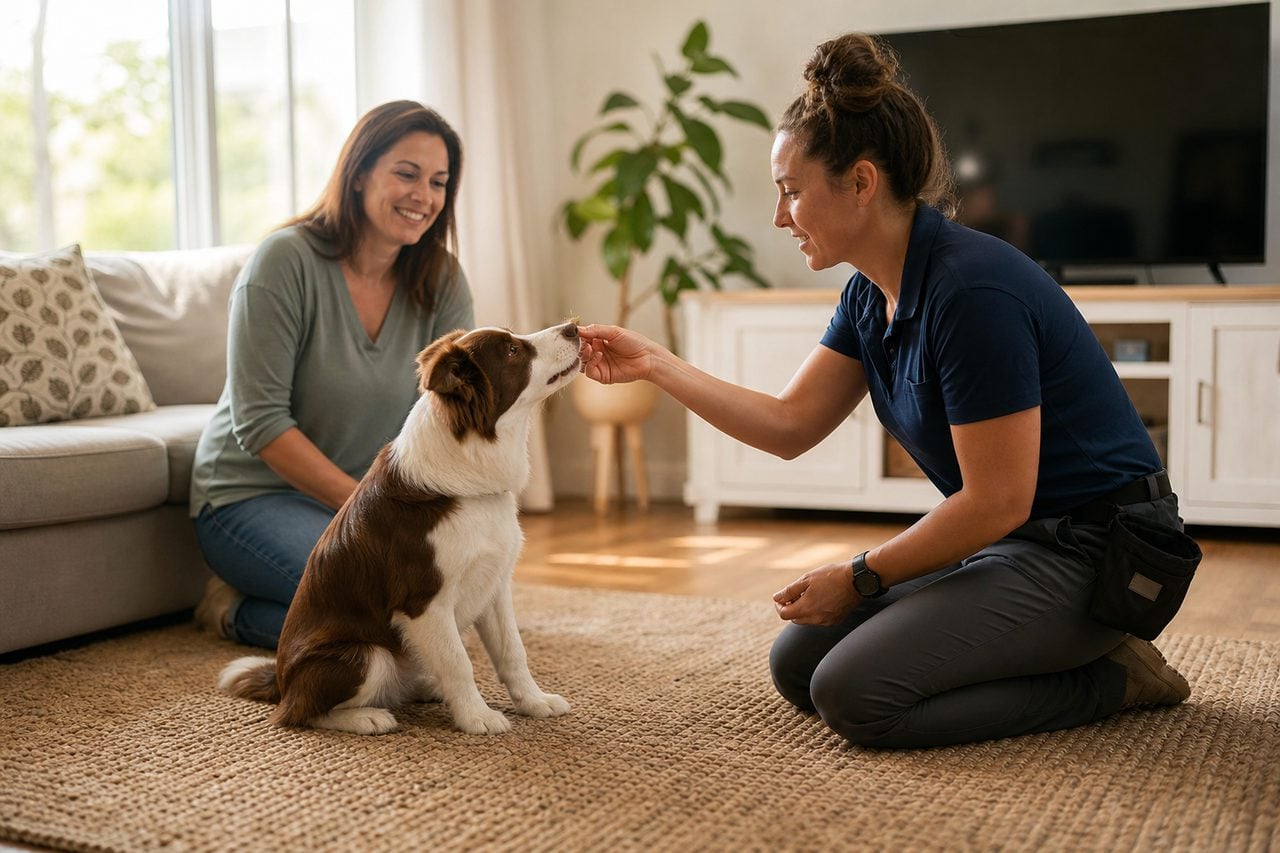
In-home training is not a niche in Wilmington. It is close to being the default. Several businesses in this directory publish it as a service, more publish no address at all — which is what a fully mobile practice looks like from the outside — and several of the metro’s larger providers start every program in the client’s house before the dog ever sees a training room.
That is a market feature worth understanding before you start calling, because it changes what you should be asking for.
Why this metro leans mobile
The businesses here publish their own reasoning and it is consistent. One states that Wilmington training begins with the in-home model so the work is connected to the dog’s actual environment, and elsewhere makes the wider argument: dogs live in homes, neighborhoods, apartment buildings, veterinary hospitals, parks, restaurants, breweries, walking trails and busy communities, so training should prepare them for those environments. Another publishes that the home environment is where a trainer can observe and address behavior where it occurs naturally.
A third puts the practical case for the owner rather than the dog: you save time, because the trainer comes to you and there is no travel or stress at either end. In a metro strung between a downtown, three beaches and two river crossings, that is not a small point.
There is also a supply reason. This is a market with a lot of single-trainer businesses and not many large facilities. A one-person practice without a building has lower overheads and can price a session accordingly, which is why in-home rates here are competitive with class prices rather than several times higher.
What it costs
In-home pricing is published more openly than any other private format in this metro.
Two more things cost nothing and are published locally. One in-home trainer offers a free fifteen-minute discovery call. Another business publishes complimentary initial consultations. Use them — an in-home trainer is going to be in your house, repeatedly, and a phone call tells you whether that is going to work.
Multi-session in-home programs sit higher. One business publishes a program including four private in-home lessons of sixty to ninety minutes each with emailed homework after every session, and a ten-lesson package running from foundations through advanced real-world skills.
What in-home is genuinely better at
Anything that only happens at home. House training. Crate work. Barking at the window. Guarding the sofa. Counter surfing. Door manners. None of these can be worked in a room full of other dogs, and a trainer who has never seen your hallway is guessing.
Households with children. One Wilmington business publishes a program specifically for expecting parents and families with toddlers, taught by a licensed parent-education instructor, and describes itself as uniquely qualified in this area for that work. Another publishes a family dog track built around age-appropriate expectations so children can take part safely. Both are in-home formats by nature: the point is the household, not the dog.
Getting everyone on the same page. A dog trained by one adult in a class does not generalize to the other three people in the house. A trainer in your living room teaches all of them at once. A Wilmington business makes the same argument about its group classes — that a good companion dog needs to be responsive to everyone in the family — but in-home is the format that actually delivers it.
Dogs that cannot cope with a room. A dog that barks for an hour at the dog three feet away learns nothing in a class. Starting at home, at a workable distance from the trigger, is the only route in.
What it is worse at, and how local trainers handle that
The obvious gap is distraction. Your living room is the easiest environment your dog will ever work in, and a dog that is perfect there may be useless on the Riverwalk. The trainers here know it and publish the answer: the work moves outward.
One business describes sessions progressing from the home into public settings. Another publishes that group classes come later, once private skills are ready to be tested around movement, dogs and people, and warns that a dog with leash reactivity or fear should not be thrown into the busiest setting just to see what happens. A Wilmington trainer’s own published client account runs home, then Long Leaf Park, then downtown — the exact progression, in the client’s own words.
So the question to ask an in-home trainer is not whether they work in public. It is at what point, and where. If the answer is that every session happens in your house forever, you will get a well-behaved dog at home and nothing else.
Coverage: who comes to which part of the metro
Service areas are published, and they matter here because the geography is awkward. One Wilmington in-home trainer names Monkey Junction, Myrtle Grove, Masonboro, Silver Lake, Wrightsville Beach, Ogden and Porter’s Neck as her working area, with video consults offered outside it. A business serving this market names Carolina Beach, Castle Hayne, Hampstead and Leland in addition to Wilmington, and invites owners just outside that list to call before ruling themselves out. A Leland in-home trainer publishes her area as select locations in and around Leland, with services offered in the client’s own home.
The river is the thing to plan around. Leland and Belville are minutes from downtown on a good day and considerably more on a bad one, so a Brunswick-side owner is usually better served by a Brunswick-side trainer. The same logic applies to Southport and Oak Island, roughly forty minutes south, where a one-to-one trainer covers Southport, Oak Island and Bolivia locally.
Watch for travel fees. At least one Wilmington business publishes that an additional travel fee may apply beyond a certain distance from its office. Ask up front rather than finding it on the invoice.
Getting value out of an in-home session
Feed your dog light beforehand rather than a full meal; almost all of this work is paid for in food. Have everyone who lives with the dog there for at least the first session. Write down what actually happens, because you will remember the demonstration and forget the detail — one local program emails homework after every session for this exact reason.
Be honest about what your household will really do. A trainer who is told you will do three sessions a day will build a plan around three sessions a day. Five minutes twice a day, done consistently, beats a plan nobody follows.
And ask about the second phase before you buy the first. In-home work that never leaves the house is half a program. The businesses in this metro that do it well already have the next step written down, whether that is a public session, a group class or a park.
The in-home market's two personalities
Look closely and the in-home providers here split into two quite different kinds of business, and knowing which you are calling saves a wasted conversation.
The specialist single-trainer practice. One person, one calendar, no building. These are the businesses in this metro with the sharpest published credentials and the narrowest offer — one publishes a Karen Pryor Academy certification and a list of continuing-education courses by name and date, and sells exactly two products, a puppy program and an adolescent-to-adult program. Another is a certified trainer offering training and pet sitting in the client’s own home around Leland, with complimentary initial consultations. You get depth, personal continuity and a real relationship. You also get one person’s availability, which in a growing market is the binding constraint.
The multi-format provider that also comes to you. The larger businesses here treat in-home as the first stage of a longer path rather than the whole product. One publishes an in-home package alongside a facility program and six months of group classes. Another begins in the home and moves into group work once private skills are ready to be tested. A third publishes four in-home lessons of sixty to ninety minutes as one option beside its residential programs. You get a route onward and more capacity; you may not get the same trainer every time, which is worth asking about.
Neither is better. A household problem with one dog and one clear goal is usually best served by the first. A dog that will eventually need public work, classes or a residential block is often better started with the second.
Reviewed In-Home Dog Training Trainers in Wilmington
These reviewed Wilmington-area trainers from our directory handle in-home dog training. Each links to a full profile with specialties, certified credentials, reviews, and contact info:
- Coquina Canine Dog Training — 5.0★ (26 reviews)
- Bubs N Beans Dog Training & Pet Care LLC — 5.0★ (12 reviews)
- AvidDog Dog Training — 4.9★ (221 reviews)
- Dog Training Elite Wilmington — 4.9★ (48 reviews)
- Pawsitive Pup Training — 4.9★ (44 reviews)
- Salty Dogs Obedience Training — 4.6★ (19 reviews)
- Sally Said So Professional Dog Training — 3.0★ (2 reviews)
- Simply Good Dog Training
See all Wilmington in-home dog training trainers →
Frequently Asked Questions
How much does in-home dog training cost in Wilmington?
A travel fee may apply beyond a certain distance – at least one business publishes that, so ask.
Is in-home training better than a class?
For anything that happens at home – house training, crate work, barking at the window, door manners, guarding – yes, decisively. For teaching a dog to behave around other dogs, no: a class is the only format that supplies other dogs. Several Wilmington businesses sell both in sequence, private work first and a class once the basics hold.
Which parts of the Wilmington area do in-home trainers cover?
Published service areas include Monkey Junction, Myrtle Grove, Masonboro, Silver Lake, Wrightsville Beach, Ogden and Porter’s Neck for one trainer; Carolina Beach, Castle Hayne, Hampstead and Leland in addition to Wilmington for another; and select locations in and around Leland for a Brunswick-side trainer. Southport, Oak Island and Bolivia are covered by a trainer based down there. Plan around the river crossing rather than the mileage.
Does everyone in the house need to be there?
For the first session, yes, and preferably for most of them. A dog trained by one person learns that the cue works when that person says it. One Wilmington business makes the point about its own classes – that a good companion dog needs to be responsive to everyone in the family – and in-home is the format that actually delivers that.
Will my dog behave outside the house too?
Only if the program takes the work outside, which the good ones do. Local businesses publish sessions progressing from the home into public settings, and one warns specifically against throwing a fearful or leash-reactive dog into the busiest setting to see what happens. Ask an in-home trainer at what point the work moves out, and where.
Related: read our complete in-home dog training guide or the full Wilmington dog training overview.
Ready to find the right in-home dog training pro in Wilmington?