
In-Home Dog Training in Louisville, KY
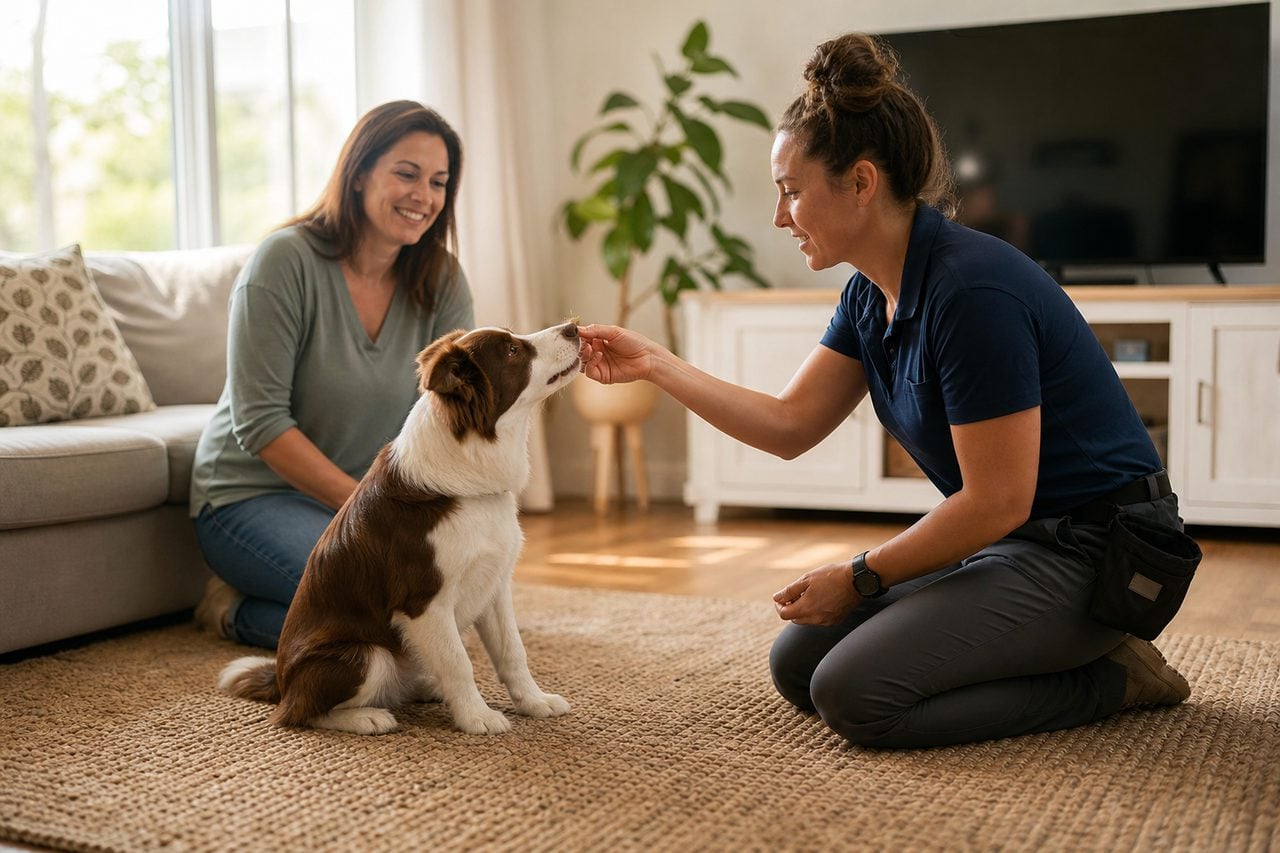
In-home training is the fastest-growing shape of dog training in Louisville, and the reason is geography as much as convenience. This is a metro where a fifteen-mile trip can take forty minutes in the wrong hour, where the dense neighborhoods and the training facilities are on opposite sides of the Watterson, and where a meaningful share of the actual problems — the door, the stairs, the sofa, the visitor — only exist inside a specific building.
A substantial number of local trainers now work exclusively this way, driving the whole metro from downtown and the Highlands out through St. Matthews, Jeffersontown and Middletown and into the Oldham and Bullitt rings. Several publish Louisville neighborhoods explicitly as their service area rather than an address, which is the clearest signal of how the format works: you are not choosing a facility, you are choosing a person who arrives at your door.
Why the house is often the whole problem
Take the four most common Louisville training complaints and notice where each one lives.
Jumping on visitors happens in one specific entryway, with one specific doorbell, at one specific height of excitement built up over years of the same sequence. Counter surfing happens at one counter, at one height, at one time of day. Door dashing happens at one door that opens outward onto one street. Barking at the window happens at one window with one sightline onto one pavement.
None of those is a general obedience deficit. They are behaviors a dog has practiced hundreds of times in a specific physical configuration, and the fastest route to changing them is to change the configuration — something a trainer can only do standing in the room.
This is why the same dog can pass a group course with a perfect sit-stay and still explode at the doorbell. The behavior was never a skill problem.
An in-home trainer typically spends the first twenty minutes of a first session doing something owners find surprising: walking the house. Where the crate is, where the lead hangs, which room the dog is in when the door opens, what the sightlines are. The plan comes out of that survey, and it usually includes moving furniture before it includes teaching anything.
What a first session looks like
Most Louisville in-home trainers run a first visit of sixty to ninety minutes with a fairly consistent structure.
A history conversation, generally longer than owners expect: when the behavior started, what has changed in the household, what has already been tried, the dog’s day in detail, and any veterinary history. Sudden behavior change in an adult dog has a medical cause often enough that a competent trainer asks.
Then observation. The trainer will usually want to see the actual problem — someone at the door, the dog in the kitchen at the wrong moment — rather than a description of it, because owners consistently misreport the sequence and the trigger.
Then a small number of changes, demonstrated and then handed to you to perform while the trainer watches. This is the part that distinguishes good in-home work: the trainer should spend more time coaching your hands and timing than showing you what they can get the dog to do. A session where the trainer looks impressive and you learn nothing is a wasted visit.
You should finish with a written or recorded plan covering what to practice, how often, and specifically what to stop doing — the last of which is usually the highest-value item.
Cost and how packages are structured
Louisville in-home pricing is unusually visible compared with most training categories.
Packages dominate for a reason that is not purely commercial. Household behavior change happens between sessions, and a single visit rarely produces durable change because there is no scheduled point at which the plan gets corrected. Three to six sessions spread over four to eight weeks is the shape that actually works.
Two things to check on any quote: whether travel across the metro is included or charged — a trainer covering Shepherdsville to Prospect is doing real mileage — and what between-session contact is included, since the questions that matter usually arrive on day four, not at the next appointment.
Where in-home work is stronger than a facility
Four categories where the home advantage is decisive.
House-training, especially in older Louisville housing stock where the door is at the end of a long hall or down back stairs, and in downtown and NuLu apartments where the trip to grass is long enough that a young dog cannot hold it. The fix is usually routing and scheduling, both of which require seeing the building.
Multi-dog households. Tension between resident dogs is about resources, space and traffic patterns in a specific home. Watching two dogs pass in a narrow hallway tells a trainer more than an hour of description.
Fearful dogs. A frightened dog in a strange facility is not learning much beyond that leaving the house is stressful. Home is where such dogs can actually work, and the early sessions may consist of very little visible training.
Elderly or mobility-limited owners, and households where getting the dog into a car is itself the problem. A meaningful part of Louisville’s in-home demand is exactly this, and it is a good use of the format.
Where it is weaker
The format has real limits and honest trainers name them.
Dog-to-dog work is the big one. If the goal is a dog that behaves around other dogs, your living room contains none, and the trainer’s ability to supply controlled canine helpers varies. Group classes and facility programs have an inherent advantage here, and the local nonprofit program’s dedicated reactive-dog course exists precisely because this is hard to do one-on-one.
Distraction proofing is the second. Home is easy by design. Any behavior that has to survive a busy sidewalk has to be practiced on one, so good in-home packages usually move outdoors by session two or three — onto your street, then a parking lot, then somewhere genuinely busy. If a package never leaves the house, ask why.
Repetition density is the third. One weekly session plus your homework is far fewer repetitions than day training provides. For a dog that needs mileage rather than insight, in-home work can be the slower path.
And scheduling: an in-home trainer covering the whole metro has finite slots at the hours everyone wants, so evening appointments book out further than facility classes do.
Choosing an in-home trainer in this metro
Three filters, applied in order.
Do they actually cover you? “Louisville and surrounding areas” means different things to different trainers. Some publish specific neighborhoods — the Highlands, St. Matthews, Jeffersontown, Anchorage — and some cover the Oldham ring or Bullitt County specifically. Ask directly, and ask whether your postcode carries a travel charge.
Do they work your problem? In-home trainers specialize more than facilities do, because they are usually one person. Some are puppy and manners specialists; some are behavior-side and take reactivity, fear and aggression cases; some are off-leash and e-collar focused. Matching matters more here than anywhere else in the market.
Will they coach you rather than perform? Ask a prospective trainer how much of a session you will spend handling your own dog. The right answer is most of it.
One further practical point specific to Louisville: several trainers advertise across the river into New Albany, Jeffersonville and Clarksville. That is a legitimate service area and it also means their calendar is spread across two states, so confirm realistic availability in your part of the metro before you commit to a package.
Making the homework actually happen
In-home training fails for one reason far more than any other: the practice does not happen between visits.
The fix is not discipline, it is design. Attach the practice to something that already occurs. Two minutes of place work while the kettle boils. Door manners rehearsed every time a delivery arrives rather than in a dedicated session. Recall practiced on the way to the car. Louisville households that succeed at this rarely report doing more than five or ten minutes a day, but they do it inside an existing routine rather than as an added task.
Second, get the whole household in the room for at least one session. A dog trained by one adult and undermined by another is the most common cause of a stalled in-home program, and it is much easier to solve in person than by relayed instructions.
Third, video yourself once a week. Owners are poor judges of their own timing and it is the single most correctable variable. Most in-home trainers in this market will review a clip between sessions if asked.
Finally, expect the trainer to change the plan. A plan that survives four sessions unchanged usually means nobody is watching closely enough.
Reviewed In-Home Dog Training Trainers in Louisville
These reviewed Louisville-area trainers from our directory handle in-home dog training. Each links to a full profile with specialties, certified credentials, reviews, and contact info:
- Dog Training Elite Kentuckiana — 5.0★ (22 reviews)
- Heel Stay Play LLC — 5.0★ (8 reviews)
- Carter K9 Training LLC — 5.0★ (8 reviews)
- New Tricks Dog Training — 5.0★ (6 reviews)
- Desert Dog Training — 5.0★ (1 review)
- Bark Busters of Louisville — 4.9★ (207 reviews)
- The Clever Canine Training Center — 4.9★ (40 reviews)
- Next-Door K9 Solutions of Louisville — 4.8★ (20 reviews)
- WiserDog — 4.6★ (23 reviews)
- Speak Friend Dog Training
See all Louisville in-home dog training trainers →
Frequently Asked Questions
Is in-home training better than a group class?
It is better for anything that only happens in your house — door dashing, jumping on visitors, counter surfing, house-training, and tension between resident dogs. It is weaker for anything that requires other dogs or genuine distraction, because your living room supplies neither. Many Louisville owners end up doing both, using a class for dog-related work and private sessions for the household problems.
How many sessions will I need?
Three to six spread over four to eight weeks is the shape that produces durable change, which is why local trainers sell packages rather than single visits. A one-off session can diagnose a problem and start a plan, but there is no scheduled point at which the plan gets corrected, and household behavior change happens between sessions rather than during them.
Do in-home trainers cover the whole Louisville metro?
Coverage varies more than the marketing suggests. Some trainers publish specific neighborhoods such as the Highlands, St. Matthews, Jeffersontown and Anchorage; others work the Oldham County ring or Bullitt County specifically; several also advertise across the river into New Albany, Jeffersonville and Clarksville. Ask directly about your postcode, any travel charge, and realistic evening availability.
What should happen in a first in-home session?
Expect a long history conversation, including veterinary history, then observation of the actual problem rather than a description of it, then a small number of changes that you perform while the trainer coaches your timing. You should leave with a written or recorded plan that includes what to stop doing. If the trainer spent the session demonstrating their own skill with your dog, you did not get the value.
Will an in-home trainer help with a fearful dog?
It is often the best starting format. A frightened dog taken to an unfamiliar facility mostly learns that leaving the house is stressful, whereas at home it can actually work. Expect early sessions to look like very little visible training, and expect the trainer to be behavior-focused rather than obedience-focused — the two specialisms are distinct in this market.
Related: read our complete in-home dog training guide or the full Louisville dog training overview.
Ready to find the right in-home dog training pro in Louisville?