
In-Home Dog Training in Harrisburg, PA
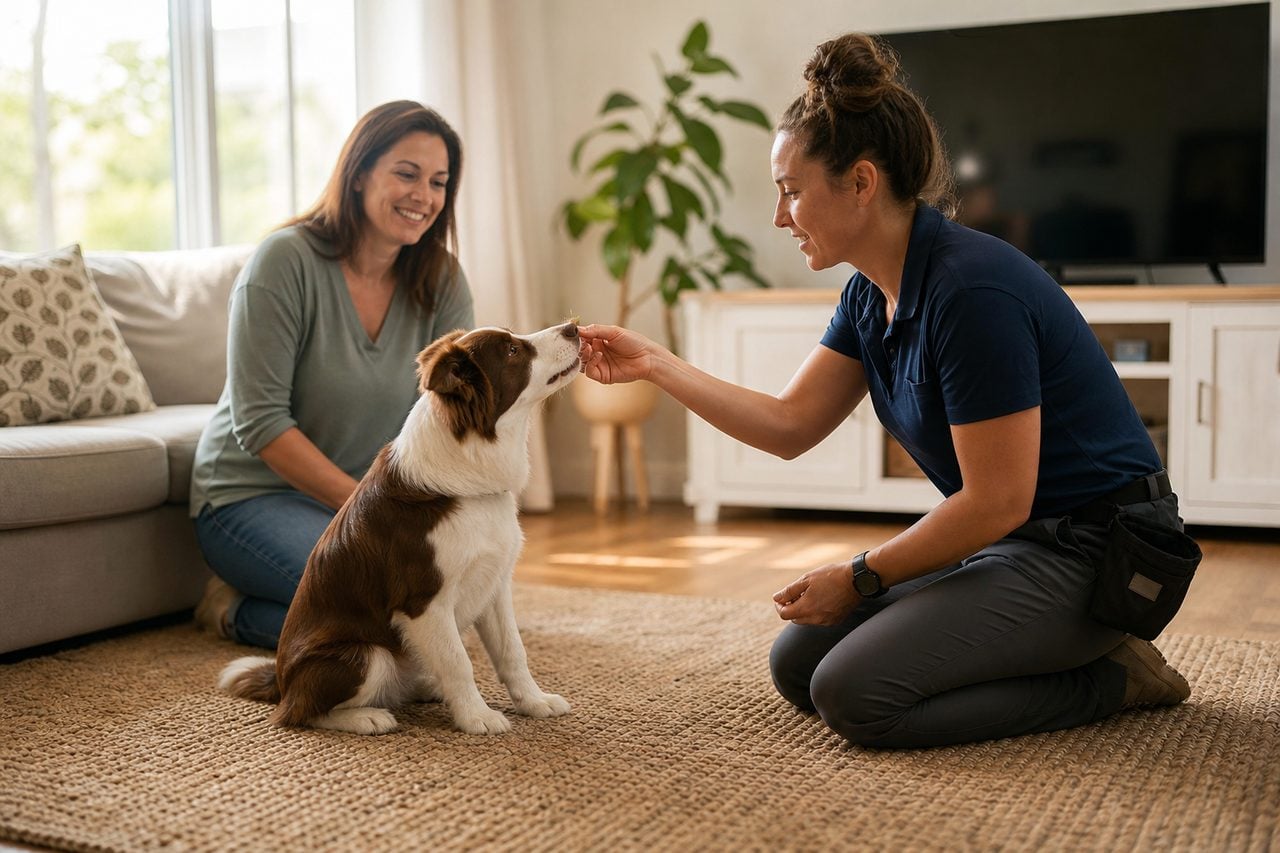
In-home dog training brings a professional trainer directly to your house anywhere across the Harrisburg region — whether that is a rowhome in the city, a split-level in Mechanicsburg, a farmhouse in Perry County, or a new build out toward Hershey. Instead of loading the dog into the car and driving to a class across the West Shore, the lesson comes to your living room, kitchen, yard, and front door — the exact places where the behaviors you care about actually happen. For many Susquehanna valley families, that convenience is the whole point, but the real advantage runs deeper than saving a drive.
Dogs are notoriously context-specific learners. A dog that sits politely in a training facility may completely fall apart when the doorbell rings at home, because the home environment is loaded with its own triggers, routines, and distractions. In-home training works on those problems in place, which is why it is especially well suited to issues like door-dashing, counter-surfing, leash reactivity on your own street, jumping on guests, and house-training. It is also a gentler option for dogs that are nervous in new environments or around unfamiliar dogs, since the dog never has to leave its safe space to learn, and it lets the whole household practice the same approach together.
Across Dauphin, Cumberland, and Perry counties, in-home training is offered by a range of independent trainers and small businesses, and the format suits the area’s mix of dense city neighborhoods and spread-out rural properties equally well. This guide explains how in-home sessions typically work, what they are best and worst at, how they compare to classes and board-and-train, and how to choose a trainer — without recommending any specific local business, since fit depends on your dog and your goals.
What an In-Home Session Looks Like
A typical in-home session begins with the trainer arriving at your house and spending the first part of the visit simply observing — watching how your dog greets a stranger at the door, how it moves through the house, and how it responds to the everyday triggers you have described. This assessment in the dog’s real environment is something a facility class can never replicate, because the behaviors you want to change are tied to that specific setting.
From there the trainer coaches you and the dog together, often working right at the trouble spots: the front door of your Camp Hill home for greeting manners, the kitchen counter for surfing, the sidewalk outside for leash work. Because so much of dog training is really owner training, a large part of the value is the trainer showing you the timing, body language, and consistency that make a technique work. Sessions usually end with specific homework to practice before the next visit, since the dog spends the other six days a week with you, not the trainer. The format is collaborative and hands-on rather than a performance you watch.
Problems In-Home Training Solves Best
In-home training shines on any behavior that is anchored to the home environment. Door-dashing and bolting when the door opens, jumping on visitors, barking at the mail carrier or at people passing on a Harrisburg side street, counter-surfing and trash-raiding, and house-training accidents all happen in specific locations that a trainer can address directly when they are standing in that location with you. Trying to fix a doorbell problem in a class across town is far less effective than working at your actual door.
House-training in particular benefits from the in-home format, because the trainer can see your dog’s schedule, your home’s layout, and the routine that is either helping or hurting. Puppy foundations — crate training, name recognition, early manners — also translate well because the puppy learns in the home it will grow up in. For families across the Cumberland Valley balancing work, kids, and a new dog, having the lesson come to the house removes a major logistical barrier and means the whole household can take part in the same consistent approach.
Where In-Home Training Has Limits
For all its strengths, in-home training is not the right tool for every goal, and an honest trainer will tell you so. The biggest limitation is socialization and proofing around distractions. A dog that behaves perfectly in the quiet of its own living room still needs practice staying calm and responsive out in the world — around other dogs, in busy places, on the trails at Wildwood Park, or in a parking lot. That kind of generalization is hard to build inside the house alone.
Reactive and fearful dogs often need controlled exposure to the very triggers they struggle with, in carefully managed settings outside the home, and group classes or structured outings can provide that in ways a living room cannot. For this reason many trainers blend formats — starting foundations in-home, then gradually moving practice into public spaces around Harrisburg as the dog is ready. In-home training is best understood as one strong component of a complete plan, excellent for home-based problems and early foundations, but usually paired with real-world practice for skills that need to hold up everywhere.
In-Home Versus Group Classes
Group classes and in-home training are not competitors so much as different tools for different jobs. A group class held at a facility on the West Shore offers something in-home cannot: a controlled dose of distraction and the presence of other dogs and people. For a dog that needs to learn focus around stimulation, or an owner who wants the structure and social motivation of a weekly class, that environment is genuinely valuable.
In-home training, by contrast, offers privacy, individual attention, and work on the exact problems happening in your house. It is the better choice for a dog too reactive or anxious to function in a group setting, for households juggling schedules that make a fixed class time impractical, or for problems — door manners, house-training, counter-surfing — that are inherently location-specific. The cost structures differ too: private in-home sessions are generally priced higher per hour than group classes because of the individualized attention and travel involved, though we list ranges only and never specific prices. Many Harrisburg owners ultimately use both, starting at home and graduating to classes.
In-Home Versus Board-and-Train
Another comparison families weigh is in-home training versus board-and-train, where the dog stays at a facility for an immersive program. The two represent opposite philosophies about where learning should happen. Board-and-train can produce fast, concentrated results for certain obedience goals and can be appealing for busy owners, but it carries a well-known challenge: transfer. Skills the dog learns with a professional handler at a facility do not automatically carry over to you and your home, so the handoff and your follow-through become critical.
In-home training takes the opposite approach by teaching the dog and the owner together, in the home, from the start — which means there is no transfer gap, because the learning was never separated from your daily life. The trade-off is pace: in-home progress depends on your consistency between sessions, so it can feel slower than an immersive program. For complex behavior issues, and especially for anything anxiety-related, the in-home, owner-involved model is generally the more durable choice. Which fits you depends on your goals, your dog, and how much hands-on involvement you want.
Choosing an In-Home Trainer in the Harrisburg Area
Because dog training is an unregulated field in Pennsylvania, the quality of in-home trainers varies widely, and choosing well matters. Look for someone who asks detailed questions about your dog before the first visit, performs a genuine assessment rather than applying a one-size-fits-all script, and can clearly explain their methods and why they use them. Reputable trainers are comfortable describing what they will do and are transparent about what they cannot promise.
Ask about their approach to training — modern, reward-based methods grounded in how dogs actually learn are the current professional standard — and about any certifications or continuing education, while understanding that certification is voluntary and not a substitute for skill. Confirm practical details too: travel area across Dauphin, Cumberland, and Perry counties, session length, and how homework and follow-up are handled. We deliberately do not endorse a particular Harrisburg trainer here, because the right fit depends on your specific dog, your goals, and your household. Trust your read of how the trainer interacts with your dog; a good one will make both of you feel understood, not lectured.
Training Across the Region’s Different Homes
One quiet advantage of in-home training across the Harrisburg region is how well it adapts to the area’s very different living situations. A trainer working a midtown Harrisburg rowhome with a small yard and a busy sidewalk out front faces a completely different set of conditions than one working a property on several acres up in Perry County or a townhouse community in Mechanicsburg, and the in-home format lets the plan fit the actual space.
For city dogs, that might mean focusing on door manners, leash work on narrow sidewalks, and managing reactions to close-quarters foot traffic. For suburban West Shore and Hershey-corridor homes, fenced yards and quiet streets open up off-leash foundations and recall practice. Rural northern properties bring their own considerations — livestock, wildlife, long driveways, and the temptation of wide-open space — that a trainer can address on the ground where they occur. The region’s snowy winters also factor in, since icy footing and short daylight shape what is realistic for a season, and an in-home trainer can adjust the plan to keep progress moving indoors when the weather turns. Meeting the dog where it lives is the format’s defining strength.
Reviewed In-Home Dog Training Trainers in Harrisburg
These reviewed Harrisburg-area trainers from our directory handle in-home dog training. Each links to a full profile with specialties, certified credentials, reviews, and contact info:
- Riverfront Dog Training — 5.0★ (56 reviews)
- Cold Creek Dog Training- Hummelstown – Harrisburg — 5.0★ (34 reviews)
- Arcona Prep — 5.0★ (32 reviews)
- Doggie U LLC — 5.0★ (27 reviews)
- Bark Boot Camp — 5.0★ (22 reviews)
- Sonador K9 Services — 5.0★ (13 reviews)
- Tried and True Canines — 5.0★ (12 reviews)
- Bark 2 Beak Animal Training — 5.0★ (7 reviews)
- The Structured K9 — 5.0★ (1 reviews)
- Preston’s K9 Academy — 5.0★ (1 reviews)
See all Harrisburg in-home dog training trainers →
Frequently Asked Questions
What is in-home dog training?
In-home dog training is private instruction where a professional trainer comes to your house rather than you driving to a facility. Sessions take place in the rooms, yard, and doorway where your dog’s behaviors actually happen, anywhere across the Harrisburg region. The trainer assesses the dog in its real environment, coaches you and the dog together, and leaves homework to practice between visits. It is especially effective for home-based problems and early foundations.
What problems is in-home training best for?
It is best for behaviors anchored to the home: door-dashing, jumping on guests, barking at the mail carrier, counter-surfing, and house-training, plus puppy foundations like crate training and basic manners. These are location-specific problems, so working at your actual door or kitchen is far more effective than addressing them in a class across town. It is also a gentler option for dogs that are nervous in new environments.
What are the limits of in-home training?
The main limit is socialization and proofing around distractions. A dog that behaves perfectly at home still needs practice staying calm in busy places, around other dogs, and on trails like those at Wildwood Park. Reactive and fearful dogs often need controlled exposure to triggers in managed settings outside the home. Many trainers blend formats, starting foundations in-home and moving practice into public spaces as the dog is ready.
How does in-home training compare to group classes?
They serve different jobs. Group classes offer controlled distraction and the presence of other dogs, which helps a dog learn focus around stimulation. In-home training offers privacy, individual attention, and work on the exact problems in your house, and suits dogs too reactive for a group setting. Private sessions generally cost more per hour than classes due to individualized attention and travel. Many Harrisburg owners use both.
Is in-home training better than board-and-train?
It depends on your goals. Board-and-train can deliver fast results for some obedience goals but carries a transfer challenge — skills learned with a handler at a facility don’t automatically carry over to you and your home. In-home training teaches the dog and owner together from the start, so there is no transfer gap, though progress depends on your consistency between sessions. For complex or anxiety-related issues, the in-home, owner-involved model is generally more durable.
How do I choose a good in-home trainer near Harrisburg?
Dog training is unregulated in Pennsylvania, so quality varies. Look for a trainer who asks detailed questions before the first visit, does a genuine assessment, and clearly explains their methods. Modern, reward-based methods are the professional standard. Ask about certifications and continuing education while knowing certification is voluntary, and confirm practical details like travel area across Dauphin, Cumberland, and Perry counties. The right fit depends on your specific dog and household.
Related: read our complete in-home dog training guide or the full Harrisburg dog training overview.
Ready to find the right in-home dog training pro in Harrisburg?