
In-Home Dog Training in Altoona, PA
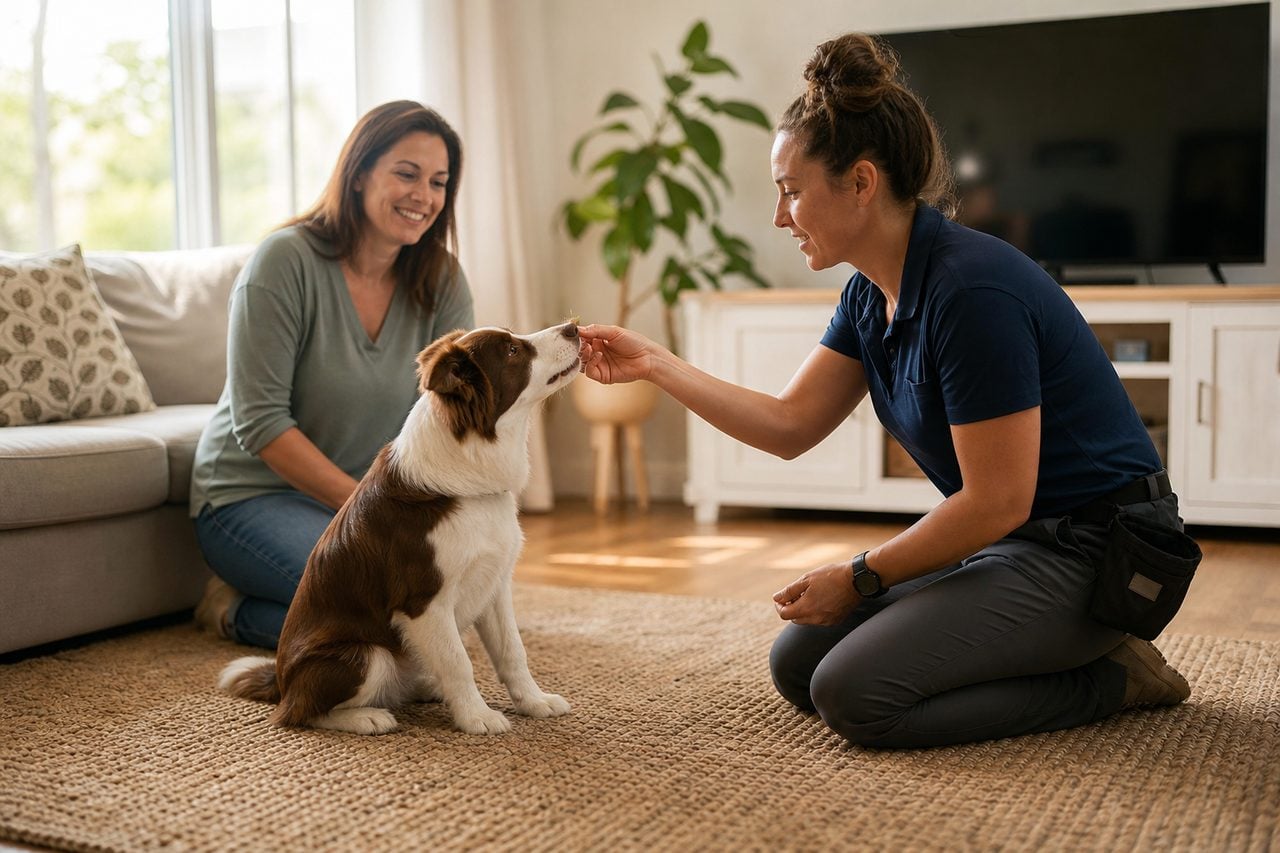
In-home dog training brings the lesson to the dog rather than the dog to the lesson. Instead of loading up and driving to a class or facility, a trainer comes to your house — whether that is a rowhome in Altoona, a place out toward Hollidaysburg, or a property in Morrisons Cove — and works with your dog in the exact environment where the problems actually happen. For many Blair County families, that is the whole appeal: the barking at the mail carrier, the door-dashing, the counter-surfing, and the leash chaos on your own street are things a dog does at home, and home is where they are most efficiently retrained. A dog that behaves perfectly in a quiet training room can still fall apart the moment it is back in the setting where the habit formed, which is exactly why working on location tends to transfer so much more cleanly to real life.
This format suits certain situations especially well. Puppies not yet fully vaccinated, dogs that are reactive or overwhelmed in a room full of other dogs, owners juggling work and family who cannot commit to a fixed weekly class slot, and households where the whole family needs to be on the same page all tend to do better with one-on-one coaching in their own space. It also works well across a spread-out county where the nearest group class might be a real drive — the trainer absorbs the travel instead of you. The trade-off is that private, in-home work is generally priced per session and does not offer the same built-in dog-to-dog socialization a group class provides, so it often works best as part of a plan rather than the whole plan.
GetDogSchool.com is a directory and information resource, not a training provider. This guide explains how in-home training works, when it is the right fit, and how to think about the local-first option across Blair County versus the wider selection of trainers within about ninety minutes in Harrisburg or Pittsburgh. Use it to decide what you need before you start contacting trainers, so your first calls are focused and you can compare options on the things that actually matter for your dog and your address.
What In-Home Training Looks Like
In-home training is one-on-one work in your dog’s own environment. A typical arrangement starts with the trainer visiting to see the dog where the behavior happens — how it greets people at your door, how it moves through your rooms, where it sleeps and eats, and what triggers it in your specific home. From there the trainer builds a plan around your actual goals, whether that is basic manners, house-training, polite greetings, leash skills on your street, or targeted work on a nuisance behavior.
Crucially, in-home sessions coach the humans as much as the dog. Because the training happens where you live, the trainer can show you how to manage the real doorway, the real kitchen counter, the real staircase — and then you practice between visits. Sessions are usually spaced out, often weekly or every couple of weeks, with homework in between, so progress depends heavily on the family keeping up the daily reps. This is different from a drop-off model: the point is to transfer skills to you, in your context, so the results stick long after the trainer stops coming. A good in-home trainer will also read your household setup for management fixes you might not have considered — a baby gate that ends the door-dashing, a change to where the food bowl sits, a spot the dog can settle away from the front window — small environmental tweaks that make the training itself easier to succeed at.
When In-Home Beats A Group Class
Group classes are excellent for many dogs, but several situations clearly favor in-home work. A young puppy that has not finished its vaccination series should not be mingling with unknown dogs yet, so early manners and house-training are safer to start at home. A dog that is fearful, reactive, or over-aroused around other dogs often cannot learn in a crowded class — it is too far over threshold to think — and needs the calmer, controlled setting of its own home first.
In-home also wins on logistics and specificity. If your problem is precisely a home problem — guarding the couch, bolting out the front door, barking at everyone who passes the window, ignoring you in the backyard — then training in a neutral facility misses the point; those behaviors need to be worked where they occur. Busy Altoona-area households that cannot commit to the same class night every week also benefit from the flexible scheduling of private sessions. And for families where several people handle the dog, having the trainer coach everyone together at home gets the whole household consistent, which is often the real fix. Dogs learn fastest when every person uses the same cue words, the same rules, and the same rewards, and mixed signals from different family members are one of the most common reasons training stalls. Getting everyone in the same room, watching the same demonstration, quietly solves that.
The Blair County Travel Radius
One practical advantage of in-home training in a place like Blair County is that the trainer, not you, covers the distance. That matters here because the population is spread across Altoona and Logan Township, Hollidaysburg, Duncansville, Tyrone, Bellwood, Roaring Spring, and the Morrisons Cove towns of Martinsburg and beyond — and a single central class location can be inconvenient for a lot of those addresses. A trainer who offers a wide service radius can reach most of these communities.
When you contact trainers, ask directly about their travel radius and whether they charge a trip fee for outlying addresses. A trainer based in Altoona may cover Logan Valley readily but treat a run out to the southern reaches of the Cove or up the ridges as an add-on. Winter is a real factor too: the Allegheny Front gets snow, and mountain and rural roads can complicate scheduling, so build in flexibility for weather. Confirming coverage and any distance surcharge up front avoids surprises — and if you are on the edge of a trainer’s radius, it is worth asking whether a slightly closer or slightly farther option changes the price much. It is also fair to ask how a trainer handles a snowed-out session — whether they reschedule freely or offer a remote check-in for that week — since a Blair County winter almost guarantees a few weather cancellations over a multi-session package. Knowing that policy in advance keeps momentum from stalling when the roads turn.
Local-First, Then Widen The Search
Our recommended approach for Altoona-area owners is local-first: start by looking for a qualified in-home trainer within Blair County, because a nearby trainer means lower or no travel fees, easier scheduling, and someone who knows the area. For mainstream goals — puppy manners, house-training, leash work, basic obedience, common nuisance behaviors — a good local in-home trainer is usually all you need, and keeping it local keeps it affordable and convenient.
Widen the search when local options are thin or when your need is more specialized. Blair County is a smaller market, so the roster of trainers — and especially those with specific behavior credentials — is naturally limited. If you cannot find a local fit, or if you are dealing with something like serious reactivity or aggression that calls for a more experienced or credentialed professional, the larger markets of Harrisburg and Pittsburgh sit about ninety minutes away and offer far more selection. Some of those trainers travel a wide radius themselves; others may combine an in-person assessment with remote follow-up. The point is to exhaust the convenient local options first, then expand the map only as far as the difficulty of your case actually requires. There is no prize for driving farther than your problem warrants, and for the everyday goals most owners have, the convenient local trainer and the distant specialist would teach much the same skills anyway.
Vetting An In-Home Trainer
Because dog training is unregulated, the burden is on you to vet whoever you invite into your home. Start with methods. Ask what happens when the dog gets it right and what happens when it gets it wrong — you want a trainer who leans on reward-based, positive-reinforcement methods and can explain their approach clearly rather than leaning on intimidation or heavy corrective tools. Ask about credentials and continuing education; certifications from recognized bodies are a reasonable signal, though experience with your specific issue matters just as much.
Then get concrete. Ask how many sessions a goal like yours typically takes, what the homework looks like, and what happens if progress stalls. Request references or reviews from local clients, ideally with similar dogs or problems. Clarify pricing plainly: per-session versus package, what a package includes, travel or trip fees for your address, and cancellation terms. A trustworthy in-home trainer will welcome these questions and answer them without pressure. Trust your read of the first visit, too — you are watching how the trainer handles your dog and your family in your own space, and if anything feels harsh, evasive, or rushed, it is reasonable to keep looking. Your dog’s comfort with the trainer is a signal worth reading, too — a dog that loosens up and engages is usually a better sign than one that shuts down. You are hiring someone to spend time in your home with your animal and your family, so a fit that feels right on both the professional and personal level is worth holding out for.
Getting The Most From Each Visit
In-home training only works if the family does the work between visits, so a little preparation multiplies the value of each session. Before the trainer arrives, write down your top two or three goals and any specific incidents — when the barking starts, exactly how the door-dashing unfolds — so you are not improvising. Have the whole household present when you can, since consistency across everyone who handles the dog is often what makes or breaks a plan. Keep treats, the leash, and anything the trainer asked for ready to go.
During the session, treat it as your lesson as much as the dog’s. Ask the trainer to watch you run each exercise and correct your timing and mechanics, because you are the one who will practice it all week. Take notes or a short video of each new drill so you remember the details later. Between visits, do short, frequent reps rather than one long push, and log what is working and what is not. In an Altoona winter, plan indoor practice for the stretches when yards and sidewalks are snowed in. The households that get the best results are simply the ones that treat the trainer as a coach and put in the daily repetitions themselves. It also helps to end each visit by agreeing on exactly what to practice before the next one, so nobody is left guessing about the week’s homework. A clear, small assignment you can actually complete beats an ambitious plan that quietly gets abandoned by Wednesday.
What In-Home Training Cannot Replace
In-home training is powerful, but it is honest to name its limits. The clearest gap is socialization with other dogs. A private session in your living room does not give a puppy the supervised, positive exposure to unfamiliar dogs that a good group puppy class provides — and that exposure, during a young dog’s key developmental window, genuinely matters. Many owners get the best of both by doing early manners and house-training in-home while adding a well-run group class specifically for the social piece once the puppy is old enough and vaccinated.
In-home work also is not the right primary tool for a couple of specific problems. True separation anxiety needs its own structured, home-based desensitization protocol and usually a veterinary partner, not general obedience visits. And serious aggression or safety cases may call for a specialist beyond a general in-home trainer — potentially the deeper bench in Harrisburg or Pittsburgh. Finally, no trainer, in-home or otherwise, can substitute for the daily practice the family provides; the trainer builds the plan and coaches the mechanics, but the repetitions that actually change the dog happen in the days between visits. Knowing these boundaries helps you combine services sensibly rather than expecting one format to do everything.
In-Home Dog Training in Altoona: Local Options & Nearest Specialists
A few Altoona-area trainers can help with milder in-home dog training needs:
- Among the Wild — 5.0★ (17 reviews)
Nearest in-home dog training specialists — Harrisburg
For complex cases, the closest metro with dedicated in-home dog training trainers is Harrisburg (an easy drive for an assessment or a board-and-train stay). Top-reviewed options:
- Riverfront Dog Training — 5.0★ (56 reviews)
- Cold Creek Dog Training- Hummelstown – Harrisburg — 5.0★ (34 reviews)
- Arcona Prep — 5.0★ (32 reviews)
- Doggie U LLC — 5.0★ (27 reviews)
- Bark Boot Camp — 5.0★ (22 reviews)
- Sonador K9 Services — 5.0★ (13 reviews)
- Tried and True Canines — 5.0★ (12 reviews)
- Magnus K9 — 5.0★ (11 reviews)
See all Harrisburg in-home dog training trainers →
Frequently Asked Questions
What is in-home dog training and how is it different from a class?
In-home training is one-on-one work done at your house, where a trainer comes to you and works with your dog in the exact environment where its behaviors happen. A group class meets at a facility on a set schedule with multiple dogs. In-home is more customized and coaches your whole household in your real space — the actual doorway, kitchen, and street — while a class adds dog-to-dog socialization that private sessions cannot easily replicate.
When is in-home training a better choice than a group class?
Choose in-home when the problem is specific to your house (door-dashing, counter-surfing, window-barking, backyard recall), when your dog is too reactive or fearful to learn around other dogs, when you have a puppy not yet finished with vaccinations, or when a fixed weekly class night does not fit your schedule. It is also ideal when several family members handle the dog and everyone needs the same consistent approach coached at once.
Will a trainer travel to my part of Blair County?
Many in-home trainers cover a wide radius, which is a real advantage across a spread-out county that includes Altoona, Hollidaysburg, Duncansville, Tyrone, Bellwood, Roaring Spring, and the Morrisons Cove towns. Ask each trainer directly about their service area and whether outlying addresses carry a trip fee. Also factor in Allegheny-region winter weather, since snow on mountain and rural roads can affect scheduling.
Should I hire locally or look toward Harrisburg or Pittsburgh?
Start local-first. For mainstream goals like puppy manners, house-training, leash skills, and common nuisance behaviors, a qualified Blair County in-home trainer keeps things affordable and convenient. Widen the search to Harrisburg or Pittsburgh (about ninety minutes each) when local options are limited or your case is specialized — for example serious reactivity or aggression — where the larger markets offer more trainers and more specific credentials.
How do I vet an in-home trainer before letting them into my home?
Ask about methods first — favor reward-based, positive-reinforcement approaches and a trainer who can explain what they do when the dog is right and wrong without relying on intimidation. Ask about credentials, experience with your specific issue, typical number of sessions, homework, references from local clients, and clear pricing including any travel fees and cancellation terms. Dog training is unregulated, so trust your read of the first visit and keep looking if anything feels harsh or evasive.
Does in-home training cover socialization?
Not fully. A private session at your house does not provide the supervised exposure to other dogs that a good group puppy class does, and that social exposure matters during a young dog’s development. A common, effective combination is doing early manners and house-training in-home while adding a well-run group class for the socialization piece once the puppy is old enough and vaccinated.
Related: read our complete in-home dog training guide or the full Altoona dog training overview.
Ready to find the right in-home dog training pro in Altoona?