
In-Home Dog Training in Chambersburg, PA
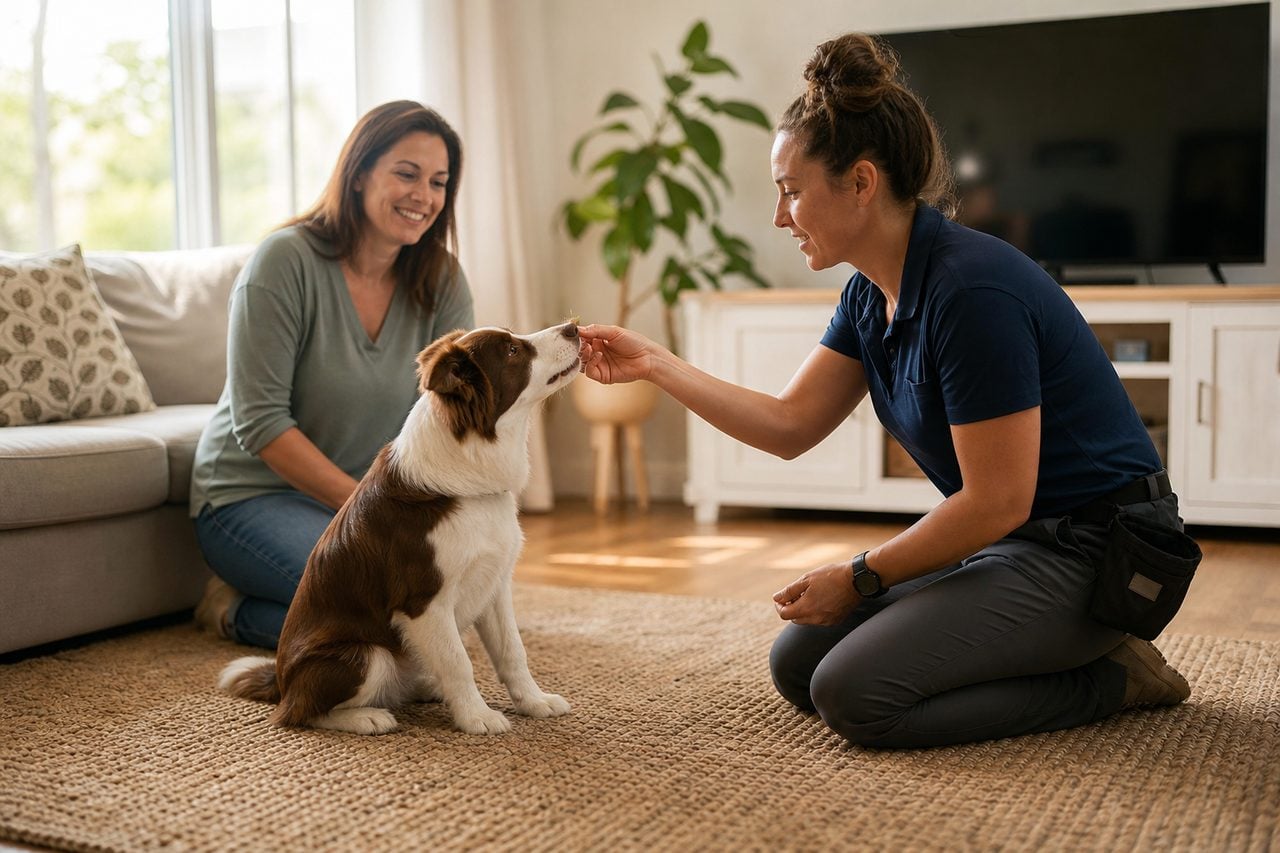
In-home dog training is exactly what it sounds like: a professional trainer comes to your house rather than you loading the dog into the car and heading to a class. For a lot of Chambersburg and Franklin County families, that difference is the whole point. The problems you most want solved — door-dashing when the mail arrives on Lincoln Way, jumping on guests, pulling on leash down your own street, chaos at dinnertime, a dog that ignores you in the backyard — happen at home, in the exact environment where you need the new behavior to stick.
Dogs are notoriously context-specific learners. A dog can be a model student in a training facility and then act like it has never heard the word “sit” the moment it walks back through its own front door. Training on location closes that gap. The trainer sees your real setup — the layout, the trigger windows, who feeds the dog, how the household actually runs — and builds a plan around it. That tailoring is why in-home work tends to be so effective for practical, day-to-day manners.
This guide covers what in-home training in the Chambersburg area typically looks like, the practical manners and household problems it solves best, the limits it runs into, how the wide travel radius across Franklin County shapes scheduling and price, how it stacks up against group classes on cost and pace, how to vet a trainer in an unregulated field, and when it makes sense to look toward the larger Harrisburg or York markets for more specialized options. The county spreads from the borough out to Waynesboro, Greencastle, Shippensburg, Mercersburg, Mont Alto, and the ridge communities, so who is willing to reach your corner of it matters as much as method. GetDogSchool’s editorial team keeps this neutral and grounded — a straightforward look at whether in-home training fits your household, not a pitch for any one format over another.
What In-Home Training Actually Is
In-home training is private, one-on-one instruction delivered where your dog lives. A trainer visits, works directly with you and your dog in your own space, and coaches the whole household on how to carry the training forward between sessions. The format is inherently customized: there is no fixed group curriculum to keep pace with, so the trainer addresses your specific dog and your specific goals.
Because so much of dog behavior is context-bound, teaching a skill in the very place it needs to be performed gives it the best chance of sticking. A recall practiced in your fenced yard off a quiet Guilford Township street, a polite greeting rehearsed at your actual front door, a settled down-stay learned by your real kitchen table — these transfer to daily life far more reliably than the same skills learned in a neutral hall and then imported home.
Just as important, the trainer becomes a coach for the people, not only the dog. In most households the real variable is human consistency: everyone giving the same cue, rewarding the same way, holding the same rules. An in-home trainer can watch how your family interacts with the dog in the moment and correct the small handling habits — timing, body language, accidental reinforcement — that a group class never gets close enough to see.
What It Solves Well
In-home training shines on the everyday manners and household-specific problems that make living with a dog easier. Think basic obedience — sit, down, stay, come, leash manners — plus the practical stuff: not bolting out the front door, greeting guests without jumping, calm behavior at mealtimes, settling on a mat, and general house manners. These are exactly the behaviors that are hardest to fix anywhere but at home, because the triggers live at home.
It is also well suited to certain mild behavior issues where the home environment is the whole story. A dog that guards a specific doorway, gets overstimulated at the living-room window watching the street, or has developed a bad routine around a particular time of day benefits from a trainer who can see the actual scene and adjust the setup, not just describe a generic technique.
Puppies are another strong fit. Early manners, house-training routines, crate comfort, gentle handling, and preventing bad habits before they form all work beautifully in the puppy’s own home — and for very young puppies not yet fully vaccinated, in-home sessions avoid the exposure concerns of a group setting. For Chambersburg families with busy schedules, the convenience of not driving anywhere, on top of the effectiveness, is often the deciding factor.
What It Is Not Ideal For
In-home training has real limits, and an honest trainer will name them. The biggest is socialization variety. A dog that needs practice being calm around other dogs, unfamiliar people, and busy environments cannot get that in an empty living room. Group classes and outings into settings like a park or a pet-friendly store in Chambersburg or up in Harrisburg exist precisely to provide controlled exposure to distractions that no home visit can replicate.
Serious behavior problems — genuine aggression, severe fear or reactivity, and separation anxiety — often need more than general in-home obedience work. Some of these can be started at home by a qualified professional, but the more severe cases call for a certified behavior specialist or even a veterinary behaviorist, and Franklin County’s smaller market means the deepest expertise usually lives toward Harrisburg or York. A good local trainer will tell you when your situation is beyond routine manners and refer you onward.
Cost is the other trade-off. Private, in-your-home sessions carry a higher per-hour price than group classes because you are paying for one-on-one time and the trainer’s travel. For many households the efficiency and customization justify it; for a straightforward, social, well-adjusted dog that mainly needs the polish and exposure of a class, a group program may deliver more value per dollar. Matching the format to the need is the whole game.
How The Franklin County Travel Radius Works
Franklin County is geographically spread out, and in-home trainers here plan for that. A trainer based near Chambersburg may routinely cover Guilford Township, Waynesboro, Greencastle, Shippensburg, Mercersburg, Mont Alto, and the smaller communities tucked along the South Mountain and Michaux ridges. That wide radius is a feature of a rural-suburban region — but it also shapes availability, scheduling, and price.
Expect travel to factor into how a trainer operates. Some include a set service area in their base rate and add a travel fee beyond it; others cluster appointments by area on given days to keep drive time reasonable. If you are out toward Mercersburg or up a ridge road, ask up front whether you fall inside the standard radius and what any travel surcharge looks like. It is a normal part of the arrangement and better clarified before booking than after.
The upside of the wide radius is genuine access. Families in the western townships or the north valley around Shippensburg who might never make a weekly drive to a fixed class location can still get professional help at their own kitchen table. When comparing trainers, weigh both who is willing to reach your specific corner of the county and whether their travel model keeps the total cost sensible for your situation.
In-Home Versus Group Classes
Neither format is universally better — they solve different problems, and plenty of Chambersburg dogs benefit from both over time. In-home training wins on customization, convenience, and fixing household-specific behaviors in the environment where they occur. Group classes win on socialization, controlled exposure to distractions, structured curriculum, and lower cost per session. The right choice depends on your dog and your goals.
A useful way to decide: if your main issues are practical manners tied to your home and routine — door manners, greetings, leash pulling on your street, settling during dinner — in-home is the stronger fit. If your dog is fundamentally sound but needs to learn to focus around other dogs and people, a group class provides the distractions and social reps a home cannot. If both are true, a common path is to start in-home to build a foundation and human consistency, then graduate into a class to proof the skills under real-world distraction.
Budget realistically. In-home commands a premium for one-on-one time and travel across Franklin County, while classes spread the trainer’s time across several dogs and cost less. Rather than asking which is cheaper, ask which format actually solves your dog’s specific problem — paying more for the wrong tool is the false economy, and paying for a class when you needed a home visit is just as much a miss.
How To Choose An In-Home Trainer
Because dog training is unregulated, vetting matters. Start with method: look for a trainer who works primarily with reward-based, force-free techniques and can explain how they handle unwanted behavior without intimidation or pain. Ask about certifications and continuing education — credentials from recognized professional bodies signal ongoing learning — and ask for references or reviews from past Franklin County clients.
Get specific about your situation before you book. Describe your dog and your goals, and listen for whether the trainer tailors the conversation or reaches for a one-size pitch. Confirm the logistics that matter locally: do they cover your part of the county, what does travel cost, how long are sessions, how many are typically needed, and what does homework between visits look like. In-home training only works if the household does the reps, so a trainer who emphasizes coaching you is a good sign.
Finally, watch for honesty about scope. The best trainers are clear about what in-home obedience work can and cannot fix, and they will tell you plainly if your dog’s issue — serious aggression, deep fear, separation anxiety — needs a behavior specialist rather than a manners program. A willingness to refer you toward the greater expertise available in Harrisburg or York, instead of taking a case beyond their depth, is one of the strongest trust signals you can find.
When To Look Toward Harrisburg Or York
Chambersburg has capable trainers, but Franklin County is a modest market, and there are situations where the larger nearby metros simply offer more. If your dog needs a certified behavior consultant, a veterinary behaviorist, a specialized reactive-dog class, a very particular sport or discipline, or you just want a wider selection to find the right personality fit, it is worth looking up the valley.
Harrisburg is roughly fifty minutes north on I-81 and York about an hour east, and both carry a deeper roster of specialists and program types than a smaller county can support. For routine in-home obedience and puppy manners, staying local is convenient and effective — there is rarely a reason to drive an hour for a sit-stay. For specialized behavior work or niche training goals, the drive can be well worth it, and some specialists will even travel to you for the right case.
The sensible approach is local-first with an eye up the valley. Handle everyday training at home in Franklin County, and reach toward Harrisburg or York when the need genuinely outstrips what the local market offers. A trustworthy local trainer will help you draw that line honestly rather than stretching a case beyond their expertise — and that honesty is exactly what you want when deciding where your particular dog gets the best help.
In-Home Dog Training in Chambersburg: Local Options & Nearest Specialists
Right now there are no listed Chambersburg trainers focused specifically on in-home dog training. Many general Chambersburg dog trainers handle milder cases, and for anything serious the nearest specialists are below.
Nearest in-home dog training specialists — Harrisburg
For complex cases, the closest metro with dedicated in-home dog training trainers is Harrisburg (an easy drive for an assessment or a board-and-train stay). Top-reviewed options:
- Riverfront Dog Training — 5.0★ (56 reviews)
- Cold Creek Dog Training- Hummelstown – Harrisburg — 5.0★ (34 reviews)
- Arcona Prep — 5.0★ (32 reviews)
- Doggie U LLC — 5.0★ (27 reviews)
- Bark Boot Camp — 5.0★ (22 reviews)
- Sonador K9 Services — 5.0★ (13 reviews)
- Tried and True Canines — 5.0★ (12 reviews)
- Magnus K9 — 5.0★ (11 reviews)
See all Harrisburg in-home dog training trainers →
Frequently Asked Questions
What kinds of problems does in-home training solve best?
It is strongest on everyday manners and household-specific behaviors: basic obedience, leash manners on your own street, not bolting out the front door, polite greetings, calm mealtimes, settling on a mat, and puppy foundations like house-training and crate comfort. These stick best when taught in the exact Chambersburg home where you need them performed.
What is in-home training not good for?
It cannot provide socialization variety — practice around other dogs, strangers, and busy places — which requires group classes or controlled outings. Serious issues like genuine aggression, severe fear or reactivity, and separation anxiety often need a certified behavior specialist or veterinary behaviorist, expertise that in Franklin County usually means looking toward Harrisburg or York.
How does travel across Franklin County affect cost and scheduling?
Trainers here plan for a wide radius covering Chambersburg, Waynesboro, Greencastle, Shippensburg, Mercersburg, Mont Alto, and the ridge communities. Many include a set service area in their rate and add a travel fee beyond it, or cluster appointments by area on given days. If you are toward Mercersburg or up a ridge road, ask about the radius and any surcharge before booking.
Is in-home training more expensive than group classes?
Usually yes. Private one-on-one sessions plus travel across the county carry a higher per-hour price than group classes, which spread the trainer’s time across several dogs. The better question is which format actually solves your dog’s problem — in-home for household-specific manners, classes for socialization and distraction proofing — since paying for the wrong tool is the real waste.
How do I choose a good in-home trainer in the Chambersburg area?
Look for reward-based, force-free methods, recognized certifications, and references from local clients. Describe your dog and goals up front and see whether the trainer tailors the plan. Confirm they cover your part of the county, what travel costs, session length, and homework expectations. Honesty about scope — and willingness to refer serious cases onward — is a strong trust signal.
When should I look toward Harrisburg or York instead of staying local?
Stay local for routine obedience and puppy manners. Reach toward Harrisburg (about fifty minutes) or York (about an hour) when you need a certified behavior consultant, a veterinary behaviorist, a specialized reactive-dog class, a niche sport, or simply a wider selection to find the right fit. The approach is local-first with an eye up the valley for specialized needs.
Related: read our complete in-home dog training guide or the full Chambersburg dog training overview.
Ready to find the right in-home dog training pro in Chambersburg?