
In-Home Dog Training in Cincinnati, OH
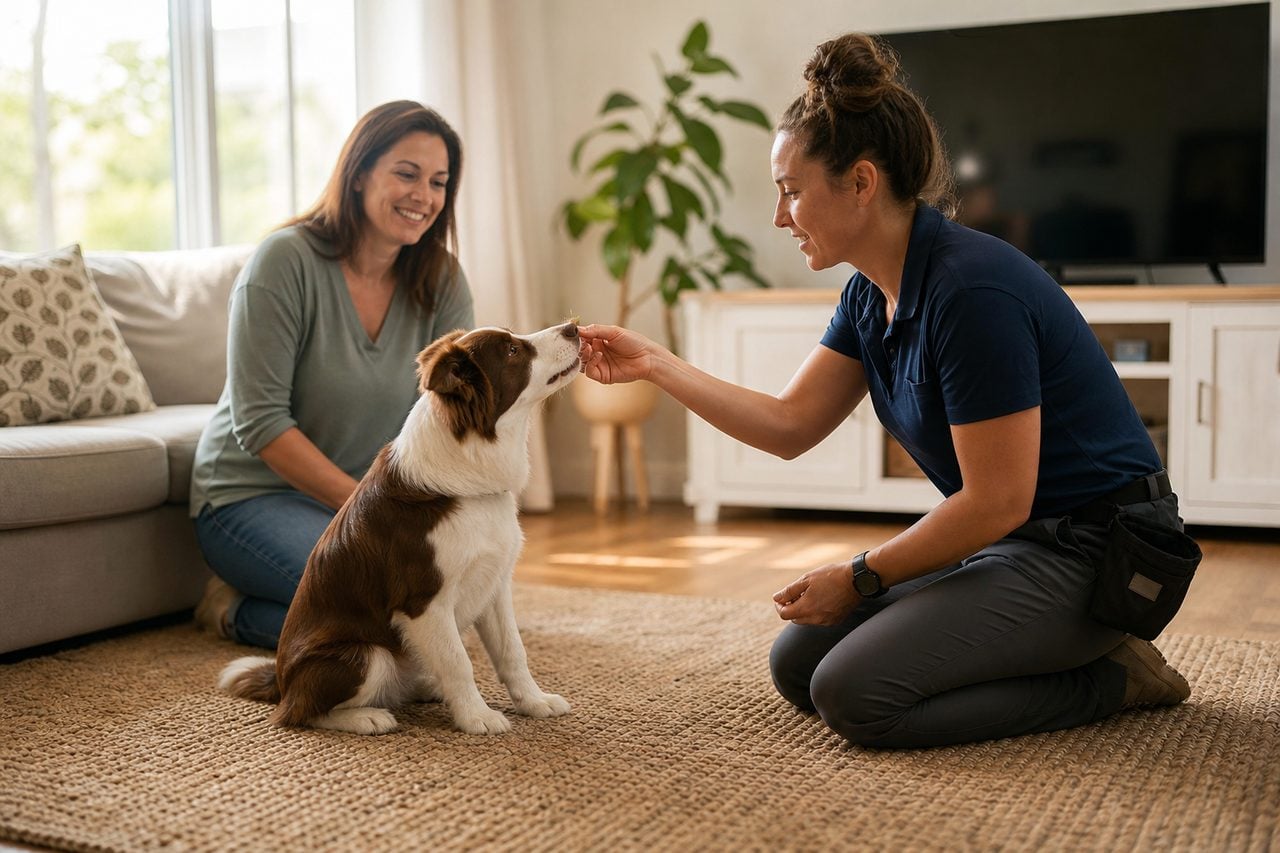
There’s a reason in-home training has quietly become one of the most requested services in Cincinnati: most of the problems owners actually want fixed don’t happen at a training facility. The dog that bolts the front door of a Hyde Park colonial when guests arrive, the one that loses its mind at the doorbell in an Oakley duplex, the counter-surfer that strips the kitchen island in a Montgomery home the second you turn your back — none of that shows up in a sterile group class across town. It shows up at home, in context, with all the real-world triggers a building full of strangers’ dogs can’t replicate.
In-home training brings the trainer to where the behavior lives. For Cincinnati’s geography that’s a genuine practical advantage. The metro sprawls from the river up through Norwood and Pleasant Ridge, out east to Anderson Township and Milford, north to West Chester, Mason and Liberty Township, and west into Delhi, Cheviot and Western Hills — a lot of ground, a lot of traffic on I-71 and I-75, and a lot of owners for whom hauling a reactive or anxious dog to a facility across the county each week is its own ordeal. A trainer who pulls into your driveway in Blue Ash erases the commute, the parking-lot chaos, and the “my dog behaves totally differently here” problem in one move.
Cincinnati has a deep bench for this. West Chester Dog Training (200+ reviews), the highly reviewed Dog Obedience Guy, BFF Canine Obedience, Underdog K-9 Academy, Dog Training Elite Greater Cincinnati in Liberty Township and Sit Means Sit Cincinnati all do in-home work, alongside specialists like Training Tracks Canine Learning Station in West Chester. This guide covers when in-home is the right call, what a session actually looks like, how Cincinnati pricing works, and the mistakes that waste an otherwise great investment.
When In-Home Training Is the Right Choice
In-home isn’t automatically better than a group class — it’s better for specific situations. Knowing which bucket you fall into saves money and gets results faster.
In-home shines when
- The problem is location-specific. Door-dashing, doorbell reactivity, counter-surfing, resource guarding a particular spot on the couch, or housetraining lapses all happen in your home and are best fixed there.
- Your dog is reactive or anxious around other dogs. Dragging a reactive dog into a room full of strangers’ dogs in Sharonville sets it up to fail. In-home lets you build foundations before any group exposure.
- You want the whole household on the same page. Everyone in the house — kids in Anderson, a partner in Madeira — gets coached on the same cues and rules at once, which is where most training falls apart otherwise.
- Logistics are a barrier. No reliable transport, a tough schedule, a new puppy not yet fully vaccinated, or simply not wanting to fight cross-town traffic to Mason every week.
A group class might serve you better when
- You specifically want controlled socialization and distraction-proofing around other dogs
- Budget is tight and the issues are basic manners
- Your dog is already confident and you want polish, not foundation work
Many Cincinnati owners do both in sequence: in-home first to build the foundation and fix the household-specific problems, then a group setting later to proof the behaviors against real-world distraction.
What a Cincinnati In-Home Session Actually Looks Like
The biggest difference between in-home and facility training is that the trainer is also reading your environment — your layout, your routines, and the dozens of small habits that quietly reinforce the behavior you want gone.
The typical arc
- Assessment in context. A good trainer spends the first visit watching the dog in its own space — how it greets at the door, where it sleeps, what sets it off. The chewed baseboard in your Pleasant Ridge hallway tells a story a questionnaire never would.
- Environmental coaching. Often the fastest wins come from changing the setup: where the food bowl sits, how guests enter, whether the dog has a clear settle spot. This is the part you simply can’t get at a facility.
- Hands-on with the real triggers. Instead of a simulated distraction, the trainer works the actual doorbell, the actual mail carrier route, the actual kids coming home from school.
- Household training. Everyone who lives with the dog learns to deliver cues consistently, so the dog isn’t getting mixed signals between the West Chester commuter who leaves at 6 a.m. and the teenager who’s home all afternoon.
- Homework between visits. In-home leans heavily on what you practice in the gaps. The trainer builds the plan; you run the reps.
Format options in Cincinnati
Most local trainers offer in-home as a package of visits (commonly four to eight), sometimes blended with phone or video check-ins between sessions. Some pair in-home foundation work with a later board-and-train or group component for proofing. Ask up front how progress is handed off to you so you’re not dependent on the trainer indefinitely.
What Makes a Good In-Home Trainer
Because the trainer is in your house and coaching your family, fit matters more here than in almost any other format. A facility trainer can be brilliant with dogs and still be a poor in-home coach if they can’t translate the plan to busy humans.
Green flags
- They coach the people, not just the dog. The whole point of in-home is changing household habits — a trainer who only handles the dog themselves leaves you no better off when they drive away.
- They observe before prescribing. A trainer who watches your dog in context before declaring a plan understands that the same surface behavior has different causes.
- Clear methods and clear homework. You should leave each session knowing exactly what to practice and why.
- Realistic timelines. Manners and basic obedience can move quickly; deep-seated reactivity or anxiety takes longer. Honesty about that is a good sign.
Red flags
- Promises of a one-visit fix for a complex behavior problem
- Heavy reliance on harsh corrections with no explanation of the underlying behavior
- No plan for transferring skills to you and your household
- Vague pricing or pressure to commit to a large package before any assessment
Cincinnati’s better-reviewed in-home names — West Chester Dog Training, Dog Obedience Guy, BFF Canine Obedience, Underdog K-9 Academy, Dog Training Elite Greater Cincinnati — got there largely on word of mouth from owners whose whole families learned to handle the dog, not just whose dog got handled. That’s the bar.
In-Home Dog Training Costs in Cincinnati
In-home generally costs more per hour than a group class because you’re buying the trainer’s travel time and undivided attention. But the per-result cost is often lower for household-specific problems, since you’re solving the issue exactly where it occurs.
Typical Cincinnati price ranges
- Single in-home session: roughly $90–$175, depending on the trainer’s experience and how far they’re driving — a trip out to Milford or Lebanon may carry a travel surcharge versus a session in Norwood or Oakley.
- Multi-session in-home packages (4–6 visits): commonly $450–$900, which is the most popular format for real behavior change.
- Comprehensive programs (6–10 visits, often including phone/video support): roughly $900–$1,800.
- Initial assessment/consult: sometimes free, sometimes $75–$150 and credited toward a package.
What drives the number
- Travel distance. Cincinnati’s spread means a trainer based in West Chester may price a Western Hills visit higher than a local one.
- Complexity. Basic manners cost less than reactivity, aggression-adjacent, or anxiety work.
- Package vs. one-off. Per-visit rates drop meaningfully when you buy a package.
Cincinnati’s below-average cost of living keeps these numbers a bit under big-coastal-city rates. As always, the cheapest quote isn’t the goal — a slightly pricier trainer who coaches your whole household to consistency is far better value than a bargain session that doesn’t stick.
Common In-Home Training Mistakes
In-home training fails for predictable, avoidable reasons — and almost all of them are on the human side of the leash.
The mistakes
- Treating the trainer as a babysitter. The value isn’t the trainer handling your dog for an hour; it’s you learning to. If you watch passively, you’re paying for a temporary fix.
- Skipping the homework. In-home leans on between-visit practice. A few minutes daily in your Anderson backyard beats one intense session a week with nothing in between.
- Inconsistent households. If one person enforces the no-jumping rule and another lets the dog up on the couch in Madeira, the dog learns the rules are negotiable. Everyone has to run the same playbook.
- Expecting facility-fast results on home turf. Home is full of established triggers and habits; unlearning them takes reps. Patience beats frustration.
- Not proofing beyond the house. A dog that’s perfect at home in Hyde Park may fall apart at Eden Park or Washington Park because it never practiced anywhere else. Plan to generalize the behaviors to real Cincinnati environments.
- Choosing on price alone. The lowest quote that doesn’t coach your family is the most expensive option in the long run.
Done right, in-home training is the most efficient way to fix the everyday problems that actually drove you to look for help — because it fixes them in the exact place they happen.
Reviewed In-Home Dog Training Trainers in Cincinnati
These reviewed Cincinnati-area trainers from our directory handle in-home dog training. Each links to a full profile with specialties, verified credentials, reviews, and contact info:
- West Chester Dog Training — 5.0★ (200 reviews)
- Dog Obedience Guy — 5.0★ (129 reviews)
- BFF Canine Obedience — 5.0★ (127 reviews)
- Underdog K-9 Academy, LLC — 5.0★ (79 reviews)
- Pups Unleashed DogTraining — 5.0★ (15 reviews)
- The Dog Wizard – Dog & Puppy Obedience Training Cincinnati — 5.0★ (4 reviews)
- Unleashed Canine Obedience, LLC — 4.9★ (109 reviews)
- Dog Training Elite Greater Cincinnati — 4.9★ (65 reviews)
- Sit Means Sit Cincinnati — 4.8★ (156 reviews)
- Training Tracks Canine Learning Station — 4.7★ (103 reviews)
See all Cincinnati in-home dog training trainers →
Frequently Asked Questions
Is in-home training better than a group class for my Cincinnati dog?
It depends on the problem. In-home is best for issues tied to your house and routine — door-dashing, doorbell reactivity, counter-surfing, housetraining — and for dogs that are reactive or anxious around other dogs. Group classes are better when you specifically want socialization and distraction-proofing around other dogs. Many Cincinnati owners do in-home first to build the foundation, then a group class later to proof it.
Will the trainer come to my neighborhood?
Most Cincinnati in-home trainers cover a wide radius — from Downtown and OTR out to Anderson Township, Milford, West Chester, Mason and the West Side. Trips to the farther edges of the metro, like Lebanon or Milford, may carry a small travel surcharge compared with a session in a central neighborhood like Oakley or Norwood. Confirm coverage and any travel fee when you book.
How many in-home sessions will my dog need?
Basic manners and household rules often come together in four to six visits. Reactivity, anxiety, or more entrenched behaviors can take longer. A good trainer gives you a realistic estimate after seeing your dog in context rather than promising a one-visit cure. Much of the progress happens in the daily practice you do between visits, so consistency on your end shortens the timeline.
What does in-home dog training cost in Cincinnati?
Single sessions typically run $90–$175, four-to-six-visit packages around $450–$900, and comprehensive programs roughly $900–$1,800. Some trainers offer a free or low-cost initial assessment credited toward a package. Travel distance and the complexity of the behavior are the main things that move the price.
Does in-home training work for puppies?
Yes, and it’s often ideal for a new puppy that isn’t fully vaccinated yet and shouldn’t be around unknown dogs in a class. In-home lets you start housetraining, crate work, and basic manners safely at home, then add a socialization class once vaccinations are complete. It also gets the whole household on the same routine from day one, which prevents a lot of bad habits.
Related: read our complete in-home dog training guide or the full Cincinnati dog training overview.
Ready to find the right in-home dog training pro in Cincinnati?