
In-Home Dog Training in Houston, TX
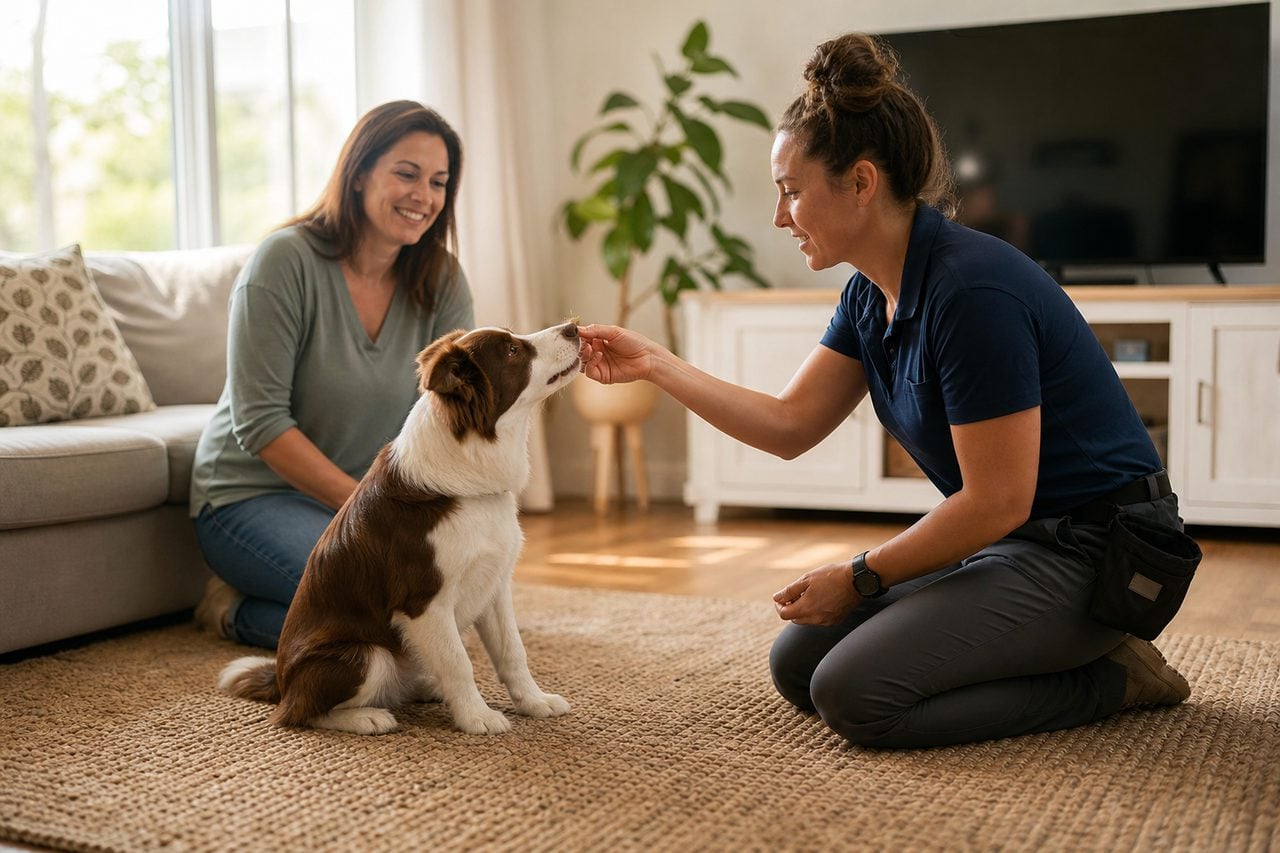
Training a dog at home in Houston means the trainer drives to you, so lessons happen in the kitchen where your dog steals food, at the front door where it jumps on guests, and on the sidewalk where it drags you toward squirrels.
Twenty-five Houston trainers name in-home work among their services, from solo mobile trainers in the Heights to certified behavior consultants, franchise teams on the northeast and south sides, and facilities that send a trainer out when a dog does better at home. This guide covers how home-based programs are usually built, who suits them, what separates a careful trainer from a hurried one, and how to plan around Houston traffic and distance.
Why train where the problems happen
Dogs learn in context. A dog that holds a perfect sit in a quiet classroom may forget everything when the doorbell rings at home, because the doorbell, the hallway and the excitement of visitors were never part of the lesson. A trainer who works in your house sees the real triggers: the window your dog barks through, the couch it guards, the gap in the fence, the routine that sets off a nightly zoomie session.
Home sessions also help owners. Many Houston households juggle long commutes and kids, and a lesson that starts in the living room removes the drive across town with an excited dog in the back seat. It also puts every family member in the same room, which matters because a dog that gets different rules from different people tends to stall.
In-home training is a strong fit for several situations.
- House manners. Jumping, counter surfing, door dashing, chewing and housebreaking all happen at home, so home is where they get fixed.
- Fearful or reactive dogs. A dog that panics in a busy classroom can start learning in a calm, familiar space and build up to the outside world.
- Multi-pet homes. Introductions between dogs, or between a dog and a cat, need to happen in the actual household.
- New puppies. Potty routines, crate habits and mouthing are easiest to shape from the first week at home.
How Houston trainers structure home visits
There is no single format, and the differences are worth understanding before you book. Some programs have the trainer work the dog first and then hand the skills to the owner. One in-home obedience company across Greater Houston runs a two-part program: in the first part the trainer handles all the work over 3 to 8 sessions inside two weeks, teaching on-leash commands, and in the second part the owner learns to handle the dog during at least two sessions, with outings to vet offices, pet stores and parks. That company describes its approach as balanced and teaches the dog what a correction means.
Other programs coach the owner from day one. A CPDT-KA trainer who founded her business in 2010 comes to the home once a week for eight weeks and coaches owners through teaching obedience, manners and structure. A behavior counseling practice builds a plan of action around the family and the dog, then supports the owner while they practice. A team that says training the human is the real work starts every program at home before moving into public settings.
A third model is in-home day training, where the trainer works the dog during the week while owners are out, then meets the family for transfer sessions. One trainer serving the West Loop and Pearland area sells in-home day training in two-, three- and four-week blocks, each with one client session a week, a homework plan and weekly updates. The 2010 trainer offers a similar day-training option for busy families.
Several businesses blend home visits with other formats. A Spring Branch daycare led by a CPDT-KA trainer holds group classes at its facility and private lessons at home, a training and boarding center on Yupondale Drive runs four- and eight-week private programs at home, at a neutral location or both, and a Greater Heights pet hotel offers its trainer either at the hotel or at your house.
Specialists who come to you
Behavior cases are where in-home work often matters most, and Houston has credentialed specialists who travel. A science-based team guided by a certified applied animal behaviorist and a certified dog behavior consultant trains at clients' homes, workplaces, local parks and even restaurants, and each of its trainers holds a bachelor's degree. A certified dog behavior consultant who focuses on fearful and aggressive dogs coaches in person across west Houston, Cypress, the Heights, Oak Forest, the Energy Corridor, Memorial, Spring Branch, the Galleria, Bellaire and River Oaks, with support between visits and live video sessions as an option.
For separation anxiety and dog-and-cat households, a behavior consultant certified in both dog and cat behavior, and as a separation anxiety trainer, starts every package with an assessment of 60 to 90 minutes, in the home or over video. A Heights trainer with CPDT-KA and CPDT-KSA credentials works with puppies, dogs, kittens and cats in Woodland Heights, Timbergrove, Lazybrook, Shady Acres and Independence Heights.
Reactive, anxious and rescue dogs have their own option in a LIMA-informed team that sends the same trainer to every session and adds field trips into parks, trails and pet-friendly stores. Its board-and-train takes one dog at a time in the team's home, and a phone consult and in-person assessment come first.
On the balanced side, a trainer who has spent seven years with dogs runs one-on-one programs at home with real-life practice in parks and on streets, a relationship- and play-based trainer works on recall, loose-leash walking, impulse control and crate habits where the dog actually lives, and two mobile businesses that name aggression and biting among common problems both open with a free evaluation that becomes a custom plan.
Choosing an in-home trainer
Because nobody else watches a private lesson in your living room, it pays to ask direct questions before the first visit. A good trainer will answer them plainly.
- What happens at the first visit? Most local programs begin with an evaluation, consultation or assessment. Ask how long it lasts and whether it is separate from the training package.
- Who does the training? Ask whether the trainer works the dog, coaches you, or both, and how the skills transfer to you if the trainer does most of the work.
- What tools and methods are used? Houston in-home trainers range from LIMA-informed and positive-reinforcement practices to balanced programs that use corrections. Ask what happens when your dog gets it wrong.
- Will the same person come each time? Some teams rotate trainers; others promise one trainer throughout.
- What support follows? A few businesses advertise lifetime support or group sessions after private work. Ask what that includes in practice.
Credentials help you compare. Among in-home trainers in the Houston market are holders of CPDT-KA, CPDT-KSA and CDBC certifications, a licensed veterinary technician, and several AKC Canine Good Citizen evaluators. A credential is no promise of a good fit, but it tells you the trainer has passed an outside assessment of knowledge or skill.
Distance, travel and what drives the cost
Houston is wide, and travel shapes in-home pricing. Some trainers cap their radius: a Heights-based mobile trainer serves roughly 20 miles out, includes travel for nearby homes and adds a fee beyond 10 miles, and a pet resort sends its trainer only within a 10-mile radius. A Greater Heights pet hotel charges more for a lesson at your house than at its own facility and adds a transportation charge. Others name service areas, such as a mobile trainer covering Midtown, Montrose and Cypress, or an in-home company that reaches out to Katy, Spring, Tomball, Copperfield and Bear Creek.
When you compare quotes, line up the same things. Count the number of visits, their length, whether the first assessment is included, any travel charge, whether day training or a board-and-train stay is bundled in, and what follow-up is part of the price. A package that looks larger may simply include more trainer-only sessions and fewer lessons where you learn to handle your own dog.
Expect gradual progress. House manners can improve within a few visits, while fear, reactivity and aggression usually take months of steady practice, and no honest trainer will promise a fixed result.
Reviewed In-Home Dog Training Trainers in Houston
These reviewed Houston-area trainers from our directory handle in-home dog training. Each links to a full profile with specialties, certified credentials, reviews, and contact info:
- Suburban K9 Dog Training — 5.0★ (164 reviews)
- Got It Dog Training — 5.0★ (130 reviews)
- Good DaweG — 5.0★ (111 reviews)
- Pull Me Not K9 Solutions — 5.0★ (28 reviews)
- Off Leash Obedience — 5.0★ (18 reviews)
- Hearth and Hounds — 5.0★ (17 reviews)
- Will Powered Dogs — 5.0★ (7 reviews)
- Cat’s Canine Academy — 5.0★ (7 reviews)
- Safepaws — 5.0★ (6 reviews)
- Dog Training Elite of South Houston — 5.0★ (5 reviews)
See all Houston in-home dog training trainers →
Frequently Asked Questions
Is in-home training better than a group class?
It depends on the goal. In-home lessons suit house-manners problems, fearful dogs and busy schedules, while group classes add the distraction of other dogs and people. Several Houston programs combine both, starting at home and moving into group classes or public outings once the basics hold.
Do in-home trainers in Houston work outside the home too?
Many do. Local trainers describe lessons in parks, on neighborhood streets, at pet-friendly stores, at workplaces and even at restaurants, because a dog needs to practice where it will actually behave. Ask which outings are part of the plan and when they start.
Can an in-home trainer help with aggression or separation anxiety?
Several Houston trainers focus on those cases, including certified behavior consultants and a certified separation anxiety trainer. Treat their guidance as a plan to practice rather than a quick fix, and ask your veterinarian to rule out pain or illness, since medical problems can drive behavior changes.
Can I use a Houston dog park for training sessions?
Dog parks are better for supervised play than for early lessons, since loose dogs make focus hard. Johnny Steele Dog Park on Allen Parkway is temporarily closed according to its official page, so check its status before planning anything there. Millie Bush Dog Park, a Harris County Precinct 4 park in west Houston, is open dawn to dusk.
How many in-home sessions will my dog need?
There is no standard number. Local programs range from a handful of visits inside two weeks to weekly lessons over eight weeks or multi-week day-training blocks. The dog's age, the problem and how much you practice between visits outweigh the package size.
Related: read our complete in-home dog training guide or the full Houston dog training overview.
Ready to find the right in-home dog training pro in Houston?