
In-Home Dog Training in Antelope Valley, CA
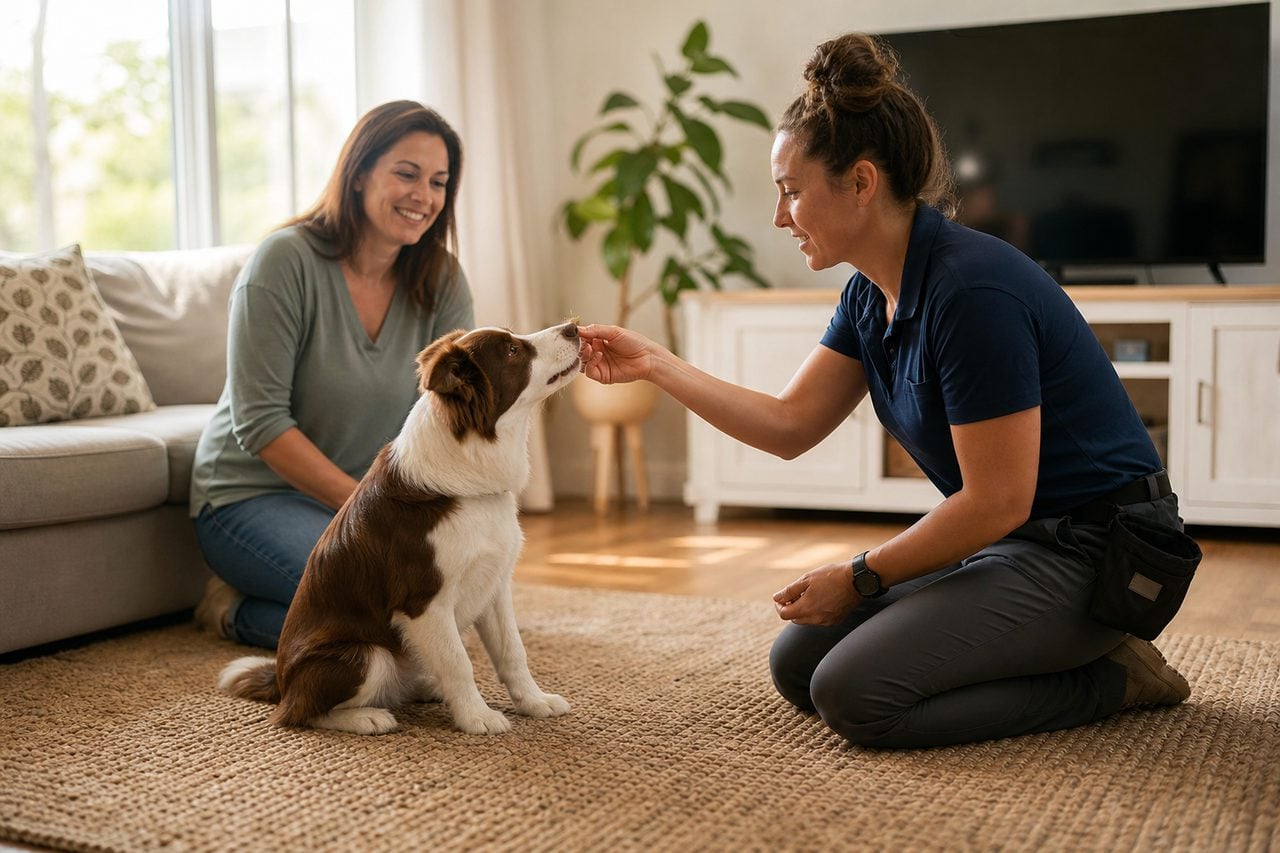
In-home training brings the trainer to the place where most problems actually happen: the front door, the kitchen, the backyard fence and the walk around the block.
In the Antelope Valley seven of the trainers listed here work in clients’ homes or neighborhoods, from Lancaster and Palmdale to Acton and Agua Dulce. This page explains when in-home training is the right choice, how local trainers run it, what a first visit looks like and how to get the most from each session.
When in-home training makes sense
- Problems tied to the house. Door rushing, jumping on visitors, counter surfing, house training and trouble settling.
- Nervous or reactive dogs. Dogs that are overwhelmed in a class or a busy training center often learn better at home first.
- Busy households. No travel for the family, and everyone who lives with the dog can take part.
- Puppies. House training and crate routines are easiest to set up where they will be used.
How local trainers do it
- Day training at home. The valley’s board-certified behaviorist comes to the client’s home, yard and neighborhood, trains skills where they matter and transfers them to the owner, with three program options.
- School sessions at home. A Palmdale school offers in-home sessions alongside group classes, with free pickup and delivery for programs that need it.
- Lessons at home or on a ranch. An Acton business gives private lessons in the client’s home or at its ranch and runs an in-home learning module for young puppies; an Agua Dulce trainer offers help in the home, on a training field or by video consultation; another Agua Dulce trainer gives private lessons at its facility or in the client’s home.
- Single focused visits. An Acton trainer offers a one-time in-home potty training session of about two hours.
- Home lessons from a rescue ranch. A rescue that runs Saturday classes also offers in-home training.
What the first visit looks like
Most trainers start by asking about the dog’s history, routine and the problems that matter most, then watch the dog in its own environment. Expect to leave the first visit with a few concrete exercises, a management plan for the problem moments and a sense of how many sessions are likely. Ask whether written notes or videos are provided.
Getting the most from each session
Have everyone who handles the dog present, keep treats and the usual leash ready, and set up the problem situation if it is safe to do so, for example a visitor knocking at the door. Practice the homework daily in short bursts. In-home training works because the owner learns to handle the real situation, so the gains depend on what happens between visits.
Travel and scheduling
The valley is large, and trainers based in Acton, Agua Dulce or Palmdale may limit the distance they travel or add a travel charge. Ask about the service area, how sessions are scheduled, and whether some sessions move outdoors to a park or a quiet street once the dog is ready.
Problems in-home trainers often solve
- Visitors at the door. Teaching a dog to go to a mat or stay back while the door opens, practiced with real knocks.
- House training and crate use. Setting up a schedule and a space that fit the household.
- Counter surfing and stealing. Management plus clear rules that everyone in the family follows.
- Reactivity on neighborhood walks. Starting at home and moving out to the street where the problem happens.
- Anxiety and settling. Building calm routines for dogs that pace, bark or struggle to relax.
These are problems tied to a place and a routine, which is why seeing the home matters. A trainer who watches the dog in the hallway or the backyard often notices details, such as where the dog can see the street, that change the plan.
In-home training versus board and train.
Board and train sends the dog to the trainer; in-home training brings the trainer to you. Board and train can be useful for busy owners and some intensive goals, but the owner still has to learn the handling afterward. In-home sessions teach the owner from the start, in the real setting. Several local trainers offer both, and some combine them, with a stay followed by home sessions to transfer the skills.
Moving training outside the home.
Most in-home programs eventually step out of the front door. Once a dog is calm and attentive at home, trainers move practice to the driveway, the sidewalk and quieter parts of the neighborhood, then to busier places such as a store parking lot. Ask how and when your trainer plans that step, because the goal is a dog that behaves well wherever you take it, not only in the living room. Some trainers in the valley also meet clients at a park or a chosen location for exactly this reason.
Reviewed In-Home Dog Training Trainers in Antelope Valley
These reviewed Antelope Valley-area trainers from our directory handle in-home dog training. Each links to a full profile with specialties, certified credentials, reviews, and contact info:
- Nutz About Mutz Behavior & Training Services — 5.0★ (31 reviews)
- Lucky K9s Dog Obedience — 5.0★ (10 reviews)
- OJ K9 COACH — 5.0★ (1 review)
- My Dog is My Rock, LLC — 4.8★ (16 reviews)
- Smart Dog Training School — 4.7★ (13 reviews)
- diGsbk9 Coaching, Inc.
See all Antelope Valley in-home dog training trainers →
Frequently Asked Questions
Do Antelope Valley trainers come to my house?
Yes. Trainers listed here offer some form of in-home or neighborhood training, including a board-certified behaviorist, a Palmdale school and several Acton and Agua Dulce trainers. Ask about travel areas before booking.
Is in-home training better than a class?
It depends on the problem. Home sessions suit household problems and nervous dogs; classes add the distraction of other dogs. Many owners use both.
How many in-home sessions will I need?
It depends on the goal. A single visit can sort out a house-training routine, while behavior problems usually need several sessions. Ask for an estimate after the first visit.
Can in-home training help with reactivity?
Often, yes. Several local trainers start reactive dogs at home and then move practice to the neighborhood where the trigger appears. Ask how they keep sessions safe.
What should I prepare before the trainer arrives?
A list of the problems in order of importance, the dog’s usual leash and treats, and everyone who lives with the dog. Keep the dog calm and secured when the trainer arrives.
Related: read our complete in-home dog training guide or the full Antelope Valley dog training overview.
Ready to find the right in-home dog training pro in Antelope Valley?