
In-Home Dog Training in Dayton, OH
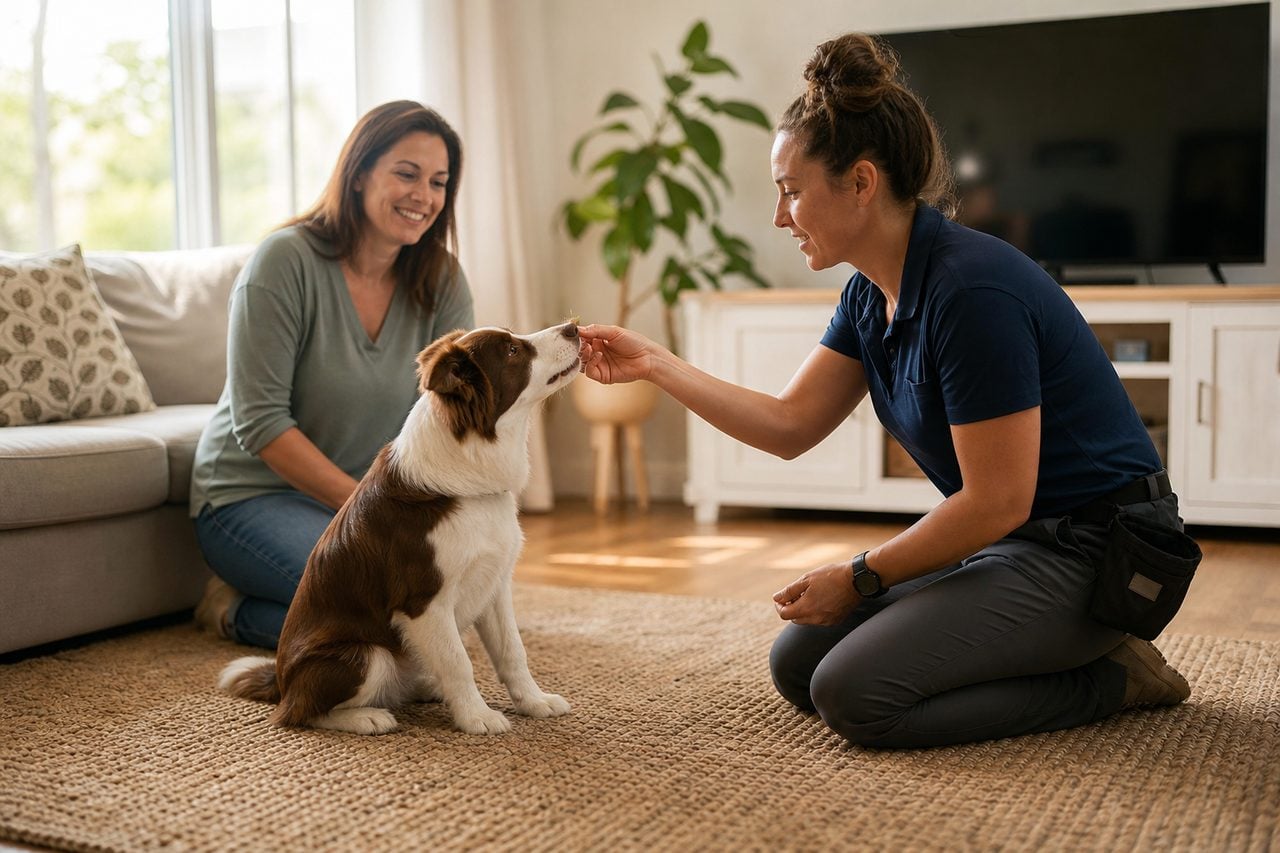
For a lot of Dayton dog owners, the most useful place to train is also the most obvious one: home. In-home dog training brings a professional to your living room, your kitchen, your front door, and your yard — the exact spots where the real problems happen. The dog that bolts out the front door of a Kettering ranch, jumps on guests in an Oakwood foyer, or loses its mind at the fence line of a Beavercreek backyard behaves very differently in those settings than it does in a sterile training-center classroom.
In-home training has grown across the Miami Valley for practical reasons too. Wright-Patterson families on rotating and shift schedules often can’t commit to a fixed weekly class downtown. New parents in Centerville and Springboro want help without loading a reactive dog into the car. And owners of older or anxious dogs — the ones who shut down in group settings — get far more out of a trainer working in the environment the dog already trusts.
This guide covers how in-home training works, which problems it solves best, how to get the most from each visit, how it compares with board-and-train and group classes, and how to choose a trainer who will actually move the needle in your house rather than just running a generic obedience script on your couch.
Why training in your own home works so well
Dogs are notoriously bad at generalizing. A dog that sits politely in a Vandalia training facility may completely fail to sit at your own front door, because the behavior was never practiced where it counts. In-home training removes that gap. The trainer works on the exact thresholds, doorways, furniture, and routines that trigger your dog’s real-world behavior, so what the dog learns is immediately usable in daily life.
The second advantage is that the trainer coaches you, the handler, in your own context. Many behavior problems are quietly maintained by household habits — the family that pets the dog when it jumps, the kids who run and squeal, the feeding routine that creates door-dashing excitement. An in-home trainer sees these patterns directly and corrects the human side, which is usually most of the fix. You can’t replicate that in a classroom because the classroom doesn’t contain your kitchen, your stairs, or your three-year-old.
It is also calmer for the dog. Reactive, fearful, or under-socialized dogs that melt down in group classes can learn at home where they feel safe, then gradually expand outward to the driveway, the sidewalk, and a quiet corner of a Five Rivers MetroPark. For these dogs, in-home is often the only realistic starting point.
What in-home training is best for
In-home training shines for any problem rooted in the household environment:
- Door manners and door-dashing — a top request in Dayton, especially in homes near busy streets where an escape is genuinely dangerous.
- Jumping on guests and family — trained at your actual entryway with realistic arrivals.
- Leash and collar manners — started on your own street and sidewalks where you actually walk.
- Puppy foundations and house-training — ideal for new puppies in Huber Heights or Miamisburg homes, since potty and crate routines are inherently home-based.
- Resource guarding and household management — worked through with your real food bowls, beds, and family layout.
- Basic obedience for fearful or older dogs — that can’t cope with a group class.
It is a weaker fit for a few goals. Dogs that specifically need proofing around heavy distraction — other dogs, crowds, novel environments — eventually need to train in those settings, so a good in-home program will deliberately move out into the neighborhood and public spaces once the foundation is solid. And intensive transformations on a tight timeline are sometimes better served by board-and-train. A reputable in-home trainer will tell you honestly when your goal points elsewhere.
What a typical in-home program looks like
Most Dayton in-home trainers start with an assessment visit: they watch the dog in its environment, interview the household, identify the priority behaviors, and lay out a plan. From there, programs usually run as a package of weekly or biweekly visits — commonly four to eight sessions — each lasting roughly 60 to 90 minutes.
The structure within a session is consistent: the trainer demonstrates a technique, then hands it to you and watches you execute it, correcting your timing and mechanics in real time. Between visits you get homework — short, daily practice reps that do the actual heavy lifting. The trainer’s visit is the lesson; your daily reps are where the learning sticks. Owners who treat the weekly visit as the whole job, rather than as coaching for the week’s practice, get slow results regardless of how good the trainer is.
Many trainers serving the Miami Valley travel across the metro — Dayton proper, Kettering, Centerville, Beavercreek, Fairborn, Springboro, Vandalia, and out toward Xenia — though some add a trip charge for the outer suburbs. Confirm the service radius before booking, especially if you’re in an outlying community.
Getting the most from each visit
Because an in-home trainer only sees your dog for an hour or so at a time, what happens around each visit decides how fast things improve. A little preparation turns a good session into a great one.
- Have everyone home for the first visit. The assessment is where household habits come to light, so the adults and older kids who handle the dog should be there to hear the plan.
- Write down the problem moments. Note when the jumping, barking, or door-dashing happens, who is involved, and what usually comes right before it. Specifics help the trainer recreate the real situation.
- Record the behavior if you can. A short phone video of the dog at the front door or the fence line shows the trainer what it looks like when they are not standing there.
- Set up the house to prevent rehearsal. Baby gates, a leash clipped on when guests arrive, or a blocked view of the street keep the dog from practicing the old habit between visits.
- Do the homework daily, in short bursts. A few minutes several times a day beats one long session the night before the trainer returns.
- Bring questions back. Keep a running list of what went wrong during the week; troubleshooting those moments is one of the most valuable parts of the next visit.
Owners who come to each session with notes and a week of practice behind them tend to need fewer visits overall and keep the results longer.
In-home vs. board-and-train vs. group class
In-home training is one of three main formats Dayton owners weigh, and each suits a different situation. Understanding the trade-offs saves you frustration and helps you pick the right starting point.
In-home training keeps the dog in its real environment and coaches the whole household, which is ideal for environment-driven problems — door manners, jumping, house-training — and for dogs too anxious or reactive for a classroom. Progress depends on your daily follow-through. It is the most flexible format and the gentlest for a nervous dog, but it asks the most of you as the handler.
Board-and-train sends the dog to live with a trainer for one to several weeks of intensive work, then returns it with a handoff lesson. It is heavily marketed across the Miami Valley and can produce fast results for owners short on time or facing stubborn issues. The catch is the transfer problem: skills learned at the facility have to be deliberately re-established in your home, and the dog’s behavior is shaped by your handling once it’s back. It works best when the trainer includes solid go-home coaching and follow-up.
Group classes are the most affordable and add something the other two can’t: real-world distraction and socialization around other dogs and people. They’re excellent for friendly, stable dogs learning manners and for proofing skills under distraction. They’re a poor fit for reactive or fearful dogs that can’t cope in a crowd.
For many Dayton families the smartest path is a blend — start with in-home work to build a calm foundation in the dog’s own space, then graduate to a group class or public practice to proof those skills under distraction. A good in-home trainer will tell you when it’s time to make that move rather than keeping you on private sessions indefinitely.
Choosing the right in-home trainer near you
Because the trainer will be in your home and coaching your whole family, fit matters as much as credentials. When you talk to Dayton-area trainers, ask:
- What methods do you use? You want a clear, consistent philosophy you’re comfortable with, and a trainer who can explain why, not just what.
- How long will my dog’s issues realistically take? A straight answer beats a vague “it depends” or an oversized package.
- Do you coach the whole household? If kids and other adults live in the home, they need to handle the dog the same way — the trainer should insist on involving them.
- Do you serve my area? Confirm coverage for your specific suburb up front, along with any trip charge.
- What’s the homework like? A good trainer leaves you with concrete daily reps and a way to ask questions between visits.
Compare in-home trainers serving Dayton and the surrounding Miami Valley communities, read reviews from local owners, and reach out to a couple before booking. The best in-home trainer for you is the one who watches your dog in your space, names the household habits feeding the problem, and gives you a plan you can actually run between visits.
Reviewed In-Home Dog Training Trainers in Dayton
These reviewed Dayton-area trainers from our directory handle in-home dog training. Each links to a full profile with specialties, verified credentials, reviews, and contact info:
- Liberty K9 — 5.0★ (90 reviews)
- Police Dog Services — 5.0★ (21 reviews)
- Pups Grow Up — 5.0★ (4 reviews)
- Dog Training Personalized — 4.9★ (108 reviews)
- Champion K-9 Dog Training — 4.8★ (18 reviews)
- Homeland K-9 Dog Training Academy — 4.7★ (34 reviews)
- The Hound Playground — 4.4★ (144 reviews)
See all Dayton in-home dog training trainers →
Frequently Asked Questions
Is in-home training better than a group class?
It depends on your dog and your goals. In-home training is better for door-dashing, jumping on guests, house-training, and any dog that’s reactive, fearful, or anxious in group settings, because it works in the exact environment where the problem happens. Group classes are more affordable and great for sociable dogs learning basic manners and for distraction-proofing. Many Dayton owners start in-home to build a foundation, then add group or public practice later.
How long does an in-home training program usually take?
Most Dayton-area packages run four to eight visits for foundations plus the main problem behaviors, with each visit lasting 60 to 90 minutes. Simple manners issues may resolve in a handful of sessions, while multiple or stubborn behaviors take longer. Your results depend heavily on the daily homework reps between visits, which is where most of the actual learning happens.
Does the whole family need to participate?
Yes, ideally. Dogs behave according to how each person handles them, so if kids and other adults respond differently, progress stalls. A good in-home trainer will coach everyone in the household to use the same cues and routines. This consistency is one of the biggest advantages of training in your own home rather than dropping the dog off somewhere.
Will an in-home trainer travel to my suburb?
Many trainers serving the Miami Valley cover Dayton, Kettering, Centerville, Beavercreek, Fairborn, Springboro, Vandalia and nearby areas, though some add a trip charge for outlying communities like Xenia or the far west side. Always confirm the service radius before booking.
How should I prepare for the first in-home visit?
Have everyone who handles the dog at home for the assessment, write down when the problem behaviors happen and what sets them off, and record a short video of the behavior if you can. Set up gates or a house leash so the dog can’t keep rehearsing the habit while you wait for the plan to start.
Related: read our complete in-home dog training guide or the full Dayton dog training overview.
Ready to find the right in-home dog training pro in Dayton?