
Board & Train in Dayton, OH
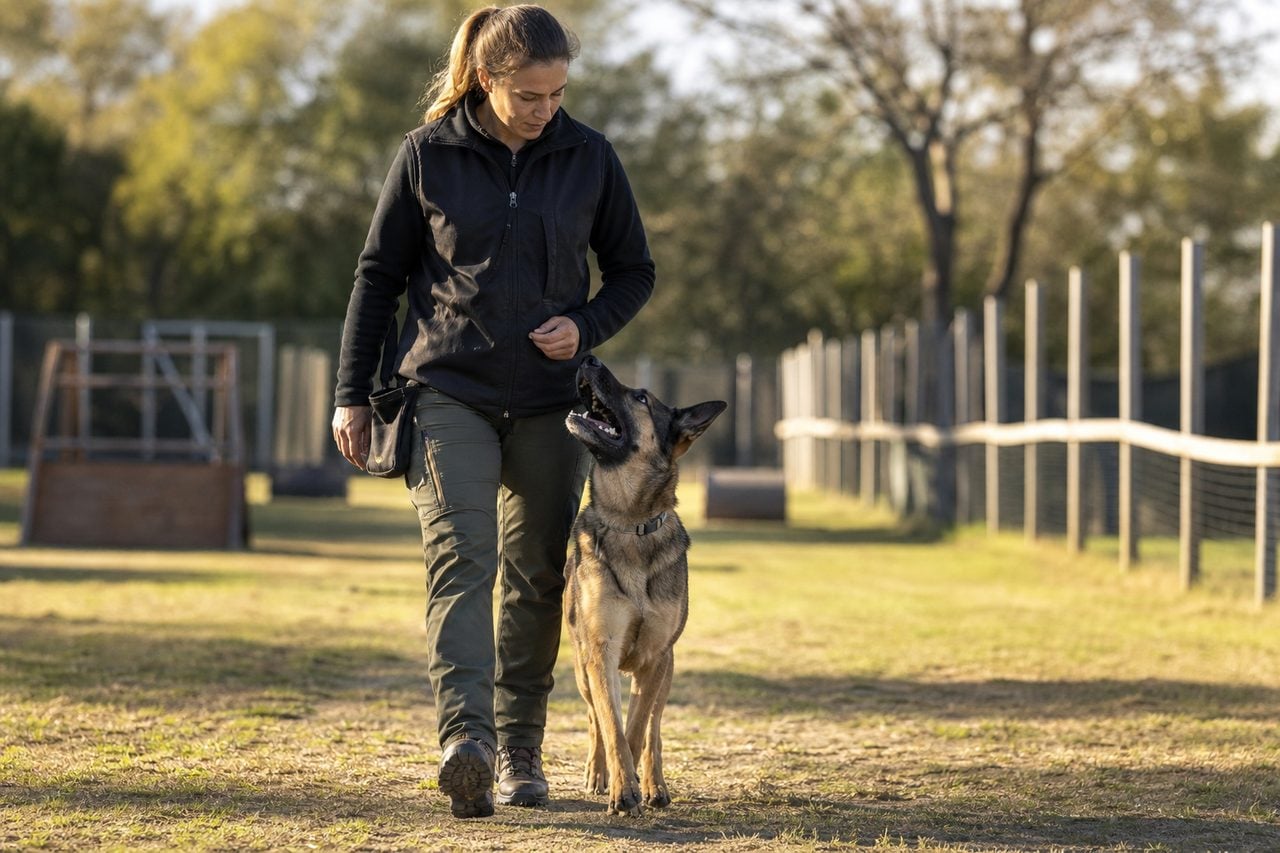
Board-and-train is the option Dayton families reach for when life is too full to run a daily training homework routine and the dog needs more than a once-a-week class can deliver. The premise is simple: your dog moves into a trainer’s facility or home for a stretch of time — usually two to four weeks in the Miami Valley — and comes back with the foundation skills already installed, so your job becomes maintenance rather than construction. For a Kettering couple juggling commutes to downtown offices, or a Beavercreek household with kids and a brand-new rescue that is already counter-surfing and bolting out the front door, that trade can be worth every dollar.
It is also the most misunderstood service in the local market. Owners picture dropping the dog off and getting back a finished, push-button companion, then feel blindsided when the trainer hands them a leash and a list of things they now have to keep doing. The honest framing is that a good board-and-train transfers a trained dog and a trained owner; the facility weeks build the behaviors, and the handoff lessons teach you to hold them. Skip that second half and the polish wears off within a month of coming home to Centerville.
Dayton’s geography quietly shapes how these programs run. Many of the kennels and training farms that offer multi-week boarding sit out in the greener edges of the metro — Xenia, Waynesville, Springboro, the rural pockets past Brookville — because square footage and outdoor acreage are cheaper there than inside the city. That means a downtown or Oregon District owner may drive 25 to 45 minutes for drop-off, while suburbs like Bellbrook and Springboro sit closer to the action. This guide walks through what board-and-train actually buys you in Dayton, what it costs, and how to judge a program before you hand over your dog.
What Board-and-Train Actually Is (and What It Isn't)
Board-and-train means your dog lives where the training happens. Instead of you practicing twenty minutes a night between work and dinner, a professional handler works your dog multiple times a day, every day, inside the environment where they also eat, sleep, and rest. The appeal is consistency and reps: a dog in a structured program might get more focused training in three weeks than a busy owner manages in three months of good intentions.
The behaviors most Dayton programs target are the practical ones that make a dog livable — reliable recall, loose-leash walking that survives a MetroParks trail full of distractions, a solid place command so the dog settles while you eat, polite greetings instead of jumping on guests, and impulse control around doors and food. Some programs layer in off-leash reliability or e-collar conditioning; others stay firmly on-leash and reward-based. There is no single correct philosophy, but there is a correct fit for your dog and your tolerance, so ask directly what tools a trainer uses before you book.
What board-and-train is not is a personality transplant or a guarantee. A genuinely fearful or aggressive dog will not come home ‘fixed’ in two weeks — that is a behavior-modification project measured in months, often best handled with the owner present from day one. And no reputable trainer promises a specific outcome, because the dog you get back still has to live with you, in your house, with your habits. The realistic promise is a dog with a strong foundation and a clear owner playbook to maintain it.
Why Dayton Owners Choose Residency Over Weekly Classes
The most common driver is simply time. A weekly group obedience class assumes you will do daily homework, and for a lot of Miami Valley households — shift workers, parents, people commuting to Wright-Patterson’s research and logistics offices on rotating schedules — that daily slot just never materializes. Board-and-train removes the homework bottleneck during the foundation phase by handing it to a professional who does nothing else all day.
The second driver is a behavior that has already become a safety problem. A dog that bolts through the front door toward Far Hills Avenue traffic, or drags a smaller owner off their feet on the leash, is not a ‘practice it slowly’ situation — owners want it interrupted now. The immersion of a residency program can move faster on these high-stakes habits because the trainer controls every repetition and never lets the dog rehearse the dangerous version.
A third group are owners who tried the slow route and stalled. They did a puppy class, maybe a basic obedience round, and hit a ceiling — the dog is fine at home but falls apart the moment a squirrel crosses the Oakwood sidewalk or another dog appears at Eastwood MetroPark. Sometimes the missing ingredient is a few weeks of concentrated, distraction-graded work that a once-weekly class structurally cannot provide. The honest caveat: residency is the more expensive path, so it makes the most sense when time, safety, or a genuine plateau justify the premium — not as a default first step for a calm puppy who would do beautifully in a standard class.
There is also a logistics angle worth naming, because it is often the deciding factor for Miami Valley households. A two-week residency removes the dog from a chaotic transition period entirely — a move, a new baby, a home renovation, a stretch of out-of-town work — and hands it back with structure already in place once the dust settles. For a family near Wright-Patterson whose schedule swings with rotating shifts, or a household where the dog’s bad habits are amplified by inconsistent handling from several different people, sending the dog somewhere with one consistent handler for a couple of weeks can break a cycle that the home environment keeps feeding. The point is not that residency is superior; it is that it solves a particular kind of problem — the problem of consistency the home can’t currently supply — and that is exactly when the premium earns its keep.
What Board-and-Train Costs in Dayton
Pricing in the Miami Valley varies more than almost any other training service, because you are paying for boarding, food, facility overhead, and one-on-one professional time all bundled together. As a working framework for the Dayton area, a two-week program typically lands somewhere around $1,500 to $3,000, and a three-to-four-week program commonly runs $2,500 to $5,000+. Programs that include off-leash or e-collar reliability work, or that cap intake to a handful of dogs for near-private attention, sit at the upper end; more standard on-leash obedience packages sit lower.
That works out to a rough weekly rate in the neighborhood of $800 to $1,500 depending on the trainer’s reputation, the staff-to-dog ratio, and how much individual handling versus kennel time the day actually includes. The cheapest quote is not automatically the worst, but a number that looks far below the local range usually means more boarding and less training — ask how many handling sessions per day the dog truly gets.
A few cost factors specific to how Dayton programs are structured: many of the multi-week facilities sit in lower-cost rural areas (Xenia, Waynesville, Springboro, Brookville), which can keep per-week rates a touch more reasonable than a comparable big-city program. Almost all reputable programs include follow-up or ‘go-home’ lessons in the price — if they do not, budget for a few private sessions ($75–$150 each locally) because the handoff is where the investment either sticks or evaporates. Always confirm in writing what is included: food, vaccinations required, number of training sessions per day, and exactly how many follow-up lessons come with the package. Never assume — the bundle varies enormously between trainers.
How to Vet a Board-and-Train Program Before You Commit
You are leaving your dog in someone else’s care around the clock, so the vetting bar should be higher than for any other service. Start with a facility tour. Ask to see where dogs actually sleep, how they are housed between sessions, what the cleaning and feeding routine looks like, and how dogs are exercised and decompressed during downtime. A trainer who is comfortable showing you the kennel area at a normal hour is telling you something good; one who keeps you in the lobby is telling you something else.
Ask exactly how your dog will be trained — what methods, what tools, what happens when the dog gets it wrong. Reward-based, balanced, e-collar: each has advocates, but the answer should be specific and you should be comfortable with it. Then ask the question many owners forget: how will you teach me to keep this going? A program that bundles structured go-home lessons and offers a clear maintenance plan is far more valuable than one that simply returns a polished dog with a wave goodbye.
Request to see updates during the stay — many Dayton trainers send photos or short videos of sessions, which both reassures you and lets you watch progress. Ask about their communication policy if something comes up. And get the scope in writing: what behaviors they are targeting, what ‘success’ looks like for your specific dog, the daily session count, and what happens if you are not satisfied. Reputable local trainers welcome these questions because the owners who ask them tend to be the ones who maintain the results.
Setting Your Dog Up to Succeed — and Keeping It After Pickup
The weeks before drop-off matter. Make sure your dog is current on the vaccinations the facility requires (most ask for rabies, distemper/parvo, and bordetella for boarding), pack their normal food to avoid a stomach upset on top of the adjustment, and be honest with the trainer about every quirk — the resource guarding around the food bowl, the fear of men in hats, the fact that they have never been crated. Hiding a problem to make your dog sound easier only sets the program up to miss the thing you most needed addressed.
The real work, though, starts at pickup. The dog comes home with new rules and a new vocabulary, and your house is the old environment full of old habits — the couch they used to own, the door they used to bolt through. Expect a short regression as the dog tests whether the rules followed it home. This is normal and it is exactly what the go-home lessons exist to handle: the trainer shows you how to hold the boundaries the dog already learned so the behaviors transfer to your Centerville living room and your Eastwood MetroPark walks.
Plan for a maintenance routine — a few minutes of structured practice a day, the same commands and rewards the trainer used, and consistency from every adult in the household. The single biggest predictor of whether a board-and-train ‘sticks’ is not the program’s quality; it is whether the owner keeps the structure for the first couple of months home. Treat the residency as the launch, not the finish line, and a Dayton board-and-train can genuinely reset a dog’s trajectory.
Reviewed Board & Train Trainers in Dayton
These reviewed Dayton-area trainers from our directory handle board & train. Each links to a full profile with specialties, verified credentials, reviews, and contact info:
- Liberty K9 — 5.0★ (90 reviews)
- Shawnee Creek Retrievers — 5.0★ (14 reviews)
- Blazing Willow Farm & K9 — 5.0★ (13 reviews)
- Perfect Love K9 Retreat, LLC — 5.0★ (5 reviews)
- Dog Training Personalized — 4.9★ (108 reviews)
- Pence K9 — 4.9★ (73 reviews)
- Birch Valley K9 — 4.9★ (56 reviews)
- Big Times Kennel — 4.8★ (91 reviews)
- Cross Creek Kennels.llc — 4.8★ (20 reviews)
- Champion K-9 Dog Training — 4.8★ (18 reviews)
See all Dayton board & train trainers →
Frequently Asked Questions
How long does a board-and-train program last in Dayton?
Most Miami Valley programs run two to four weeks. Two weeks is common for foundational obedience and manners; three to four weeks is typical when adding off-leash reliability or working through more stubborn habits. Genuine behavior problems like real aggression usually need a longer, owner-involved approach rather than a short residency.
How much does board-and-train cost in the Dayton area?
As a working range, a two-week program tends to fall around $1,500 to $3,000, and three to four weeks around $2,500 to $5,000 or more, which works out to roughly $800 to $1,500 per week. Off-leash or e-collar programs and low-intake, near-private setups sit at the top of the range. Always confirm in writing what the price includes — food, daily session count, and follow-up lessons.
Will my dog come back fully trained and require nothing from me?
No — and any trainer who promises that is overselling. A good board-and-train returns a dog with strong foundation skills plus go-home lessons that teach you to maintain them. Expect a short adjustment period at home and plan on a daily maintenance routine for the first couple of months. The owners who keep the structure are the ones who keep the results.
What's the difference between board-and-train and a dog boot camp?
The terms overlap, but board-and-train usually describes a multi-week residency focused on building a broad obedience foundation at a steadier pace. A boot camp is typically marketed as a shorter, more intensive sprint aimed at fixing a specific set of problem behaviors fast. If your priority is a thorough foundation, lean board-and-train; if it’s a rapid reset on a couple of urgent habits, look at boot camps.
Is my dog a good candidate for board-and-train?
It fits best when time is the bottleneck, when a safety-critical habit like door-bolting or leash-dragging needs to be interrupted quickly, or when a dog has plateaued in weekly classes. A calm puppy with a low-key home may do just as well in a standard group class for far less money. Fearful or aggressive dogs are often better served by owner-involved behavior work than by a drop-off program.
Related: read our complete board & train guide or the full Dayton dog training overview.
Ready to find the right board & train pro in Dayton?