
In-Home Dog Training in Albany & the Capital Region, NY
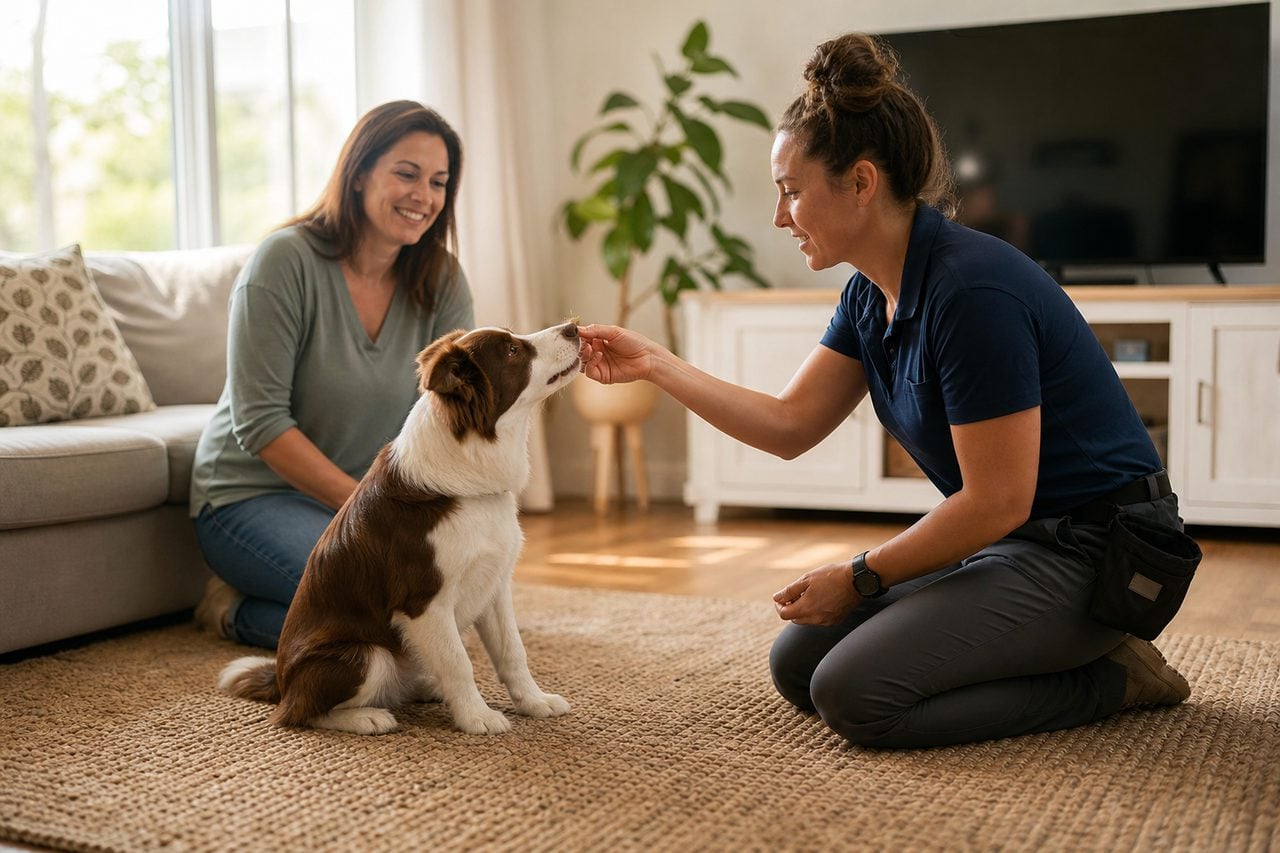
Twenty-two of the fifty dog training businesses serving the Capital Region publish in-home or private one-to-one training — more than any other format. That is not a quirk of this directory. It reflects what the Albany, Schenectady and Troy market actually is: a metro of small cities and spread-out towns where very few trainers can fill a training room every night of the week, and where the problems people call about mostly happen indoors.
In-home training means a trainer comes to your house and works with you and your dog in the environment where the behavior is actually happening. It is the most expensive format per hour in this metro and frequently the cheapest per problem solved, because it addresses the specific hallway, the specific doorway and the specific family habit that is maintaining the thing you called about.
This page covers what in-home training is good for, who offers it around the Capital Region, how the coverage areas work here, and what the sessions look like.
The problems that only exist in your house
Read the published problem lists of the Capital Region’s in-home trainers and the same items recur, because they are the items a group class cannot reach.
One Albany in-home trainer publishes potty training, leash walking, biting, jumping, separation anxiety and recall as her named list. Another publishes house manners, polite greetings and leash walking. A Schenectady trainer publishes basic obedience through behavior modification with a dog-centric approach. Every one of those is a household behavior with a household cause.
Housebreaking is the clearest case. A dog going indoors is a problem about your schedule, your floor plan, your door and, in this climate, about whether the trip outside in February is unpleasant enough that indoors wins. No training room contains any of those variables.
Door behavior is the second. A dog that charges the door, mugs guests or barks at every delivery is responding to a specific sequence — the sound of the porch step, the doorbell, the way the door opens inward into a narrow Albany rowhouse hallway. A trainer standing in that hallway sees it in ninety seconds.
Settling is the third, and in a two-income Capital Region household it is often the one that matters most. A dog that cannot switch off in the evening or cannot be left for the commute to Schenectady or down the Northway is a household problem with a household solution — where the crate is, what happens at four in the afternoon, who reinforces the pacing.
Multi-dog and multi-species friction rounds it out. One Capital Region behavior practice publishes dog-and-cat households as a named specialty: adding a cat to a dog household, a dog that cannot settle when the cat is around, a cat too frightened to come near. That is entirely a floor-plan and routine problem, and it cannot be worked on anywhere but at home.
Who offers it around the Capital Region
The twenty-two in-home businesses in this metro are not one kind of operation.
Solo practices that do only this. Several Albany and Schenectady trainers work exclusively one-to-one, in the client’s home, with no facility at all. One publishes one-hour in-home sessions with personalized instruction and clear next steps against the owner’s stated goals; another works across the Capital Region with an emphasis on the owner as much as the dog. Because they carry no building, these are usually the most flexible on scheduling and the most focused on your specific list.
Trainers with a facility who also travel. A Clifton Park facility, a Troy practice and several Albany businesses publish private one-to-one training alongside classes or residential programs. Useful if you might want to move between formats later without changing trainer.
Care businesses that train. A distinctive feature of this metro: a Bethlehem-area mobile pet-care business publishes training alongside walks, enrichment and drop-in care across four named towns; a Schenectady pet sitter publishes training among dog walking, in-house sitting and feeding visits, with a free meet and greet before any booking. For a household that needs midday coverage anyway, putting both through one person is a real convenience.
Behavior specialists working at home by design. The Capital Region practice built around reactivity and fearful dogs works in person locally and virtually from anywhere; an Albany trainer certified in Predation Substitute Training works one-to-one. For behavior cases, home is not a convenience, it is the correct venue.
Virtual as a first-class option. At least three local practices publish video sessions, and one describes a blended approach of video and in-person visits to keep consistency. For a Capital Region owner in February, a video session costs no drive and no salt on the pads.
Coverage areas: how far a Capital Region trainer will actually come
This is the practical question, and the answers here are unusually explicit because a mobile business has to publish a boundary.
Some publish named towns. One Bethlehem-area business publishes the Town of Bethlehem, the Town of New Scotland, Guilderland and Albany — four towns, which makes it trivial to tell whether you are in it. A Rensselaer County pet-care business publishes Averill Park, East Greenbush, North Greenbush, Rensselaer, West Sand Lake and Wynantskill.
Some publish the region. Several trainers publish “the Capital Region” or “Albany and the surrounding Albany County area”, and one Troy practice publishes Troy, Albany and the surrounding Capital Region. In practice a Capital Region trainer’s working radius covers Albany, Colonie, Latham, Troy, Schenectady, Bethlehem and Clifton Park — the three cities are fifteen to twenty minutes apart, so most of the metro is inside one drive.
Where it thins out is the ring: Voorheesville, Altamont, Duanesburg, Berne, Averill Park, Nassau and the Helderberg towns. If you live out there, expect a travel fee or a longer wait for a slot, and expect a smaller list of trainers willing to come. That is also the part of the metro where the residential programs are, which is not a coincidence.
Ask three things when you call: whether your address is inside the standard area, whether there is a travel charge, and what the scheduling window looks like. A mobile trainer’s calendar is built around drive time, so a trainer based in Schenectady may be able to see you Tuesday afternoons and no other time.
What a session actually looks like
The published local descriptions are consistent enough to set expectations.
Sessions run about an hour. One Schenectady practice publishes one-hour in-home sessions including personalized instruction and clear next steps; an Albany trainer publishes sessions built around the family’s lifestyle and home environment.
The household attends. This is emphasized locally more than in most metros: one Albany trainer publishes that all members of the household are encouraged to join in-home sessions, and one Capital Region trainer states plainly that she works as much with the owner as with the pet. In a household where one person trains and three undo it, nothing changes.
You leave each session with a plan rather than a demonstration. One local practice’s published FAQ says exactly this: each session is personalized and practical, you leave with a better understanding of your dog, realistic strategies you can use right away, and ongoing support to stay consistent. Another publishes five-page written summaries after a session covering what was worked on, what equipment to buy, and video of the work.
Frequency is usually weekly or fortnightly, in packages rather than one-offs. One Troy practice publishes lesson packages explicitly on the argument that real progress comes through consistency rather than single sessions.
Between sessions is where the change happens. The local trainers who publish support structures — a puppy-parent hotline as part of a membership, phone and video support, private owner groups — are selling the six days, not the one hour.
Costs, and why in-home is worth the premium here
In-home training is the most expensive Capital Region format per hour and almost nobody publishes a rate. One Albany trainer publishes a rates and services page and another publishes prices, which is unusual; most quote after a free consultation, and free consultations are close to universal in this metro — a Troy practice, a Clifton Park facility, a Schenectady trainer and a Schenectady pet sitter all publish a free first conversation or meet and greet.
The reason the premium is often worth paying here is arithmetic rather than luxury. A six-week group course teaches your dog to sit, stay and walk politely in a training room; if your actual complaint is that the dog empties the trash, charges the door and will not settle, you finish the course with the same three problems and a dog that sits nicely. Two in-home sessions aimed at exactly those three things frequently cost less than the course did.
The inverse is also true and worth saying: if you want your dog to learn to work around other dogs, in-home training cannot deliver it and a class can, for a fraction of the price. The two formats are complements. Plenty of Capital Region trainers publish both, which makes it straightforward to do a class for the social work and a couple of home visits for the household list.
Travel is the hidden variable. A trainer coming out to Altamont or Averill Park is spending an hour in the car for an hour of work, and the price reflects it. If you are in the rural ring and price-sensitive, ask about a video session for the planning and an in-person visit for the work.
Getting the most out of a trainer in your house
Do not tidy up. The trainer needs to see the actual gate that does not close, the actual couch the dog guards and the actual counter the dog surfs. A staged house produces advice for a house you do not live in.
Have everyone there. Including the teenager who feeds the dog from the table and the partner who thinks the jumping is funny. Local trainers ask for this explicitly.
Write the list before the visit. Three specific problems in priority order beats “he is badly behaved”. Trainers here build the session around your stated goals, so the goals need to exist.
Have the dog hungry. Skip the meal before the session. Food is the currency, and a full dog is an uninterested student.
Ask what happens between sessions. This is where the outcome is decided. Ask for written notes, ask whether you can text a question, and ask what to practice and for how many minutes.
Be honest about what you will do. If nobody in your household will do twenty minutes a day, say so, and let the trainer design something you will actually run. A plan that gets done beats a better plan that does not.
Reviewed In-Home Dog Training Trainers in Albany & the Capital Region
These reviewed Albany & the Capital Region-area trainers from our directory handle in-home dog training. Each links to a full profile with specialties, certified credentials, reviews, and contact info:
- Canine Behavior Consultants, LLC — 5.0★ (156 reviews)
- Adventure Tails Dog Training & Enrichment — 5.0★ (37 reviews)
- Canine Coach Mike — 5.0★ (29 reviews)
- Spotted Snout — 5.0★ (22 reviews)
- Kaitlyn’s Critter Care LLC — 5.0★ (8 reviews)
- Game of Bones Dog Training & Pet Sitting — 5.0★ (5 reviews)
- Flow State Canine LLC — 5.0★ (5 reviews)
- Happy Tails Dog Training and More — 5.0★ (1 review)
- Old Dogs New Tricks Dog Training — 5.0★ (1 review)
- Must Love Pawz — 4.8★ (161 reviews)
See all Albany & the Capital Region in-home dog training trainers →
Frequently Asked Questions
How much is in-home dog training in the Albany area?
Most Capital Region trainers quote after a free consultation rather than publishing a rate, though a couple publish a rates page. It is the most expensive format per hour in this metro and often the cheapest per problem solved, because it targets the specific household behaviors you called about. Expect a travel component if you are out in the rural ring — Altamont, Duanesburg, Averill Park, Nassau — where a visit costs the trainer an hour of driving each way.
What is the difference between in-home training and a group class?
A class teaches your dog to work while other dogs are nearby, which is a skill you cannot practice at home, and it is much cheaper per hour. In-home training fixes the things that only happen in your house: housebreaking, door charging, counter surfing, guarding, settling, multi-dog friction. They are complements rather than alternatives, and plenty of Capital Region trainers publish both so you can do them with the same person.
Do all Albany-area trainers travel to my house?
Twenty-two of the fifty publish in-home work, so most but not all. Coverage areas are published in two styles here: named towns — one Bethlehem-area business publishes four, a Rensselaer County business publishes six — or a region, usually “the Capital Region” or “Albany and surrounding Albany County”. The three cities and their inner suburbs are covered by almost everyone; the Helderberg towns and the eastern hills have fewer options and may carry a travel fee.
Who should be home during the session?
Everyone who interacts with the dog. Local trainers publish this explicitly — one Albany practice encourages all members of the household to join in-home sessions, and another states she works as much with the owner as with the pet. Consistency between people is usually the difference between a plan that works and one that does not, and it is the most common reason progress stalls between visits.
Can in-home training help with aggression?
Yes, and for several kinds it is the correct venue rather than a compromise. Resource guarding, multi-dog household conflict and dog-cat friction are all floor-plan and routine problems that cannot be reproduced anywhere else. One Capital Region behavior practice specializes in reactivity, fearful dogs and multi-species households and works in person locally; several other local in-home trainers publish behavior modification. For severe bite-risk cases, ask about the assessment process before booking a standard session.
Are virtual sessions worth it?
For the right jobs, yes, and several Capital Region trainers publish them as a full option rather than a fallback — one describes a blended approach of video sessions and in-person visits to keep consistency. Video works well for planning, housebreaking, crate and settle work, equipment setup and troubleshooting, and it is genuinely useful in a Capital Region February. It works less well for hands-on leash mechanics and for anything where the trainer needs to read the dog at close range.
Related: read our complete in-home dog training guide or the full Albany & the Capital Region dog training overview.
Ready to find the right in-home dog training pro in Albany & the Capital Region?