
Dog Boot Camp in Dayton, OH
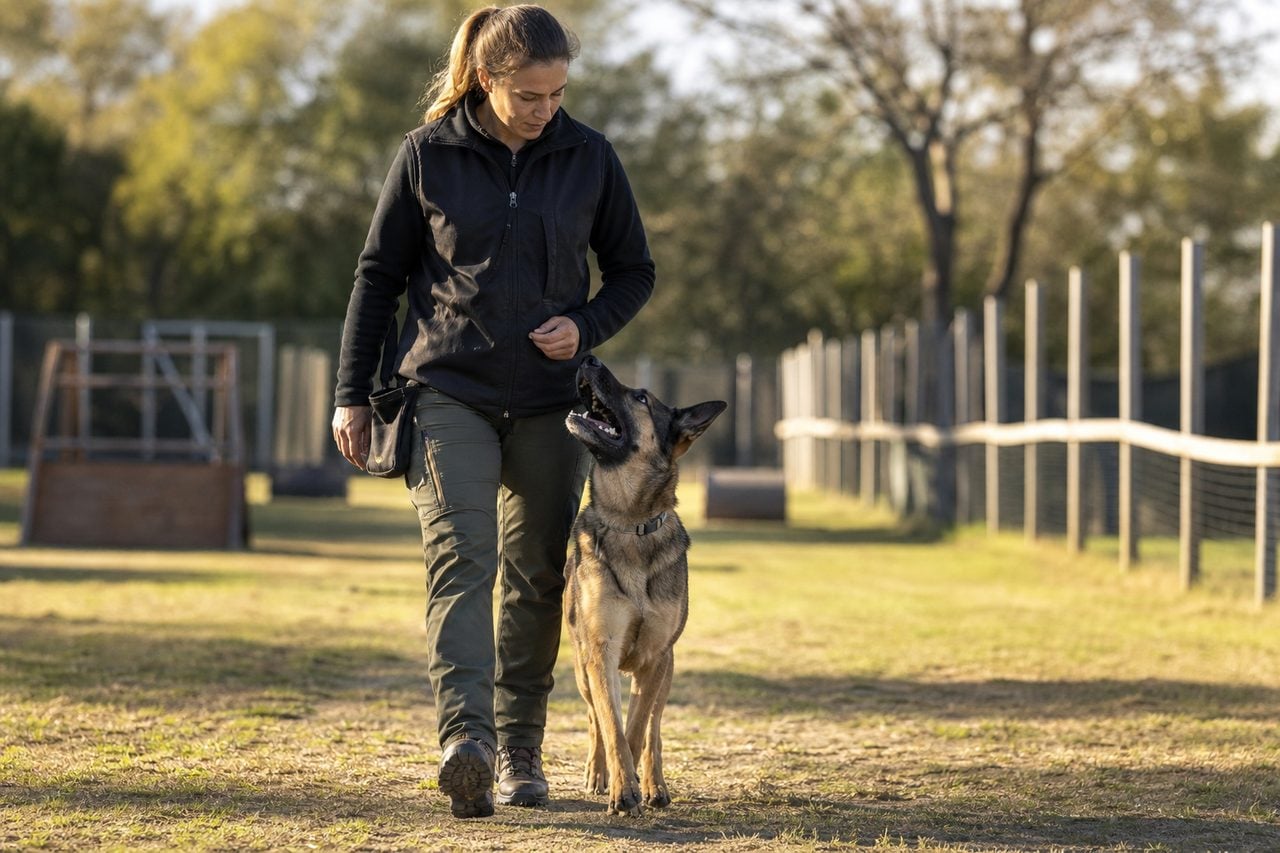
A dog boot camp is the express lane of the training world: an intensive, immersive program built to move fast and hit hard on a defined set of problem behaviors. In Dayton the term gets used loosely — some trainers use ‘boot camp’ and ‘board-and-train’ interchangeably — but the spirit of a true boot camp is a short, concentrated sprint, often two or three weeks, where the dog trains multiple times a day with the explicit goal of resetting urgent habits in the shortest honest timeframe. Think of it as triage with a curriculum: less about a leisurely foundation and more about putting out the fires that are making daily life with the dog miserable.
The Dayton families who go this route are usually at a breaking point. The Huber Heights household whose dog has started bolting toward the street. The Centerville owner whose 70-pound adolescent is now dragging them down the sidewalk and lunging at every passing dog. The Beavercreek family near Wright-Patterson whose rescue is jumping on the kids and stealing food off the counter, and who simply cannot wait out a twelve-week class curriculum. Boot camp sells speed, and for the right dog and the right problem, that speed is real.
But speed has a cost and a catch. A boot camp can install or interrupt behaviors remarkably quickly, yet whatever gets compressed into two weeks of intensity has to be maintained by an owner who was not in the room for most of it. That is the central tension of every boot camp, and the rest of this guide is about getting the upside without the bounce-back — what boot camp does well, what it cannot do, what it costs in the Miami Valley, and how to tell a serious intensive program from a marketing label slapped on ordinary boarding.
Boot Camp vs. Board-and-Train: The Difference That Matters
On paper the two services look almost identical — your dog lives with the trainer and comes back with skills. The difference is in the intent and the intensity. A board-and-train is generally framed as a foundation-builder: a steadier multi-week residency that installs a broad, durable obedience base. A boot camp leans toward a faster, harder, more targeted sprint focused on specific problem behaviors — the term itself promises intensity and a quick turnaround.
In practice that shows up in a few ways. Boot camps tend to be shorter and more aggressive about reps, packing more daily sessions into a tighter window. They are often pitched at a defined problem list — leash reactivity, door-bolting, jumping, recall — rather than a from-scratch curriculum for a blank-slate puppy. And they are usually sold on the promise of fast visible change, which is exactly why owners in crisis gravitate toward them.
Why does the distinction matter for a Dayton owner? Because it tells you which tool fits your situation. If you have a young dog and want a thorough, unhurried foundation, a board-and-train framing serves you better. If you have an urgent, specific behavior making daily life unsafe or unbearable and you need it interrupted now, a boot-camp framing is the right shape. The catch with the faster path is that compression raises the maintenance stakes: the more is crammed into a short window, the more disciplined you have to be at home afterward to keep it. Speed is a feature, but it is not free.
What an Intensive Program Can Realistically Achieve in Two Weeks
A well-run two-to-three-week boot camp can do a lot. Obedience mechanics — sit, down, place, a reliable recall, loose-leash walking — respond well to high-frequency, professionally delivered repetition, and a skilled handler can build genuinely impressive responses in that window because they control every rep and never let the dog rehearse the wrong version. For impulse-control problems like counter-surfing, door-dashing, and jumping on guests, the immersion advantage is real: the dog simply never gets to practice the bad habit for two solid weeks, and that interruption alone can break a deeply grooved pattern.
It is also genuinely effective on leash manners and basic distraction work. A dog that has learned to walk politely past controlled distractions in a training environment has a foundation that, with owner follow-through, transfers to a real Dayton sidewalk or an Eastwood MetroPark trail. The trainer can grade the difficulty far faster than a once-a-week class ever could, dialing distractions up and down in a controlled way the owner of a single dog in a single neighborhood simply can’t replicate at home.
The thing to keep front of mind is that intensity cuts both ways. The same compression that installs a recall in two weeks also means the dog is doing a lot of learning in a short, demanding window, which is mentally taxing — a responsible program builds in real rest and decompression, not just back-to-back drilling. And because the gains are dense, they are also more fragile at first: a behavior built over twelve unhurried weeks is more weatherproofed against a sloppy owner than the same behavior crammed into fourteen days. None of that makes boot camp a bad choice; it makes it a choice that demands an owner who shows up for the handoff and the maintenance. Go in understanding the trade and you get the speed without the disappointment.
What two weeks cannot do is rewrite emotion. Fear, anxiety, and true aggression are not obedience gaps — they are emotional responses, and changing how a dog feels about strangers, other dogs, or being left alone is a gradual process measured in months, usually with the owner involved throughout. A reputable Dayton trainer will tell you straight that a two-week boot camp is the wrong container for those problems, and may steer you toward a behavior-modification plan instead. Be skeptical of any program promising to ‘cure aggression’ in a sprint; that is a red flag, not a feature.
What Dog Boot Camp Costs in Dayton
Because boot camps bundle intensive daily training with boarding, food, and facility overhead, they sit in the same general price territory as board-and-train — and in the Miami Valley that means real money. A working range for a two-week intensive in the Dayton area is roughly $1,500 to $3,000, with three-week programs commonly landing in the $2,500 to $4,500+ band. Programs that promise more daily sessions, a lower dog-to-trainer ratio, or specialized off-leash and e-collar work push toward the upper end.
One thing to scrutinize specifically with boot camps: the daily session count is the whole value proposition. The word ‘intensive’ should translate into a concrete number of structured handling sessions per day, not just a kennel with a fancier name. Ask directly — ‘how many training sessions does my dog get each day, and how long is each?’ A program charging boot-camp prices but delivering one short session a day and a lot of crate time is selling boarding dressed up as training. The honest ones answer that question without hesitation.
Two more cost notes for Dayton owners. First, follow-up matters even more here than with a standard board-and-train, because compressed gains fade fastest — confirm that go-home or transfer lessons are included, and if they are not, budget for a few private sessions (commonly $75–$150 each locally) to lock in the handoff. Second, get the inclusions in writing: food, required vaccinations, exact session count, and the number of follow-up lessons. The headline price means little until you know what is actually inside it. And never accept a guaranteed-outcome promise as justification for a premium price — no ethical trainer guarantees a specific result on a living animal.
Spotting a Real Boot Camp vs. a Marketing Label
‘Boot camp’ is a marketing phrase with no licensing or standard behind it, so the burden is on you to confirm there is substance under the label. The single most revealing question is about daily structure: a genuine intensive runs the dog through multiple focused sessions a day with clear decompression in between, and the trainer can describe that schedule in detail. Vague answers about ‘lots of training throughout the day’ usually mean a lot of kennel time and a little training.
Tour the facility and look at the downtime, not just the training. Where do dogs rest between sessions? Is the kennel clean, climate-controlled, and calm, or chaotic and loud? An intensive program is physically and mentally taxing on a dog, so good recovery conditions are part of doing it responsibly. A trainer who shows you the whole operation — sessions and rest — is more credible than one who only demos a flashy obedience routine.
Ask about methods and tools up front, and make sure you are comfortable with the answer; intensity can mean firmer corrections in some programs, so you want to know exactly what your dog will experience. Then pin down the maintenance plan, because with a boot camp the handoff is the make-or-break moment. The best programs build in transfer sessions where they coach you, send progress videos during the stay, and hand you a written routine for the weeks after pickup. Treat any program that promises a finished dog and skips owner training as the warning sign it is.
Holding the Gains After an Intensive Program
The hard truth of boot camp is that the dropout happens at home, not at the facility. A dog that learned in two intense weeks to stop bolting and to walk on a loose leash will test, within days of coming back to the same Huber Heights front door and the same Centerville sidewalk, whether the new rules actually apply here. That testing is normal. Whether the boot camp pays off depends almost entirely on how you respond to it.
The first move is to actually use the go-home lessons. Show up to the transfer sessions, learn the exact cues and tools the trainer used, and practice them under the trainer’s eye before you are on your own. The goal is for the dog to see no daylight between the trainer’s rules and yours — same commands, same expectations, same consequences and rewards. Every adult in the household has to be on the same page, because one person who lets the dog jump on the couch can quietly unravel two weeks of work.
Then build a short daily maintenance habit and hold it for at least the first month or two — a few minutes of structured practice, real-world reps on your normal walks, and steady follow-through when the dog tests a boundary. Because boot-camp gains are compressed, they fade faster without reinforcement than a slow-built foundation does, so the early consistency matters even more here. Owners who treat pickup as the start of a maintenance phase keep the transformation; owners who treat it as the finish line watch it erode by week three. The speed of a boot camp is genuinely valuable — but only if you are ready to be the one who keeps it.
Reviewed Dog Boot Camp Trainers in Dayton
These reviewed Dayton-area trainers from our directory handle dog boot camp. Each links to a full profile with specialties, verified credentials, reviews, and contact info:
- Liberty K9 — 5.0★ (90 reviews)
- Shawnee Creek Retrievers — 5.0★ (14 reviews)
- Blazing Willow Farm & K9 — 5.0★ (13 reviews)
- Perfect Love K9 Retreat, LLC — 5.0★ (5 reviews)
- Dog Training Personalized — 4.9★ (108 reviews)
- Pence K9 — 4.9★ (73 reviews)
- Birch Valley K9 — 4.9★ (56 reviews)
- Big Times Kennel — 4.8★ (91 reviews)
- Cross Creek Kennels.llc — 4.8★ (20 reviews)
- Champion K-9 Dog Training — 4.8★ (18 reviews)
See all Dayton dog boot camp trainers →
Frequently Asked Questions
How is a dog boot camp different from board-and-train?
Both have your dog live with the trainer, but a boot camp is typically the shorter, more intensive version — a fast sprint aimed at resetting specific problem behaviors like leash reactivity, bolting, or jumping. A board-and-train is more often framed as a steadier multi-week residency that builds a broad obedience foundation. Boot camp trades a thorough base for speed, which raises the stakes on home maintenance afterward.
How much does a dog boot camp cost in Dayton?
Expect a working range of roughly $1,500 to $3,000 for a two-week intensive and $2,500 to $4,500 or more for three weeks in the Miami Valley. Programs with more daily sessions, lower dog-to-trainer ratios, or specialized off-leash work sit at the top. The key question is how many structured training sessions per day your dog actually gets — that’s what separates a real intensive from boarding with a fancy name.
Can a boot camp fix my dog's aggression in two weeks?
No, and be skeptical of any program that claims it can. Aggression, fear, and anxiety are emotional responses that change gradually over months, usually with the owner involved throughout — not obedience gaps you can drill out in a sprint. A reputable Dayton trainer will tell you a two-week boot camp is the wrong tool for true aggression and point you toward a behavior-modification plan instead.
Will the results last after my dog comes home?
Only if you maintain them. Boot-camp gains are compressed, so they fade faster than a slow-built foundation when they aren’t reinforced. Use the go-home transfer lessons, keep every household adult consistent with the trainer’s cues, and run a short daily maintenance routine for the first month or two. Owners who treat pickup as the start of a maintenance phase keep the results; those who treat it as the finish line lose them.
What should I look for to make sure a boot camp is legit?
‘Boot camp’ is just a marketing term, so verify substance: ask for the exact number and length of daily training sessions, tour the facility including where dogs rest between sessions, confirm what methods and tools will be used, and make sure go-home or transfer lessons are included. Trainers who answer these directly and coach you on maintenance are the credible ones; vague answers and guaranteed-outcome promises are red flags.
Related: read our complete dog boot camp guide or the full Dayton dog training overview.
Ready to find the right dog boot camp pro in Dayton?