
Dog Training Prices in Milwaukee, WI
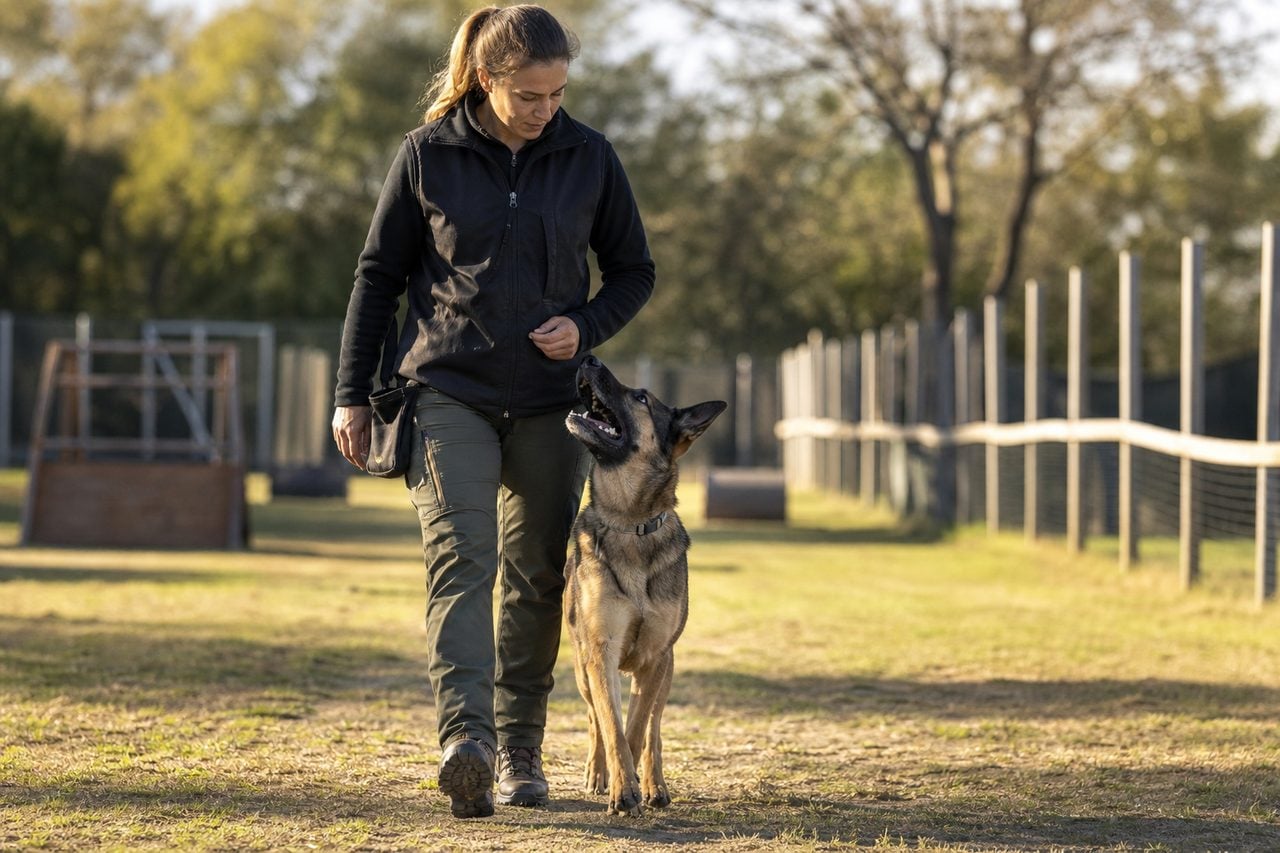
Dog training in the Milwaukee area is sold in five formats, from a club-run group class to a residential program, and the format decides most of what you pay. The price table on this page shows what local trainers publish on their own websites for the formats where enough of them publish a price. This page goes through the formats one by one, so you can work out which one your problem belongs in before you start ringing round.
What Dog Training Costs in Milwaukee (2026)
In the Milwaukee area, a private lesson typically costs $115 and a group class course $165. These are not national estimates: we read the prices that 15 Milwaukee-area trainers publish on their own websites.
| Service | Typical price | Most trainers charge | Lowest to highest | Trainers |
|---|---|---|---|---|
| Private lesson, one session | $115 | $65 to $150 | $60 to $159 | 7 |
| Group class, full course | $165 | $125 to $185 | $120 to $319 | 11 |
| First consultation, when charged | $175 | $100 to $200 | $25 to $225 | 5 |
The price range for each service
what the middle half of trainers chargetypical (median) price
Private lessons: $60 to $159 a session
7 trainers publish a single-session price, and the middle half charge $65 to $150. Behavior cases such as reactivity or aggression usually cost more than basic manners, and in-home visits more than lessons at the trainer’s facility.
Group classes: $120 to $319 for a course
11 trainers publish a course price. Courses here run 4 to 7 weeks with one class a week, so the typical $165 course works out to roughly $41 a class. Club and nonprofit classes tend to sit at the low end; small-group and specialty courses at the high end.
Milwaukee compared with other areas
Typical prices in Milwaukee next to the typical price across the 514 US areas we have read so far.
4% lower in Milwaukee
6% lower in Milwaukee
Published prices by trainer (15 trainers)
| Trainer | Private lesson | Group course | Board and train |
|---|---|---|---|
| Agility Possibilities | — | $150 / 6 wk | — |
| Amy Ammen | $159 | $319 | — |
| Bay View Bark | — | $185 / 6 wk | — |
| Canine Einstein | $115 | $150 / 4 wk | — |
| Central Bark Oak Creek | — | $180 | — |
| Crosby's Canine Care | $60 | $180 | — |
| Cudahy Kennel Club | — | $120 | — |
| Dog is Your Copilot LLC | — | $120 / 4 wk | — |
| Happy Dog In-home Dog Training | $86 | — | — |
| ICON K9 Obedience LLC | $65 | — | — |
| Milwaukee Dog Training Club | — | $200 / 7 wk | — |
| Mood Swing K9 | — | — | $1,925 / wk |
| Off Leash MKE | $125 | $165 / 4 wk | — |
| SideKick Dog Training | $150 | — | $1,225 / wk |
| Trim Time Inc | — | $125 / 4 wk | — |
Each price is the trainer’s own published price as read in November 2026. Prices change; confirm with the trainer.
Statewide: what dog training costs across Wisconsin.
The sections below also cover the things that quietly change the total — travel supplements, package structures, what happens between sessions, and the Milwaukee-specific reality that the cheapest format in the city is unavailable for about a third of the year.
Group classes: the cheapest real training
The cheapest real training in the metro, and for a great many dogs the right answer. The group class row in the table above is a price for a whole course, so divide it by the number of weeks before comparing it with anything priced by the session.
Club-run sessions are often, though not always, toward the low end of that row; the per-trainer table shows where each one sits. These are typically taught by experienced volunteer instructors in a purpose-built matted hall, and they are the only realistic local route if you eventually want to compete.
Independent facility courses are spread across the row, and small-group or specialty courses tend to sit at the top of it.
What you get for the money: an hour a week, other dogs at a controlled distance, an instructor watching your handling, and homework. What you do not get: individual attention on a problem specific to your house, or anything that can only be rehearsed at your own front door.
The test is whether the problem can be worked on in a hall with other dogs present. Most puppy and adolescent problems can, which is why this row is the right place for most owners to start.
One-to-one at a facility
A middle band that many owners do not know exists: a private lesson at the trainer’s own premises instead of at your home. It falls in the private lesson row of the table above, usually toward the lower end, because the trainer is not traveling. A couple of local facilities also rent their floor privately by the hour to owners who want to work their own dog with no other dogs present.
This is the cheapest way to get individual professional attention in the metro, and it is underrated for three situations. A dog that cannot cope in a group but does not have a household problem. An owner whose mechanics need fixing — timing, lead handling, marker use — which is faster to correct one-to-one than in a class. And a specific skill that needs a controlled floor: a solid recall, a settle, or work on equipment.
Its limitation is the same as a class’s: the trainer is not seeing your house. If the problem is the shared entrance or the food bowl, you are paying for the wrong location.
The private-floor rental option deserves a mention on its own. For a reactive or nervous dog, an hour of an empty hall with nobody else in it is genuinely valuable and usually cheap, and a handful of Milwaukee facilities publish it.
In-home private training
The deepest part of the local market and the widest spread. In-home visits are in the private lesson row in the table above, spread across it and not grouped at one end, and behavior cases usually cost more than manners work.
The row gives the price of one visit. A single visit answers a single question; a behavior problem takes a run of them over weeks or months, so ask each trainer how many they expect and what the package rate is before comparing two session prices.
Two things move the total. Travel — some local trainers add a supplement beyond a set radius, and at least one published example charges an additional fee beyond twenty miles from its base, which matters if you are at the Franklin or Mequon edge of the metro. And between-session support: a trainer who answers questions by message between visits is delivering materially more than one who does not, and it is rarely priced separately.
Value judgement: for anything that happens in or around your home — doors, stairwells, elevators, crates, food bowls, barking at neighbors, settling, being left alone — this is the correct band and the class band is simply the wrong tool at any price.
Structured in-home programs
A distinct local tier that sits between hourly private work and residential training: a fixed number of in-home lessons sold as one program, with a set curriculum and a single price. Too few local trainers publish a program price for the table above to carry a row for it, so the way to judge a quote is to divide it by the number of lessons and compare the result with the private lesson row.
Whether the premium over plain sessions is worth it depends entirely on how much structure you need. An owner who will do the homework from a cheaper package does not need this tier. An owner who needs a plan, a timetable and accountability often gets more out of it than out of buying twice as many hours.
The honest comparison to make is against the residency tier. Ask whether someone in the household will do the daily practice between lessons. If the answer is yes, the in-home program is better value and the learning happens where the dog lives.
Board-and-train
The top of the Milwaukee market. Few local trainers publish a board-and-train price, so the table above has no row for it, and programs here are usually quoted after a conversation about the dog. They also come in different shapes: besides the standard residency of two weeks or more, local options include a week-long in-home stay with a Saturday go-home lesson, and a hybrid of four in-home lessons followed by a mini residency. Compare quotes per week and by what is included, not by the headline total.
What the money buys is frequency and expertise: multiple short sessions a day for two weeks or more, delivered by someone with better timing than you have yet, in an environment they control.
What determines whether it was worth it is the handover. Every honest program says so, and two local ones build it into the price — one with a go-home lesson on the day the dog returns, one with unlimited follow-up private lessons for the life of the dog. When comparing prices in this band, compare the handovers, not the daily rates.
The seasonal caveat matters for value. A residency in July gets the Oak Leaf Trail, the valley and the summer city for proofing; the same money in late January buys mostly indoor work, because the paths are iced. If the behavior you are paying to change is a public one, a winter residency will build the skill and leave the proofing for you.
Value judgement: this band is justified for genuine time poverty, for a dog whose behavior has outrun the household’s capacity, or for a substantial off-leash project. It is not justified as a way to avoid doing the work, because the work comes home with the dog.
The things that change the total
Travel. Ask whether your address is inside the trainer’s standard radius. Published local practice includes supplements beyond twenty miles from base, which catches the southern and northern edges of this metro.
Assessment fees. Some programs charge separately for an initial consultation; others fold it in. The first consultation row in the table above shows what the separate charge looks like locally.
Package versus hourly. Nearly every local practice prices packages below the per-session rate. For a behavior problem that will take months, that is a real saving; for a single question, it is buying sessions you may not need.
Between-session contact. Rarely priced, frequently decisive. The gap between sessions is where the training actually happens, and a trainer who is reachable in it is worth more than one who is cheaper per hour.
Equipment. A decent front-clip harness, a two-meter lead and a long line are a one-off purchase; a basket muzzle, if your case needs one, is another. Ask whether any of it is included before you buy.
Day care during a behavior program. For separation-anxiety work specifically, the suspension requirement means day care or a walker for the duration, and that frequently costs more than the training itself. Plan it before starting, not in week four.
Licensing and vaccination. Wisconsin requires dogs to be licensed, and every local class will want proof of vaccination before the first session.
How to spend a fixed budget well in this city
The price of one course. A group class, and the best value in the market. For a puppy or an ordinary adolescent this is the whole plan.
A course plus a few private sessions. Two or three in-home visits for the thing that happens at your own door, then a class. This combination — fix it where it happens, then proof it in a group — is the best-value serious plan available locally and it is what several local trainers will recommend unprompted.
Several times that. Either a structured in-home program with a defined curriculum, or a longer run of individual sessions for a behavior case that needs months rather than weeks. For reactivity, aggression or separation anxiety, this is a realistic budget and the residency band above is usually the wrong purchase.
The largest budgets. Board-and-train becomes a genuine option, and the decision rests on your household rather than your dog. If nobody at home will do daily practice, a residency buys a head start that will erode. If someone will, the same money spread across in-home sessions and classes usually produces a better long-term result.
The winter footnote. The cheapest band in this city is unavailable outdoors for about a third of the year, and the heated halls that carry the winter fill early — book a January class in November. In the deepest weeks, in-home training is the format that does not get canceled, which is worth factoring into an annual budget rather than a per-session one.
Reviewed Dog Trainers in Milwaukee
These reviewed Milwaukee-area trainers from our directory can walk you through pricing for their programs. Each links to a full profile with specialties, certified credentials, reviews, and contact info:
- Off Leash K9 Training Milwaukee/ Madison — 5.0★ (355 reviews)
- Canine Communication Dog Training LLC — 5.0★ (130 reviews)
- Happy Dog In-home Dog Training — 5.0★ (105 reviews)
- Dog Training Elite Milwaukee — 5.0★ (103 reviews)
- Canine Einstein — 5.0★ (43 reviews)
- Heather Mayo, In-Home Dog Training & Grooming — 5.0★ (24 reviews)
- Dog is Your Copilot LLC — 5.0★ (11 reviews)
- Tailblazers Behavior Consulting — 5.0★ (10 reviews)
- Ultimate K9 — 5.0★ (8 reviews)
- Teacher’s Pet Dog Training Llc — 5.0★ (3 reviews)
See all Milwaukee dog trainers →
Frequently Asked Questions
What is the cheapest way to train a dog in Milwaukee?
A club-run group class. It is the right answer for puppies and ordinary adolescents, and the wrong answer for anything that only happens inside your own home.
How much does board-and-train cost here?
Few Milwaukee-area trainers publish a board-and-train price, so it is usually quoted after a conversation about the dog. Local options include standard residencies of two weeks or more, a week-long in-home stay with a go-home lesson, and a hybrid of in-home lessons plus a shorter residency. When comparing options in this band, compare the handovers rather than the daily rates: two local programs build the transfer in, one with a go-home lesson and one with unlimited follow-up lessons for the life of the dog.
Is expensive training better?
Not reliably, and the commonest expensive mistake in this market is buying a residency when three in-home sessions would have done. Price mostly reflects format — how many hours of a professional’s time you are buying and whether they travel — rather than quality. Match the format to where the behavior actually happens first, then compare prices within that band.
Are there hidden costs?
A few worth checking. Travel supplements — at least one local practice charges beyond twenty miles from base, which catches the edges of this metro. Equipment: a front-clip harness, a two-meter lead and a long line, plus a basket muzzle if your case needs one. And for separation-anxiety work specifically, day care or a walker for the duration of the protocol, which frequently costs more than the training itself.
Does training cost more in winter in Milwaukee?
The prices do not change, but the availability does, and that has a cost. Outdoor classes stop from roughly December to March because of the freeze-thaw ice, which funnels the whole market into a limited number of heated halls that fill early — book a January class in November. In-home training is the format that does not get canceled by weather, and it sits in a higher band than group classes. Owners who plan an annual training budget rather than a per-session one tend to handle this better.
Do local trainers offer payment plans?
Some do, and it is worth asking rather than assuming, particularly in the higher bands where a residency is a large commitment. For most owners the more practical route is a package, which nearly every local practice prices below the per-session rate, or spreading sessions over a longer period.
Related: read our complete dog training prices guide or the full Milwaukee dog training overview.
Ready to find the right dog trainer in Milwaukee?