
Dog Training Prices in Raleigh, NC
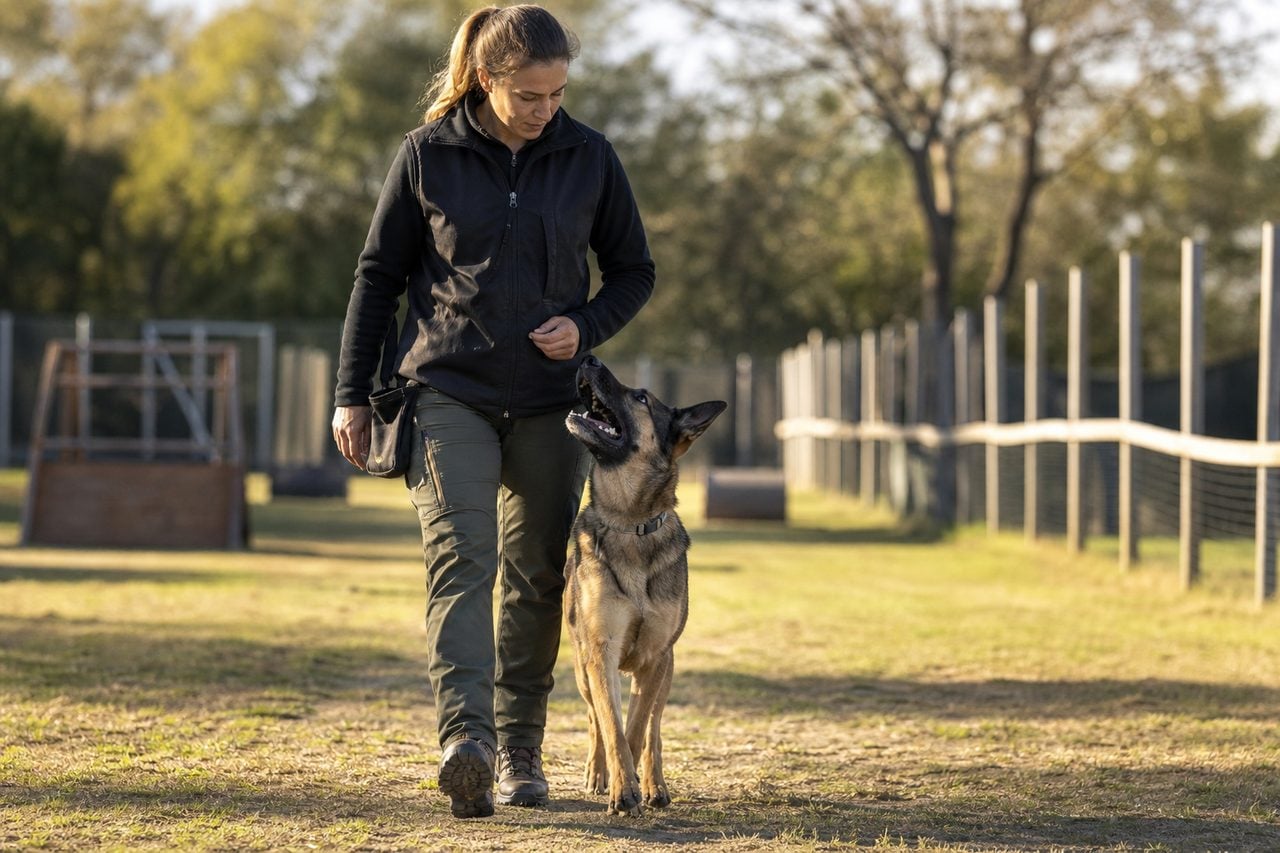
Dog training in the Raleigh metro is priced across an unusually wide range, and the range is not mainly about quality. It is about format. The same trainer will charge one figure to talk you through a problem, several times that to do the repetitions for you, and several times that again to keep your dog for two weeks. Once you understand which of those you are buying, the local price list stops looking chaotic.
What Dog Training Costs in Raleigh (2026)
In the Raleigh area, a private lesson typically costs $100, a group class course $235, and board and train about $1,000 a week. These are not national estimates: we read the prices that 33 Raleigh-area trainers publish on their own websites.
| Service | Typical price | Most trainers charge | Lowest to highest | Trainers |
|---|---|---|---|---|
| Private lesson, one session | $100 | $100 to $140 | $50 to $200 | 16 |
| Group class, full course | $235 | $150 to $265 | $85 to $300 | 7 |
| Board and train, per week | $1,000 | $950 to $1,250 | $400 to $1,700 | 18 |
| First consultation, when charged | $150 | $125 to $181 | $25 to $250 | 9 |
The price range for each service
what the middle half of trainers chargetypical (median) price
Private lessons: $50 to $200 a session
16 trainers publish a single-session price, and the middle half charge $100 to $140. Session length explains much of the spread: of the 10 trainers who state a length, 9 run about an hour and 1 run 45 minutes or less. Worked out per hour, the typical rate among those trainers is about $100. Behavior cases such as reactivity or aggression usually cost more than basic manners, and in-home visits more than lessons at the trainer’s facility.
Group classes: $85 to $300 for a course
7 trainers publish a course price. Courses here run 3 to 7 weeks with one class a week, so the typical $235 course works out to roughly $47 a class. Club and nonprofit classes tend to sit at the low end; small-group and specialty courses at the high end.
Board and train: $400 to $1,700 a week
18 trainers publish a board-and-train price. Programs here run 1 to 4 weeks, and the published program totals range from $950 to $4,200. Ask what follow-up lessons are included, because that is where programs differ most.
Raleigh compared with other areas
Typical prices in Raleigh next to the typical price across the 514 US areas we have read so far.
17% lower in Raleigh
34% higher in Raleigh
About the same in Raleigh
Published prices by trainer (33 trainers)
Each price is the trainer’s own published price as read in November 2026. Prices change; confirm with the trainer.
Statewide: what dog training costs across North Carolina.
- Consultations: what it costs to start
- Private sessions and packages: where the per-session price falls
- Group classes: the cheapest structured option
- Board-and-train: comparing residencies by the week
- Financing, discounts and the things you can ask for
- What actually drives the price, and where to spend
- Reviewed trainers
- FAQ
The price table on this page is built from what businesses in this metro publish on their own websites. Nothing in it is an estimate carried over from elsewhere. The figures are also starting points rather than quotes: almost every business here begins with a consultation, and several will not book anything else until that has happened. Prices also change, so treat the table as a map of the market rather than an invoice. The sections that follow explain what sits behind each row and how to turn it into a total for your own dog.
A note on what is missing. A significant share of local businesses publish no prices at all and quote after an assessment. That is not a red flag in this industry – a behavior case genuinely cannot be priced from a phone call – but it does mean that the table reflects the publishing end of the market, not all of it.
Consultations: what it costs to start
Most of this metro starts free. Free consultations or evaluations are published by businesses across Raleigh, Cary, Apex, Garner, Clayton, Wake Forest and beyond – one Apex facility runs a two-step online evaluation form, several Raleigh trainers publish a free in-home or phone consultation, and one Zebulon academy runs a free assessment before any program.
Not all of it does, which is why the table above has a row for first consultations that are charged. Where there is a fee, ask two things: whether it is credited toward a package if you go ahead, and whether it covers a visit to your home. A fee that pays for the drive across the metro is a sensible way to price travel rather than a fee to be irritated by.
And one Raleigh business makes a free thirty-minute consultation compulsory before anything else can be booked, so the trainer has enough information to plan the sessions properly. In a market where a lot of money gets spent on the wrong product, a required consultation is a feature.
Private sessions and packages: where the per-session price falls
Private-lesson rates vary widely across the metro, and the table above gives the published per-session range. What moves a rate up is generally travel, the trainer’s specialization, and whether the session includes work the owner does not have to attend.
The single-session price is rarely what you end up paying. Almost every business here discounts for volume. The general rule locally is that a package of four brings the effective hourly rate down by fifteen to twenty percent, and that anything beyond a single specific problem is cheaper bought as a block.
So read the table’s private-lesson row as the top of what a session costs you, not the average. Decide first how many visits the problem needs – one or two for a single specific issue, a block for general manners, more for a behavior case – then ask for the package price for that number and divide. Check what each tier adds as well as what it costs: one local package ladder has an intermediate tier that adds off-leash work to the same syllabus, which is worth paying for only if off-leash reliability is what you want.
Group classes: the cheapest structured option
The table above prices a group class as a full course, so divide by the number of weeks before comparing it with a private lesson. Per hour of instruction nothing else in the metro comes close.
A Raleigh business runs an eight-week group obedience course in the client’s own neighborhood, with the trainers bringing the equipment to the doorstep for evening sessions – an unusual format that sits between a class and a private lesson.
The training centers in Cary and north Raleigh price group classes within their regular timetables rather than publishing single figures, and those timetables are where the range is widest: three levels of puppy class, obedience, agility, AKC titles, therapy and service strands, plus Canine Good Citizen testing.
Group work is not just cheaper. It buys something a private lesson structurally cannot – other dogs to work around – which is the whole point if that is where your problem lives.
Board-and-train: comparing residencies by the week
The table above shows board-and-train as a price per week, because program lengths differ and a total on its own tells you little. To compare two local residencies, take each published total, divide by the number of weeks, and then look at what the weeks contain.
Local residencies mostly publish tiers rather than single prices – two-week programs are the commonest shape, and one Zebulon academy runs a four-week flagship sold on full off-leash reliability with lifetime trainer support attached. A longer program is not automatically the dearer one per week, and a shorter one is not automatically the bargain.
Ask what the weekly price leaves out: follow-up lessons after the dog comes home, equipment, and any refresher stay. The handover is where the training transfers to you, so a program with several follow-up lessons included can be better value than a cheaper one with none.
Whether any of it is good value depends entirely on whether you would otherwise have done those repetitions yourself.
Financing, discounts and the things you can ask for
More is available here than most owners realize, and all of it is published rather than negotiated.
One Apex facility advertises six and twelve-month interest-free financing through a pet care card. A Wake Forest business publishes a dedicated dog training payment plans page alongside its price page, which is rare enough to be worth noting. One Raleigh in-home company publishes ten percent off any training for military, police and fire department clients. A Clayton trainer operates a pay-as-you-wish option on some items. One Raleigh residency publishes a results guarantee on its board-and-train program, and one Zebulon academy advertises lifetime trainer support after the program ends.
A Zebulon business runs a six-week course with payment plans discussed at the first session. And one Raleigh trainer states plainly on its own site that a dog’s training should never be hindered by financial constraints – which is an invitation to have the conversation rather than walk away.
What actually drives the price, and where to spend
Four things move a quote in this metro. Format is by far the largest: somebody else doing the repetitions costs several times more than being taught to do them yourself. Travel is second, in a metro this spread out – a trainer crossing from Zebulon to Apex is losing an hour each way, and several businesses publish a travel fee or a virtual alternative for clients outside their standard area. Specialization is third: behavior consultants with credentials that can be checked in a public register charge more than general obedience trainers, and reasonably so. Duration is fourth, and it is the one owners consistently underestimate, because a behavior case is measured in months.
If the budget is tight, the highest-value spending in this directory is the cheapest: a consultation with somebody who will tell you what your problem actually is. A large share of money wasted locally is spent on the right service for the wrong problem – obedience lessons for a separation-anxiety case, a residency for a household-management problem, a group class for a dog that cannot yet cope with a room. One north Raleigh trainer sells a pre-purchase and adoption consultation for owners who have not chosen a dog yet, which is the same principle taken to its logical conclusion.
Reviewed Dog Trainers in Raleigh
These reviewed Raleigh-area trainers from our directory can walk you through pricing for their programs. Each links to a full profile with specialties, certified credentials, reviews, and contact info:
- Born to Lead Dog Training — 5.0★ (483 reviews)
- Canine Training Co. — 5.0★ (139 reviews)
- Proactive Dog Training, LLC — 5.0★ (135 reviews)
- Blue Line K-9 Dog Training — 5.0★ (107 reviews)
- Fluid K9 Dog Training — 5.0★ (56 reviews)
- Always Faithful Dog Training of Raleigh — 5.0★ (33 reviews)
- RooDog Training — 5.0★ (33 reviews)
- Dog Training Elite Raleigh — 5.0★ (22 reviews)
- Southern Oaks K9 Training — 5.0★ (17 reviews)
- Suburban K9 Dog Training — 5.0★ (16 reviews)
See all Raleigh dog trainers →
Frequently Asked Questions
How much does dog training cost in the Raleigh area?
It depends on the format. The price table at the top of this page shows what Raleigh-area trainers publish for a private lesson, a group class course, a week of board-and-train and a paid first consultation. Group classes cost least per hour, private lessons sit in the middle, and board-and-train costs most because the trainer does the repetitions for you.
Why do prices vary so much between trainers here?
Four reasons. Format is the largest – paying someone else to do the repetitions costs several times more than being taught to do them yourself. Travel matters in a metro this spread out, and several businesses publish a travel fee or a virtual alternative outside their standard area. Specialization raises rates, and behavior consultants with checkable credentials charge more. And duration, which owners underestimate, because behavior cases run in months.
Are there payment plans or discounts?
More than owners expect, and all published rather than negotiated. One Apex facility advertises six and twelve-month interest-free financing through a pet care card; a Wake Forest business publishes a dedicated dog training payment plans page; a Raleigh in-home company publishes ten percent off any training for military, police and fire department clients; and a Clayton trainer runs a pay-as-you-wish option on some items. It is always worth asking.
Why do some trainers not publish prices?
Because a behavior case genuinely cannot be priced from a phone call, and a serious trainer will not guess. In this metro a significant share of businesses quote after an assessment, which is normal rather than evasive. What you should expect is a free consultation first – most local businesses publish one – and a clear written price before any work starts. If the number only appears after the dog has been collected, that is a different problem.
Related: read our complete dog training prices guide or the full Raleigh dog training overview.
Ready to find the right dog trainer in Raleigh?